Fender Rhodes Stage 88 · Volume 1
Fender Rhodes Stage 88 — Vol 01: Overview & History
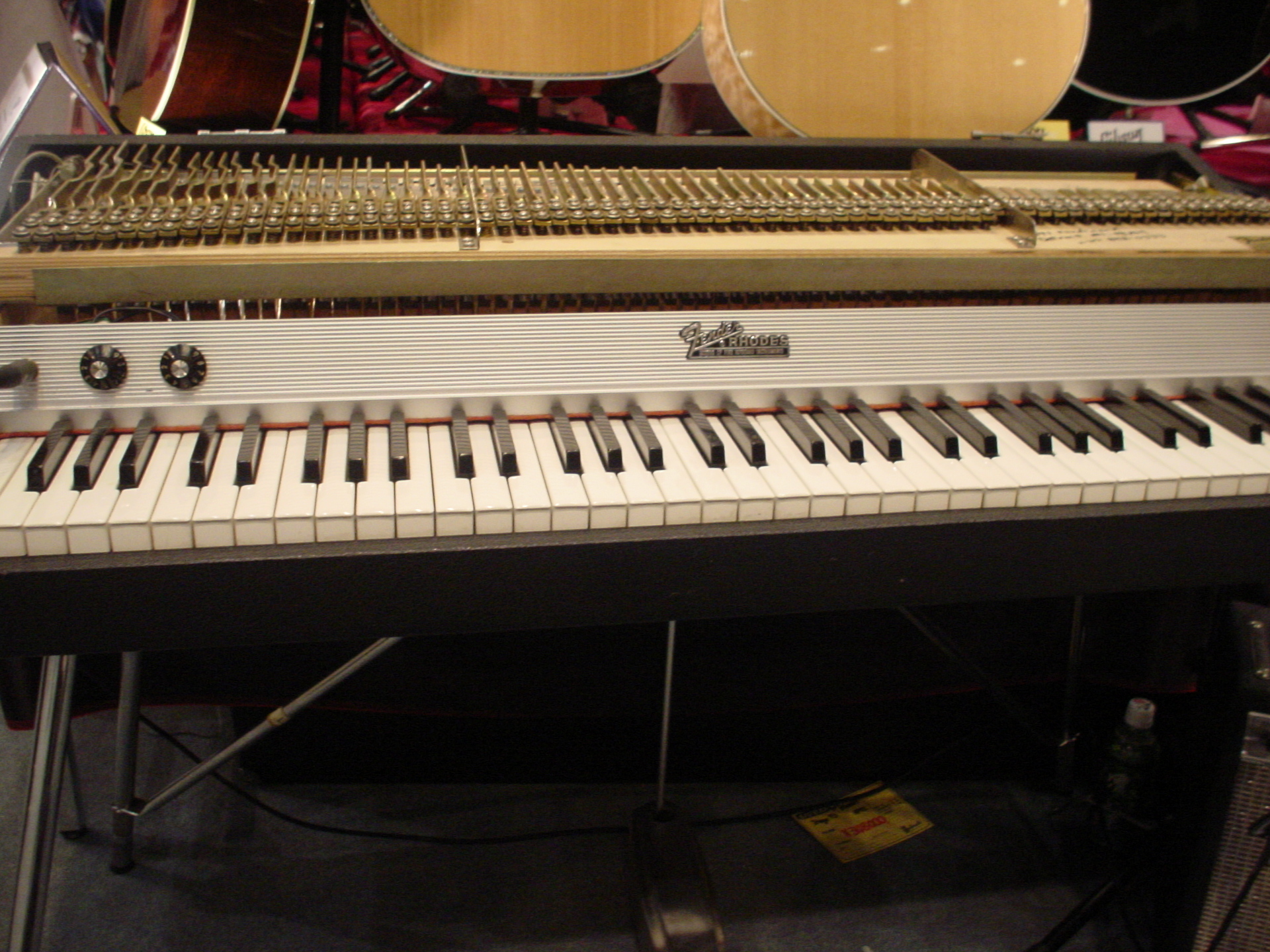
This volume defines what the Fender Rhodes Stage 88 is, traces it back to Harold Rhodes and the wartime lap piano that started the line, places it within the Rhodes family (Suitcase vs Stage; Mark I / Mark II / Mark V; the 73- vs 88-note split), and explains how to date and authenticate a genuine unit. The tine-and- tonebar tuning-fork mechanism, the passive harp wiring, the action, voicing, and the optional active-preamp conversion are treated in later volumes; cross- references are inline.
Note: The subject of record for this deep dive is the canonical passive Stage 88 — the amplifier-less, speaker-less full-compass Rhodes — across the Mark I (1970–1979) and Mark II (1979–1983) generations, with the Mark V (1984) noted as a variant. Because the Stage carries no electronics beyond its passive pickups, its instrument-level output is developed in Vol 02 §2 and the active-preamp (“Suitcase-style”) conversion in Vol 09.

1.1 What the Stage 88 is
The Fender Rhodes Stage 88 is an 88-note electromechanical electric piano in the portable “Stage” format. Each key drives a hammer that strikes a stiff steel tine, one half of an asymmetric tuning fork whose other half is a resonating tonebar; the tine’s vibration is sensed by an electromagnetic pickup, exactly as a guitar string is sensed, producing a small electrical signal rather than acoustic loudness (Wikipedia, Rhodes piano; fenderrhodes.com, Mark I). The tone-generation mechanism is developed fully in Vol 02 §2.
Defining traits:
- Full 88-note piano compass, A0–C8, tuned to A4 = 440 Hz (Wikipedia, Rhodes piano). The 73-note Stage covers a narrower E–E span (see “Stage 73 vs 88” below).
- Passive output only. A Stage instrument contains no preamplifier, no power amplifier, and no speakers. The pickups feed a passive, high-impedance, instrument-level signal to a single output jack; the piano is silent until plugged into an external amplifier (fenderrhodes.com, Mark I; chicagoelectric piano.com). This is the central distinction from the Suitcase model and the reason the signal path differs from a self-amplified instrument (see Vol 02 §2; contrast the line-level, self-contained organ of the Hammond deep dive).
- A 73- vs 88-note family. The Stage was sold in both 73-note and 88-note configurations throughout the Mark I and Mark II eras (fenderrhodes.com, Mark I 1975–1979).
- Portable, single-piece design. The keyboard case stands on four bolt-on legs (the early legs were adapted from Fender pedal-steel-guitar hardware) with a sustain pedal on a pushrod; unlike the Suitcase, there is no companion speaker cabinet to stack (fenderrhodes.com, Mark I).
Note: “Electric piano,” not “electronic.” The Rhodes generates its pitch mechanically — a struck metal fork — and only the sensing is electric. It is closer in principle to an electric guitar than to a synthesizer or a tonewheel organ. The mechanism, not the circuitry, is the instrument.
1.2 Harold Rhodes & the lineage
The instrument descends from Harold Burroughs Rhodes (born 1910 or 1911 per conflicting sources; died December 17, 2000), a piano teacher who, while serving in the U.S. Army Air Corps (c. 1942–1944), built a small therapeutic keyboard to help injured servicemen recover finger and arm coordination. Lacking materials in wartime, he fashioned its bars from aluminum tubing salvaged from aircraft — commonly cited as B-17 bomber stock or scrapped-aircraft hydraulic tubing — yielding a 29-note, non-amplified lap instrument known as the Army Air Corps Lap Piano, or “Xylette” (Wikipedia, Harold Rhodes; fenderrhodes.com, history; rhodesmusic.com).
The post-war development arc:
- Pre-Piano (late 1940s). The first electrically amplified Rhodes: a compact 38-note instrument with a built-in amplifier (also marketed as the “Bantam Piano”). Sources place its debut at 1946 or at a Los Angeles unveiling on May 21, 1948 — both are cited and the discrepancy is noted here, not resolved (system-audio.com; fenderrhodes.com, history).
- Piano Bass (1959). A 32-note keyboard bass (E1–B3 range) built on the same tine principle; it later became the instrument Ray Manzarek used in The Doors (Wikipedia, Rhodes piano; fenderrhodes.com).
- Fender partnership (1958–1959). Harold Rhodes partnered with Leo Fender to manufacture the instruments; Fender’s Fullerton, California plant took on production. Sources give 1958 or 1959 for the partnership; the Piano Bass followed in 1959 (fenderrhodes.com; Wikipedia, Rhodes piano).
- CBS (1965). CBS acquired the Fender companies in 1965, and under CBS ownership the first full-size 73-note Fender Rhodes electric piano was released. The Stage and Suitcase pianos that define the instrument’s classic era are all CBS-era products (Wikipedia, Rhodes piano; fenderrhodes.com).
- Mark I → Mark V (1970–1984), then Roland (1987). The Mark-series pianos ran from 1970 to 1984; CBS sold the Rhodes name to Roland in 1987, ending original production (fenderrhodes.com; Wikipedia, Rhodes piano).
1.3 Suitcase vs Stage (why passive matters)
Rhodes sold the electric piano in two formats that share an identical mechanical instrument — the same keybed, hammers, tines, tonebars, harp, and pickups — but differ entirely in electronics and packaging (gearspace.com, Suitcase-vs-Stage thread; chicagoelectricpiano.com).
Table 1 — Suitcase vs Stage (why passive matters)
| Attribute | Stage (subject of record) | Suitcase |
|---|---|---|
| Onboard electronics | None — passive pickups straight to the output jack | Active preamp + stereo power amplifier |
| Sound reproduction | Requires an external amp/keyboard amp/PA | Built-in speaker cabinet the keyboard sits atop |
| Output signal | Passive, high-impedance, instrument level | Buffered/preamplified line-capable output |
| Stereo vibrato (“tremolo”) | Not onboard (the active circuit is what pans it) | Yes — amplitude panning across the stereo amp |
| Amplifier history | n/a | FR7054 (≈80 W) early; FR7710 (100 W stereo, 2 × 50 W) from ~1977–78, with 1/4″ console I/O |
| Packaging | Single keyboard case on legs | Two boxes: keyboard + speaker “suitcase” base |
| Weight penalty | Lighter (no amp/speakers) | Heavier (amp + speaker base ≈ 115 lb extra) |
Why the passive design matters in practice:
- The Stage is electrically inert until amplified. Its output is closer to a passive guitar pickup than to a mixer-ready line signal: high source impedance, modest level, and sensitive to cable capacitance and the load impedance of whatever it plugs into. Correct gain-staging and DI/preamp choice are therefore consequential — developed in Vol 02 §2 and Vol 11.
- The Suitcase’s “tremolo” is really stereo panning generated in the active preamp, not a mechanical effect; a Stage cannot produce it without added electronics. Adding a preamp (e.g. restoring Suitcase-style circuitry or fitting a modern active preamp) is the active conversion covered in Vol 09.
- The instruments are otherwise interchangeable. A Stage and a Suitcase of the same year, played through the same amplification, are mechanically the same piano (chicagoelectricpiano.com; gearspace.com).
1.4 Mark I / Mark II / Mark V
The three production generations share the tine mechanism but differ in cabinetry, action/hardware details, and keybed material.
Table 2 — Mark I / Mark II / Mark V
| Attribute | Mark I (1970–1979) | Mark II (1979–1983) | Mark V (1984) |
|---|---|---|---|
| Top lid | Sculpted/raised; early units in sparkle tolex (“sparkle top”), later flat-black tolex | Flat harp cover; removable music rack | Flat, all-plastic body |
| Name rail | ”Fender Rhodes” until ~1974, then “Rhodes” (CBS dropped the Fender name) | “Rhodes" | "Rhodes” |
| Keybed | Wooden keys | Wooden, then plastic keys from 1980 | Returned to wooden keys |
| Notable mechanical changes | Hammer tips felt→neoprene and Raymac→Torrington (swaged) tines (both ~1971, see Vol 02 §“…tines” / Vol 05 §“Sourcing tines”); molded plastic hammers (1976–77); key-pedestal “bump” mod (1977) | Cosmetic redesign over late Mark I; otherwise carries the mature Mark I mechanism | Improved dampers (less snap-back → more bell-like sustain); one-piece collapsible stand |
| Sizes offered | Stage 73, Stage 88, Suitcase 73, Suitcase 88 | Stage 73/88, Suitcase 73/88; also Rhodes 54 (1980) and Mark III EK-10 synth hybrid (1980) | Stage 73 only in production; Stage 88 shown in brochures but never actually sold |
| Status | The volume mainstream | Final mass-production generation | Last original Rhodes; factory closed shortly after |
Notes and conflicts:
- Mark I start date. The Stage/Suitcase Mark I line is dated 1969/1970 depending on source (the 73-note model by 1970; the Suitcase name from 1969). The 88-note model is dated 1971 by some sources and 1972 by others; both are recorded here and the exact first-shipment year is (est.) (fenderrhodes.com, Mark I 1969–1974; Wikipedia, Rhodes piano).
- The Mark II was, at first, a cosmetic change. Its 1979 introduction was a “sleek black design, removable music rack, and flat harp cover” over the latest Mark I; the consequential change came in 1980 with plastic keys, intended to cure the warping of road-worn wooden keys (fenderrhodes.com, Mark II). Harold Rhodes objected, holding that plastic keys hurt the feel.
- The Mark V Stage 88 essentially does not exist as a production instrument. Only the Stage 73 reached production before the factory closed; the Stage 88 appeared in brochures but was never sold (fenderrhodes.com, Mark V). A genuine Stage 88 is therefore, in practice, a Mark I or Mark II instrument.
1.5 Stage 73 vs 88
The Stage was sold in two compasses throughout the Mark I and Mark II eras.
Table 3 — Stage 73 vs 88
| Attribute | Stage 73 | Stage 88 |
|---|---|---|
| Notes | 73 | 88 |
| Compass | E–E (commonly cited; narrower than a full piano) | A0–C8 (full piano compass), A4 = 440 Hz |
| Approx. case length | ≈45 in | ≈53.5 in |
| Approx. weight | ≈130–140 lb (≈59–64 kg) | ≈160 lb (≈73 kg) (est.) |
- The 88 is the full piano range; the 73 trades the extreme octaves for weight. The 73-note Stage drops the lowest and highest keys, shortening the harp and case and removing roughly fifteen note-assemblies’ worth of tines, tonebars, hammers, and pickups (Wikipedia, Rhodes piano; fenderrhodes.com).
- The 88 is meaningfully heavier and longer. Published curb weights for the Stage 88 are not factory-documented and vary by source; ≈160 lb is a community figure and is flagged (est.) (ep-forum.com weight thread). The 73’s ≈130–140 lb range is more consistently reported.
- Tonally, the extra octaves change the instrument’s job. The 88’s added bass tines extend the woolier, growling low register and the added treble extends the glassy, bell-like top — relevant to voicing in Vol 07. The lowest notes use tines without tonebars and the highest use special hammer tips, detailed in Vol 02 §2 and Vol 05.
1.6 Dating & spotting a genuine unit
A genuine CBS-era Rhodes can be dated and authenticated from internal date codes and a handful of generational tells. Open the lid and lift the harp cover to read them (fenderrhodes.com, How old is my Rhodes?; chicagoelectricpiano.com, How to date a Rhodes).
- Pickup-rail date code (best indicator). A 4-digit code on the right-hand side of the pickup rail, beneath the part number, in week-of-year + year form — e.g. 0978 = 9th week of 1978. This dates the pickup rail, typically finished one to four months before the piano (fenderrhodes.com).
- Tonebar-rail finish code (secondary). Lower right of the tonebar rail. 1965–1973: week/year. From 1974: week/year/day (e.g. 1581 = week 15, 1978, Monday). From 1980: the year digit resets at 0 (1501 = week 15, 1980, Monday) (fenderrhodes.com).
- Harp stamp. A week/year stamp (e.g. 24/73 = 24th week of 1973) is often found on the upper-right corner of the harp (chicagoelectricpiano.com).
- Name rail / serial plate. The badge reads “Fender Rhodes” before ~1974 and “Rhodes” after, as CBS retired the Fender name; the changeover was gradual as old plates were used up, so the badge brackets rather than pinpoints the year (fenderrhodes.com, Mark I 1975–1979).
- Keybed material. Wooden keys indicate a Mark I, a pre-1980 Mark II, or a Mark V; plastic keys indicate a 1980-or-later Mark II (fenderrhodes .com, Mark II). This is a fast generation/era cross-check against the date codes.
Warn: “Rhodes” and “Fender Rhodes” are valuable badges, and the name is reproduced on later electronic pianos, software instruments, and reissues that are not the CBS-era tine instrument. Confirm a genuine unit by lifting the harp cover and physically verifying the tine-and-tonebar tuning forks and magnetic pickups — and by reading the date codes above — not by the logo on the name rail.
1.7 Cultural arc
The Rhodes left its intended market — practice and home use — and became one of the defining keyboard voices of the late-1960s through the early-1980s. The arc, in brief and with dated exemplars:

- Jazz and fusion (late 1960s onward). Miles Davis put the Rhodes at the center of In a Silent Way and Bitches Brew (both 1969–70), with Herbie Hancock, Chick Corea, and Joe Zawinul at the keyboard; it became the signature electric-piano color of jazz-fusion (system-audio.com; Wikipedia, Rhodes piano).
- Funk and soul (early–mid 1970s). Hancock’s “Chameleon” (1973) used the Rhodes as a rhythmic engine; Stevie Wonder, Billy Preston (who played a Rhodes at the Beatles’ 1969 rooftop set), and Donny Hathaway made it a soul staple (system-audio.com; fenderrhodes.com, artists).
- Pop and rock (1970s–early 80s). Steely Dan’s Donald Fagen built much of the band’s sound on a (often Dyno-My-Piano-modified) Rhodes — Aja (1977), “Kid Charlemagne,” “Hey Nineteen”; the warm Rhodes tone was, by one account, audible on a large share of 1970s radio hits (system-audio.com; redbull music academy daily).
- Decline and revival. The polyphonic synthesizer — especially the Yamaha DX7 (1983), whose own “E. PIANO” patch imitated the Rhodes — collapsed demand for the heavy electromechanical instrument, and original production ended mid- 1980s (fenderrhodes.com, Mark II; Wikipedia, Rhodes piano). The instrument later returned to favor as a vintage-tone staple, sustaining the refurbishment and active-conversion work that the rest of this deep dive documents.
Sources
- Wikipedia, Rhodes piano and Harold Rhodes (inventor) — Xylette/Army Air Corps lap piano, Pre-Piano, Piano Bass (1959), Fender partnership, CBS (1965), Mark I/II/V timeline, Stage vs Suitcase, 73 vs 88 compass, cultural arc.
- fenderrhodes.com — Mark I (1969–1974), Mark I (1975–1979), Mark II & III (1979–1983), Mark V (1984), history, and How old is my Rhodes?: Stage/Suitcase definitions, name-rail/“Fender” drop (~1974), wooden→plastic keys (1980), Mark V Stage 88 never sold, FR7054/FR7710 amps, date-code method.
- chicagoelectricpiano.com — Mark I vs Mark II and How to date a Rhodes: shared mechanism between formats, pickup-rail/tonebar/harp date codes.
- ep-forum.com (weight thread), gearspace.com (Suitcase-vs-Stage), reverb.com — community weight/dimension figures for Stage 73/88 (flagged est.) and Suitcase amp/speaker base weight.
- system-audio.com, redbullmusicacademy daily, rhodesmusic.com — cultural arc and dated exemplar recordings (Davis, Hancock, Wonder, Fagen).
Cross-references: tine/tonebar tuning-fork mechanism, pickups, and the passive instrument-level output in Vol 02 §2; cabinet/tolex and name-rail cosmetics in Vol 04; tines, tonebars, and grommets in Vol 05; action regulation in Vol 06; voicing and tine-to-pickup alignment in Vol 07; tuning in Vol 08; the active-preamp (“Suitcase-style”) conversion in Vol 09; amplification and effects in Vol 10; recording and integration in Vol 11.
Comments (0)