Hammond B-3 · Volume 1
Hammond B-3 — Vol 01: Overview & History
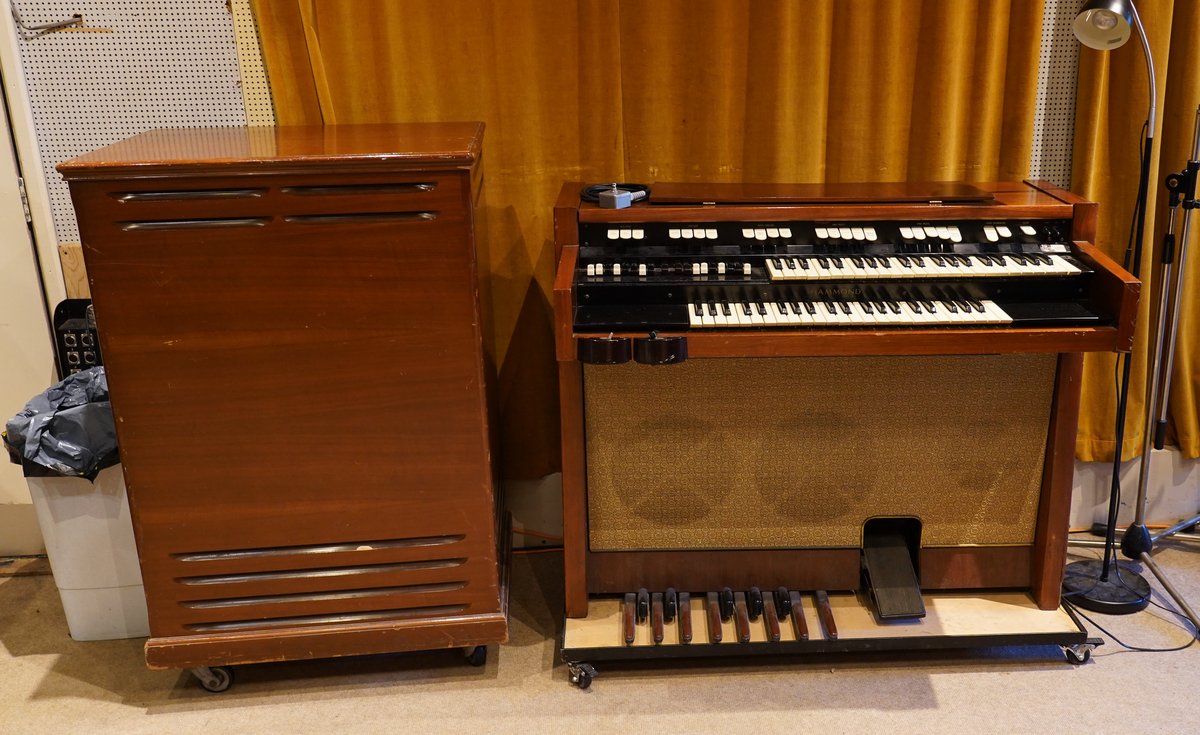
This volume defines what the Hammond B-3 is, where it sits in the tonewheel-console family, how it differs from its close siblings (the C-3 and the A-100), and why it became the reference instrument it is today. Theory of operation, the drawbar/control detail, the Leslie 122, and the pedal/bass-expander signal path are treated in later volumes; see the cross-references inline.
Note: The subject of record for this deep dive is a Hammond B-3 console feeding a Leslie 122 rotary speaker, with a stock 25-note pedalboard plus a Trek II bass expander. Generator and amplifier specifics are developed in Vol 02 §2; the Leslie in Vol 04; the pedal/bass path in Vol 05.
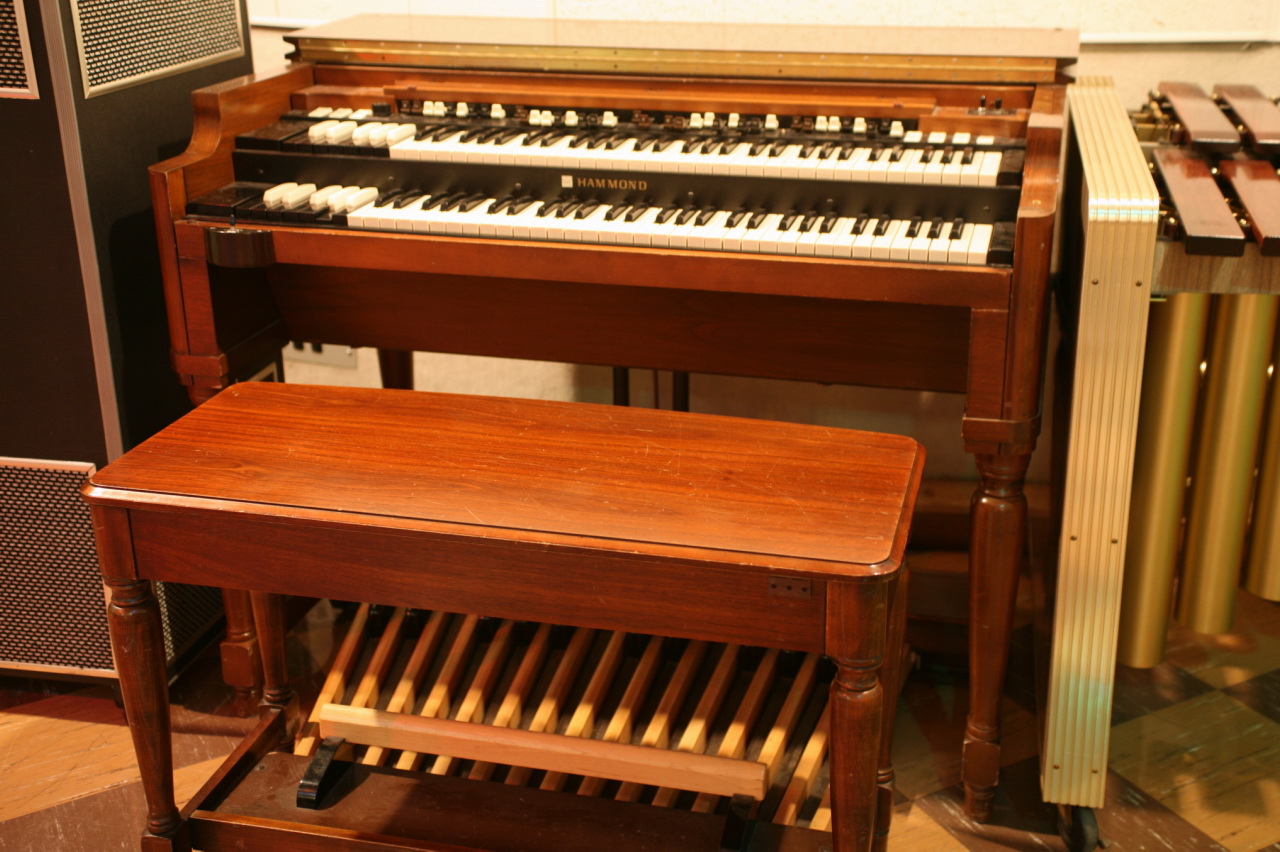
1.1 What the B-3 is
The Hammond B-3 is a dual-manual, drawbar tonewheel console organ built by the Hammond Organ Company. Sound is produced electromechanically: a synchronous motor turns a shaft of rotating tonewheels past magnetic pickups, generating near-sinusoidal voltages that the player combines with nine harmonic drawbars per manual. The result is additive synthesis — discrete harmonics summed in chosen proportions — rather than the subtractive filtering of later analog synthesizers (Vail, The Hammond Organ: Beauty in the B; Hammond B-3/C-3 Service Manual).
Defining traits:
- Two 61-note manuals (upper “Swell,” lower “Great”), a 25-note pedalboard, and an expression (swell) pedal (Hammond B-3/C-3 Service Manual).
- Nine drawbars per manual governing footages from 16′ to 1′, plus pedal drawbars (Hammond wiki, hammondwiki.org).
- A Harmonic Percussion section (second/third harmonic, selectable decay and volume) that is one of the B-3’s signature additions (Wikipedia, Hammond organ; Vail).
- No internal speakers and no internal power amplifier. The B-3 outputs a line-level signal to an external tone cabinet, classically a Leslie rotary speaker, via the 6-pin amphenol connector. The instrument is therefore inert until a cabinet is connected (Hammond B-3/C-3 Service Manual; see Vol 04 §4.1 for the Leslie interface).
Note: “Drawbar organ” and “tonewheel organ” are not interchangeable with every Hammond. Later transistor and LSI Hammonds kept the drawbar interface but discarded the tonewheel generator. The B-3 is specifically a tonewheel instrument — the generator is the point.
1.2 Lineage & the tonewheel console family
The instrument traces to Laurens Hammond, a clock and motor engineer, and his chief collaborator John M. Hanert. Hammond founded the Hammond Clock Company in 1928; the tonewheel principle reportedly grew out of listening to the geared, synchronous-motor clocks the company already built (Wikipedia, Hammond organ; Vail). As organs eclipsed clocks the firm became the Hammond Organ Company.
The first product was the Model A, introduced in June 1935. It already carried most of the features that defined every console Hammond that followed: two 61-key manuals, a 25-key pedalboard, an expression pedal, and 12 reverse-color preset keys (Wikipedia, Hammond organ). From the Model A grew a long console family — the A, B, C, RT, D, and G lines and their numbered revisions (B-2/C-2, B-3/C-3, and so on) — sharing the same essential tonewheel generator and manual layout while differing in cabinetry, presets, percussion, pedal voicing, and (in the RT) a 32-note AGO pedalboard plus a Pedal Solo Unit (Hammond B-3/C-3 Service Manual; Vail).
1.2.1 The tonewheel console family — full model table
The table below covers the principal tonewheel console models in production order. Spinet models (M, L series) are a separate, reduced-key branch addressed under “Spotting a genuine console” below.
Table 1 — The tonewheel console family — full model table
| Model | Production | Cabinet | Key distinction |
|---|---|---|---|
| Model A | 1935–1938 | Open four-leg bench | First Hammond; tremolo (amplitude mod.) only; no scanner vibrato; no percussion; shallower case than later B-series consoles |
| Model AB | 1935–1938 | B-series cabinet (deeper than A) | A-series internals housed in the new B-cabinet to accommodate future options; no chorus generator fitted; the designation “Model B” alone was never marketed (Wikipedia, List of Hammond organs) |
| Model BC | 1936–1942 | Open bench (B-series) | Chorus generator added — slightly off-pitch secondary tones (approx. 0.8 % to 0.4 % off-pitch) to imitate pipe-organ unison beats; predecessor to the open-bench B line (electricdruid.net; quadibloc.com) |
| Model C | 1939–1942 | Enclosed slab-side church | BC electronics in a closed cabinet sized for the chancel; no audience view of the organist’s feet; functionally identical to the BC (Wikipedia, Hammond organ) |
| Model D | 1939–1942 | Enclosed church (C-style) | C-cabinet fitted with the chorus generator — in effect a church-cabinet BC (hammondwiki.org; Wikipedia, List of Hammond organs) |
| Model E | 1937–1949 | Open bench (wider) | First Hammond with a 32-note AGO radial-arc pedalboard; added four toe pistons and a Great-to-Pedal coupler for classical organists; the origin of the RT pedalboard line (Wikipedia, List of Hammond organs) |
| Model G | 1941–1944 | BC console + G-40 tone cabinet | Government/military contract instrument; supplied with the G-40 tone cabinet (which included an internal reverb unit); some surplus G units reached the civilian market after 1945 (Wikipedia, List of Hammond organs; hammondwiki.org) |
| BV / CV | 1946 / 1945–1949 | Open bench (BV) / Church (CV) | Scanner vibrato (John M. Haert invention) replaces the earlier mechanical tremulant; all subsequent consoles use the scanner; BV = B-cabinet, CV = C-cabinet (Wikipedia, Hammond organ; hammondwiki.org) |
| B-2 / C-2 | 1949–1954 | Open bench / Church | Selective scanner vibrato — on/off per manual independently; Normal/Soft volume tablet; pre-percussion; B-2 = bench, C-2 = church (Wikipedia, Hammond organ) |
| RT / RT-2 | 1949–1954 | Wider console (AGO width) | 32-note AGO pedalboard + monophonic Pedal Solo Unit (full harmonic range on pedals); RT-2 adds selective vibrato to match the B-2/C-2 era; no Harmonic Percussion yet (Hammond B-3/C-3 Service Manual; Wikipedia, List of Hammond organs) |
| B-3 / C-3 | 1954–1975 | Open bench (B-3) / Church (C-3) | Harmonic Percussion (2nd/3rd harmonic, selectable Fast/Slow decay and Soft/Normal level); smooth drawbars; all-metal expression-pedal frame; the reference instrument of this manual (Wikipedia, Hammond organ; Vail) |
| RT-3 | 1954–1973 | Wider console (AGO width) | B-3/C-3 electronics and drawbar/percussion system in the wider RT cabinet; 32-note AGO pedalboard + Pedal Solo Unit; same tonewheel generator as the B-3/C-3 (Hammond B-3/C-3 Service Manual) |
| A-100 / A-105 | 1959–1974 | Self-contained console | B-3/C-3 tonewheel generator + internal power amplifier, internal speakers, and spring reverb unit — no external cabinet required; A-100 = open bench-style, A-105 = C-style church cabinet (Wikipedia, Hammond organ) |
| D-100 | 1963–1969 | Self-contained wide console | RT-3 electronics + self-contained cabinetry with built-in PR-40 speaker system; the largest and heaviest production console at ≈ 575 lb (261 kg, est.); informally called the “Cadillac of Hammonds” (hammondwiki.org; Wikipedia, List of Hammond organs) |
| G-100 | 1963–1967 | Extra-large self-contained | Non-drawbar: 65 stop tablets fully to AGO specification; 32-note pedalboard; oversized tone generator; complex vibrato scanner; external dual-cabinet amplification rack; diverges substantially from the B-3/C-3 architecture (Wikipedia, List of Hammond organs) |
Note: Production-year spans above reflect the consensus of hammondwiki.org and Wikipedia List of Hammond organs; sources vary by ±1 year at start/end points. Where two sources conflict, the wider span is cited here. The B-3/C-3 start is commonly stated as both 1954 (announcement) and 1955 (volume production); this table uses 1954 per the Wikipedia Hammond organ article, with the discrepancy noted in §Production & dating below.
1.2.2 Console family tree
The SVG below shows the principal development path from the Model A through the B-3/C-3 and its self-contained descendants. Models E (AGO pedalboard line) and G-100 (non-drawbar AGO instrument) are noted but branch away from the B-3/C-3 core architecture; the spinet branch (M/L series) is shown as a separate, reduced-key family.
Note: Spinet Hammonds (M-series, L-series, and similar) are a separate, smaller branch — shorter manuals, a stub pedalboard, and a reduced generator. They are not console organs and are addressed under “Spotting a genuine console” below.
1.3 B-3 vs C-3 vs A-100
Electronically, the B-3 and C-3 are the same instrument: identical generator, drawbars, preset system, percussion, manuals, and pedals. The difference is the cabinet. The B-series uses an open, four-leg “bench” cabinet in the manner of a square grand piano; the C-series uses an enclosed, slab-sided “church” cabinet with a modesty back panel (Wikipedia, Hammond organ; organforum.com). The two sound identical through the same tone cabinet.
The A-100, introduced in 1959, takes the same B-3/C-3 electronics and makes them self-contained, adding an internal power amplifier, internal speakers, and a built-in spring reverb so the organ can be played without an external cabinet (Wikipedia, Hammond organ; Hammond service manual). Its generator and drawbar voicing match the B-3/C-3.
Table 2 — B-3 vs C-3 vs A-100
| Attribute | B-3 | C-3 | A-100 |
|---|---|---|---|
| Cabinet | Open four-leg “bench” | Enclosed slab-sided “church” | Enclosed self-contained console |
| Generator / tonewheels | 91 active tonewheels (96 total) | Same as B-3 | Same as B-3 |
| Drawbars / presets | 9 drawbars per manual; reverse-color presets | Same as B-3 | Same as B-3 |
| Harmonic Percussion | Yes (2nd/3rd, selectable) | Yes | Yes |
| Internal amp / speakers | None — external cabinet required | None — external cabinet required | Built-in amp + speakers |
| Internal reverb | None | None | Yes (spring) |
| Typical use | Stage / studio (with Leslie) | Church / institutional | Home / church without separate cabinet |
Tip: A B-3 and a C-3 recorded through the same Leslie are indistinguishable on tape. When a credit says “C-3,” it is not a lesser instrument — it is a B-3 in a different box. Cabinet choice was about the room, not the sound.
1.4 Production & dating
Hammond introduced the B-3/C-3 with Harmonic Percussion in 1954, and the model stayed in continuous production through early 1975 — roughly a two-decade run that outlasted most of its console siblings (Wikipedia, Hammond organ; Vail). Sources vary between 1954 and 1955 for the first units, reflecting the gap between announcement and volume shipping; both are commonly cited and are reconciled here as a 1954/55 start.
1.4.1 The data plate and console serial number
Hammond affixed a metal (or, on some units, plastic) identification plate to each console. The plate carries the model designation and the serial number. Physical location varies by era:
- Pre-1969 consoles (all B-3/C-3 production): The plate is typically fastened to the shelf — the horizontal surface inside the console to the right of center when facing the instrument from the front; access requires opening the lid panel or sliding out the lower-manual assembly (hammondwiki.org; community consensus, organforum.com). Some units also carry a secondary stamp on the rear panel at the bottom-left or bottom-right corner.
- Post-1969 consoles (late A-100 and other models): The plate migrated to the underside of the keyboard structure, visible from the left or right when a manual is tilted up.
Because the B-3/C-3 was produced entirely before 1969, the shelf location is the canonical search point for this instrument.
1.4.2 Generator serial number
The tonewheel generator carries its own serial number, stamped on the generator housing. This number is related to but not necessarily identical to the console data-plate number; cross- referencing both confirms whether the generator is original to the cabinet or a replacement (hammondwiki.org). The generator serial number location is on the generator end-plate or housing — visible with the rear access panel removed (Hammond B-3/C-3 Service Manual).
1.4.3 Post-1968 serial-number prefix system
Hammond introduced a letter-prefix convention for organs built from 1969 onward: A = 1969, B = 1970, C = 1971, D = 1972, E = 1973, after which the prefix system was discontinued. A B-3 or C-3 with a letter-prefixed serial number dates from the final years of production (1969–1975) (hammondwiki.org; community research, organforum.com).
1.4.4 Dating by observable component changes
Where the serial number is obscured or suspected of mismatch, a set of factory engineering changes brackets the build year to within one to two years. All dates below are from published community research (Hammond Today, 2015; hammondwiki.org):
Table 3 — published community research (Hammond Today, 2015; hammondwiki.org)
| Change | Approx. year | Location |
|---|---|---|
| Vibrato line-box case: wood → metal | 1958 | Below lower manual, left side |
| Side blocks (manual cheeks): wood → plastic | 1960 | Left and right ends of each manual |
| Pilot lamp added to start/run assembly | 1961 | Start/Run panel |
| Vibrato knob: smooth → ribbed/fluted profile | 1962 | Upper-left control panel |
| AO-28 preamp transformer color: silver → black | mid-1962 | Inside rear chassis; see below |
| Percussion circuit — red capacitor caps introduced | Spring 1964 | Percussion board inside lid |
| Hammond script logo: small → large (new logo) | 1965 | Music-rack nameplate |
| Cabinet felt pads → foam pads | 1965 | Under manual cheeks |
| R/C networks added to tones 37–48 (hum/crosstalk reduction) | 1965 | Generator terminal board |
| Drawbar knobs: plain plastic → engraved footage labels | 1969 | All drawbars |
1.4.5 AO-28 transformer as a dating bracket
The AO-28 preamplifier transformers provide a particularly reliable dating marker: silver-cased transformers date the AO-28 board to pre-mid-1962; black-cased transformers (introduced mid-1962) carry a four-digit date code stamped into the transformer bell housing in YYWW format (two-digit year, two-digit week), allowing the board assembly to be dated to the specific production week (hammondwiki.org).
1.4.6 EIA component date codes
Most passive components — capacitors, resistors, and inductors — carry an EIA (Electronic Industries Alliance) date code stamped or printed on the body. Reading these codes across the preamp, percussion board, and generator terminal board narrows the build window even when the data plate is missing:
- Capacitors: Four-digit code
YYWW— the first two digits are the last two digits of the calendar year; the last two are the production week. Example:6214= week 14 of 1962. - Speakers (A-100 series): Six-digit code
XXXYWW— the first three digits are the EIA manufacturer code (e.g., Jensen = 220, Rola = 285), the next digit is the last digit of the year, and the final two are the production week. Example:220642= Jensen speaker, week 42 of 196x (decade determined by context). - Tubes: Production codes vary by manufacturer; many use date codes readable against standard tube-code tables.
Because the B-3/C-3 was built over a 20-year span, components were sometimes replaced during service. A capacitor dated later than the serial-number range does not imply a later organ — it may indicate a previous service. The oldest dated components set the earliest-possible build date; the data-plate serial number narrows the window further.
1.4.7 Cross-referencing the serial list
Published serial-number lists (hammondwiki.org; tonewheelgeneral.com age-determination list, maintained by Rick Prevallet) correlate B-3/C-3 serial numbers to approximate production years. Hammond’s serial numbering was not strictly sequential across production runs, so the published lists carry inherent uncertainty of ±1 to ±2 years for some ranges; the community research note is explicit: “if your unit has a serial number in the 20000 to 30000 range you must check date codes to get an accurate reading” (tonewheelgeneral.com, 2025). Serial numbers above approximately 30000 were allocated to A-100 series production, not B-3/C-3.
Note: Total B-3 production is frequently quoted in the “tens of thousands,” but Hammond did not publish per-model totals and surviving figures conflict; an exact unit count is (est.) and is not relied upon here. Date the individual instrument by plate, generator number, and component stamps — not by a global production figure.
1.5 Why the B-3 endured
The B-3 outlived its intended market — the home and the church — because performers adopted it for sounds Hammond never advertised. In jazz, Jimmy Smith established the B-3-through-Leslie voice as a lead instrument in the mid-1950s, and the organ-trio format followed (Vail). Gospel adopted the same instrument for its vocal, swelling sustain; rock, soul, and blues took the overdriven tonewheel-and-Leslie sound into the 1960s and beyond (Vail; Wikipedia, Hammond organ).
What made it durable was the combination, not any single part: a tonewheel generator that drifts and beats just enough to sound alive, key-click and percussion transients with real attack, drawbars that let a player dial timbre in real time, and a rotating Leslie that turns a static line signal into a moving, Doppler-rich field (developed in Vol 04). That stack — B-3 + Leslie — is the sound; the console alone is only half of it.
1.6 Spotting a genuine console
Tells of a real tonewheel B-3 (as opposed to a spinet, a later transistor Hammond, or a clone):
- The tonewheel generator. A genuine B-3 carries the full console generator — 96 tonewheels of which 91 are active sound sources, the remaining few being blank balance wheels — driven by a synchronous motor (hammondwiki.org; Tone Generator, dairiki.org). The generator is heavy, numbered, and visible inside the cabinet. A spinet’s generator is smaller and produces fewer tones.
- Foldback. Because only 91 frequencies exist, the top and bottom of the keyboard reuse tones via foldback — the highest manual octaves and the pedal/upper extremes wrap onto existing wheels rather than adding new ones (hammondwiki.org). This is intrinsic to the console design.
- Reverse-color preset keys. Each manual has a left-hand octave of inverted-color (reverse) keys used to select presets, a layout inherited from the Model A (Wikipedia, Hammond organ). Their presence is a strong console tell.
- The Harmonic Percussion section. B-3/C-3-class consoles have the percussion controls (On/Off, Soft/Normal, Fast/Slow decay, Second/Third harmonic) — absent on pre-percussion consoles and on spinets (Hammond B-3/C-3 Service Manual).
- Two full 61-note manuals and a 25-note pedalboard. A console has full-length manuals and a full 25-note pedalboard; spinets (M/L-series) have shorter manuals and a stub pedalboard, and are a common misidentification (Wikipedia, Hammond organ).
Warn: “B-3” is heavily counterfeited as a label. Digital clones, software instruments, and later transistor Hammonds reproduce the interface but not the tonewheel generator. Confirm a genuine console by physically locating the rotating tonewheel generator and its serial-stamped plate — not by the badge on the music rack.
1.7 Where this manual goes
This volume establishes the instrument: what the B-3 is, where it sits in the Hammond family, and how to identify and date a specific console. The remaining 17 volumes develop the full bench-manual arc across four parts.
Part I — Foundation & Operation (Vols 2–5) covers the tonewheel generator, additive synthesis, and the AO-28 preamp (Vol 02); all controls — drawbars, presets, percussion, vibrato/chorus scanner, expression pedal, and start/run (Vol 03); the Leslie 122 rotary speaker in detail — its 40 W tube amplifier, 800 Hz crossover, and horn/drum rotor system (Vol 04); and the 25-note pedalboard signal path plus the Trek II bass expander (Vol 05).
Part II — The Refurbishment Bench Manual (Vols 6–12) is a complete hands-on service manual beginning with tools, mains safety, the death-cap hazard, and how to move a ≈ 425 lb (193 kg) console safely (Vol 06). Subsequent volumes cover the tonewheel generator — oiling intervals, oil types, the consequences of dried lubricant, and full generator service (Vol 07); power supply, capacitor replacement, and the AO-28 preamp and percussion circuit (Vol 08); manual key contacts, the “Hammond fix” busbar, and drawbar service (Vol 09); the vibrato/chorus scanner — the most delicate B-3 repair, given its own volume (Vol 10); Leslie 122 service including the 6550A amplifier recap, rotor motors, drive belts, and bearings (Vol 11); and standard-cabinet restoration — refinishing, veneer repair, hardware, bench, and legs (Vol 12).
Part III — The Chop and Portable Builds (Vols 13–15) covers the planning and ethics of chopping a B-3 for portable use — including the community principle “don’t chop a clean one,” weight budget, and what to preserve (Vol 13); teardown and portable-cabinet fabrication (Vol 14); and chop electronics — choice between the original AO-28 and a modern combination preamp, half-moon/Leslie switching, and output wiring (Vol 15).
Part IV — Build Records and Reference (Vols 16–18) opens with the owner build-record gallery covering standard restores and chop variants (Vol 16, authored in first person as a personal build log); recording and live integration — mic placement on the Leslie, signal levels, and studio/MIDI interfacing (Vol 17); and the full reference cheatsheet — spec tables, drawbar registration chart, tonewheel frequency table, and consolidated bibliography (Vol 18).
Sources
- Hammond B-3 / C-3 Service Manual (Hammond Organ Company) — generator, controls, presets, percussion, connector and dating-plate references.
- Wikipedia, Hammond organ — Model A (June 1935), reverse-color presets, Harmonic Percussion (1954), B-3/C-3 production through early 1975, A-100 (1959, self-contained), B vs C cabinets.
- Wikipedia, List of Hammond organs — production years and distinguishing features for Model AB, BC, C, D, E, G, BV/CV, B-2/C-2, RT/RT-2/RT-3, A-100/A-105, D-100, G-100; spinet branch (M/L series).
- hammondwiki.org — tone generator (96 wheels / 91 active), foldback, drawbars, serial and date-stamp dating; Tone Generator, dairiki.org; AO-28 transformer dating (silver/black, 4-digit bell-housing code); serial-number-to-year cross-reference.
- Mark Vail, The Hammond Organ: Beauty in the B — company history (Laurens Hammond, John M. Hanert, Hammond Clock Company), cultural arc (Jimmy Smith and the organ trio).
- organforum.com — community confirmation that B-3 and C-3 share identical electronics; console data-plate location.
- Hammond Today (hammondtoday.com, 2015) — year-by-year feature-change timeline for dating (vibrato line box, side blocks, pilot lamp, transformer color, drawbar knobs, script logo, red caps, foam vs felt, R/C network addition).
- Tonewheel General Hospital (tonewheelgeneral.com) — Hammond/Leslie age-determination list (R. Prevallet); serial-prefix letter system (A=1969 … E=1973); EIA capacitor and speaker date codes; note on serial-number uncertainty in the 20000–30000 range.
Cross-references: generator and additive synthesis detail in Vol 02 §2; drawbars and the control surface in Vol 03; the Leslie 122 interface in Vol 04 §4.1; the 25-note pedal path and Trek II bass expander in Vol 05; refurbishment bench manual overview in Vol 06 §6.1; chop planning and ethics in Vol 13 §13.1; build-record gallery in Vol 16.
Comments (0)