Hammond B-3 · Volume 3
Hammond B-3 — Vol 03: Controls & Operation
The subject is the player-facing control surface of the Hammond B-3: the drawbars, the preset keys, Harmonic Percussion, the scanner-based vibrato/chorus, the expression pedal, and the Start/Run powering-up ritual. The tone-generation theory behind these controls — the tonewheel generator, the 96 wheels (91 active), the nine key contacts per note, and the footage relationships — is established in Vol 02 §2.x and is referenced here rather than repeated. The Leslie 122 is Vol 04; the pedalboard and Trek II are Vol 05.
Note: Throughout this volume, drawbar registrations are written in the conventional nine-digit form grouped as
00 0000 000(sub/quint — white-fundamental block — mutations), read left to right as the physical bar order16′ 5⅓′ 8′ 4′ 2⅔′ 2′ 1⅗′ 1⅓′ 1′.
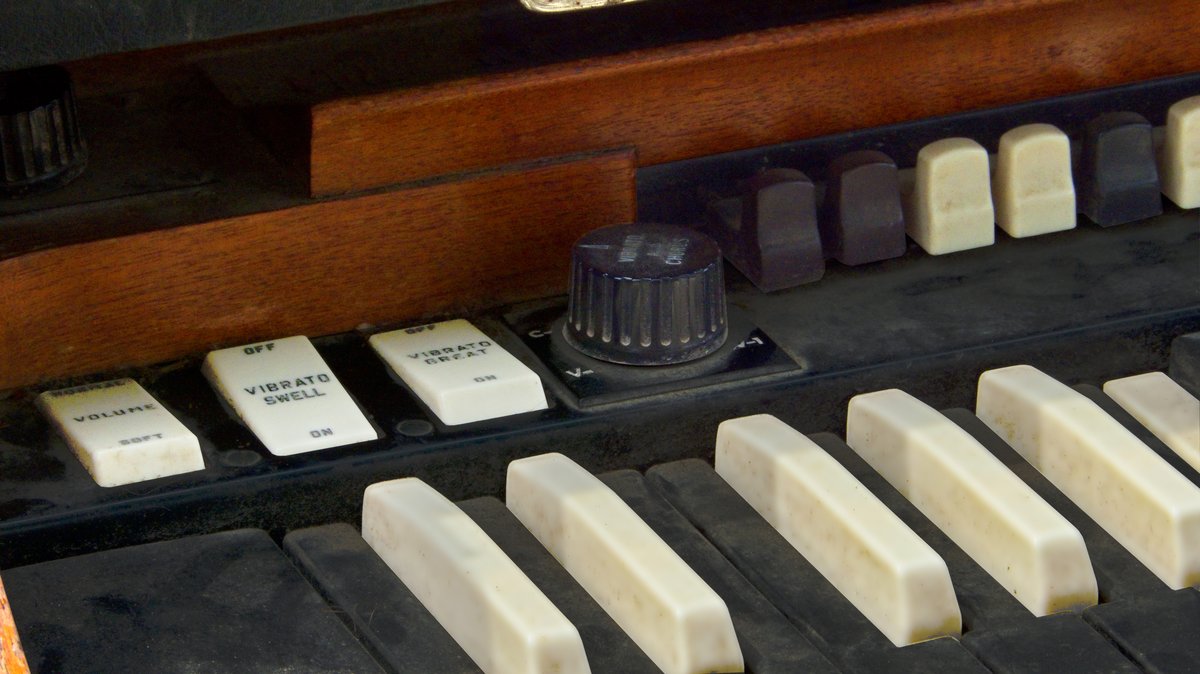
3.1 The drawbars
Each manual carries two sets of nine drawbars (a left set and a right set), and there are two further drawbars for the pedals — so the full bank is eighteen upper, eighteen lower, and two pedal bars (38 in all) (Hammond B-3/C-3 Service Manual; hammondwiki.org). The two sets per manual let the player park two contrasting registrations and switch between them with the preset keys (below). Each bar is a sliding harmonic control with nine detented loudness steps numbered 0 (off, fully in) through 8 (loudest, fully out); pulling a bar out adds more of that harmonic to the mix. The footages are pipe-organ nomenclature: the number is the speaking length of the organ pipe that would sound that pitch, so 16′ is an octave below unison and 1′ is three octaves above it (Vol 02 §2.x).
The bars are colour-coded by harmonic function. The white bars carry the fundamental (8′) and its octave members (4′, 2′, 1′). The two brown bars are the sub-octave 16′ and the sub-third quint 5⅓′. The black bars are the mutation/upper-harmonic ranks — the dissonant or “tinted” partials (2⅔′, 1⅗′, 1⅓′) that a player blends in sparingly for colour (Hammond B-3 Owner’s Playing Manual; hammondtoday.com).
Table 1 — The drawbars
| # | Footage | Colour | Pitch relative to key | Harmonic role |
|---|---|---|---|---|
| 1 | 16′ | Brown | One octave below unison | Sub-octave (sub-fundamental body) |
| 2 | 5⅓′ | Brown | A fifth above unison | Sub-third / quint (3rd harmonic of 16′) |
| 3 | 8′ | White | Unison (the played pitch) | Fundamental |
| 4 | 4′ | White | One octave above | 2nd harmonic (octave) |
| 5 | 2⅔′ | Black | An octave + a fifth above | 3rd harmonic (nazard/quint mutation) |
| 6 | 2′ | White | Two octaves above | 4th harmonic (super-octave) |
| 7 | 1⅗′ | Black | Two octaves + a major third above | 5th harmonic (tierce mutation) |
| 8 | 1⅓′ | Black | Two octaves + a fifth above | 6th harmonic (larigot mutation) |
| 9 | 1′ | White | Three octaves above | 8th harmonic (octave) |
3.1.1 Drawbar position levels
Each detent step represents roughly 3 dB of level change — approximately halving or doubling the perceived loudness of that harmonic contribution (dairiki.org/HammondWiki/Drawbars). Position 0 is a complete circuit break (the contact is fully lifted), not merely a low-level signal. The table below gives the attenuation relative to full-out (position 8 = 0 dB reference):
Table 2 — Each detent step represents roughly 3 dB of level change — approximately halving or doubling the perceived loudness of that harmonic contribution (dairiki.org/HammondWiki/Drawbars). Position 0 is a complete circuit break (the contact is fully lifted), not merely a low-level signal. The table below gives the attenuation relative to full-out (position 8 = 0 dB reference)
| Position | Bar state | Level relative to pos. 8 | Character |
|---|---|---|---|
| 0 | Fully in — off | Silence (contact lifted) | Harmonic absent |
| 1 | Barely out | −21 dB (est.) | Barely-audible colouration |
| 2 | Slightly out | −18 dB (est.) | Very subtle presence |
| 3 | Quarter out | −15 dB (est.) | Delicate tinting |
| 4 | Half out | −12 dB (est.) | Moderate contribution |
| 5 | Past half | −9 dB (est.) | Clearly audible |
| 6 | Mostly out | −6 dB (est.) | Prominent |
| 7 | Nearly full | −3 dB (est.) | Very strong |
| 8 | Fully out | 0 dB (reference) | Maximum loudness |
Tip: The standard left-to-right physical layout is
16′ 5⅓′ 8′ 4′ 2⅔′ 2′ 1⅗′ 1⅓′ 1′— note the 5⅓′ quint sits to the left of the 8′ fundamental even though it is a higher pitch, a layout quirk inherited from the original 1930s tonal scheme.
3.2 Preset keys
To the left of each manual sits an octave of reverse-colour preset keys (the naturals appear black, the sharps appear white) that recall complete drawbar registrations without touching the bars. The far-left reverse key, C, is the cancel key — it has no contacts and silences that manual (no registration, no sound). The two right-most keys, A♯ (B♭) and B, are the adjustable presets: each brings one of the manual’s two live drawbar sets into play — A♯ the left set, B the right set — so whatever the player has dialled into a set sounds only when its key is engaged. The keys between them (C♯, D … A) call up factory-wired internal registrations soldered to binding posts inside the organ (Hammond B-3/C-3 Service Manual; hammondwiki.org PresetPanel).
3.2.1 Upper manual (Swell) factory presets
The table below gives the standard factory upper-manual wiring for the nine documented preset keys (hammondwiki.org StandardPresets).
Table 3 — Upper manual (Swell) factory presets
| Reverse key | Function / name | Drawbar registration |
|---|---|---|
| C | Cancel — manual silent (no contacts) | — (no sound) |
| C♯ | Stopped Flute | 00 5320 000 |
| D | Dulciana | 00 4432 000 |
| D♯ | French Horn | 00 8740 000 |
| E | Salicional | 00 4544 222 |
| F | Flutes 8′ & 4′ | 00 5403 000 |
| F♯ | Oboe Horn | 00 4675 300 |
| G | Swell Diapason | 00 5644 320 |
| G♯ | Trumpet | 00 6876 540 |
| A | Full Swell | 32 7645 222 |
| A♯ (B♭) | Adjust — left drawbar set | whatever is set on the left bars |
| B | Adjust — right drawbar set (percussion source) | whatever is set on the right bars |
3.2.2 Lower manual (Great) factory presets
The lower manual carries its own factory-wired set, distinct from the upper (Hammond B-3/C-3 Service Manual). Specific drawbar registrations for the lower manual varied across production years and are harder to document with a single authoritative source; the names below are well-attested (hammondwiki.org; Hammond B-3 Owner’s Playing Manual), and the registrations are marked (est.) where a single canonical figure could not be confirmed:
Table 4 — The lower manual carries its own factory-wired set, distinct from the upper (Hammond B-3/C-3 Service Manual). Specific drawbar registrations for the lower manual varied across production years and are harder to document with a single authoritative source; the names below are well-attested (hammondwiki.org; Hammond B-3 Owner's Playing Manual), and the registrations are marked (est.) where a single canonical figure could not be confirmed
| Reverse key | Function / name | Notes |
|---|---|---|
| C | Cancel — manual silent | No contacts, as on the upper |
| C♯ | Cello | Flute-like, 8′-focused (est.) |
| D | Open Diapason | Broad 8′ principal tone (est.) |
| D♯ | Dulciana | Soft string (est.) |
| E | Flute | (est.) |
| F | Flutes 8′ & 4′ | Parallel to upper-manual F preset |
| F♯ | Diapason | (est.) |
| G | Gedeckt | (est.) |
| G♯ | Open Diapason | Fuller variant (est.) |
| A | Full Great | Full-organ foundation voicing (est.) |
| A♯ (B♭) | Adjust — left drawbar set | Live drawbars |
| B | Adjust — right drawbar set | Live drawbars |
Note: The two adjustable drawbar sets per manual are reached by the A♯ (B♭) and B preset keys (the left and right sets respectively). In the classic playing technique a contrasting registration is parked on the inactive set so the player can flip between two live sounds mid-phrase with a single preset key. The far-left C key is the cancel (silent) — it has no contacts and recalls no registration. The percussion controls below operate only when the upper manual is played from the B (right-set) adjust preset.
3.3 Harmonic Percussion
Harmonic Percussion is a B-3/C-3 feature (not present on earlier models) that adds a decaying overtone “ping” to the attack of each note, evoking a marimba/harp/chime transient before the sustained drawbar tone settles in. It is generated on the upper manual only, and only when that manual is played from the B (adjust) preset (Hammond organ documentation; hammondwiki.org).
Four rocker tablets govern it, each with two positions:
3.3.1 Percussion controls
Table 5 — Percussion controls
| Tablet | Position | Effect on sound | Key interactions |
|---|---|---|---|
| On / Off | On | Percussion active; 1′ drawbar silenced from the sustained mix | Requires B (adjust) preset; all four tablets take effect |
| Off | No percussion envelope; 1′ drawbar restored to normal | All other tablets inert | |
| Harmonic | Second | Percussive overtone at the 4′ pitch (one octave above the played note; the 2nd harmonic of the 8′ fundamental) | The 4′ tonewheel signal feeds the percussion decay circuit |
| Third | Percussive overtone at the 2⅔′ pitch (an octave + a fifth above; the 3rd harmonic) | The 2⅔′ tonewheel signal feeds the decay circuit | |
| Volume | Soft | Percussion quieter; sustained drawbar level unaffected | Lower percussion-to-drawbar ratio |
| Normal | Percussion louder; sustained drawbar level slightly reduced | The circuit gain shift that makes percussion louder partially attenuates the drawbar signal | |
| Decay | Fast | Overtone fades in ~1 s (est.) — xylophone / marimba character | Decay time varies with capacitor age and line voltage |
| Slow | Overtone fades in ~4–5 s (est.) — chime / vibraphone character | Decay time varies with capacitor age and line voltage |
Decay time estimates from organforum.com user measurements on vintage B-3/C-3 and A-100 series instruments (similar percussion circuit); the Hammond service manual specifies component values rather than calibrated decay durations, so field variation is significant and these figures are flagged (est.).
3.3.2 Percussion interactions
The four tablets interact with specific tonewheel taps and circuit paths in ways that affect both the percussion envelope and the sustained drawbar tone (Hammond B-3/C-3 Service Manual; Hammond organ documentation; hammondwiki.org):
Table 6 — The four tablets interact with specific tonewheel taps and circuit paths in ways that affect both the percussion envelope and the sustained drawbar tone (Hammond B-3/C-3 Service Manual; Hammond organ documentation; hammondwiki.org)
| Condition | 1′ drawbar in sustained mix | Sustained drawbar level | Percussion pitch | Rearming |
|---|---|---|---|---|
| Percussion OFF | Sounds normally | Full | — | — |
| Percussion ON, Soft, Second | Silenced | Full | 4′ (one octave up) | On full key release |
| Percussion ON, Soft, Third | Silenced | Full | 2⅔′ (octave + fifth up) | On full key release |
| Percussion ON, Normal, Second | Silenced | Slightly reduced | 4′ (one octave up) | On full key release |
| Percussion ON, Normal, Third | Silenced | Slightly reduced | 2⅔′ (octave + fifth up) | On full key release |
Three essential interactions in detail:
-
The 1′ drawbar is silenced. When percussion is switched ON, the upper-manual 1′ drawbar contact tap is re-routed into the percussion trigger circuit and removed from the normal drawbar mix. The 1′ bar therefore goes silent in the drawbar tone whenever percussion is engaged, regardless of its physical position (Hammond B-3/C-3 Service Manual; Hammond organ documentation).
-
The 4′ or 2⅔′ tonewheel feeds the percussion tone. The actual percussive sound is derived from the 4′ tonewheel connection when the Harmonic tablet is set to Second, or from the 2⅔′ tonewheel when set to Third. These tonewheel taps are routed through the percussion decay network in the AO-28 preamplifier (V5/V6/V7 tube stages), shaped by the Fast/Slow capacitor and the Soft/Normal gain setting, and appear as the decaying attack overtone. The percussion tone pitch is therefore one octave above (Second) or an octave-plus-fifth above (Third) the played note, matching the 4′ and 2⅔′ drawbar footage relationships (Hammond B-3 Owner’s Manual; Sound on Sound).
-
Normal drops the overall sustained level. Selecting Normal percussion volume increases the percussion signal gain, but the way that gain is applied against the main signal path causes a slight reduction in the manual’s sustained drawbar level — a circuit side-effect, not a design defect (Hammond B-3 Owner’s Manual).
Warn: Harmonic Percussion is single-trigger and therefore deliberately non-legato. The percussion envelope re-arms only after all keys on the manual are released; during a legato line the ping sounds on the first note/chord only and stays silent under the slurred notes that follow. Lifting fully between notes restores the attack on each — this is why percussive B-3 lines are played with crisp, detached articulation.
3.4 Vibrato & chorus (the scanner)
The B-3 vibrato and chorus are produced by an electromechanical scanner rather than by any electronic oscillator. The signal is fed through a multi-tap LC delay line (a ladder of inductor/capacitor all-pass sections), so each successive tap presents the same signal with a little more phase delay. A motor-driven rotary capacitor “scanner” — a single-pole, sixteen-throw air-dielectric switch driven off the run-motor shaft via a separate gear train — sweeps along those taps and back, continuously picking off progressively delayed (hence pitch-shifted) versions of the signal. Sweeping toward longer delay drops the pitch slightly; sweeping back raises it; the cyclic result is vibrato (Hammond B-3/C-3 Service Manual; hammondwiki.org Vibrato; modularsynthesis.com).
The console B-3 delay line has 18 all-pass L/C stages with a total swept delay of approximately 1 ms (est.) at maximum vibrato depth (V3/C3); the scanner’s 16 rotor plates sweep through these taps in a back-and-forth cycle. The scanner runs at roughly 412 rpm — about 7 Hz vibrato rate (~6.9 Hz (est.) in practice) (hammondwiki.org Vibrato; electricdruid.net). The six selector positions split into two families:
- V1 / V2 / V3 — pure vibrato. Only the scanned (phase-shifted) signal reaches the output. The number sets depth by controlling how much of the delay line is swept: V1 uses roughly one-third of the 18 stages, V2 roughly one-half, and V3 all 18 stages — so V1 is shallow and V3 is the widest pitch excursion.
- C1 / C2 / C3 — chorus. The scanned signal is mixed back with the dry, un-shifted signal. The fixed dry tone beating against the swept tone yields the shimmering Hammond chorus; C1/C2/C3 widen the scan depth exactly as V1/V2/V3 do, but the dry component gives a chorus shimmer rather than pure vibrato.
Upper and lower manuals have independent vibrato on/off switches (Swell and Great tablets), so the chorale of one manual can be wet while the other stays dry; the V/C selector knob is shared between both manuals.
3.4.1 Vibrato/chorus selector table
Table 7 — Vibrato/chorus selector table
| Position | Effect type | Delay-line portion swept | Frequency depth | Audible character |
|---|---|---|---|---|
| V1 | Pure vibrato | ~6 of 18 stages (~1/3) | Shallow | Gentle, barely noticeable pitch wobble |
| V2 | Pure vibrato | ~9 of 18 stages (~1/2) | Medium | Clear vibrato; the most “vocal” depth |
| V3 | Pure vibrato | All 18 stages (full) | Deep | Wide, singing vibrato; the classic full Hammond effect |
| C1 | Chorus | ~6 stages scanned; dry mixed in | Shallow | Subtle shimmer; transparency with just a hint of movement |
| C2 | Chorus | ~9 stages scanned; dry mixed in | Medium | Lush, warm chorus; the most commonly used live setting |
| C3 | Chorus | All 18 stages scanned; dry mixed in | Full | Wide, ensemble-like shimmer; the richest chorus setting |
Depth fractions are approximate, derived from dairiki.org and the DAFX-16 conference paper on Hammond vibrato modelling; the Hammond service manual describes the selector wiring but does not express tap counts as fractions.
The mechanism is detailed mechanically in Vol 02 §2.x (scanner construction and its place on the run-motor shaft); this volume treats it strictly as a control. The vibrato/chorus effect is upstream of the Leslie (Vol 04), so a player can stack scanner chorus and Leslie rotation independently.
3.5 Expression pedal
The B-3’s expression pedal is a swell/volume control acting on the whole instrument’s signal after the preamplifier — not a per-manual control and not a tone control. It is wired as a variable shunt (a multi-tap potentiometer arrangement) that attenuates the combined output level: at heel-down the signal is shunted to ground, giving the softest level; at toe-down the shunt is removed, passing the full signal (Hammond B-3/C-3 Service Manual). The shunt arrangement means the pedal sees the full preamp output voltage at all times, attenuating rather than reducing gain — a distinction relevant when measuring output impedance.
The taper is roughly logarithmic, matching the ear’s perception of loudness so that pedal travel feels even rather than bunched at the loud end. Because the swell sits after the preamp and before the power stage, it controls dynamics without changing the harmonic balance set on the drawbars. The output impedance of the pedal’s wiper varies continuously with pedal position, which can interact with the cable and amplifier input impedance when driving external stages; driving a Leslie through the standard 6-pin line avoids this consideration since the Leslie amplifier’s input stage is designed for the B-3’s source impedance.
Tip: Since the pedal scales the entire instrument, expressive swells affect upper manual, lower manual, and pedal tone simultaneously — a deliberate sustain-and-swell technique, distinct from balancing manuals against each other (which is done with the drawbars and presets).
3.6 Start/Run & powering up
The tonewheel generator is turned by an AC motor that must be brought up to synchronous speed before it will hold pitch. Powering up is therefore a two-switch ritual using the Start and Run switches (Hammond B-3/C-3 Service Manual):
- Hold the Start switch (the spring-loaded one). This energises a separate, self-starting run-up motor that spins the generator assembly up from rest. Hold it for roughly ~8 s until the generator is up to speed.
- With Start still held, throw the Run switch ON. This brings power to the synchronous motor, which locks the generator to the AC line frequency and holds pitch.
- Release Start. The synchronous motor now carries the generator on its own; the run-up motor de-energises.
To shut down, the Run switch is simply turned OFF.
Note: The ~8 s hold is the conventional figure; the exact spin-up interval varies with line voltage and a given machine’s bearing condition, so it is given as an approximate ritual rather than a hard spec. The pitch stability of the whole instrument depends on the synchronous motor staying locked to the mains frequency (Vol 02 §2.x).
3.7 Driving it: a first registration
A worked example ties the controls together. The classic jazz starting point on the upper manual is the registration written 88 8000 000 — the 16′, 5⅓′, and 8′ bars pulled fully out (loudness 8) and everything above 8′ pushed in. This yields a fat, fundamental-heavy sound with the quint adding body, and is the bedrock “drawbar one” voicing from which countless gospel and jazz settings depart.
To bring it up on the instrument:
- Choose the manual and preset. Set the upper-manual bars to
88 8000 000and play from the B (adjust) preset so the live drawbars sound. (Cancel — B♭ — would leave the manual silent.) - Add the attack. Switch Harmonic Percussion ON — Third harmonic, Soft volume, Fast decay is a common first choice. Remember that engaging percussion cuts the 1′ drawbar (already at 0 here, so no audible loss) and that Normal volume would dip the sustained level slightly; the single-trigger behaviour means the ping returns only when keys are fully released.
- Choose the modulation. Select C3 for a wide chorus shimmer, or a V position for pure vibrato; switch the upper-manual vibrato ON and leave the lower manual dry if a contrast is wanted.
- Set dynamics with the foot. The expression pedal scales the whole result; ride it for swells.
- Add the cabinet. Route to the Leslie 122 and use its speed control for the final voice (Vol 04 §4.x).
Tip: Parking a contrasting registration on the second (inactive) drawbar set lets the player flip between, say,
88 8000 000and a bright00 8888 000with a single preset-key stab — the core of the live B-3 “two-sound” technique.
Sources consulted: Hammond B-3/C-3 Service Manual; Hammond B-3 Owner’s Playing Manual; Hammond B-3 Owner’s Manual (ManualsLib); hammondwiki.org (PresetPanel, StandardPresets, Vibrato, Drawbars); Mark Vail, The Hammond Organ: Beauty in the B; modularsynthesis.com (vibrato scanner); electricdruid.net (technical aspects); organforum.com (percussion decay times, percussion harmonics); Sound on Sound (Hammond synthesis); hammondtoday.com. Values marked “(est.)” are approximate and flagged where a single authoritative figure could not be confirmed.
Comments (0)