Hammond B-3 · Volume 5
Hammond B-3 — Vol 05: Bass — Pedalboard & the Trek II Expander
This volume documents the bass end of the Hammond B-3 rig: the stock 25-note pedalboard and its contact mechanism, how its tones are generated from the tonewheel generator’s lowest complex wheels through the two pedal drawbars (16′ and 8′), what the generator’s bottom-of-the-compass foldback means for pedal bass, how the pedal division is keyed (monophonic, lowest-note priority), and what the B-3 does and does not provide at the very bottom of the range. It then documents the aftermarket Trek II bass expander — specifically the Trek II String Bass unit (model SB-2500B) — fitted to this rig to augment the pedals, including its install wiring. The physics of the tonewheel generator and additive synthesis are Vol 02 §2.x; the manual drawbars, presets, percussion, and expression are Vol 03 §3.x; mic’ing and levels for recording the bass are Vol 17 §17.x; the Leslie 122 that radiates the result is Vol 04. This volume references those, not duplicates them.
Note: On the B-3 the pedal tones are not a separate oscillator bank. They are tapped from the same tonewheel generator as the manuals — specifically its lowest complex wheels — and shaped by two pedal drawbars rather than the nine-drawbar sets of each manual (Vol 02 §2.x covers the generator and key-contact matrix). Everything in §“Pedal tone generation & foldback” follows from that fact.
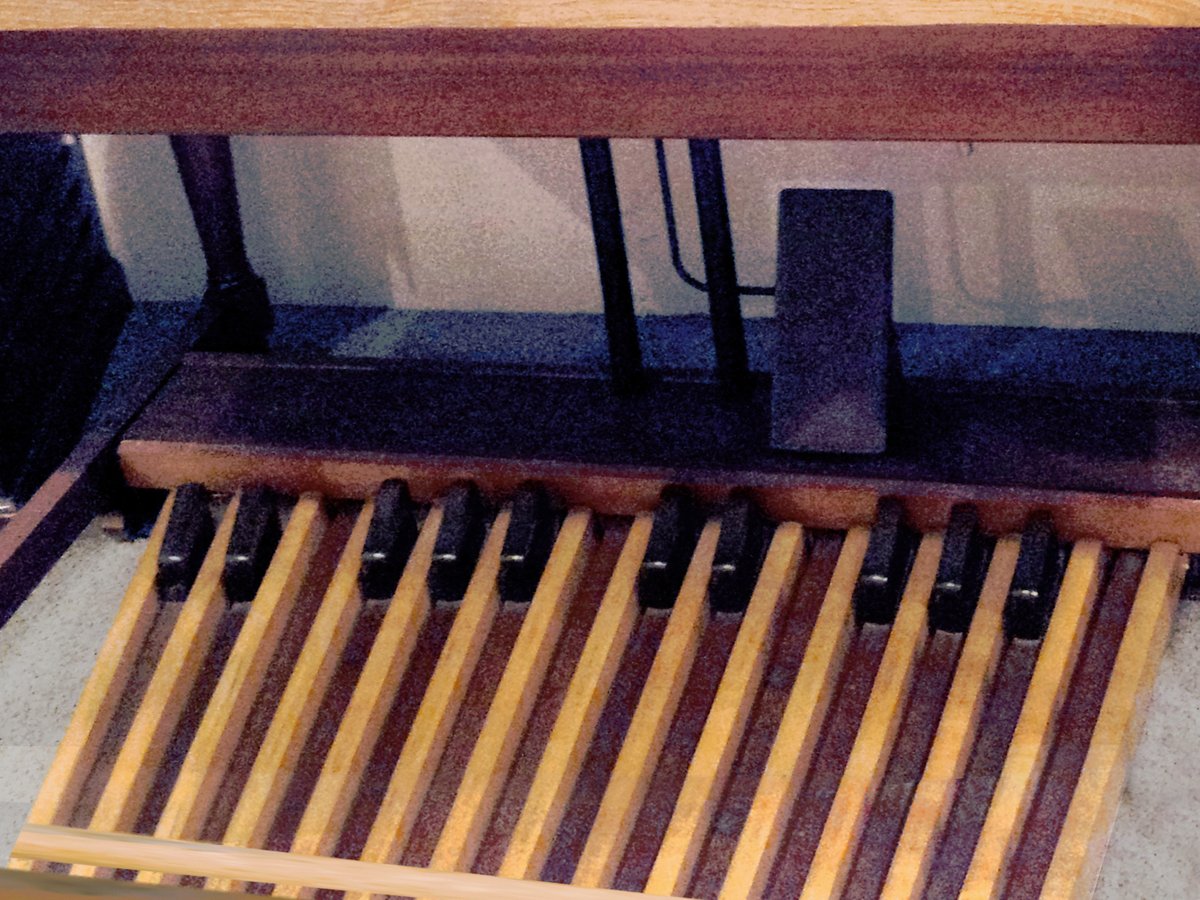
5.1 The 25-note pedalboard
The B-3 console carries the standard Hammond 25-note pedalboard: 25 chromatic pedals running from a low C up two octaves to middle C (i.e. two octaves plus the top note — C, C up an octave, C up a second octave) (azurehillsmusic.com, “Hammond Organ Pedalboard”; Pedal keyboard, en.wikipedia.org; Hammond organ, en.wikipedia.org). This is the layout shared across the console line (B-3, C-3, A-100) and is the board fitted to the subject rig.
Two pattern questions matter for technique and for swapping boards:
- Radiating vs. parallel. The Hammond 25-note board uses radiating pedals (the pedals fan out from a point behind the player so the spacing suits the natural sweep of the feet), the same radiating geometry as the larger AGO board (azurehillsmusic.com).
- Concave vs. flat. The defining difference from a full AGO (American Guild of Organists) pedalboard is concavity. The AGO specification calls for 32 pedals, C to g′, in a concave and radiating pattern; the standard Hammond console 25-note board is radiating but essentially flat (minimal concavity) (azurehillsmusic.com; HammondWiki “Classical Organists Dislike Most Hammonds”, dairiki.org). The flat-ish, short Hammond board is exactly what gospel and jazz players favour for fast pedal work and what classical players tend to dislike (azurehillsmusic.com).
Note: The pedal dimensions and spacing of the Hammond 25-note board are, for practical purposes, the same as the AGO board’s — only the note count (25 vs 32) and the concavity (flat vs concave) differ (azurehillsmusic.com). A player trained on AGO pedals will find the reach familiar but the curvature and top range missing.
The 25-note range is the load-bearing fact for the rest of this volume: the pedals cover two octaves, the bottom note is a low C, and there is no pedal note below that low C on a stock B-3 (contrast the RT-3 in §“Pedal drawbars & solo”).
5.1.1 Pedal contact mechanism
The pedals are hinged wooden keys, each fitted with a felt-tipped pusher lever (sometimes called a switch pusher) at its rear end. When a pedal is depressed, the lever closes the pedal’s contacts against the audio bus — completing the circuit that routes the tonewheel signal through the active drawbars (Hammond B-3/C-3 Service Manual; b3world.com “Hammond Technical Information”). The pedal keys themselves carry no audio; they are purely mechanical switches. Each pedal contact assembly is housed in a phenolic retainer that bears against the bus structure when the pusher actuates (Hammond B-3/C-3 Service Manual).
The natural pedal keys (C, D, E, F, G, A, B) are the wider, lower-lying keys. The accidental keys (C♯/D♭ through A♯/B♭) are narrower and raised above the naturals — mirroring the keyboard pattern in foot-actuated form. The radiating geometry means key spacing widens from front to rear of the board; the player’s heel pivot follows this arc naturally.
The pedalboard mounts to the console floor frame below the expression pedal and detaches as a unit for service. The pedal contact assembly — the electrical switching structure for the pedals — is accessible from underneath when the board is removed. This is where the Trek II contact strip is added during SB-2500B installation (§“The Trek II bass expander”).
5.2 Pedal tone generation & foldback
The pedal division draws its audio from the lowest tonewheels of the generator. The tonewheel generator produces 91 discrete frequencies at semitone intervals, numbered 1 to 91 in ascending order (electricdruid.net “Technical aspects of the Hammond Organ”; HammondWiki tonewheel data, dairiki.org). Tonewheel no. 1 is the lowest, at approximately 32.7 Hz (C1 at equal temperament) — the 16′ fundamental of the lowest pedal note.
5.2.1 The complex (wide-tooth) tonewheels
A key feature of pedal-bass tone is the physical design of tonewheels 1 through 12 (C1 through B1; approximately 32.7 Hz to 61.7 Hz). Unlike the upper tonewheels, which are machined to produce a near-sinusoidal waveform, the lowest twelve are cut with a more complex tooth profile — producing a waveform closer to a square wave, with 3rd and 5th harmonics already present in the raw tonewheel output (electricdruid.net “Technical aspects of the Hammond Organ”; HammondWiki “Tone Wheel”, dairiki.org; soundonsound.com “Synthesizing Tonewheel Organs Part 1”). These harmonics are intrinsic to the wheel shape, not added by the drawbars. In the B-3, C-3, and equivalent models, the original simple two-tooth wheels in that bottom octave were replaced with twelve complex-cut wheels, enriching the fundamental with odd-number harmonics (goodeveca.net “Hammond Tone Wheels”; HammondWiki).
Tonewheels 1–12 are exclusively available on the pedalboard on console-model Hammonds including the B-3. The manual keyboards cannot address them in normal factory wiring.
5.2.2 Foldback at the bottom of the compass
Because tonewheels 1–12 belong to the pedals, the bottom octave of the lower manual cannot use them. When the lowest manual keys are played at the 8′ drawbar pitch, the signal is drawn from tonewheels 13–24 (C2–B2, approximately 65.4 Hz to 123.5 Hz) — one octave above the written pitch — rather than the true sub-octave complex wheels. This wrap-around, where the signal folds to the next available tonewheel above, is called foldback (electricdruid.net; organforum.com “Why did Hammond foldback the bottom octave on most consoles?”). The entire C1–B1 written register of the lower manual is subject to this foldback.
For the pedals there is no equivalent foldback: the 16′ pedal drawbar accesses tonewheels 1–12 directly, sounding the genuine complex fundamental. The 8′ pedal drawbar accesses tonewheels 13–24 — the true octave-up, not a substituted equivalent. Since the stock B-3 pedals carry only the 16′ and 8′ drawbars (no sub-octave 32′ drawbar), no pitch register below tonewheel no. 1 is ever called for, and pedal foldback does not arise in practice. The lowest tonewheel sets a hard floor on the generator’s range — there is simply nothing below ~32.7 Hz in the instrument.
Note (timbre implication): Because the bottom manual octave folds back to tonewheels 13–24, a bass line played on the lower manual in the C1–B1 register does not sound the same tonewheel as the corresponding pedal note at the same written pitch — the pedal gets the genuine complex wheel; the manual gets the folded-up equivalent. This is part of why tonewheel pedal bass has a distinctly different, fuller character than manual-keyboard bass in the same register, even before drawbar settings are considered.
5.3 Pedal drawbars & solo
5.3.1 The two pedal drawbars
The pedal division is voiced by two adjustable drawbars — one labelled 16′ and one labelled 8′ — as opposed to the nine-drawbar registration set provided for each manual (HammondWiki, dairiki.org; hammondorganco.com “Pedalboards”; azurehillsmusic.com). The 16′ drawbar contributes the deep sub-octave fundamental via the complex tonewheels; the 8′ drawbar adds the octave above for definition and audibility on limited-LF systems.
Mapping the 25-note range onto sounding fundamentals (equal temperament, low pedal C at 16′ pitch taken as C1 = 32.70 Hz):
Table 1 — Mapping the 25-note range onto sounding fundamentals (equal temperament, low pedal C at 16′ pitch taken as C1 = 32.70 Hz)
| Pedal note (board) | 16′ drawbar sounding f0 | 8′ drawbar sounding f0 |
|---|---|---|
| Low C (bottom) | ≈ 32.70 Hz (C1) | ≈ 65.41 Hz (C2) |
| F (5 semitones up) | ≈ 43.65 Hz (F1) | ≈ 87.31 Hz (F2) |
| C (octave up) | ≈ 65.41 Hz (C2) | ≈ 130.81 Hz (C3) |
| G (19 semitones up) | ≈ 98.00 Hz (G2) | ≈ 196.00 Hz (G3) |
| C (top, middle C) | ≈ 130.81 Hz (C3) | ≈ 261.63 Hz (C4) |
Frequencies are standard equal-tempered values anchored to the cited low-C tonewheel figure (≈ 32.7 Hz; electricdruid.net, dairiki.org); intermediate notes are computed for orientation, not separately sourced from device measurements.
Pedal drawbar roles:
Table 2 — Pedal drawbar roles
| Pedal drawbar | Footage | Pitch relative to played pedal | Role |
|---|---|---|---|
| Pedal 1 | 16′ | Sub-octave (one octave below 8′) | Deep fundamental via complex tonewheel; the body of the bass note (≈ 32.7 Hz at low C) |
| Pedal 2 | 8′ | Unison reference octave | Octave-up reinforcement for pitch definition and audibility on limited-LF systems |
Tip: Because there are only two pedal drawbars, pedal “registration” on a stock B-3 is essentially a balance between deep (16′) and present (8′). Pulling only 16′ gives a soft, felt sub-bass that can disappear on a modest speaker; adding 8′ brings the line forward. Through a Leslie 122 the bass is radiated by the rotating drum (Vol 04 §“Horn & drum rotors”), so the perceived weight also depends on the cabinet, not the drawbars alone.
Note: The 16′/8′ pedal drawbars feed the same downstream audio chain as the manuals — matching transformer → AO-28 output amplifier → Leslie (Vol 02 §2.x; Vol 04). There is no separate pedal amplifier or pedal output on a stock B-3; the pedal bass and the manual signal share one balanced line to the cabinet.
5.3.2 Monophonic keying and lowest-note priority
The pedal division is monophonic with lowest-note priority: pressing two pedals at once sounds the lower of the two, which is what makes legato pedal-bass lines and quick “walking” patterns play cleanly without doubled or muddied notes (this monophonic, lowest-note behaviour is the standard Hammond pedal characteristic and is the design the Trek II String Bass deliberately mirrors — “monophonic, which is desirable for faster playing”; trekii.com SB-2500B literature, dannychesnut.com).
The natural envelope of the stock pedal bass is fast-decaying and fairly pure in attack: a tonewheel pedal note has little inherent sustain — it behaves more like a plucked or struck bass that dies away than a sustained pipe-organ pedal. Exact decay times are not published as a device spec and are not asserted here in ms; the qualitative behaviour — quick decay, limited ring — is the point, and it is precisely the limitation the Trek II’s adjustable sustain is sold to address (§“The Trek II bass expander”).
Note: “Monophonic” here describes the pedal division, not the organ. The two manuals are fully polyphonic (Vol 03 §3.x). Lowest-note priority on the pedals is a feature, not a defect: it keeps a foot-played bass line unambiguous.
5.3.3 Pedal solo on the B-3 vs the RT-3’s 32′
A point of frequent confusion is worth stating flatly: the stock B-3 has no 32′ pedal pitch and no dedicated pedal-solo division. Its bottom pitch is the 16′ drawbar, and its lowest sounding pedal fundamental is the low-C tonewheel near 32.7 Hz (electricdruid.net; dairiki.org). The pedal voicing is just the 16′ + 8′ drawbars described above.
The organ that does add the deep solo bass is the RT-3 (and its relatives the RT-2 and D-100). The RT-3 is essentially a B-3 with two additions (Hammond organ, en.wikipedia.org; organforum.com “Can a Hammond RT3 pedalboard… be swapped out for the standard 25?”):
- a 32-note concave-radiating AGO pedalboard (C to g′), instead of the 25-note flat board; and
- a Pedal Solo Unit — a separate solo bass system with its own volume control that produces pitches from 32′ down through 2′, i.e. an octave below the B-3’s 16′ at the bottom.
Table 3 — Pedal solo on the B-3 vs the RT-3's 32′
| Feature | Stock B-3 | RT-3 (for contrast) |
|---|---|---|
| Pedalboard | 25 notes, low C → middle C, radiating/flat | 32 notes AGO, C → g′, concave-radiating |
| Lowest pedal pitch | 16′ (low C ≈ 32.7 Hz) | 32′ via the Pedal Solo Unit (≈ 16 Hz region) |
| Pedal voicing | 2 drawbars (16′ + 8′) | 16′/8′ drawbars plus a separate Pedal Solo Unit (32′–2′) with its own volume |
| Dedicated solo division | None | Yes — independent solo bass system |
Warn: Do not attribute a 32′ “solo pedal” sound to a stock B-3. That feature belongs to the RT-2/RT-3/D-100 concert models (en.wikipedia.org; organforum.com). On the subject rig, the only way to extend or thicken the bottom beyond the 16′/8′ tonewheel pedals is the aftermarket Trek II unit documented next — which adds a string-bass voice and sustain, not a true 32′ pipe-organ sub-octave.
5.4 The Trek II bass expander
Note (product identity): Trek II Products makes several Hammond add-ons, and the bass expander is often loosely described as a “pedal sustain” mod. The specific, sourceable product is the Trek II String Bass, current model SB-2500B (trekii.com; HammondWiki “Trek II String Bass with Simultaneous Retention of Hammond Pedal Tones”, dairiki.org; dannychesnut.com). It is not merely a sustain enhancer bolted onto the existing tonewheel pedal tones — it is a separate synthesized string-bass voice generator with its own adjustable sustain and pluck, which can run alongside the original Hammond pedal tones. Where this volume cannot confirm a numeric spec from Trek II’s own literature, it says so and marks the value “(est.)” rather than inventing one.
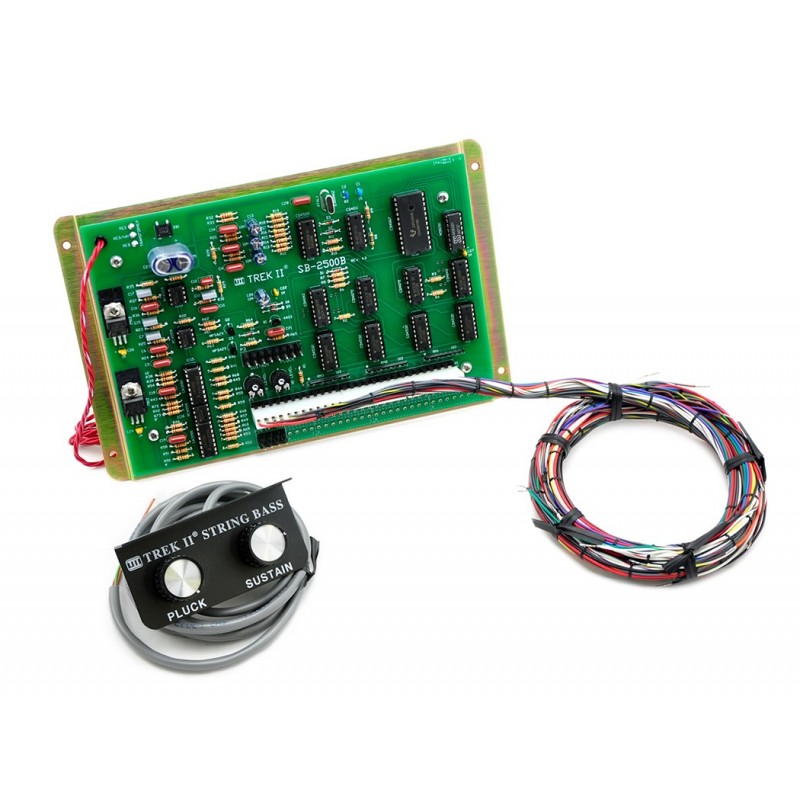
What it does. The SB-2500B generates a string-bass voice keyed from the organ’s pedals, with a longer, adjustable sustain and an adjustable initial “pluck” attack — emulating an upright/electric bass rather than the pure, fast-decaying tonewheel pedal tone. Trek II’s literature states it provides 25 notes in both an 8′ and a 16′ voice, that the tones are monophonic (“desirable for faster playing with a relatively long sustain time”), and that using both 16′ and 8′ pedal tones yields “a much richer string bass with more variation in tone” than the earlier Krueger string-bass system it supersedes (trekii.com SB-2500B; dannychesnut.com; HammondWiki, dairiki.org).
Simultaneous retention of the Hammond pedals. The distinguishing feature, and the reason the HammondWiki page is titled as it is, is that the installation provides four pedal drawbars: 16′ and 8′ original Hammond, plus 16′ and 8′ Trek II string bass. The player can select Hammond only, Trek II only, or any blend of the two (HammondWiki, dairiki.org). The stock tonewheel pedal bass is therefore preserved, with the string-bass voice layered on top as desired.
Controls. From published Trek II descriptions:
Table 4 — Controls. From published Trek II descriptions
| Control | Function | Source / confidence |
|---|---|---|
| Sustain (length) | Sets how long each string-bass note rings after release — the core “adds sustain” feature; adjustable from the console | Published (trekii.com; dannychesnut.com) |
| Pluck | Sets the strength/character of the initial attack transient (the simulated string “pluck”) | Published (trekii.com; dannychesnut.com) |
| 16′ / 8′ string-bass voices | Two footages of the string-bass tone, paralleling the Hammond pedal footages; selectable via the added drawbars | Published (trekii.com; HammondWiki) |
| Tuning | Quartz-referenced tuning for accuracy/stability | Published as “quartz tuning accuracy” (trekii.com) |
| Output level / separate outputs | Separate output(s) available to feed an external amplifier (so the string bass can be routed apart from the organ’s main signal) | Published in general terms; exact level/impedance not published (n/p) |
The Pluck/Sustain control is typically mounted to the underside of the organ’s front wooden rail within reach of the player and connects to the main circuit board via a Molex connector (trekii.com; dannychesnut.com).
Installation. The unit taps the pedal contacts, not the audio bus. A Krueger-style contact strip mounts to the pedal support structure, and nineteen wires — eighteen covering each pedal tone (from low C through the second F at 16′ and 8′ pitch) (Trek II’s product page states 25 notes, while HammondWiki’s installation description references an 18-point Krueger contact strip covering low C to second F; the two figures are not reconciled in available sources.) plus one signal common — run from that contact strip to the Trek II board, bundled into a DB25 miniature connector so the assembly can be unplugged cleanly for board removal. Wire gauge is No. 22 AWG stranded (HammondWiki, dairiki.org). The main circuit board mounts anywhere convenient inside the console, and the unit’s power transformer is mounted near the organ’s run-motor end — well away from the audio signal path — to avoid inducing hum into the organ’s signal chain (trekii.com; dannychesnut.com; HammondWiki, dairiki.org). The added string-bass drawbars sit alongside the original 16′/8′ pedal drawbars.
Trek II SB-2500B install wiring schematic (component placement inside the console):
Warn (unconfirmed specifics — not invented): Trek II’s public literature describes the SB-2500B’s functions and controls but does not publish hard numbers for several parameters relevant to a bench writeup. The following are not confirmed from Trek II sources and are deliberately left unspecified rather than estimated: the sustain time range in seconds/ms, the output level (V/dBu) and impedance of the separate output, the internal supply voltages, and the exact attack/decay shaping of the pluck. The string-bass voicing is an analog emulation of a plucked string bass, distinct from the tonewheel pedal tone — it does not add a true 32′ sub-octave (that remains an RT-3 feature, §“Pedal drawbars & solo”).
Note (model/ambiguity): The “B” suffix (SB-2500B) denotes the current revision of the String Bass unit; earlier Trek II string-bass and pedal-sustain variants exist, and Trek II’s catalogue also includes unrelated Hammond accessories (e.g. line-out kits). The product documented here is the String Bass / SB-2500B, identified as the bass expander on the subject rig. If a different Trek II bass accessory is in fact fitted, the controls and installation specifics above may differ and should be re-verified against the unit’s own label and Trek II’s page for that model.
5.5 Bass in the signal path
In the installed rig the two bass voices live in parallel: the stock tonewheel pedal bass (16′ + 8′, fast-decaying, complex-tonewheel character) and the Trek II string bass (16′ + 8′ string voice, adjustable pluck and sustain), both keyed monophonically from the same 25 pedals, both ultimately summed into the organ’s balanced line to the Leslie 122 (Vol 04).
5.5.1 Pedal-bass signal path with the Trek II inserted
Worked example — a sustained gospel bass note. A player wants a low F under a chord, held long, with an upright-bass feel:
- The foot presses the F pedal (5 semitones up from low C). Monophonic keying sounds that one note; the tonewheel path produces F at the 16′ pitch ≈ 43.7 Hz plus the 8′ octave ≈ 87.3 Hz (§“Pedal tone generation & foldback”), from one of the complex-cut tonewheels in the bottom octave.
- The stock tonewheel pedal bass speaks immediately and, on its own, would decay quickly (little natural sustain).
- The Trek II String Bass, keyed from the same pedal contact, adds its 16′/8′ string voice with the Sustain control set long, so the note rings on after the foot lifts, and the Pluck control set to taste gives the attack an upright-bass “thump.” The player has dialled the four pedal drawbars to blend Hammond 16′ + Trek II 16′/8′ (HammondWiki, dairiki.org).
- Both voices sum into the organ’s balanced line and are radiated by the Leslie 122’s rotating drum (Vol 04 §“Horn & drum rotors”), which adds the low-frequency wash. Recording this — mic choice and the very-low-frequency content near 30–45 Hz — is a Vol 17 §17.x topic.
Tip: Because the Trek II runs in parallel with the stock pedals, the most useful starting point is to set the Hammond 16′/8′ for the fundamental weight and the Trek II string voice for the sustain and articulation, then balance the two with their respective drawbars. Pulling the Trek II to zero returns the rig to a pure stock B-3 pedal bass at any time.
Sources consulted: Hammond organ and Pedal keyboard — en.wikipedia.org (25-note range, RT-3 32-note AGO board and 32′ Pedal Solo Unit); “Hammond Organ Pedalboard — Pros and Cons of 25 and 32 Note Versions” — azurehillsmusic.com (25-note C–C range, radiating vs concave, dimensions); HammondWiki — dairiki.org (“Classical Organists Dislike Most Hammonds”; “Trek II String Bass with Simultaneous Retention of Hammond Pedal Tones”: 19-wire/DB25/No. 22 AWG/Krueger contact strip/transformer placement; “Tone Wheel”: complex-cut bottom-octave tonewheels; tonewheel/frequency data); “Technical aspects of the Hammond Organ” — electricdruid.net (tonewheel #1–12 complex tooth profile yielding near-square-wave with 3rd/5th harmonics; foldback at the bottom octave; lowest pedal tonewheel ≈ 32.7 Hz); goodeveca.net “Hammond Tone Wheels” and soundonsound.com “Synthesizing Tonewheel Organs Part 1” (complex-wheel tooth design for odd-harmonic enrichment); The Organ Forum — organforum.com (“Why did Hammond foldback the bottom octave on most consoles?”; lowest pedal tonewheel; RT3 pedalboard swap thread); Hammond Organ Co. — hammondorganco.com (pedalboards, two pedal drawbars 16′/8′); Trek II Products — trekii.com (SB-2500B String Bass: adjustable sustain/pluck, quartz tuning, 25 notes in 8′ and 16′, separate outputs); dannychesnut.com (Trek II String Bass installation — pedal contact strip, 19 wires/DB25, No. 22 AWG, Molex console control, transformer placement near run-motor end); Hammond B-3/C-3 Service Manual and b3world.com (pedal pusher lever / switch-pusher mechanism, phenolic retainer, contact bus). Frequencies in the pedal table are equal-tempered values anchored to the cited ≈ 32.7 Hz low-C tonewheel; intermediate notes are computed for orientation. Trek II numeric specs not in its published literature (sustain time range, output level/impedance, supply voltages, pluck shaping) are explicitly left unspecified rather than invented; the B-3-vs-RT-3 distinction (no 32′ / no pedal-solo division on the stock B-3) is stated per en.wikipedia.org and organforum.com.
Comments (0)