Wind Systems · Volume 5
Wind Systems — Vol 05: Steadiness & the Tremulant
Vol 03 built a reservoir that holds the delivered wind at one set pressure across its whole rise and fall, and Vol 04 measured that pressure and sized the supply to demand. A reader could be forgiven for thinking the wind problem is now closed: set the loader, invert the ribs, size the trunk, and the pipes see a flat line. They do not. Even a well-regulated organ delivers wind that dips momentarily when notes speak and recovers, that lets one pipe rob another, and that carries a low residuum of ripple and shake the reservoir cannot fully iron out. This volume is about that residual unsteadiness — where it comes from, why a little of it is wanted, and the small fast dampers (concussion bellows / winkers) that tame the rest. It then turns the argument inside out and covers the tremulant: a device that makes the wind pulsate on purpose, for a vibrato, and how the busker organ dispenses with the mechanism entirely by tuning a rank slightly sharp.
The division of labour with the sibling volumes is deliberate. Vol 03 covered how the reservoir is meant to hold pressure flat; Vol 05 covers what leaks through that ideal in real time. Measurement of the ripple — the manometer, static versus dynamic pressure, the arithmetic of “running out of wind” — stays in Vol 04; this volume describes the phenomena and their cures qualitatively. And the busker organ’s acoustic substitute for a tremulant — a rank tuned a few cents sharp so it beats against a unison rank — is worked in full in the sibling John Smith Universal, Vol 05 §4 and Vol 10 §4, and is cross-referenced here rather than reproduced.
Voice/units note. Pressures are in inches of water column (in H₂O) with mm, Pa/kPa, and mbar equivalents; 1 in H₂O = 25.4 mm = 249.1 Pa = 2.491 mbar ≈ 0.0361 psi (so 5 in H₂O = 127 mm ≈ 1.245 kPa ≈ 12.45 mbar). Tremulant and beat rates are in Hz, transients in milliseconds. Unsourced figures are marked (est.) and never invented.
5.1 Why a regulated system still isn’t perfectly steady
A reservoir regulates the average pressure, on a timescale set by how fast its loaded lid can move. It is a poor regulator of fast events, and speech transients are fast. Three mechanisms let unsteadiness through.
The reservoir is remote, and the trunk between is a resistance. The stored, regulated wind sits in the reservoir; the pipe draws it through a length of wind trunk and the chest (Vol 03 §8, Vol 04). That conveyance has flow resistance and the moving air in it has inertia. When a pallet opens and a pipe suddenly demands its share of flow, the wind that answers first is the air already in the chest and trunk near the pipe; the reservoir only “hears” the demand after the pressure signal has travelled back up the trunk, and it only answers after its loaded lid has accelerated. In the interval — of order tens of milliseconds (est.) — the local pressure at the pipe sags below the set value while the near-field air is drawn down faster than the reservoir refills it.
The lid has mass and the loader has compliance. A weighted or sprung lid is a mass on a spring; it cannot change velocity instantly, and once moving it can overshoot. A step change in demand therefore produces not a clean step in reservoir volume but a damped transient — a dip, a recovery, sometimes a slight overshoot above set pressure before it settles. This is the reservoir’s own dynamics, and it is why a lightly damped reservoir can “breathe” audibly and why a badly matched Schwimmer can enter the low-frequency pumping oscillation (“Schwimmer bounce”) flagged in Vol 03 §5.
The feeders never stopped rippling. Vol 02’s feeders deliver wind in pulses; the reservoir smooths them, but not to zero. A residual feeder ripple at the crank or blower frequency rides on the delivered pressure — small, but present, and worst when the reservoir is near empty and its smoothing reserve is thin.
The audible sum of all three is what organ-builders call the wind: on a solo line the ear may hear nothing, but on attacks and releases the pitch and loudness give a faint, living tremor. The dip-and-recover on a single note attack is the signature event; Figure 1 traces it.
Figure 1 — Pressure at the pipe against time. A single-note attack produces a brief dip and recovery (with an overshoot if the reservoir is lightly damped). A large chord imposes a demand the local wind cannot meet, so the pressure sags to a lower plateau for as long as the chord is held — robbing, which pulls the sounding pipes flat. A concussion bellows / winker (green) absorbs the fast attack transient and its overshoot, but sustained robbing is a supply-and-storage problem the winker cannot fix.
5.2 Robbing: one pipe stealing another’s wind
Robbing (also “wind-robbing” or, of a whole chest, being “underwinded”) is the sustained cousin of the attack dip. When many pipes speak together — a full chord, or the bass and a loud chorus at once — their combined flow demand can exceed what the local wind can supply at the set pressure. The pressure at the chest sags to a lower value at which supply and demand rebalance, and it stays there for as long as the heavy draw continues (the plateau in Figure 1). The Organ Historical Society states the mechanism plainly: “playing a large number of pipes simultaneously would deplete the air in a windchest, causing a drop in pressure,” and the resulting pitch drop is what an organist means by being “underwinded” (OHS, Organ Wind).
The audible consequence follows from how a flue pipe uses pressure. Pressure sets the jet velocity at the flue’s languid, and jet velocity sets both loudness and, within limits, the frequency at which the air-reed drives the pipe. Rob the wind and the jet slows: the pipe speaks quieter and slightly flat, and if the sag is bad enough it can lose the higher speaking regime entirely and drop or unstick. So a big bass chord does not merely get louder — it can pull the whole texture flat as it robs the trebles, and the trebles, having small pipes and little local reserve, are the first to be pulled (the Incorporated Society of Organ Builders notes treble pipes are “especially sensitive to undulations”; ISOB, The Anti-Concussion Valve). Voicing depends on the pipe seeing the pressure it was voiced at, so robbing is directly a voicing and tuning fault, not just a loudness one (cross-ref Vol 04 on consumption; “How Organ Pipes Make Sound,” on jet velocity and pressure).
Robbing is fundamentally a supply and storage problem: the cure is more stored wind close to the demand and more flow behind it, not a fast damper. The winker of §4 cannot manufacture the missing air; it can only smooth the transient at the edges of the event.
5.3 The aesthetic line: liveliness prized, unsteadiness a fault
It would be a mistake to read all of this as defect to be eliminated. A completely dead, mechanically perfect wind is widely judged lifeless. Pykett and many builders hold that a trace of natural flexibility — the wind “giving” very slightly under the pipes, breathing a little on attacks — is part of what makes real pipe organs sound alive rather than like a bank of steady oscillators (Pykett, pykett.org.uk, on wind steadiness). Historic instruments winded from hand-pumped or foot-pumped bellows had a gentle liveliness built in, and some modern builders deliberately under-stabilise the wind (“flexible winding”) to recover it.
The line between the two is one of degree and audibility. A liveliness the ear reads as warmth on attacks and never as pitch-wobble on held notes is prized; a sag deep enough to be heard as the organ shaking, going flat under chords, or “gulping” is a fault. The engineering target is therefore not zero flexibility but a controlled one, and the cures of §4 are graded tools for placing the system on the right side of that line — used in moderation, not to kill the wind stone dead.
5.4 Cures: reservoir, double-rise, winkers, and trunk area
Four measures, from slow-and-bulk to fast-and-local, place the wind where §3 wants it. They are complementary, and a good instrument uses several at once.
5.4.1 Bigger reservoir, and double-rise regulation
The reservoir is the primary store, and the simplest cure for both attack dip and robbing is more of it: a larger stored volume answers a transient for longer before the pressure moves, and a lower loading-to-area ratio yields a softer, better-behaved response. A double-rise reservoir (Vol 03 §4) helps twice over — it roughly doubles the stored reserve for a given plan area and its inverted rib courses keep the delivered pressure flat across a long travel, so the reserve can be drawn deep without the pressure walking. For the church, concert, and band/fairground scales this is the backbone of steadiness. The limit is that the reservoir is remote (§1): it cannot answer the first tens of milliseconds of a transient, however large it is, because the trunk stands between it and the pipe. That first interval is the winker’s job (§4.3).
5.4.2 Adequate wind-trunk cross-section
If the trunk between reservoir and chest is undersized, it throttles flow and turns every demand transient into a pressure drop — the reservoir may be full and flat, but the pipe cannot get at it fast enough. Adequate trunk cross-sectional area, with generous radii at offsets and runs, keeps the conveyance resistance low so the stored wind is actually available at the chest (Vol 03 §8; Audsley on wind trunks/conveyances). This is the cheapest cure and the most often neglected: a big reservoir behind a mean trunk still robs. Sizing the trunk to the peak flow is a Vol 04 calculation; here the point is only that trunk area is a steadiness parameter, not merely a plumbing detail.
5.4.3 Concussion bellows / winkers — the fast local damper
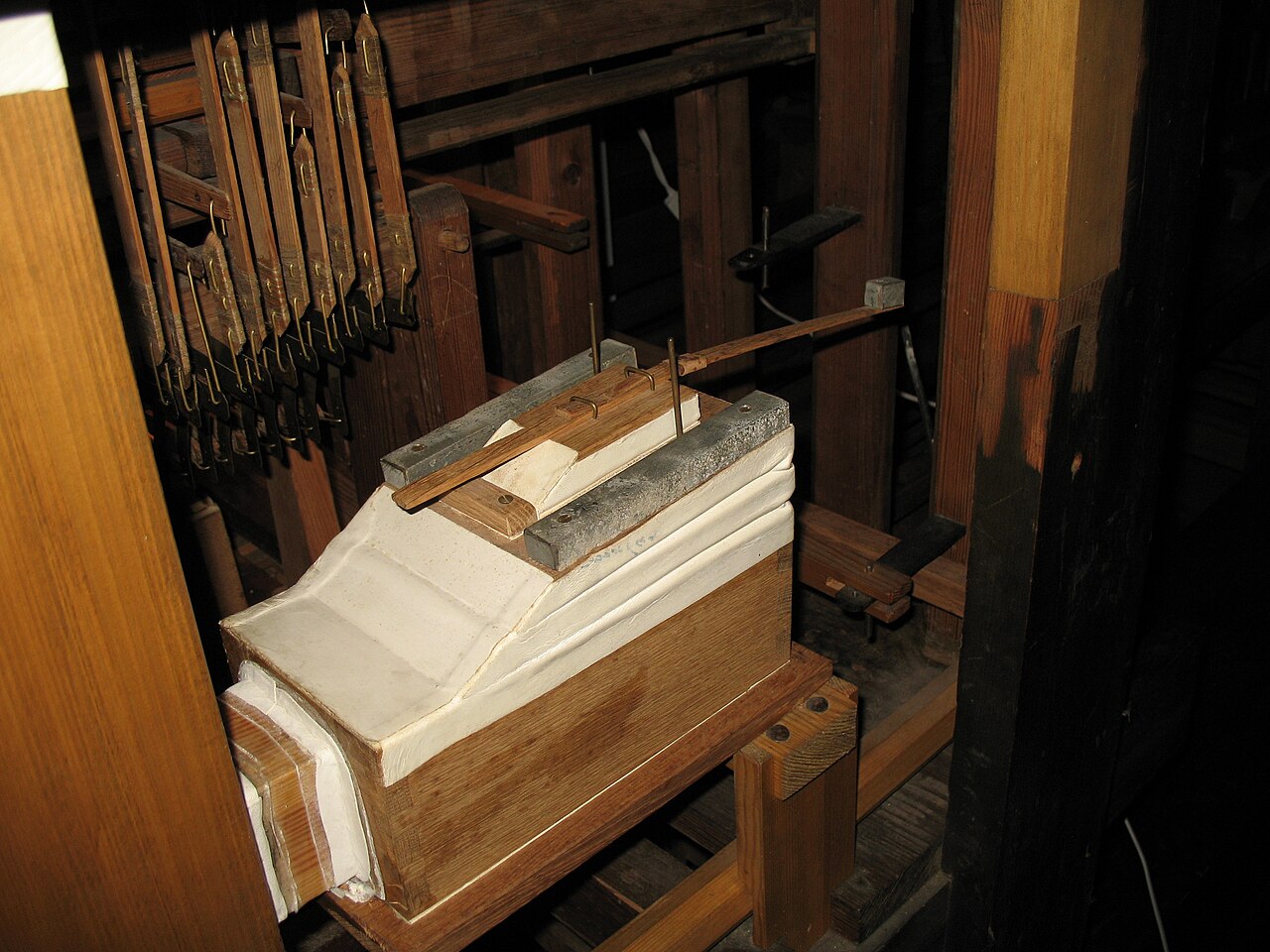
A concussion bellows — a small one is a winker, the name taken from its eyelid-like bob — is a small spring-loaded bellows tapped into the wind close to the chest. The OHS describes it as a small wedge-shaped bellows attached to the wind chest through a short tube, which opens as chest pressure rises and is closed by its spring as pressure drops (OHS, Organ Wind). It is, in effect, a small, fast, local capacitance with damping, positioned where the reservoir cannot reach in time — “as close to the wind-chest as possible,” precisely because the sensitive treble pipes need the fastest help (ISOB).
Its action is symmetric, which is the point. The ISOB’s account of the anti-concussion valve — a board on six or eight ribs forming a small wedge or square-drop bellows, balanced by a spring against the wind — describes both directions: on a surge (demand drops, or the reservoir bounces) “the spring will give way” and the bellows opens, taking up the excess air; on a sudden demand the “spring is caused to expand, collapsing the valve towards the closed position,” pushing its stored air back into the wind to replace the deficit (ISOB, The Anti-Concussion Valve). It thus damps the attack dip and the overshoot of Figure 1. What it cannot do is supply sustained robbing: its stored volume is small by design (its whole virtue is being fast and local), so once its little bellows is emptied the plateau of §2 returns. Winker for the transient; reservoir and trunk for the sustained draw.
5.4.4 Summary: unsteadiness sources and their cures
Table 1 — 4.4 Summary: unsteadiness sources and their cures
| Source of unsteadiness | Mechanism | Timescale | Primary cure(s) |
|---|---|---|---|
| Attack dip | Local wind drawn down faster than the remote reservoir can refill through the trunk; lid inertia | ~10–100 ms transient (est.) | Concussion bellows / winker close to the chest; larger trunk area; more responsive reservoir |
| Robbing / underwinding | Combined flow of a big chord exceeds supply; pressure sags to a lower plateau, pulling pipes flat | Sustained (held chord) | Bigger reservoir; double-rise for reserve + flat pressure (Vol 03 §4); more feeder/blower flow (Vol 04) |
| Overshoot / breathing | Loaded lid is a lightly damped mass–spring; steps ring | Transient / low Hz | Winker damping; softer, better-damped loading; avoid under-damped Schwimmer |
| Feeder / crank ripple | Residual pump pulsation the reservoir doesn’t fully smooth | At crank/blower rate | Feeder alternation (Vol 02); adequate reservoir reserve; winker |
| Schwimmer bounce | Inlet-servo lid, springs, and blower mismatched → pumping oscillation | Low Hz | Match lid area, spring rate, and blower; add damping (Vol 03 §5) |
| Undersized trunk | Conveyance resistance throttles flow into the chest | Aggravates all of the above | Adequate trunk cross-section and radii (§4.2) |
5.5 The deliberate tremulant
Everything so far has fought unsteadiness. A tremulant does the opposite: it makes the wind pressure pulsate deliberately, at a few Hz, so that every pipe drawn through it warbles together in a vibrato / tremolo. The OHS calls it exactly that — “a controllable stop that intentionally destabilises the wind supply,” usually drawn as a non-speaking stop, producing “a wavering in pitch caused by the differences in wind pressure from moment to moment” (OHS, Organ Wind). It is, mechanically, an unsteadiness generator deliberately inserted into the wind the rest of the system works to keep flat.
5.5.1 The beating tremulant — a sprung, weighted pallet that bobs
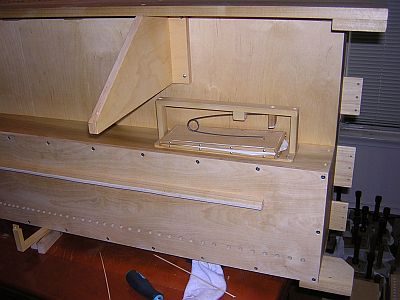
The classic mechanism is the beating tremulant: a sprung, weighted pallet set in the wind that bobs open and shut of its own accord, chopping the pressure into pulses. In the French classical idiom this is the tremblant doux — a spring-loaded flap mounted inside a division’s wind trunk that, when engaged, drops into the moving wind and bounces as the wind passes it, the spring returning it into the wind supply each cycle so the pressure pulses — a non-wind-wasting design (à vent clos) that modulates the wind without dumping it (Wikipedia, Tremulant). A common English form is a pivoted rod carrying a weight at one end and a felt-and-leather-faced disc (the pallet) at the other, hung over a vent in the wind; the weight of the pallet assembly has to overcome the wind pressure to lift and reseat, and the balance of weight against pressure sets the rate (Wikipedia; organ-builder practice). The related tremblant fort simply gives some wind an escape route from the trunk; the loss of wind, pulsing as the valve bobs, creates a stronger, coarser tremulant.
The self-oscillation is a relaxation cycle: wind pressure lifts the pallet against its weight/spring, which vents wind and drops the pressure, which lets the pallet reseat, which restores the pressure — and round again. The rate is set by the loading (weight and spring) against the pallet area and the wind pressure, and the depth by how much wind each bob dumps and by a deliberately slight lag in the reservoir’s recovery, so the regulated pressure swings a little above and below its design value each cycle. A pipe organ tremulant is judged to sound best at roughly 360–400 pulses per minute ≈ 6–6.7 Hz, with practical technicians setting ~6.2–6.8 Hz; the human vocal vibrato it imitates runs about 5–7 Hz (organ-technician practice, The Organ Forum; BYU OrganTutor). Slower settings (~3–4 Hz) read as a heavier, more theatrical sway. Figure 2 shows the mechanism and the pressure pulsation it produces.
Figure 2 — The beating tremulant. A sprung, weighted pallet hinged over a vent in the wind trunk self-oscillates: wind pressure lifts it against its weight and spring, venting a puff and dropping the pressure, whereupon the pallet reseats and the pressure recovers. The result is a pressure pulsation of a few Hz — typically about 6 Hz, a period near 160 ms — swinging just above and below the set pressure, which every pipe drawn through that wind reads as vibrato.
5.5.2 Smoother designs, and the fan tremulant
The beating tremulant’s waveform is nearer a relaxation pulse than a clean sine, and on a full chorus it can sound coarse or “gulpy.” Smoother designs shape the pulsation toward a sinusoidal swing for a gentler, more vocal vibrato. Pneumatic and motor-driven tremulants move the whole regulator lid gently up and down at the set rate rather than chopping the wind with a bobbing pallet, producing a rounder pressure modulation (OHS). A distinct family, the fan tremulant (and the Austin blade), does not modulate the supply pressure at all: an electric motor drives wooden fan blades or a rotating blade above or across the pipes, creating an “unsteady current” of air over the mouths so the pipes see a fluctuating external condition instead of a fluctuating supply (OHS, Organ Wind; Wikipedia, Tremulant). All aim at the same ~5–7 Hz perceptual target; they differ in the shape of the modulation and therefore in how sweet or how emphatic the wobble sounds. Depth and rate are usually trimmable — by the pallet weight and spring on a beater, or by motor speed and throw on the powered types — and the tasteful setting is a shallow, singing undulation, not a seasick heave.
5.5.3 The busker organ’s substitute: a slightly-sharp undulating rank
Small crank and busker organs almost never carry a mechanical tremulant. There is no room for a bobbing pallet in the wind, the wind path is short, and adding a deliberate pressure pulsation to a supply that already fights robbing is unattractive. Instead the busker organ produces its shimmer acoustically, with no moving tremulant at all: it carries a rank tuned a few cents sharp of a unison rank, so the two ranks, sounding together, are close but not identical in pitch and therefore beat — the small frequency difference is heard as a slow amplitude undulation, the same celeste / undulating effect as a Voix Céleste. This is the John Smith Universal organ’s approach, worked in full in John Smith Universal, Vol 05 §4 (the rank layout and beat) and Vol 10 §4 (setting the beat on the bench): a front rank tuned roughly +7 cents (est.) to beat at about 1.8 Hz against a unison rank at A4, tuned by a target cents offset per note so the beat scales naturally with pitch.
The two effects sound similar but are physically distinct, and the distinction is worth stating cleanly:
- A tremulant modulates the wind pressure in time, at a few Hz, so a single rank’s pipes all warble together — a genuine vibrato driven by the supply. Rate is set by the mechanism; it works on one rank.
- An undulating rank leaves the wind dead steady and instead sounds two ranks a few cents apart, whose beat frequency (the difference of two fixed pitches) is the undulation. It needs two ranks and costs no wind steadiness; the rate rises with pitch for a fixed cents offset.
For the busker scale the undulating rank wins on every count — no mechanism, no wind penalty, and a sweetness that suits the repertoire — which is why the mechanical tremulant of §5.1 belongs to the church, theatre, and larger band organs, and the slightly-sharp rank belongs to the monkey organ. Both are covered here only to draw the line; the busker realisation is the John Smith dive’s, not repeated.
5.6 Where this hands off
This volume closed the gap between the reservoir’s ideal flat pressure (Vol 03) and the real-time wind the pipes actually see: the attack dip and its recovery, robbing under heavy chords, the prized trace of liveliness, and the graded cures — reservoir size, double-rise reserve, adequate trunk area, and the fast local winker. It then covered the deliberate inverse, the tremulant, and the busker organ’s acoustic substitute for it.
- Vol 04 — Pressure, Flow & Measurement quantifies what this volume described: measuring the ripple and the robbing sag with a manometer, and sizing the supply and reserve so the sustained sag of §2 stays within tolerance.
- Vol 06 — Building & Troubleshooting a Small Wind System builds and leak-tests a small reservoir and (optionally) a winker at busker scale, and diagnoses shakes and robbing on the bench.
- John Smith Universal, Vol 05 §4 / Vol 10 §4 — the concrete slightly-sharp undulating rank that a busker organ uses in place of a tremulant.
The measure of good winding remains what Vol 03 stated: the listener should hear neither the pump nor the demand — only, if the builder chose to leave it, a faint living breath on the attacks, and, if a tremulant is drawn, a sweet and even warble that never tips into a wobble.
5.6.1 Cross-references
- Vol 03 — Storing & Regulating — the reservoir, double-rise/compensating ribs, Schwimmer, and spill/cut-off valves whose ideal this volume qualifies.
- Vol 04 — Pressure, Flow & Measurement — measuring ripple and robbing; sizing supply and reserve to demand.
- Vol 06 — Building & Troubleshooting a Small Wind System — bench realisation and fault-finding of shakes and robbing.
- John Smith Universal, Vol 05 §4 and Vol 10 §4 — the slightly-sharp undulating rank the busker organ uses instead of a tremulant.
Sources
- Colin Pykett — pykett.org.uk — organ wind supply and steadiness; the value of a trace of natural wind flexibility (“the wind”) against a dead-steady supply; tremulant behaviour.
- Organ Historical Society, Organ Wind (organhistoricalsociety.org) — underwinding/robbing when many pipes sound; concussion bellows/winkers on the chest; the tremulant as a controllable destabiliser, and fan/motor tremulant types.
- Incorporated Society of Organ Builders, The Anti-Concussion Valve (isob.co.uk) — the winker/anti-concussion bellows on six or eight ribs, spring balanced against wind; symmetric action on surge and demand; mount close to the chest; treble sensitivity to undulations.
- Audsley, G. A., The Art of Organ Building (1905, public domain) — wind trunks and conveyances; reservoirs as the primary steadiness store.
- Wikipedia, Tremulant — tremblant doux (spring-loaded flap bouncing in the wind trunk), tremblant fort (wind escape), and the Austin/blade tremulant.
- Organ-technician practice (The Organ Forum) and BYU OrganTutor — typical tremulant rate ~360–400 pulses/min ≈ 6–6.7 Hz (practical ~6.2–6.8 Hz); imitating a ~5–7 Hz vocal vibrato.
- John Smith Universal Organ, Vol 05 / Vol 10 — sibling dive; the slightly-sharp undulating rank (+7 cents (est.), ≈ 1.8 Hz beat at A4) used in place of a mechanical tremulant.
Comments (0)