Encoding The Music · Volume 1
The Organ as a Programmed Machine
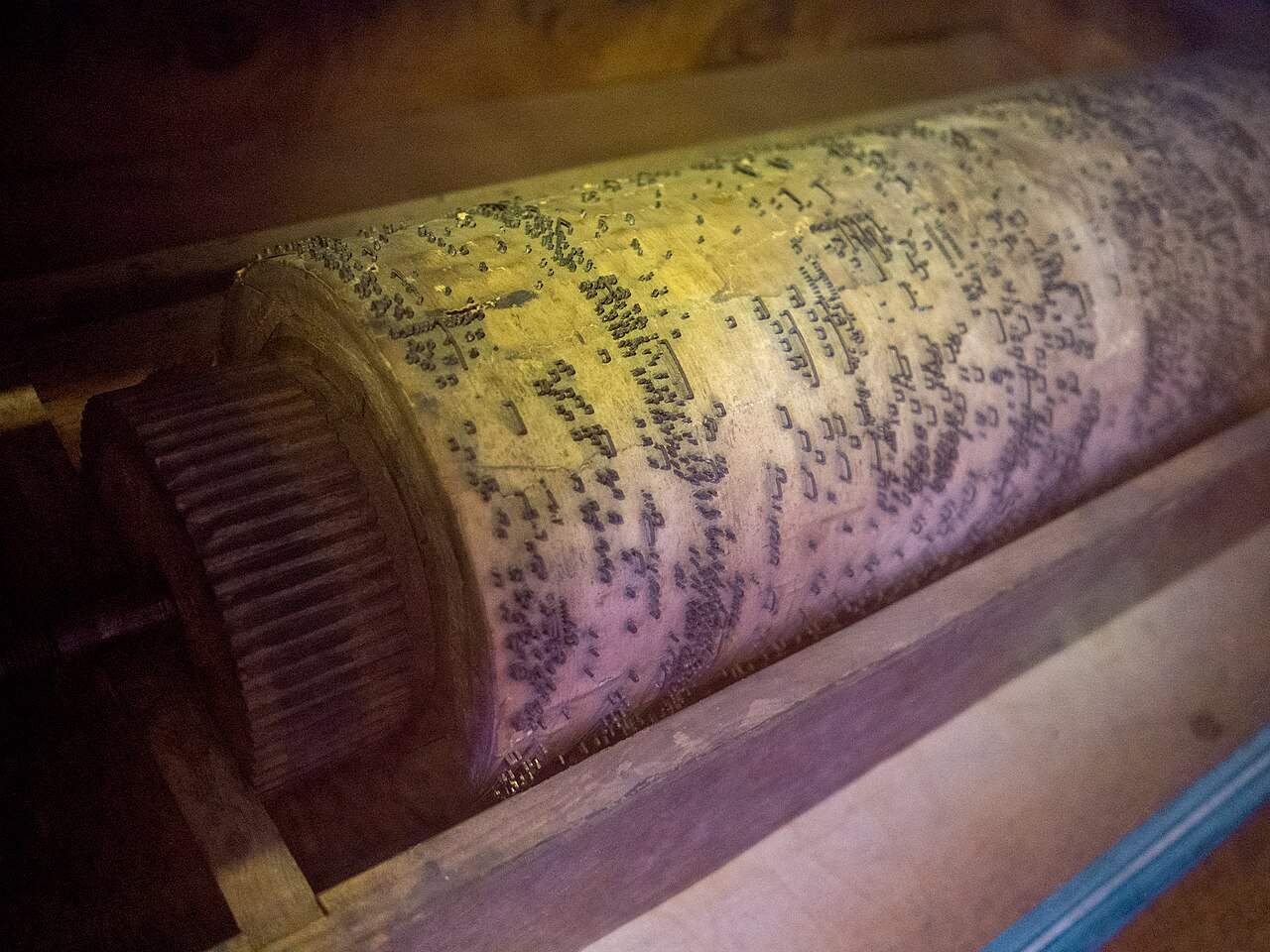
A mechanical organ is two machines in one enclosure. The first is an instrument — pipes, wind, a bellows and a chest — that can sound a fixed set of pitches on command. The second is a program: a physical record of which of those pitches must sound, and exactly when. The genius of the automatic organ, from the eighteenth-century church barrel organ to a modern MIDI-driven busker box, is that these two machines are cleanly separable. Change the program and the same instrument plays a different tune; nothing about the pipes, valves or wind supply need alter at all. This volume is about the program — what it stores, the common abstraction underneath every storage medium, and the mechanism that reads it back. It is the map for the six volumes that follow, each of which takes one medium (or the arranging craft) in depth.
The central claim, stated once so the rest of the series can lean on it: every encoding medium a mechanical organ has ever used stores the same information — a two-dimensional grid of pitch against time — and differs only in the physical form that grid takes and in how a reader converts it back into wind. A pinned barrel, a folded cardboard book, a perforated paper roll and a MIDI file are four notations for one idea.
1.1 The common abstraction: notes on a grid of pitch and time
Consider what an organ actually needs to be told. It has no keyboard and no performer choosing pitches in real time (see the sibling John Smith Universal dive, Vol 3, on why a busker organ’s note count is a literal hardware count). Each pitch it can sound corresponds to one channel — one valve feeding one pipe or stop-group. To drive the instrument, the program must specify, for every channel, the instants at which that channel should be open (its pipe speaking) and closed (silent). That is all. Harmony, melody, rhythm and articulation are entirely emergent from the on/off timing of a fixed bank of channels.
This is exactly a piano-roll grid: one horizontal track per pitch (per channel), time running along the other axis, and a mark placed on a track wherever that note is to sound. Three properties of the grid are universal across media and worth naming precisely:
- Pitch is discrete and fixed. The vertical axis is not continuous; it has one lane per available note — 20 for a Raffin busker scale, 89 for a Gavioli fairground book, 128 addressable in MIDI. A pitch the instrument does not possess simply has no lane, which is the entire subject of arranging for a gapped scale (Vol 6; and the John Smith dive Vol 3 on the missing B natural).
- Time is encoded as position. On every physical medium the time axis is a distance: how far along the barrel, book or roll a mark sits. Tempo is therefore encoded geometrically — a note twice as long occupies twice the distance — and playback speed is set by how fast the medium is drawn past the reader, not by any independent clock. (In MIDI the position becomes a numeric timestamp, but the logic is identical.)
- A mark’s length is the note’s duration. A short mark makes a short note; a long mark holds the note. The pinned barrel expresses this as a long bridge or staple spanning the arc the note is held; the book and the roll express it as a long slot; MIDI expresses it as the interval between a note-on and its matching note-off message. One concept, four spellings.
The grid is not merely a teaching diagram: it is literally the working view an arranger edits in roll-editor or MIDI software (Vol 6), and it is what the reader mechanism scans one column at a time as the medium moves. Everything downstream of the grid — how a mark physically triggers wind — is the reader’s job.
1.2 The reader: turning a mark into a speaking pipe
A reader is the mechanism that scans the moving program and converts each mark into a mechanical or pneumatic action that opens a pallet or valve, admitting wind so a pipe speaks. It is the hinge between the two machines. Each medium has its own reader, but they are functionally the same device viewed four ways:
- Pinned barrel — the pin lifts a key. As the studded barrel rotates, each pin or bridge passes under a row of pivoted keys (levers). The pin lifts its key, the key opens a pallet, the pallet admits wind. The pin is the mark and the key is the reader; note length is set by the arc length of a bridge (Bowers; Ord-Hume, Barrel Organ). Detailed in Vol 2.
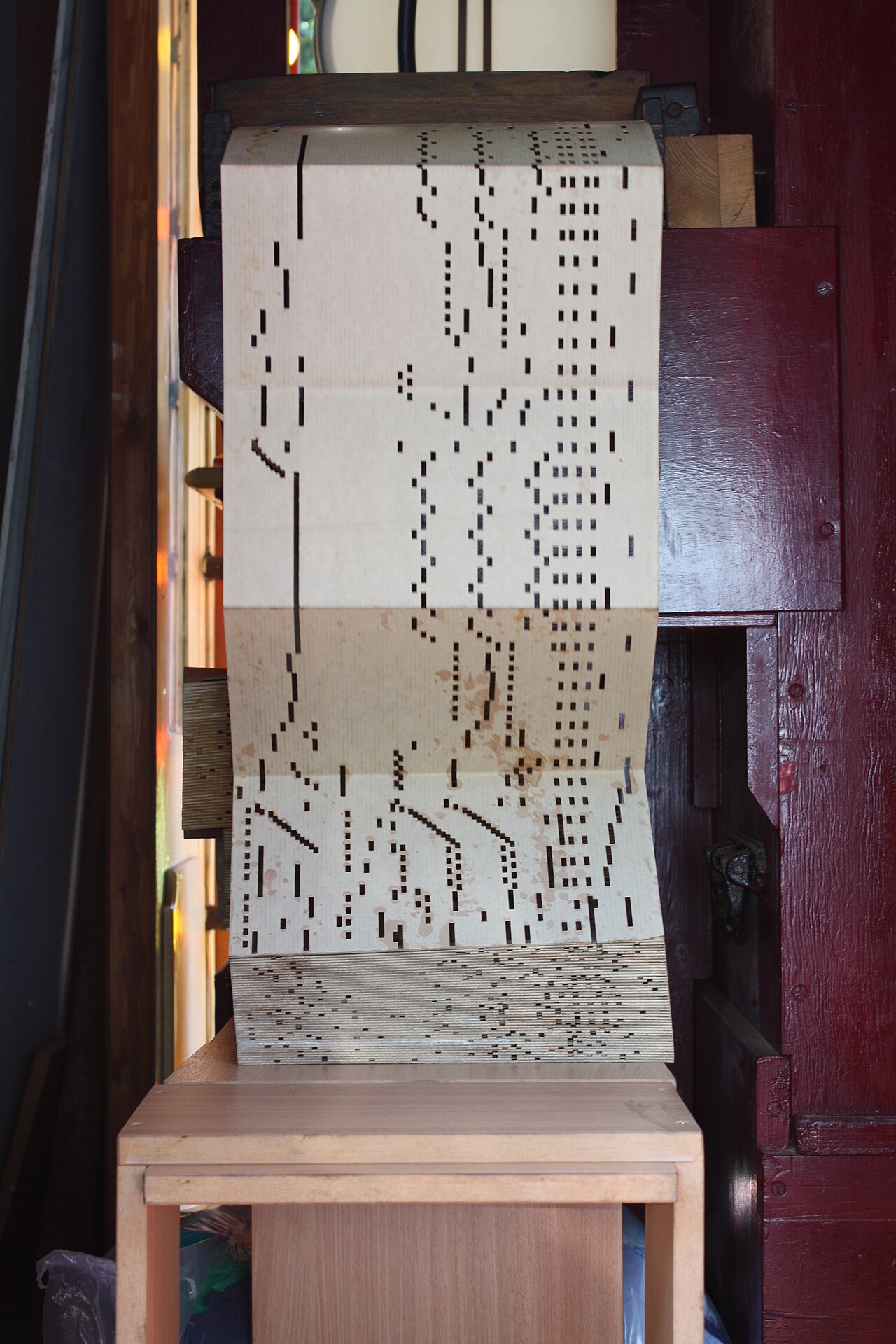
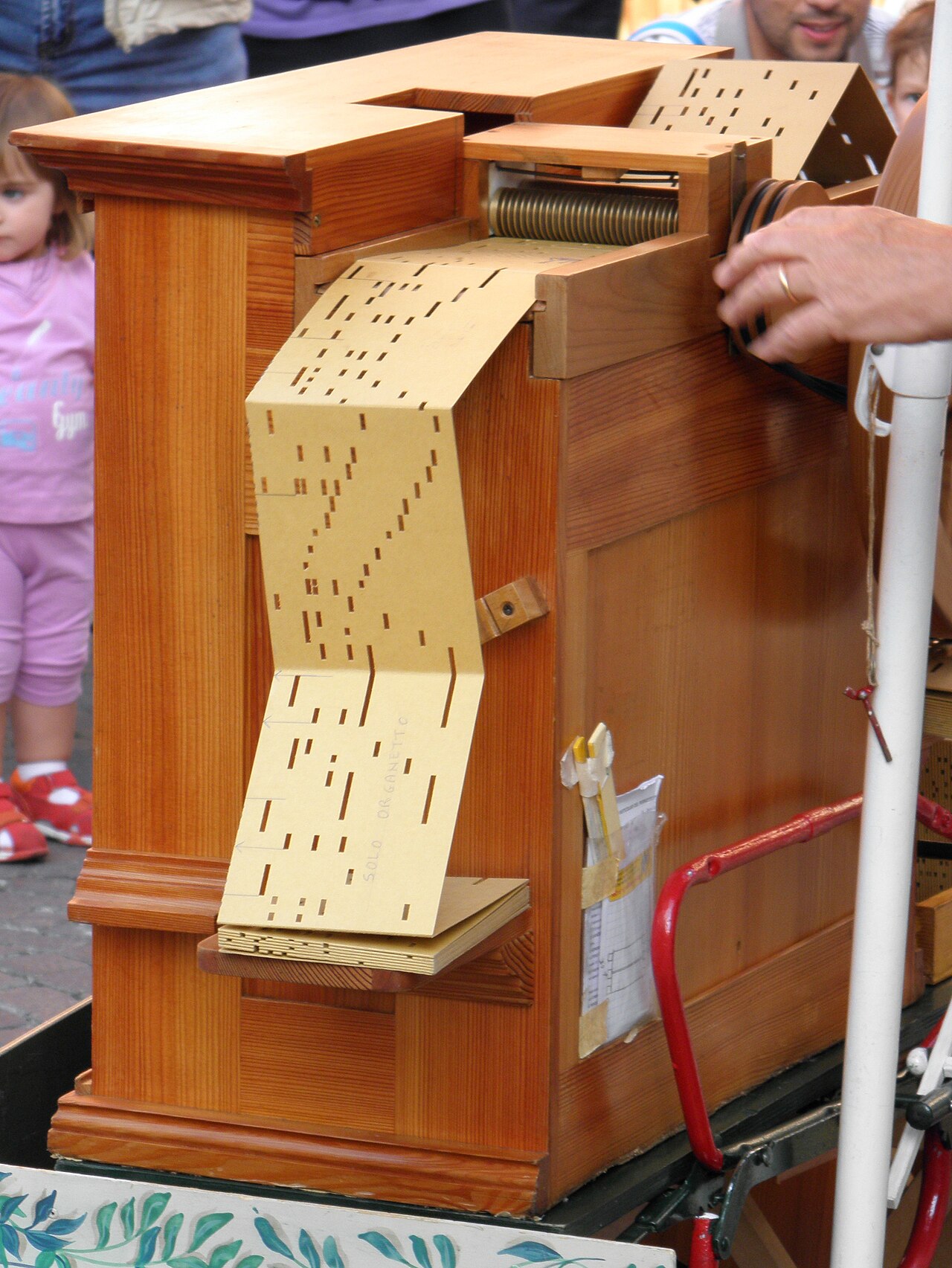
- Cardboard book — the key falls into a hole. The fan-folded book is drawn through a keyframe whose row of sprung keys rides on the card’s surface. Where a hole is punched, the sprung key drops into it and, through a mechanical or pneumatic linkage, opens the corresponding note; the key rises again at the hole’s trailing edge (Gavioli’s 1892 invention; Bowers). Detailed in Vol 3.
- Paper roll — the hole admits wind through a tracker bar. The roll unwinds over a tracker bar, a fixed row of small holes, one per channel. A perforation uncovers its tracker hole and either admits wind directly to the pipe (a valveless “direct” system) or admits a control signal to a pneumatic pouch-and-valve that does the heavy lifting (a valved system — see the John Smith Universal dive, Vol 2 and Vol 6). Detailed in Vol 4.
- MIDI / electronic — a decoder fires a solenoid. A MIDI note-on message (note number 0–127, middle C = 60) is decoded by a microcontroller or dedicated board, which energises a solenoid valve (or pneumatic relay) to open the pipe; the matching note-off de-energises it. The “reader” is now firmware and a driver transistor rather than a lever, but the input-to-output contract is unchanged (Vol 5; and the John Smith dive Vol 3 on the MIDI note-source path).
Two design consequences follow directly from having a reader per channel. First, the number of channels is a hard ceiling — twenty tracker holes means twenty possible simultaneous notes, no more, and a note and its would-be duplicate cannot share a lane at the same instant. Second, the reader defines the medium’s time resolution and reliability: how small a mark it can resolve, how much tracking error it tolerates before it reads the wrong lane, and how cleanly it closes a note at the mark’s trailing edge. These are the practical differentiators the next four volumes examine.
1.3 The four families at a glance
Historically the grid has been realised in four dominant media, in roughly chronological order of adoption. Each is the subject of a later volume; the point here is to see them side by side as variations on the one abstraction.
1.3.1 Pinned barrel or cylinder
The oldest programmable medium, inherited from carillon drums and perfected in the musical box and the barrel organ (eighteenth–nineteenth centuries; Bowers, Encyclopedia of Automatic Musical Instruments; Ord-Hume). A wooden or metal barrel is studded with pins and bridges; rotation carries them under the reading keys. Several tunes (typically 8–10) live on one barrel, selected by shifting the barrel laterally to a different set of pin tracks. Tune length is limited by circumference and note count by the number of key tracks. Repinning is skilled, slow work — the program is effectively read-only once cut. Covered in Vol 2.
1.3.2 Cardboard book music (fanfold)
Anselme Gavioli’s 1892 book system was the transformative advance for fairground and dance organs (Bowers; Ord-Hume). Music is punched into fan-folded cardboard “books” drawn through a keyframe; near-unlimited tune length (just add pages) and great robustness made it the standard for the large continental organs — Gavioli, Marenghi, Limonaire, Mortier, Bruder, Ruth. Scales are large and maker-specific (e.g. the 89-key Gavioli) and mutually incompatible. Covered in Vol 3.
1.3.3 Perforated paper roll
Borrowed from the player-piano and orchestrion tradition (late nineteenth to early twentieth century), the roll unwinds over a tracker bar (Bowers). It is the busker-organ medium: the Raffin 20-note (110 mm) and 31-note scales, the John Smith 20/26, and others (see the John Smith Universal dive, Vol 3, for the concrete 110 mm case). Rolls are cheap and light and can be punched at home from paper masters (Melvyn Wright) or bought ready-cut (Ed Gaida), but paper tears and absorbs damp. Covered in Vol 4.
1.3.4 MIDI / electronic
The modern realisation: a MIDI file is the roll, and a microcontroller decodes its note-on/note-off messages to fire solenoid or pneumatic valves (Vol 5). This is the basis of the “MIDI-driven 20-note crank organ” build (the subject of Vol 5 here and cross-referenced from the John Smith dive Vol 3). It offers an unlimited, weightless library and trivial editing and transposition, at the cost of power, electronics, and a step away from mechanical “authenticity.”
1.4 The four media compared
The trade-offs cluster along five axes — durability, capacity, editability, cost and cultural authenticity — and they explain why each medium dominated the era and instrument class it did.
Table 1 — The four media compared
| Medium | Era of adoption | Capacity / tune length | Durability | Editability | Cost | Typical use |
|---|---|---|---|---|---|---|
| Pinned barrel / cylinder | 18th–19th c. (from carillons, musical boxes) | 8–10 tunes per barrel; length limited by circumference | Very high (metal pins in wood/brass); wears slowly | Very low — repinning is skilled, near read-only | High to make; cheap to store | Church/chamber barrel organs, street “monkey” organs, musical boxes |
| Cardboard book (fanfold) | 1892– (Gavioli) | Near-unlimited (add pages); large scales (e.g. 89-key) | High — robust card, survives outdoor fairground use | Low–moderate — re-punch or splice pages | High per book; durable investment | Large fairground & dance organs (Gavioli, Mortier, Ruth) |
| Perforated paper roll | c.1890– (from player piano) | One tune (or a few) per roll; length limited by spool | Low–moderate — paper tears, absorbs damp | Moderate — punch from masters, edit, splice | Low — cheap paper, DIY-punchable | Busker / crank organs (Raffin, John Smith 20/26) |
| MIDI / electronic | c.1980s– | Effectively unlimited library, weightless | Digital (no wear); depends on electronics reliability | Trivial — edit, transpose, re-voice in software | Low storage; needs power + electronics | Modern busker & show organs; DIY MIDI builds |
Read down the editability column and the historical arc is plain: the medium has grown steadily easier to change, from the barrel’s read-only pinning to MIDI’s one-keystroke transposition — which is precisely why arranging (Vol 6) has moved from a specialist craft toward something a hobbyist can do at a laptop.
1.5 The fixed-scale constraint, previewed
One property cuts across all four media and deserves flagging now because it governs the whole arranging craft in Vol 6: the pitch axis is fixed and usually gapped. A mechanical organ owns a specific, often incomplete set of pitches. The de-facto-standard Raffin 20-note busker scale, for instance, is essentially an F-major scale with one added E♭ and no B natural anywhere — eight pitch classes across roughly two octaves (F3–D6, MIDI 53–86), detailed exhaustively in the John Smith Universal dive, Vol 3. Whatever the medium, the arranger must fit real music into whatever lanes exist: transposing into playable keys, dropping or re-voicing unavailable accidentals, folding wide melodies into range, and writing a three-register oom-pah texture (bass, harmony, melody) within the channel budget. The 26-note Alderman extension and its handling of accidentals, again in the John Smith dive Vol 3, is one worked response to that constraint. Vol 6 of this series generalises the craft across all media and the tooling — roll editors, MIDI arrangers, punching machines.
1.6 Roadmap to Volumes 2–7
The rest of this series takes each medium and craft in the depth this overview only sketches:
- Vol 2 — Pinned Barrels & Cylinders. The pin-and-bridge program, key-lifting readers, lateral barrel shift for multiple tunes, and the pinning craft; from the carillon and musical-box lineage.
- Vol 3 — Cardboard Book Music. Gavioli’s 1892 fanfold, the keyframe reader and its sprung keys, the perforating workflow, durability, and the maker-specific fairground scales.
- Vol 4 — Perforated Paper Rolls. Roll, tracker bar and spool box; direct (valveless) vs pneumatic reading; the busker scales (Raffin 20/31, John Smith 20/26); punching your own from masters.
- Vol 5 — MIDI & Electronic Encoding. Note-on/note-off to solenoid or pneumatic valves; the MIDI file as the modern roll; decoders and microcontrollers; percussion and registration; the DIY MIDI-organ case.
- Vol 6 — Arranging & Making Music. Living inside a fixed, gapped scale; the transcription workflow; roll-editor and MIDI-arrangement software; punching tools; commercial versus DIY music.
- Vol 7 — Reference & Cheatsheet. The full media-comparison table, common scale and standard references, a glossary, tools/suppliers/software, a bibliography, and a cross-index to Vols 1–6 and the sibling Mechanical Organs dives.
The thread through all six is the grid introduced here. Whether a note is a brass pin driven into a walnut barrel, a slot punched in fairground card, a hole in a strip of 110 mm paper, or a pair of bytes in a MIDI file, it says the same thing: this pitch, from here to there. The organ does the rest.
Sources
- Q. David Bowers, Encyclopedia of Automatic Musical Instruments — the standard reference for pinned barrels, book music, paper rolls, and the makers (Gavioli, Mortier, Ruth, et al.).
- Arthur W. J. G. Ord-Hume, Barrel Organ and Player Piano — barrel-and-pin programming, the reading action, and mechanical-music history.
- Melvyn Wright, melright.com/busker — busker paper rolls, paper masters and home punching; the Raffin 20-note standard.
- Ed Gaida — ready-punched busker rolls (community source).
- MBSI (Musical Box Society Int’l) and COAA (Carousel Organ Assoc. of America) journals; Mechanical Music Digest, mmdigest.com.
- Wikipedia — Barrel organ, Book music, Player piano, MIDI — for dates and cross-checks (Gavioli’s 1892 book system; MIDI note-number conventions).
Cross-references: the concrete Raffin 20/26-note scale, tracker-bar hole map, and arranging constraints in the John Smith Universal dive, Vol 3; its air path and pneumatic reading action in that dive’s Vol 2 and Vol 6. Within this series: pinned barrels in Vol 2, book music in Vol 3, paper rolls in Vol 4, MIDI in Vol 5, arranging for a fixed scale in Vol 6, and the consolidated reference in Vol 7.
Comments (0)