Encoding The Music · Volume 7
Encoding the Music — Vol 07: Reference & Cheatsheet
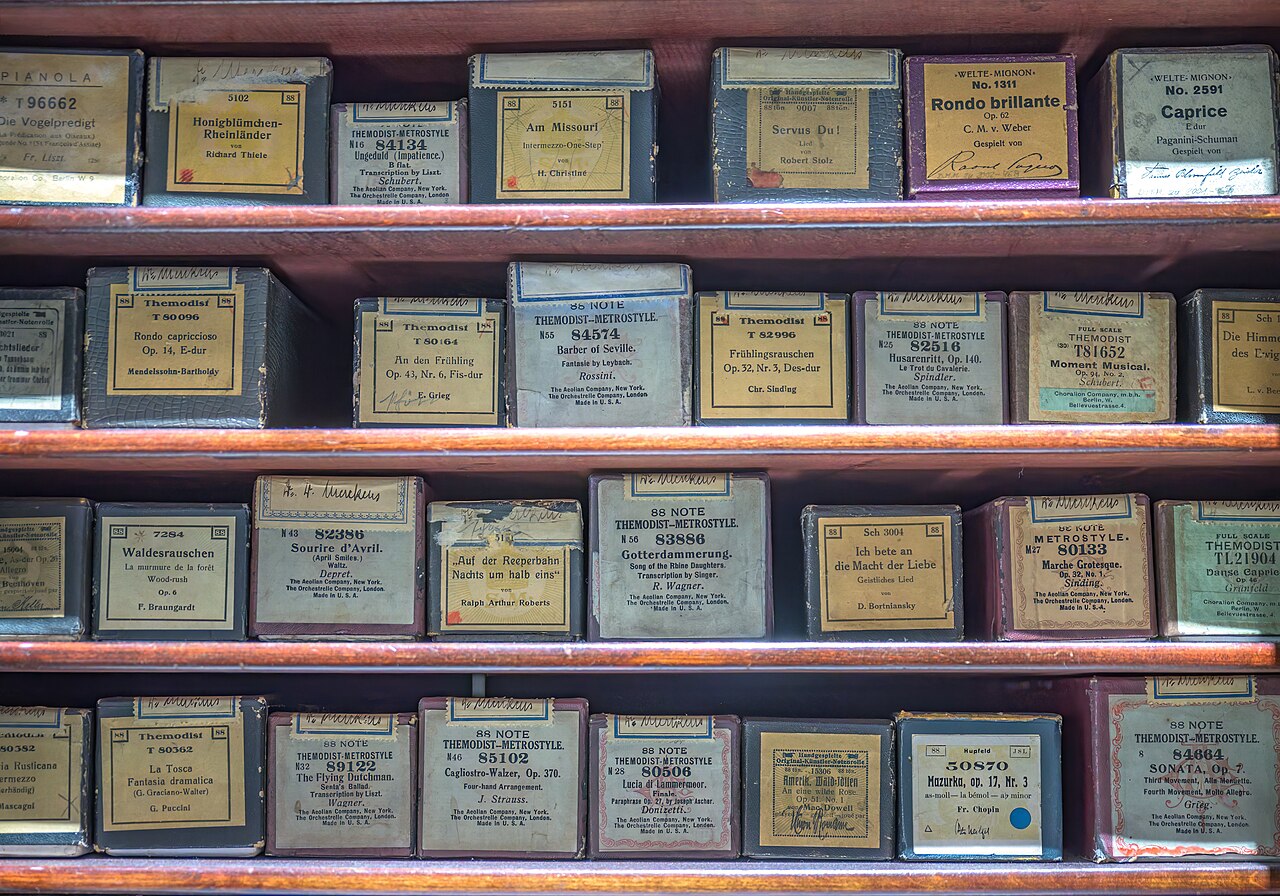
This final volume consolidates the six that precede it into a single bench
reference: the four-media comparison, the common scale and standard geometries, a
one-page “same phrase in all four media” recap, a decision guide for choosing a
medium, a glossary of the working vocabulary, a tools/suppliers/software list, a
cross-index to Vols 01–06, and a de-duplicated bibliography. It introduces no new
claims. Every value here traces to the volume that first established it, cited in
each row or entry as “(Vol N)”; figures a source leaves informal are repeated with
the same (est.) flag rather than hardened into a specification. Where two
volumes stated something in different words, the wording is reconciled inline with
a > **Note:**. The scale facts throughout are held consistent with the sibling
John Smith Universal dive, Vol 03 (the concrete 20/26-note Raffin case), which
is the authority for any pitch-by-pitch detail.
Note: One abstraction underlies this entire dive (Vol 01 §“The common abstraction”): every medium stores the same two-dimensional grid of pitch against time — one lane per note, distance (or timestamp) standing for time — and a mark’s length is the note’s duration. A pin/bridge, a punched hole/slot, and a MIDI note-on/note-off pair are four spellings of one idea. Do not read any single table below in isolation from the medium volume it summarises.
7.1 The four media at a glance
The full comparison, consolidating the trade-off tables of Vol 01 §“The four media compared”, Vol 02 §6, Vol 03 §8 and Vol 05 §“Physical media versus MIDI”. The five governing axes are durability, capacity, editability, cost and authenticity.
Table 1 — The four media at a glance
| Axis | Pinned barrel (Vol 02) | Cardboard book (Vol 03) | Paper roll (Vol 04) | MIDI / electronic (Vol 05) |
|---|---|---|---|---|
| Era of adoption | 13th c. carillon drum → 18th–19th c. organ | 1892– (Gavioli) | c. 1890– (from the player piano) | c. 1980s– (MIDI standardised 1983) |
| Capacity / tune length | 7–9 tunes/barrel (up to ~15), each ≈ one revolution | Near-unlimited — pages pasted end to end (10–20 m ordinary, ~100 m exists) | One-to-a-few tunes per roll; limited by spool | Effectively unlimited — thousands of SMFs on one card |
| Note (pitch) capacity | Fixed by track count (one per key) | High — e.g. 89-key Gavioli carries full arrangements | Small — busker 20/26/31; player-piano 65/88 | 128 addressable; only the wired subset responds |
| Durability | Very high — brass in hardwood; survives centuries | High — laminated card shrugs off damp the fairground throws at it | Low–moderate — paper tears, absorbs damp | Digital (no wear); depends on electronics reliability |
| Editability | Very low — re-pinning is a multi-day skilled job | Low–moderate — re-punch or splice pages | Moderate — punch from masters, tape, splice | Trivial — edit, transpose (add a constant to note #), re-voice in seconds |
| Cost | High to make; cheap to store | High per book; durable investment | Low — cheap paper, DIY-punchable | Higher one-off electronics; near-zero per extra tune |
| Authenticity / sound | The historically authentic self-player | Period-correct; the fairground tradition | The sentimental busker favourite; silent program | Identical pipe sound but adds solenoid click; “less authentic” to purists |
| Reader mechanism | Keys ride the surface (purely mechanical) | Keyed (sprung keys) or keyless (tracker bar + pneumatic) | Tracker bar; valveless (direct) or pneumatic (pouch/valve) | Microcontroller decoder → driver → solenoid valve |
| Typical instruments | Church/chamber organs, street “monkey” organs, musical boxes | Large fairground, dance & concert organs (Gavioli, Mortier, Ruth) | Busker / crank organs (Raffin, John Smith 20/26) | Modern busker & show organs; DIY MIDI builds (program dive 7) |
| Bulk of the program | Heavy solid cylinder; street organ ~25–50 lb, up to ~100 lb / 11–45 kg | Bulky, heavy library of card | Light spools of paper | Weightless — a memory card |
Read down the editability column and the historical arc of Vol 01 is plain: the medium has grown steadily cheaper to change, from the barrel’s read-only pinning to MIDI’s one-keystroke transposition — which is exactly why arranging (Vol 06) has moved from a specialist craft toward something a hobbyist does at a laptop.
7.2 Common scales and standards
The lateral layout of channels on a physical medium is a scale (tracker scale): a fixed map from lane position to musical function, at a fixed spacing on a fixed width. A carrier cut for one scale is mechanically meaningless on an instrument built for another (Vol 03 §5; Vol 04 §4). The table anchors the common geometries; counts and widths marked (est.) are approximate where sources are informal.
Table 2 — Common scales and standards
| Scale / standard | Width | Notes | Geometry / spacing | Where used |
|---|---|---|---|---|
| Raffin 20-note (German 20er) | 110 mm | 20 | Paper perforations ≈ 3 mm dia.; tracker holes 4 mm melody / 6 mm bass | The busker-organ standard; Raffin, Hofbauer, Stüber, Schlemmer, Hendrickx; John Smith Universal (Vol 04 §4) |
| John Smith Busker / Senior 20 | 140 mm | 20 | John Smith’s own wider format (16 × 6 mm + 3 × 9 mm gaps) | John Smith’s valveless siblings; not interchangeable with the 110 mm Raffin (Vol 04 §4) |
| John Smith Universal (20/26) | 110 mm (Raffin) | 20 or 26 | 26-note (Alderman) adds 6 channels in the roll margins, back-compatible with 20-note rolls | The Universal, built to Raffin geometry to inherit the commercial library (Vol 04 §4; JS Vol 03) |
| Raffin / German 31-note (31er) | 140 mm | 31 | More pitches, fuller harmony; the standard 31er street-organ scale | Larger street & small fairground organs (Raffin, Hofbauer) (Vol 04 §4) |
| Player-piano “88-note” (standard) | 286 mm (11¼ in) | 88 | 9 holes/in (≈ 2.82 mm centres) | Home pneumatic player pianos; the ancestor format (Vol 04 §1) |
| Player-piano “65-note” | 286 mm (11¼ in) | 65 | 6 holes/in (coarser, obsolete) | Earlier player-piano standard (Vol 04 §1) |
| Gavioli 89-key (“G4”) | book | 89 (also 87, 110) | Keyed (square holes); switchable violins + clarinets | The dominant large-organ scale, the de-facto reference (Vol 03 §5) |
| Marenghi | book | 87, 89, 98 | ”VB” (Violin-Baritone) layouts (est.) | Paris concert & fairground organs (Vol 03 §5) |
| Limonaire Frères | book | ~46, 52–56 (est.) | Smaller books than the big Gaviolis | Paris street & fairground organs (Vol 03 §5) |
| Mortier | book | 89, 98 | Register-rich dance-organ books | Antwerp dance organs (Vol 03 §5) |
| Bruder (Wilhelm/Gebr.) | book/roll | 52, 61, 65, 78, 84 (est.) | Both keyed and keyless scales | Waldkirch fairground & street organs (Vol 03 §5) |
| Ruth (A. Ruth & Sohn) | book | 33, 38, 52 keyless, 89 (est.) | Keyless (round-hole) common on smaller models | Waldkirch fairground organs (Vol 03 §5) |
Note: The Raffin 20-note pitch set is the reference used throughout Vols 04–06: it spans F3 to D6 (MIDI 53–86) but owns only eight pitch classes — C, D, E♭, E, F, G, A, B♭ (F major plus an added E♭), with no B natural, F♯, C♯, G♯ or A♭ anywhere; the 26-note Alderman adds a bass D, an accompaniment F♯, and melody F♯, C♯, D♯/E♭ and a top B♭ (Vol 06 §“The arranger’s problem”; JS Vol 03). “89-key Gavioli” names a scale, not merely a note count — a same-count scale from another maker need not agree (Vol 03 §5).
7.3 The same phrase in all four media
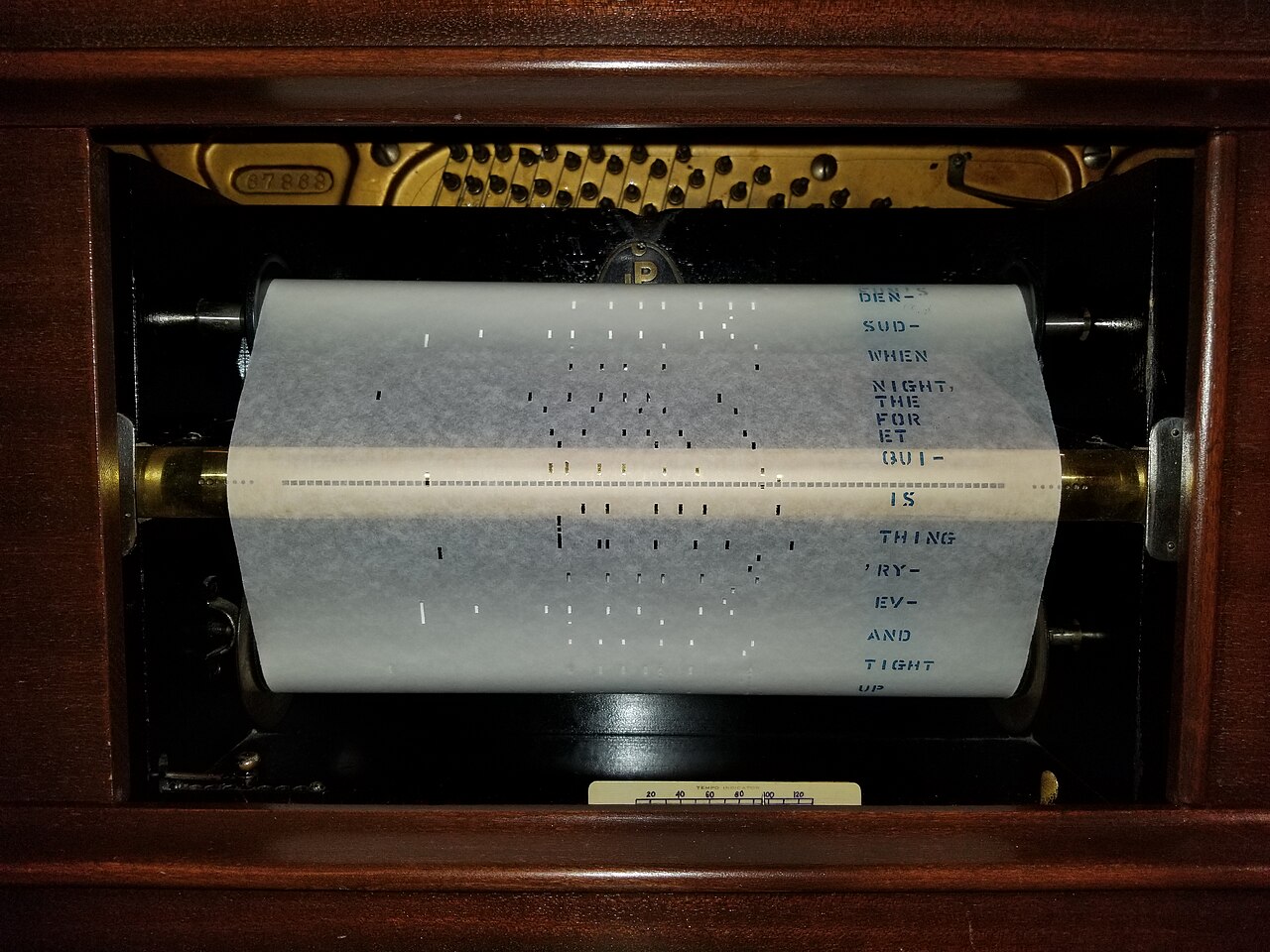
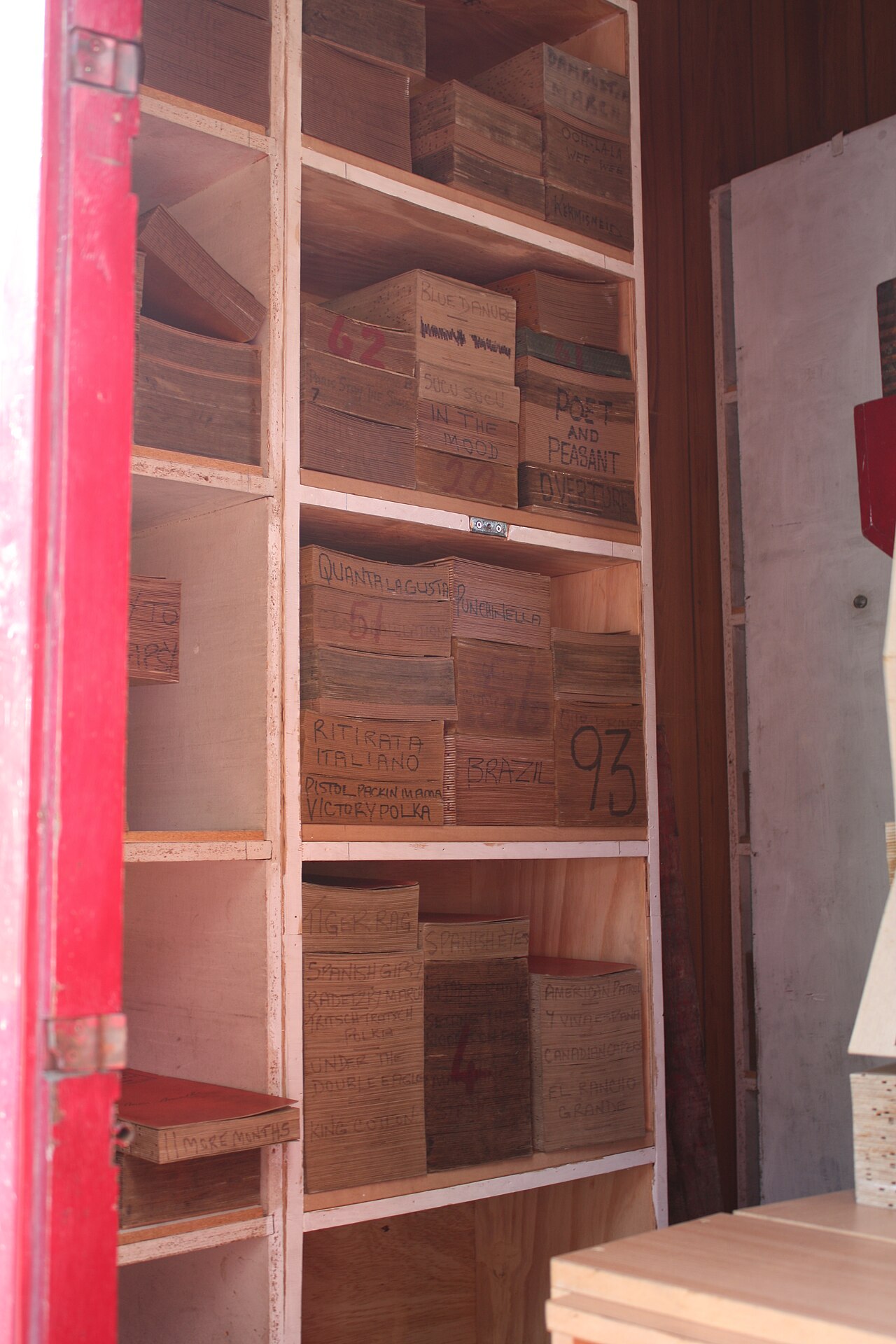
The recap below places one short oom-pah phrase — a bass “oom” on the beat, an off-beat accompaniment “pah”, and a melody with one short and one held note — onto a shared time axis, encoded four ways. The information is identical in every row; only the physical carrier and its reader differ (Vol 01 §“The four families”).
7.4 Choosing a medium: a decision guide
There is no universally best medium — the right one depends on instrument size, the value placed on authenticity, and how often the repertoire must change (Vol 01; Vol 05 §“Physical media versus MIDI”). The guide below distils the trade-offs into the questions a builder actually asks.
Glossary
Terms as used across this dive; the volume that develops each is cited.
Table 3 — Glossary
| Term | Meaning |
|---|---|
| Pin | A short brass/steel wire driven into a barrel; marks a short note (Vol 02 §2). |
| Bridge / staple | A longer raised span on a barrel; marks a held note, its arc length setting duration (Vol 02 §2). |
| Barrel shift | Sliding the barrel axially to bring a different interleaved set of pin tracks under the keys — selects one tune of several (Vol 02 §4). |
| Track (lane) | One circumferential/longitudinal position = one note channel on the note-vs-time grid (Vol 01; Vol 02 §2). |
| Pinning / versteken | The craft of marking out and driving a barrel’s pins and bridges from an arrangement (Vol 02 §5). |
| Book / fanfold | Fan-folded cardboard, punched with holes/slots, drawn through a keyframe; length unlimited by pasting pages (Vol 03 §1). |
| Keyframe | ”The brain of the organ” — the mechanism that reads a book; keyed (sprung keys, square holes) or keyless (tracker bar, round holes, pneumatic) (Vol 03 §3). |
| Key scale (tracker scale) | The map from lane position to pitch/register/percussion; maker-specific and mutually incompatible (Vol 03 §5). |
| Roll | A perforated paper strip drawn over a tracker bar; the busker medium (Vol 04). |
| Tracker bar | A fixed row of ports, one per channel, that the paper is drawn across; a hole uncovers a port (Vol 04 §2). |
| Spool (supply / take-up) | The cores the roll pays off and reels onto; the take-up is crank-driven on a hand organ (Vol 04 §2). |
| Slot | An elongated perforation = a held note; length ÷ paper speed = duration (Vol 04 §2). |
| Pouch / valve | In pneumatic reading, a leather diaphragm the tracker signal inflates to lift a valve admitting full playing wind (Vol 04 §3.2). |
| Valveless (direct) | Reading where the paper hole itself admits playing wind straight to the pipe — no valve (Vol 04 §3.1). |
| Bridge (paper/card) | A narrow un-punched span (~1.5–2 mm on books) breaking a long note so the medium stays rigid yet plays continuously (Vol 06 §“Mechanical limits”). |
| Chain perforation | A long note rendered as closely-spaced holes rather than one slot, to avoid weakening the paper (Vol 04 §2.2). |
| Gamma | A scale-definition file for arranging software (e.g. Venable’s 20-Raffin: MIDI 53–86, 3 mm holes, 110 mm, 385-unit internote spacing) (Vol 04 §5.2; Vol 06). |
| MIDI | Musical Instrument Digital Interface (standardised 1983); performance events, not audio (Vol 05). |
| Note-on / note-off | MIDI messages 0x9n / 0x8n; the interval between them is the note’s duration (Vol 05). |
| Note number | The discrete pitch index, 0–127, one per semitone; middle C = 60, A440 = 69 (Vol 05). |
| Velocity | Attack-strength byte (0–127); largely ignored by organ decoders (a pipe speaks or does not) (Vol 05). |
| Channel | One of 16 MIDI streams; GM channel 10 carries percussion, note # selecting a drum (Vol 05). |
| PPQN / division | Ticks per quarter note (commonly 480); with the tempo meta-event, converts ticks to seconds (Vol 05). |
| SMF | Standard MIDI File (.mid) — the stored delta-time/event stream; “the file is the roll” (Vol 05). |
| Decoder | The microcontroller that parses MIDI and maps each note number to an output pin via the scale map (Vol 05). |
| Scale map | The firmware lookup from note number to valve output; the build-specific heart of a MIDI organ (Vol 05). |
| Solenoid valve | A coil that pulls a pallet to admit wind to one pipe on note-on (Vol 05). |
| Driver / flyback diode | The MOSFET or Darlington (ULN2803A) stage switching coil current; the flyback diode absorbs inductive kickback (Vol 05). |
| Master | A full-size printed layout of every perforation, laid over blank stock and punched by hand (Vol 04 §5.3; Vol 06). |
| Punch (perforator) | The bench of punches, hand- or MIDI-driven, that cuts a roll or book from an arrangement (Vol 03 §6; Vol 06). |
| Oom-pah | The three-register busker texture — bass on the beat, off-beat accompaniment chords, melody on top (Vol 01; Vol 06). |
| Foldback (octave displacement) | Folding an out-of-range note by ±12 semitones onto a wired channel (Vol 06). |
7.5 Tools, suppliers and software
Consolidated from Vol 04 §5, Vol 05 §“Commercial systems” and Vol 06 §“Tools and software”. No one build needs every item.
Table 4 — Tools, suppliers and software
| Category | Item | Role / notes |
|---|---|---|
| Roll/book editor | Melvyn Wright’s Music Roll and Organ Book Editor (1988) | The first purpose-built roll/book editor; prints templates, drives a punching machine, exports MIDI (Vol 06) |
| MIDI→template | MIDIBoek (hobbydraaiorgel.nl) | Free; converts an SMF to a punching/printing template; flags out-of-scale notes; enforces bridge/gap rules (Vol 06) |
| Piano-roll editor | Noteur | Mechanical-instrument-focused MIDI editor, distributed alongside MIDIBoek (Vol 06) |
| Sequencer | PowerTracks Pro Audio & general sequencers | Bulk transposition / octave moves before import into a scale-aware editor (Vol 06) |
| Scale definition | Wallace Venable 20-Raffin gamma (wallace-venable.name) | The Raffin 20-note geometry for arranging software (Vol 04 §5.2; Vol 06) |
| Commercial music | Melvyn Wright (melright.com/music) | Arranges most scales up to 56-key; waterproof plastic rolls; custom punching (JS 20/26, Raffin 20/31; ~7-day US turnaround) (Vol 06) |
| Commercial music | Ed Gaida (edgaida.com) | Long-standing US busker-roll arranger/supplier (domain intermittently unreachable — confirm via COAA/busker community) (Vol 04 §5.1; Vol 06) |
| Commercial music | Thomas Sterk (thomas-sterk.nl) | Commercial 110 mm Raffin 20-note rolls (Vol 06) |
| Roll punch | Hand or MIDI-driven roll/book perforator | Hobby hand punches to computer-driven punches reading a MIDI/gamma file (Vol 04 §5.3; Vol 06) |
| MIDI decoder | Arduino/AVR, Teensy, ESP32, Raspberry Pi Pico | Reads SMFs off SD; runs the scale-map state machine (Vol 05) |
| Solenoid driver | ULN2803A Darlington array / IRLZ44N logic-level MOSFET + 1N4007 flyback | Switches coil current; ULN2803A has clamp diodes on-chip (Vol 05) |
| Solenoid valve | Peterson pipe-organ valve (≈ 90 Ω, ≈ 133 mA at 12 V) | Common off-the-shelf choice; ~3 ULN2803A cover 20 melody/bass valves (Vol 05) |
| Retrofit / commercial | Raffin electronic, Wersi; Mike Knudsen Build a MIDI Interface for the Raffin (COAA); Classic Organ Works | MIDI-driven commercial organs and retrofit interfaces (Vol 05) |
| Community | COAA journal Carousel Organ, MBSI, Busker Organ Forum, Mechanical Music Digest | Plans, arranging threads, supplier leads (all vols) |
7.6 Cross-index to Volumes 01–06
Table 5 — Cross-index to Volumes 01–06
| Topic | Volume |
|---|---|
| The note-vs-time grid; the reader abstraction; four media at a glance | Vol 01 §“The common abstraction”, §“The reader”, §“The four families” |
| Pins vs bridges; barrel anatomy; lateral shift; the pinning craft; barrel limits | Vol 02 §§2–6 |
| Gavioli’s 1892 book; keyed vs keyless frames; the key scales; punching; durability | Vol 03 §§1–7 |
| Roll/tracker bar/spool box; valveless vs pneumatic; roll scales; buying/punching rolls | Vol 04 §§2–5 |
| MIDI messages, note numbers, channels; 31.25 kbaud; the decoder→driver→valve chain; scale map | Vol 05 (throughout) |
| Arranging for a gapped scale; transposition, substitution, foldback; texture; workflow; tools | Vol 06 (throughout) |
| Held-note bridging & repeated-note gap rules | Vol 03 §6; Vol 06 §“Mechanical limits” |
| Media comparison, scales, glossary, tools, bibliography | Vol 07 (this volume) |
7.7 Sibling Mechanical Organs program dives
This dive is dive 4 (Track 1, Foundations & Theory) of the Mechanical Organs program (Mechanical Organs README). The encoding theory here connects outward to:
- The John Smith Universal Organ (dive 5, Building) — the applied paper-roll case: the concrete 20/26-note Raffin scale and tracker-hole map (its Vol 03), the pouch/valve pneumatic reading action (its Vol 06), the spool box, friction transport and crank-cadence→tempo coupling (its Vol 07), and the busking repertoire and suppliers (its Vol 11). The authoritative source for any pitch-by-pitch scale detail cited across Vols 04–06.
- How Organ Pipes Make Sound (dive 2) — what the reader ultimately drives: the pipe the pallet admits wind to, once a mark opens its channel.
- Wind Systems (dive 3) — the pallet-and-chest chain a lifted key or energised valve opens, and the crank that both moves the medium and raises the wind (Vol 02 §7 cross-refs Wind-Systems Vol 01–02).
- The MIDI-Driven 20-Note Crank Organ (dive 7, five registers) — the applied electronic case whose encoding/electronics principles Vol 05 sets out without pre-empting; the particular build (decoder choice, PWM hold-current, solenoid chest) belongs to that dive.
- The Four-Register Crank Organ (dive 6) and The Hobby Crank Organ (Brommer, dive 8) — the other build cases in the program.
- Fairground & Dutch Street Organs (dive 14) — the great book-organ tradition (Vol 03) at full scale: the large Gavioli, Mortier, Bruder and Ruth instruments the cardboard book was invented to feed.
7.7.1 Bibliography
Consolidated and de-duplicated from the sources sections of Vols 01–06.
Books
- Q. David Bowers, Encyclopedia of Automatic Musical Instruments — the standard reference for pinned barrels, book music, paper rolls, the player-piano/orchestrion roll tradition, and the makers (Gavioli, Mortier, Ruth, et al.) (Vols 01–06).
- Arthur W. J. G. Ord-Hume, Barrel Organ: The Story of the Mechanical Organ and its Repair (A. S. Barnes, 1978) and Player Piano: The History of the Mechanical Piano — barrel construction and pinning; the 65-/88-note roll standards, chain perforation, pneumatic reading (Vols 01, 02, 04).
- G. de Waard, From Music Boxes to Street Organs (1967) — traditional arranging methods for mechanical organs (Vol 06).
Community, technical and web sources
- Melvyn Wright, melright.com/busker and melright.com/music — busker rolls, paper masters, the 1988 roll/book editor, MIDI-driven punching machines, the custom punching service, the Raffin electronic organs, and the Adding MIDI to the Busker organ series (Vols 01, 04, 05, 06).
- Ed Gaida (edgaida.com) — busker-roll arranger/supplier (community-standard; domain intermittently unreachable) (Vols 01, 04, 06).
- Wallace Venable, wallace-venable.name/mechanical-music — the 20-Raffin gamma (MIDI 53–86, 3 mm holes, 110 mm, 385-unit internote spacing), Notes on Arranging Music for Paper Rolls, 21st Century Arranging for Band Organs, “Hand-Punching My Own Rolls from MIDIBoek Templates” (Carousel Organ #35) (Vols 04, 06).
- MIDIBoek, hobbydraaiorgel.nl — free MIDI-to-template software; out-of-scale detection; the ~2 mm repeated-note gap and 1.5–2 mm held-note bridge rules (Vol 06).
- MIDI Manufacturers Association, MIDI 1.0 Detailed Specification, and the Standard MIDI File specification — message format, note numbers (middle C = 60), 16 channels, GM channel-10 percussion, 31.25 kbaud / 5 mA current loop, SMF delta-time/tempo/division (Vol 05).
- Yoctopuce, Building a MIDI automatic organ — decoder architecture and the ULN2003A/ULN2803A/TBD62003 driver recommendation (Vol 05).
- Mike Knudsen, Build a MIDI Interface for the Raffin Crank Organ, COAA Carousel Organ — a published retrofit interface (Vol 05).
- Ron Bopp, “Book It!” and “An Update on Bookmaking,” COAA Carousel Organ — the book advance over the barrel; book-perforating and construction (Vol 03).
- mechanicalmusicradio.com, The A to Z of Mechanical Music — the keyframe as “the brain of the organ”; keyed vs keyless; Gavioli 89-key “G4”; shellac-in- alcohol hardening (Vol 03).
- Wikipedia — Barrel organ, Music box, Book music, Fairground organ, Player piano, Piano roll, MIDI — dates and cross-checks (Vols 01–05).
- essentialvermeer.com, The Carillon — the 13th-c. carillon drum, versteken, and the labour of re-pinning (Vol 02).
- Dean Organ Builders (deanorganbuilders.co.uk) and the Mechanical Music Press tracker-scale references — Limonaire/Bruder/Ruth scale lists (Vol 03).
- shop4musicboxes.co.uk — blank folded cardboard; books up to ~100 m; ~30–60 uncut sheets per 10–20 m book (Vol 03).
- Busker Organ Forum (tapatalk.com/groups/buskerorgan) — solenoid-valve construction, “Building a John Smith Music Punch,” MIDI-arranging threads (Vols 05, 06).
- MBSI (Musical Box Society International) and COAA (Carousel Organ Association of America) journals; Mechanical Music Digest (mmdigest.com) — busker/street/fairground-organ practice underlying every volume (Vols 01–06).
- Sibling — John Smith Universal Organ dive: its Vol 03 (the Raffin 20/26-note scale, tracker-hole map, roll geometry), Vol 06 (pouch/valve reading), Vol 07 (spool box, transport, crank-tempo coupling), Vol 11 (repertoire and suppliers) — the authority for the concrete scale facts (Vols 01, 04, 05, 06).
Cross-references: the note-vs-time grid and four-media overview Vol 01; pinned barrels Vol 02; cardboard book music Vol 03; perforated paper rolls Vol 04; MIDI & electronic encoding Vol 05; arranging for a fixed, gapped scale Vol 06. Sibling Mechanical Organs dives: the applied paper-roll build John Smith Universal (dive 5), pipe sound (dive 2), wind (dive 3), the MIDI build (dive 7), and the book-organ tradition at scale Fairground & Dutch Street Organs (dive 14).
Comments (0)