Encoding The Music · Volume 6
Encoding the Music — Vol 06: Arranging & Making Music
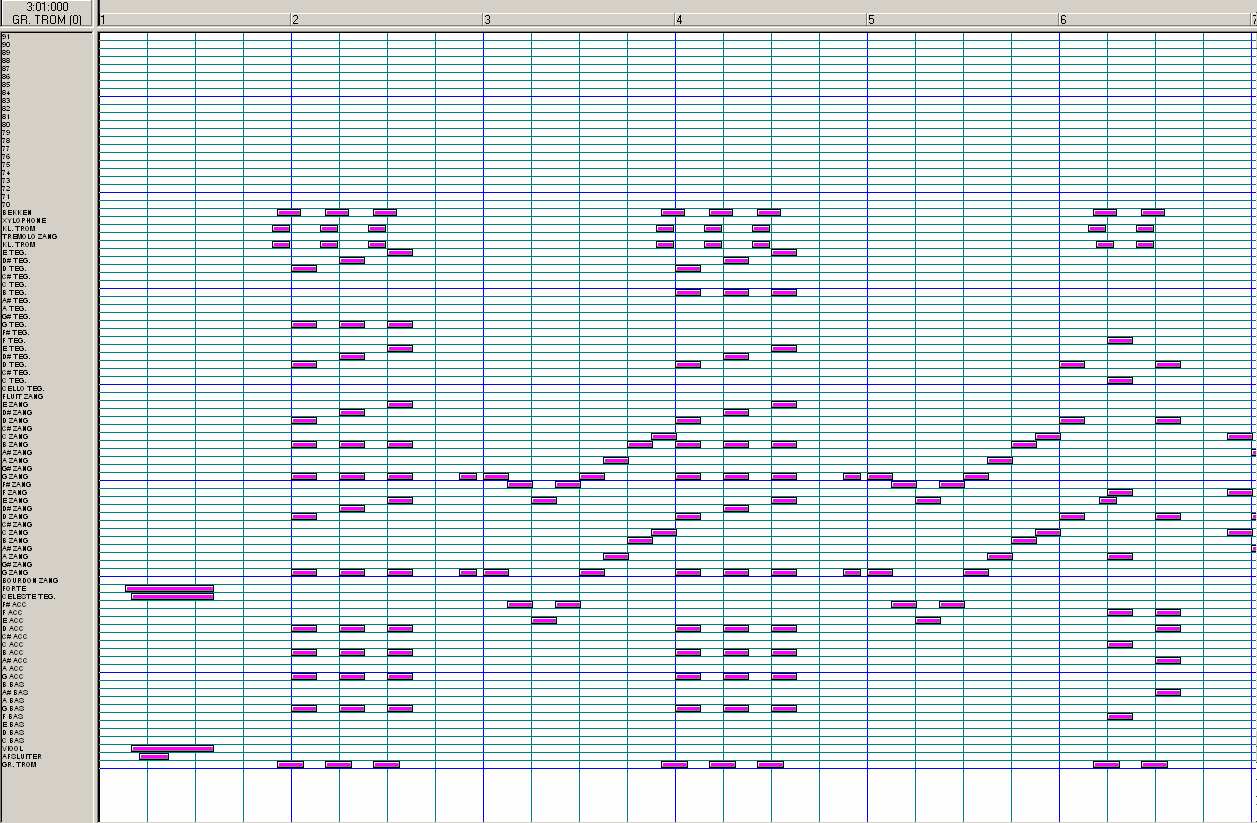
The preceding five volumes described the media — how a pinned barrel (Vol 02), a cardboard book (Vol 03), a perforated paper roll (Vol 04) or a MIDI file (Vol 05) each store the same abstraction: which notes sound, and when. This volume is about the human step that happens before any hole is punched or any pin is set: arranging — turning a piece of music into something a fixed, gapped, dynamics-less mechanical organ can actually play, and then realizing that arrangement onto one of the four media. The scale theory — exactly which pitches a 20-note or 26-note busker organ owns and why — is developed in the sibling John Smith Universal dive, Vol 03; this volume treats that scale as a hard constraint and concentrates on the craft of composing inside it (Wright, melright.com/busker; Venable, wallace-venable.name/mechanical-music).
6.1 The arranger’s problem stated plainly
A hand-cranked busker organ has no keyboard and no performer choosing pitches in real time. Every note it can ever sound is one hardware channel — one tracker hole, one valve, one pipe or stop-group. The de-facto-standard Raffin 20-note scale provides exactly twenty channels spanning F3 (MIDI 53) to D6 (MIDI 86), but only eight distinct pitch classes: C, D, E♭, E, F, G, A, B♭ — an F-major scale with an added E♭ (John Smith Vol 03; Venable 20-Raffin gamma). There is no B natural, no F♯, no C♯, no G♯ and no A♭ anywhere on the instrument. The 26-note Alderman scale adds six channels — a bass D, an accompaniment F♯, and melody F♯, C♯, D♯/E♭ and a top B♭ — which soften the worst compromises but still fall well short of a chromatic octave (John Smith Vol 03; MMD Digest 1997.08.29).
Three consequences drive everything an arranger does:
- Pitch is quantized to eight (or, on 26-note, roughly ten) classes. Notes outside the set do not exist and cannot be bent; they must be transposed away, substituted, or dropped.
- Twenty channels must simultaneously carry bass, harmony and melody. With only three bass channels (F3, B♭3, C4) and ten melody channels (≈ C5–D6), register economy is not a stylistic choice — it is forced (John Smith Vol 03).
- There is no dynamic control in the program. A hole is open or closed; loudness is set by crank speed and wind pressure, not by the arrangement. Every note plays at the same nominal level (Wright, melright.com/busker).
A good arrangement is therefore a negotiated settlement between the tune and the machine, and most of the craft is knowing which compromises are inaudible and which are fatal.
6.2 Choosing a key that fits
The single most powerful tactic is transposition into one of the organ’s home keys. Because the scale is F major plus E♭, the natural homes are F major and B♭ major, with G minor and D minor close by; C major is only partly available because its leading tone, B natural, is missing (John Smith Vol 03). A tune written in G major or D major — keys that need F♯ and C♯ — is usually unplayable as written but becomes clean once transposed down into F or B♭.
The worked example below takes a fragment written in C major that reaches for two notes the 20-note organ does not own — an F♯5 (a chromatic passing tone) and a B5 (the leading tone) — and lands entirely on available channels simply by transposing the whole line down one whole tone (−2 semitones) into B♭ major. Every pitch maps to a channel the instrument has; the tune’s shape, intervals and character are preserved exactly. This is why experienced arrangers audition two or three keys before writing a note: the right key can make an “impossible” tune trivial (Venable, Arranging, wallace-venable.name).
6.3 When transposition is not enough
No single key clears every problem, especially in tunes that modulate or that use chromatic passing tones as melodic ornaments. Three further tactics handle the residue:
- Passing-note substitution. A chromatic note that survives transposition — say an F♯ used as a passing tone between F and G — is replaced by the nearest available scale tone (here F or G), or the melodic gap is filled with a repetition or a neighbour tone. On a bright flute rank at busking tempo the substitution is usually inaudible; the ear hears the line, not the missing semitone (Venable, Arranging). The 26-note scale exists precisely to reduce how often this is necessary, since it owns F♯ and C♯ outright (John Smith Vol 03).
- Octave displacement (foldback). The ten melody channels span only about C5–D6. A melody note above D6 or below C5 is folded by ±12 semitones onto a channel the organ has — the mechanical-organ equivalent of Hammond foldback. Because the flute ranks are timbrally uniform across the compass, an octave shift of a single note rarely registers as a wrong note (John Smith Vol 03).
- Re-harmonization and omission. Where the harmony wants a chord the organ cannot voice — anything needing B natural, or a dominant of C — the arranger reharmonizes to the available palette (essentially the chords of F and B♭ major: F, B♭, C, Dm, Gm, and a C7 coloured by the added E♭) or simply omits the offending voice. A convincing cadence in C is faked by approaching the tonic from above (D→C) rather than through the missing leading tone B (John Smith Vol 03; De Waard, From Music Boxes to Street Organs, 1967).
6.4 Writing the texture within the channel budget
With pitch resolved, the arranger builds the classic three-register busker texture — oom-pah — inside twenty channels:
- Bass (F3, B♭3, C4) plays the “oom” on the strong beats, typically the root of the chord. Only three bass pitches exist on 20-note, so the bass line is reduced to a I–IV–V skeleton (F, B♭, C in F major); the 26-note bass D fills the missing IV–V–I approach note (John Smith Vol 03).
- Accompaniment (≈ D4–B♭4) supplies the off-beat “pah” chords — two or three middle-octave notes struck between the bass beats.
- Melody (≈ C5–D6) carries the tune on top, kept high so it never collides with the accompaniment.
The governing rule is one channel, one voice at any instant: two notes cannot share a channel, so if the melody dips into the accompaniment octave the arranger must decide which voice owns that channel at that moment and rewrite the other. Keeping the three registers physically separated on the roll — bass low, harmony middle, melody high — is the single most reliable way to avoid these collisions (John Smith Vol 03). Arrangers also lean on octave doubling of the melody, rhythmic drive, and grace notes to add interest that the thin harmonic palette cannot supply; the strong, march-like rhythm that characterizes good busker arrangements is a direct response to harmonic poverty (Wright, melright.com/music).
6.5 The missing dimension: no dynamics, so articulate and register instead
Because a punched hole is binary — open or shut — the arrangement cannot vary loudness note to note. Crank speed sets a global volume-and-tempo, buffered by the reservoir, and pushes both together (John Smith Vol 03 §Paper speed; Vol 04 §4.1 of that dive). The arranger recovers expressive contrast by other means:
- Articulation. Shortening a note (a shorter slot with silence after it) reads as staccato accent; lengthening and slurring reads as legato. Rhythmic placement and note length are the arranger’s only per-note “dynamics”.
- Registration. On an organ with drawable stops (e.g. the Universal’s four melody ranks and its optional glockenspiel), the arranger can call for a stop change between sections — thin the texture to closed flute for a verse, add the octave rank and tremolo rank for a chorus — encoding a terraced dynamic that the fixed wind cannot give continuously (John Smith Vol 05 of that dive). On book and roll media a dedicated control channel can drive the stop action; on MIDI, a separate channel or note-number range fires the register solenoids (Vol 05).
- Texture density. More notes sounding at once reads as louder and fuller; dropping to a bare melody reads as softer. Building and thinning the chord voicing is a compositional substitute for a crescendo.
6.6 Mechanical limits of the marks
The physical medium imposes limits that have no analogue in ordinary notation, and the arranger must respect them or the organ misbehaves:
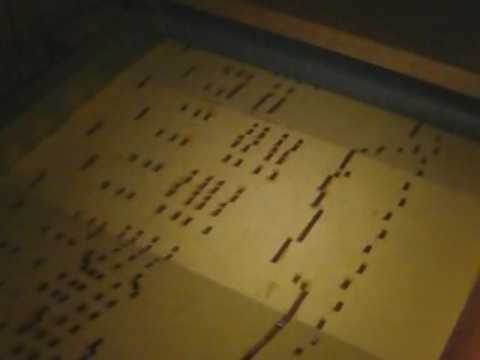
- Held-note limit and bridging. A long note is a long open window. On a cardboard book a single very long slot would weaken the card and let it buckle, so a sustained note is punched as a chain of holes separated by narrow bridges of about 1.5–2 mm; the bridges keep the card rigid while remaining short enough that the key never re-seats and the note plays as one continuous tone (MIDIBoek documentation, hobbydraaiorgel.nl). On a paper roll the same logic gives a long slot with occasional paper bridges to stop the roll tearing (John Smith Vol 04 of that dive). On a pinned barrel the equivalent is a bridge/staple whose length sets the duration (Vol 02).
- Repeated-note gap. Two successive notes on the same channel must be separated by an un-punched gap so the key drops back (or the valve re-closes) and re-articulates. On books the working minimum is about 2 mm of solid card between the two holes of one key; with less, the two notes merge into one held note (MIDIBoek, hobbydraaiorgel.nl). This is why a rapidly repeated melody note is a hazard: the arranger must shorten the first note to open a clean gap, or the repetition is lost.
- Tempo is distance, not a setting. There is no tempo control on the instrument; the music plays at the rate the paper is drawn or the barrel turns. Tempo is therefore encoded — a note twice as long is twice the physical length, and the arranging software works in a fixed internote spacing (the Raffin gamma specifies a nominal roll speed and a 385-unit internote value) so that the punched result plays at the intended musical tempo (Venable 20-Raffin gamma; John Smith Vol 03 §Paper speed).
6.6.1 Arranging constraints and the tactics that answer them
Table 1 — Arranging constraints and the tactics that answer them
| Constraint | Why it exists | Arranging tactic |
|---|---|---|
| Missing accidentals — no F♯, C♯, G♯, A♭, B on 20-note | Only 8 pitch classes (F major + E♭) | Transpose into F or B♭ major; passing-note substitution to nearest scale tone; reharmonize; or omit |
| No B natural (leading tone of C) | Absent channel | Avoid true C major; approach the tonic from above (D→C); substitute or omit the leading tone at cadences |
| Narrow melodic range ≈ C5–D6 (10 notes) | Only ten melody channels | Octave displacement / foldback (±12 semitones onto a real channel); rewrite the contour |
| Only 3 bass pitches (F3, B♭3, C4) | Three bass channels | Reduce bass to a I–IV–V skeleton; use 26-note bass D for stronger cadences |
| No dynamics (fixed wind, binary holes) | A hole is open or shut | Articulation (note length), registration (stop changes), and texture density instead of volume |
| One channel = one voice at a time | Two notes can’t share a channel | Register economy — bass low, harmony middle, melody high; decide voice priority on collision |
| Held-note weakens the card / tears paper | Long open window in the medium | Bridge a long note (chain of holes with ~1.5–2 mm bridges) so it plays continuously yet the medium stays rigid |
| Repeated same-channel notes merge | Key/valve must re-seat between notes | Leave an un-punched gap (~2 mm on books) between the two holes; shorten the first note |
| Limited chord palette (F, B♭, C, Dm, Gm, C7) | Diatonic-plus scale | Reharmonize to available chords; drive the arrangement with rhythm, not harmony |
| Tempo = physical distance, no tempo knob | Playback rate fixed by drivetrain | Encode tempo as note spacing / internote units in the editor; set once at punch time |
6.7 The workflow: arrange, proof, then realize
Modern arranging converges on a common pipeline regardless of which medium the music will finally live on. The source — a printed score, a MIDI file captured from a sequencer or downloaded, or a tune worked out by ear — is entered into a roll/book editor or a MIDI arranger, edited against the target scale, proofed by on-screen simulation, and only then realized onto a barrel, book, roll or MIDI file. The proof step is what makes computer arranging so much faster than the old paper-master method: the arranger hears the arrangement through a software organ voice and sees every out-of-scale note flagged before committing a single hole (Venable, 21st Century Arranging, wallace-venable.name; MIDIBoek, hobbydraaiorgel.nl).
6.7.1 Tools and software
- Melvyn Wright’s Music Roll and Organ Book Editor — published 1988, the first computer editor written specifically for music rolls and organ books (not a general-purpose sequencer). It composes or arranges from scratch, prints a roll or book template, drives a MIDI-operated punching machine, and exports a MIDI file of the arrangement (Wright, melright.com/busker/editor.htm). Wright was the first in the UK, and possibly the world, to build a working computer roll editor and automatic roll/book punching machines (melright.com/busker/editor.htm).
- MIDIBoek — a free Windows program that converts a standard MIDI file into a punching/printing template for street organs, pianolas, music boxes and the like, for both key-frame and pneumatic-tracker instruments. It supports variable and fixed note length, flags notes that fall out of the target scale, lists the misfits, and enforces the bridge/gap rules for held and repeated notes (hobbydraaiorgel.nl).
- Noteur — a piano-roll MIDI editor focused on mechanical-instrument work, distributed alongside MIDIBoek (Venable, wallace-venable.name).
- PowerTracks Pro Audio and general sequencers — used for the heavy lifting of transposition and per-note octave moves before the file is imported into a scale-aware editor; Venable notes moving a missing bass note to another octave, or a missing melody note up or down a 3rd, 5th or 7th, directly in the piano-roll view (Venable, Arranging, wallace-venable.name).
6.8 Commercial versus DIY: where the music comes from
The realized arrangement can be bought, or made at home, and the two paths meet at the same 110 mm roll (or book, or MIDI file) geometry:
- Buy ready-made. The lowest-effort path is pre-punched commercial music. Melvyn Wright arranges and produces music for nearly every organ scale, from small hand-cranked buskers up to 56-key fairground organs, issued as cardboard books, paper rolls, computer disks or micro-chips; his rolls are punched on strong, waterproof plastic “paper” that will not shrink or tear (melright.com/music/sales.htm). Ed Gaida (edgaida.com) has historically been a principal US source of busker rolls, and Thomas Sterk (thomas-sterk.nl) supplies commercial 110 mm Raffin 20-note rolls; any standard 110 mm Raffin roll, including second-hand stock, will play on a 20-note organ (John Smith Vol 03). (As of this writing the edgaida.com domain is intermittently unreachable — builders should confirm current suppliers via the COAA/busker-organ community.)
- Buy the arrangement, punch it yourself. Wright also runs a custom punching service — he will punch a chosen arrangement in John Smith 20/26 or Raffin 20/31 note formats, with roughly a 7-day turnaround to the USA — and punches rolls for many of the leading roll suppliers (melright.com/busker/ punching.htm). Builders who want a library without buying a machine simply send arrangements to be punched.
- Roll your own end to end. The DIY arranger enters or captures a MIDI file, arranges it to scale in the software above, and either drives a home-built punching machine or prints a template and hand-punches blank stock. The COAA literature documents the full hand-punching-from-MIDIBoek-templates workflow (Venable, “Hand-Punching My Own Rolls from MIDIBoek Templates”, Carousel Organ #35), and the busker-organ community has long circulated plans for building a John Smith music punch (Busker Organ Forum, “Building a John Smith Music Punch”). A MIDI file can also skip paper entirely and play a MIDI-driven valve system directly — the subject of Vol 05 and of the program’s Dive 7 (the MIDI-driven 20-note crank organ).
For the busking repertoire itself — the lively marches, waltzes and popular tunes that suit a strongly rhythmic, harmonically simple instrument — and the practical side of playing at rallies and COAA events, see the John Smith Universal dive Vol 11 (Music, Playing & Reference), which this volume complements: that volume lists where to get rolls for one specific organ, while this one covers the general craft of making the music for any of the four media.
6.8.1 Cross-references
- Vol 02 (Pinned Barrels) — realizing an arrangement as barrel pins/bridges.
- Vol 03 (Cardboard Book Music) — punching/printing a fanfold book; the bridge and gap rules for key-frame reading.
- Vol 04 (Perforated Paper Rolls) — punching a roll from a master; slot vs bridge for held notes.
- Vol 05 (MIDI & Electronic Encoding) — exporting a MIDI file; driving solenoid valves directly.
- John Smith Universal, Vol 03 — the 20/26-note scale theory this volume arranges within (the constraint); Vol 05/11 for stops/registration and the busking repertoire.
- Program Dive 7 — the MIDI-driven 20-note crank organ (the electronic front-end for the same scale).
Sources
- Melvyn Wright, melright.com/busker (editor.htm, punching.htm, jsart21.htm) and melright.com/music (sales.htm) — the 1988 roll/book editor, MIDI-driven punching machines, custom punching service (JS 20/26, Raffin 20/31; waterproof plastic rolls; ~7-day US turnaround), and commercial arranging.
- Wallace Venable, wallace-venable.name/mechanical-music — Notes on Arranging Music for Paper Rolls (transposition and octave-move tactics, PowerTracks, MIDIBoek, Noteur); 21st Century Arranging for Band Organs; the 20-Raffin gamma (pitch list MIDI 53–86, roll-speed and 385-unit internote spacing); “Hand-Punching My Own Rolls from MIDIBoek Templates,” Carousel Organ #35 (COAA).
- MIDIBoek, hobbydraaiorgel.nl — free MIDI-to-template software; out-of-scale detection; the ~2 mm repeated-note gap and 1.5–2 mm held-note bridge rules for cardboard books.
- Busker Organ Forum, tapatalk.com/groups/buskerorgan — “Building a John Smith Music Punch”; MIDI-arranging threads.
- G. de Waard, From Music Boxes to Street Organs (1967) — traditional arranging methods for mechanical organs.
- Q. David Bowers, Encyclopedia of Automatic Musical Instruments; Arthur W. J. G. Ord-Hume, mechanical-music histories — the broader arranging and media context.
- John Smith Universal dive, Vol 03 — the Raffin 20-note / Alderman 26-note scale definition, pitch classes (F major + E♭), and register roles this volume treats as the fixed constraint.
Comments (0)