Encoding The Music · Volume 3
Cardboard Book Music
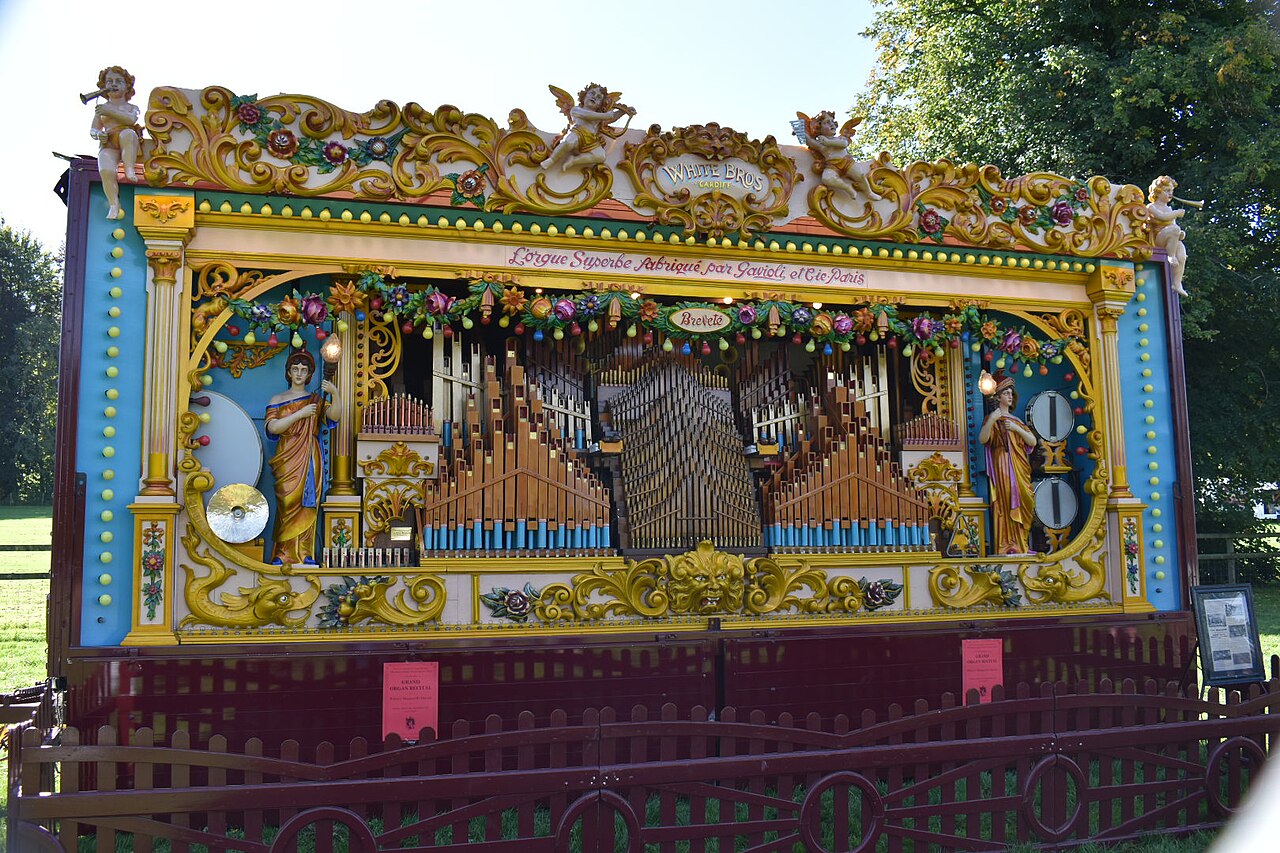
The medium that made the big organ possible. Where the pinned barrel (Vol 2) bound a machine’s whole repertoire to a fixed cylinder, and where the paper roll (Vol 4) later brought cheap, light programmes to street and busker organs, the folded cardboard book occupied the demanding middle ground: the large fairground, dance, and concert organs that had to play long, richly voiced arrangements outdoors, week after week, in damp and dust, and survive it. From its introduction in 1892 until well into the electronic era, book music was the dominant programme medium for organs above roughly 40 keys, and it remains the working medium of the surviving showmen’s and dance organs today.
The subject is the book itself: what Gavioli invented, how a keyframe reads a punched book, why the medium won for large instruments, the tangle of mutually incompatible key scales that grew up around it, how books are punched, and how they are handled and repaired. The arranger’s craft — fitting a tune to a fixed, gapped scale — is treated only in outline here and developed fully in Vol 6.
3.1 Gavioli’s 1892 invention
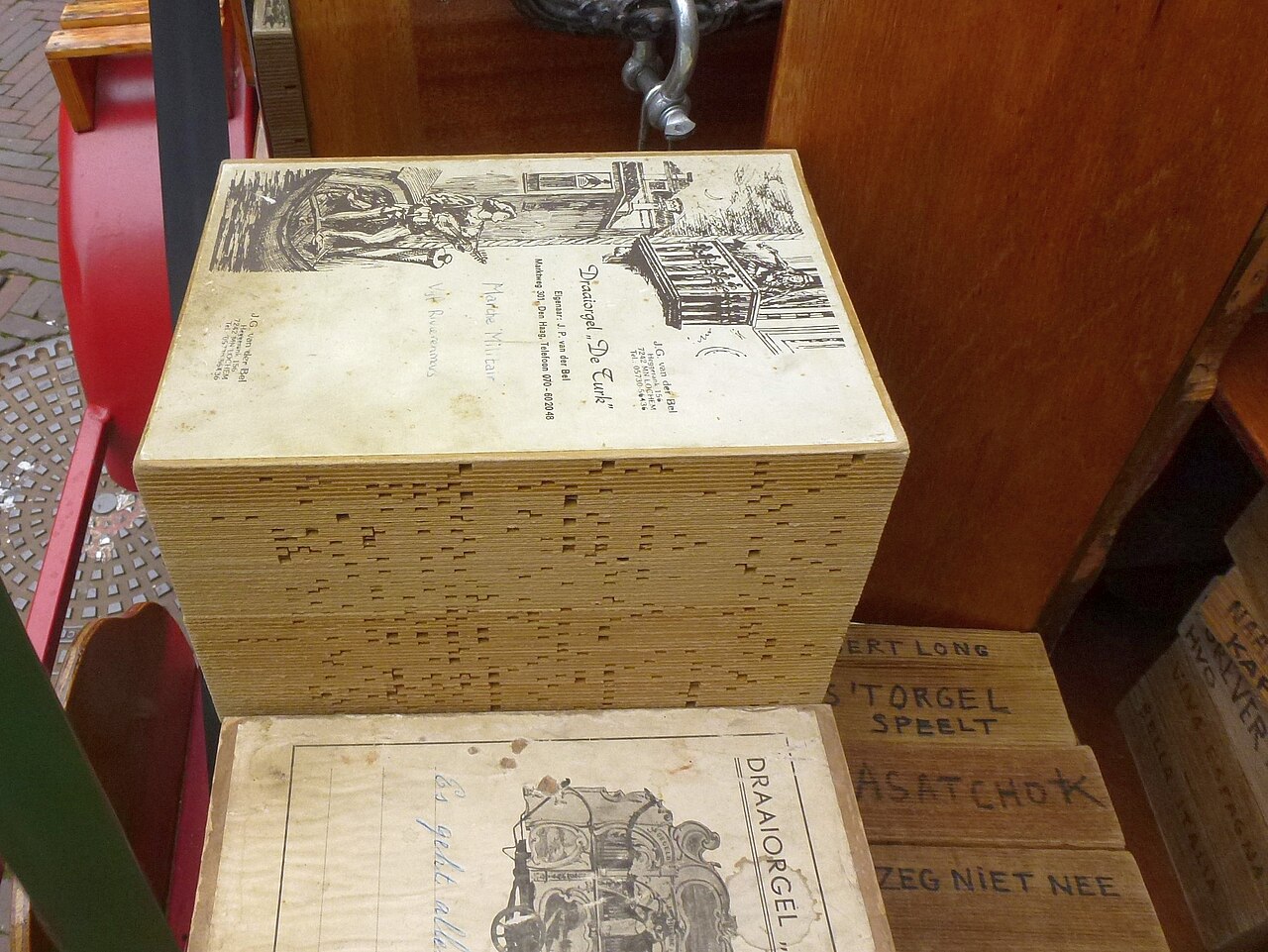
Book music is the work of the Gavioli firm, French-domiciled organ builders of Italian origin, and is credited to Anselme Gavioli, with the patent dated 1892 (some sources give 1891 for the first working system; the patent protection is conventionally cited as 1892).12 It replaced the pinned barrel, which had governed automatic organs since the carillon and musical-box traditions (Vol 2). The barrel had two fatal limits for a large travelling organ: tune length was bounded by the barrel’s circumference, and the number of tunes by how many pin-tracks could be crowded across its length — typically eight to ten short tunes per costly, heavy cylinder that could only be re-pinned by a specialist.3
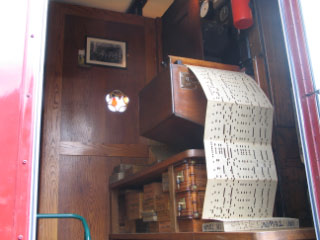
Gavioli’s answer was to move the programme off the cylinder and onto a fan-folded book of thick cardboard, perforated with holes and slots. 2 The book is drawn horizontally through a reading mechanism — the keyframe — one fold (one “page”) at a time, and it re-folds concertina-style on the far side. Because a book is simply a stack of pages hinged at alternating edges, its length is limited only by how many pages are pasted end to end: books of 10–20 m are ordinary, and lengths approaching 100 m exist for long concert pieces, folded down to a manageable stack that fits through a doorway. 4 Tune length ceased to be a design constraint at all — the single most important consequence of the invention.
The advance was decisive commercially. It made the Gavioli firm the most prolific of the fair-organ builders of its era (Anselme Gavioli lived 1828–1902; the firm carried on until it ceased organ-building in 1912), and the book became the template every serious competitor had to adopt: Marenghi, Limonaire, Gasparini, Mortier, Decap, Bursens (dance organs), and the German builders Bruder, Ruth, Wilhelm Bruder Söhne, and Gebrüder Bruder among them.13
3.2 How the book encodes music
Book music is a direct realisation of the note-vs-time grid described in Vol 1. The long axis of the book is time; the transverse position across the book’s width selects the note (or register/percussion control). Each note in the organ’s scale is assigned a track — a longitudinal lane at a fixed transverse position. A perforation in that lane commands that note to sound; the note sounds for exactly as long as the perforation is long. Hole length = note duration. A short slot is a staccato note; a long slot is a held note; a run of short holes in one lane is a repeated note.2
This is the same abstraction as a barrel pin-bridge (Vol 2) or a paper-roll slot (Vol 4). What differs is the physical carrier — laminated cardboard rather than a pinned cylinder or a paper web — and, with it, the durability, capacity, and editability of the programme.
The perforations are cut across the width of the cardboard and read as the book advances. A design consequence of the fold is that no single perforation may straddle a fold line; long notes that would cross a fold are broken into segments, which the ear does not resolve as separate notes provided the gaps are short.
3.3 The keyframe: reading the book
The keyframe is, in the organ-builders’ own phrase, “the brain of the organ” — the mechanism that converts holes in the card into note commands. 5 Two families of keyframe exist, and the choice governs the shape of the holes and the whole downstream action.
3.3.1 Keyed frames (mechanical reading)
In a keyed frame, a row of pivoted metal keys — one per track, hence “89-key” and so on — presses lightly upward against the underside of the book as it is drawn across the top of the frame. Each key is spring-loaded. Where the card is solid, the key is held down; where a hole passes over the key, the spring pushes the key’s tip up into the hole, and it stays raised for the full length of the perforation. The rise of the key is the note command: it is linked, directly or through a pneumatic relay, to the pallet or valve that admits wind to the corresponding pipe. When the trailing edge of the hole reaches the key, the card cams the key back down and the note stops.25
Keyed frames read square-ended (rectangular) holes, because the key must fall cleanly into a well-defined opening and be cammed out by a definite trailing edge.5 The key literally “feels” the card, so a keyed frame is tolerant of a slightly dirty or repaired book but is comparatively hard on the cardboard — the metal key tips abrade the card each pass, which is why keyed books are routinely hardened (§7).
3.3.2 Keyless frames (pneumatic reading)
The keys’ wear on the card, and the mechanical load of pushing a whole row of sprung keys, drove a later refinement: the keyless frame. Here there are no keys at all. Instead the book runs over a tracker bar pierced with one small port per note — exactly the arrangement of a player-piano tracker bar (Vol 4). Each port is held under suction (or pressure). A hole in the card uncovers its port and lets air through; the resulting change in pressure is amplified by a small pneumatic motor / pouch-and-valve that opens the pipe’s pallet.2 Nothing touches the card but a smooth bar and the air, so the book wears far more slowly and the reading is lighter and faster.
Keyless frames read round holes, punched to register with the round tracker ports.5 The round-vs-square distinction is a quick field diagnostic: a book of rectangular slots was cut for a keyed frame; a book of round holes for a keyless one, and the two are not interchangeable even at the same key count.
3.4 Why the book won for big organs
Three properties made book music the standard for large fairground, dance, and concert organs.
Near-unlimited tune length. Because a book is pages pasted end to end, adding music means adding pages. A full march, waltz, or medley with introduction and repeats fits without the compromises a barrel’s fixed circumference forced. Programme length became a musical decision rather than a mechanical ceiling.
Robustness in the field. Laminated cardboard tolerates the fairground far better than paper. The medium’s decisive practical virtue is that it is not subject to the expansion and contraction with humidity that plagues paper rolls, and it resists the tearing that a thin paper web suffers in an outdoor, hand-handled machine.5 A hardened book survives many seasons of daily use; a torn page is a local repair, not a lost roll.
Capacity for rich, full arrangements. A high key count — the 89-key Gavioli carries far more tracks than a busker roll’s 20 or 31 — gives the arranger melody, counter-melody, a full accompaniment, a bass line, and separate tracks to switch registers (rank on/off) and drive percussion (drum, cymbal, triangle). The result is the full-band sound of a fairground organ, not a single-line tune. The trade is cost and weight: books are expensive to arrange and cut, and a large machine’s music library is a heavy, bulky asset — which is exactly why the cheaper, lighter paper roll (Vol 4) prevailed at the small, portable end of the market.
3.5 The key scales — and why nothing was standardised
A key scale (or tracker scale) is the map from track position to musical function: which transverse lane is which pitch, which lanes are bass, accompaniment, melody, counter-melody, trumpet/violin registers, and percussion. A book cut for one scale is meaningless in a frame built for another — the holes line up with the wrong keys. Because each major builder devised its own scale, and often several, book music fragmented into dozens of mutually incompatible systems, a fragmentation that was never resolved.
Gavioli’s own 89-key scale (the “G4”) became the nearest thing to a common tongue among the largest organs, widely built in Paris and Waldkirch and copied by others; but “89-key Gavioli” names a scale, not merely a note count, and a same-count scale from another maker need not agree with it.51 Standardisation never happened for straightforward commercial reasons: a builder selling both the organ and its music had every incentive to lock customers to a proprietary scale, and the surviving instruments each embody the scale they were born with. The practical upshot for a modern owner is that music must be sourced, arranged, or re-punched specifically for that instrument’s scale — there is no universal catalogue.
Table 1 — 5. The key scales — and why nothing was standardised
| Maker / system | Typical key counts | Origin | Notes and use |
|---|---|---|---|
| Gavioli (89-key “G4”) | 89 (also 87, 110) | Paris / Waldkirch | The dominant large-organ scale; violins + clarinets switchable; the de-facto reference other makers were measured against.15 |
| Marenghi | 87, 89, 98 | Paris | Concert and fairground organs; “VB” (Violin-Baritone) layouts with saxophone melody and violin counter-melody (est.).5 |
| Limonaire Frères | ~46, 52–56 (est.) | Paris | Street and fairground organs; smaller books than the big Gaviolis.6 |
| Mortier | 89, 98 | Antwerp | Belgian dance-organ builder; large, register-rich books for indoor dance halls.5 |
| Bruder (Wilhelm/Gebr.) | 52, 61, 65, 78, 84 (est.) | Waldkirch | German fairground and street organs; both book- and roll-played scales in the range.6 |
| Ruth (A. Ruth & Sohn) | 33, 38, 52 keyless, 89 (est.) | Waldkirch | German fairground organs; keyless (round-hole) scales common on the smaller models.6 |
Counts marked “(est.)” reflect that most makers issued several scales over time and sources vary; the table anchors the range and character rather than an exhaustive census. The single reliable rule is empirical: read the instrument’s own keyframe, count and measure the keys/ports, and match music to that.
3.6 Punching a book
Book music begins as an arrangement — the tune reduced to the notes, registers, and percussion actually available in the target scale (the subject of Vol 6). The arrangement is transcribed into a plan of holes: for each note, which track, where it starts along the length, and how long it runs. Historically this plan was cut on a book-perforating machine: a bench holding a set of punches on the note-track pitch, into which blank hardened cardboard is fed and indexed along its length while the operator drives the punches to cut each perforation at the marked position and length.3 Long notes are cut as long slots (or, on keyless work, as a close run of round holes reading as one held note); the fold lines are respected so no perforation crosses a crease.
Blank stock is bought as uncut folded cardboard in the fold pitch (page size) of the target scale, and the finished book is assembled by pasting punched lengths together and lacquering the joins. An average book of 10–20 m consumes on the order of 30–60 uncut sheets.4 In the modern era the plan is prepared and edited in software and the physical cutting is done on computer-controlled punches or plotters, but the geometry — track pitch, hole length as duration, respect for the folds — is unchanged from Gavioli’s day. The arranger’s craft of making a full, idiomatic arrangement fit a fixed and often gapped scale is deferred to Vol 6.
3.7 Handling, durability, and repair
Book music earns its reputation for toughness, but only when maintained. The two recurring failure modes are key wear (on keyed frames) and fold fatigue.
Hardening against key wear. On a keyed organ the metal key tips abrade the card at every hole edge, gradually enlarging and softening the perforations. The standard countermeasure is to paint the book with shellac thinned in alcohol, which stiffens the card weakened by punching and gives it a harder wearing surface against the keys.5 Keyless (pneumatic) books, touched only by a smooth tracker bar and air, wear far more slowly and often need no such treatment.
Fold and edge repair. The folds are the weak line — repeated concertina-folding eventually cracks a crease, and the leading and trailing edges of pages fray from handling. The routine repair is re-taping: reinforcing a split fold or a torn page edge with cloth or paper tape (or a pasted card patch), taking care not to intrude on any perforation or to add thickness that would foul the keyframe. A well-kept book can be re-taped many times over its life; a badly damaged page can be cut out and a freshly punched replacement pasted in, provided the splice preserves the exact longitudinal registration so the timing does not shift.
Storage and running. Books are stored flat-folded in boxes, kept dry, and inspected for lifting joins and cracked folds before a run. In the frame the book must feed squarely and re-fold cleanly on the take-up side; a book that is fed skewed reads its holes off-track and mis-times or drops notes, and a re-fold that jams can tear a page. These handling disciplines, more than any material limit, determine how long a book lasts.
3.8 Where the book sits among the media
The cardboard book is the durable, high-capacity, expensive middle of the programme-media spectrum. Compared with the pinned barrel (Vol 2) it trades a fixed, cylinder-bound repertoire for effectively unlimited tune length and a swappable library; compared with the paper roll (Vol 4) it trades cheapness and light weight for ruggedness and the high track counts that carry full arrangements; and compared with MIDI (Vol 5) it trades trivial editing and a bottomless library for mechanical self-sufficiency and period authenticity. For the large fairground, dance, and concert organs it was designed to feed, that balance has never been bettered on its own terms — which is why book music is still cut, played, and repaired today. The craft of writing the music that fills those tracks is the subject of Vol 6.
3.8.1 Cross-references
- Vol 1 — the note-vs-time grid common to every medium; the reader-to-action chain.
- Vol 2 — pinned barrels: the medium the book displaced, and the pin/bridge = duration parallel.
- Vol 4 — perforated paper rolls: the tracker-bar reading the keyless frame borrows, and the cheaper small-organ medium.
- Vol 5 — MIDI and electronic encoding: the modern successor to the book’s programme role.
- Vol 6 — arranging for a fixed, gapped scale: how the holes in §6 are chosen.
Footnotes
-
“Gavioli,” Wikipedia; and And We Say Thank You for the Music, Fairground Heritage Trust — Anselme/Anselmo Gavioli’s 1892 book-organ patent; folded cardboard; keys rise in the key frame; the 89-key Gavioli built in Paris and Waldkirch. https://en.wikipedia.org/wiki/Gavioli ; https://www.fairground-heritage.org.uk/learning/and-we-say-thank-you-for-the-music/ ↩ ↩2 ↩3 ↩4
-
“Book music,” Wikipedia — cardboard with perforated holes; keys as small levers that rock up as a hole passes; the keyless frame where holes admit air; folded zig-zag; not subject to humidity expansion/contraction. https://en.wikipedia.org/wiki/Book_music ↩ ↩2 ↩3 ↩4 ↩5
-
Ron Bopp, “Book It! A Summary of Mechanical Musical Instruments Operated by Book Music,” and “An Update on Bookmaking,” Carousel Organ (COAA) — barrel limits vs the book advance; book-perforating and construction. https://coaa.us/ ↩ ↩2 ↩3
-
shop4musicboxes.co.uk — blank folded cardboard for key and keyless organs; books up to ~100 m folded zig-zag; ~30–60 uncut sheets for a 10–20 m book. https://www.shop4musicboxes.co.uk/ ↩ ↩2
-
“The A to Z of Mechanical Music,” mechanicalmusicradio.com — the keyframe as “the brain of the organ”; keyed frames feel the card and read square holes; keyless frames use a tracker bar and round holes; Gavioli 89-key “G4”; Marenghi 87/89/98 and VB layout; Mortier 89/98 dance organs; shellac-in-alcohol hardening. https://www.mechanicalmusicradio.com/atoz.html ↩ ↩2 ↩3 ↩4 ↩5 ↩6 ↩7 ↩8 ↩9 ↩10
-
Dean Organ Builders scale list and the Reblitz/Mechanical Music Press tracker-scale references — Limonaire ~46 and 52–56 key; Bruder 52/61/65/78/84 (est.); Ruth keyless 33/38/52 (est.). Counts vary by model and year. https://deanorganbuilders.co.uk/scales.htm ; https://www.mechanicalmusicpress.com/rbook/scales.htm ↩ ↩2 ↩3
Comments (0)