Encoding The Music · Volume 4
Encoding the Music — Vol 04: Perforated Paper Rolls
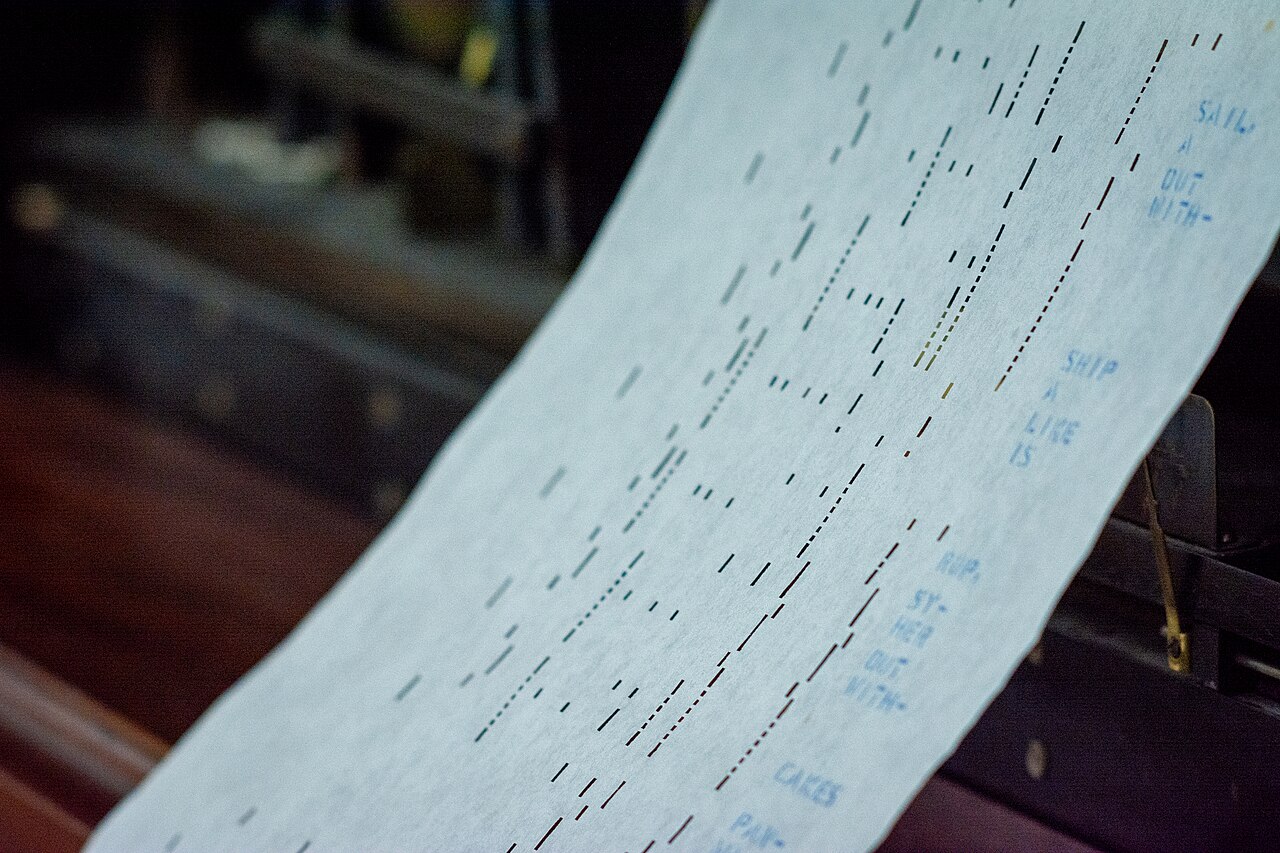
Of the four encoding media surveyed in this dive (pinned barrel, Vol 02; cardboard book, Vol 03; MIDI, Vol 05), the perforated paper roll is the one that carried mechanical music into the twentieth century and, in a shrunken form, still supplies most of the world’s hand-cranked busker organs. It is the same “note-vs-time grid” set out in Vol 01 §1 — one lane per note, distance along the medium standing for time — but realised on a continuous ribbon of paper rather than a rigid barrel or a fan-folded book. A perforated paper roll unwinds from a supply spool, is drawn across a tracker bar (a row of small holes, one per note channel), and is wound onto a take-up spool. Where a punched hole in the paper passes over a tracker-bar hole, that channel is momentarily “open”; the reading mechanism turns that open window into a speaking pipe. This volume owns the roll medium end to end: the tradition it came from, the physical mechanism, the scales and standards that make rolls interchangeable (or not), and how a builder gets or makes them.
The concrete case — the 110 mm Raffin 20-note roll on the John Smith Universal — is developed in that dive’s Vol 03 (the scale) and Vol 07 (the transport). This volume generalises: what the roll medium is, across the whole player-organ family, and how to reason about it.
4.1 Where the roll came from: the player-piano tradition
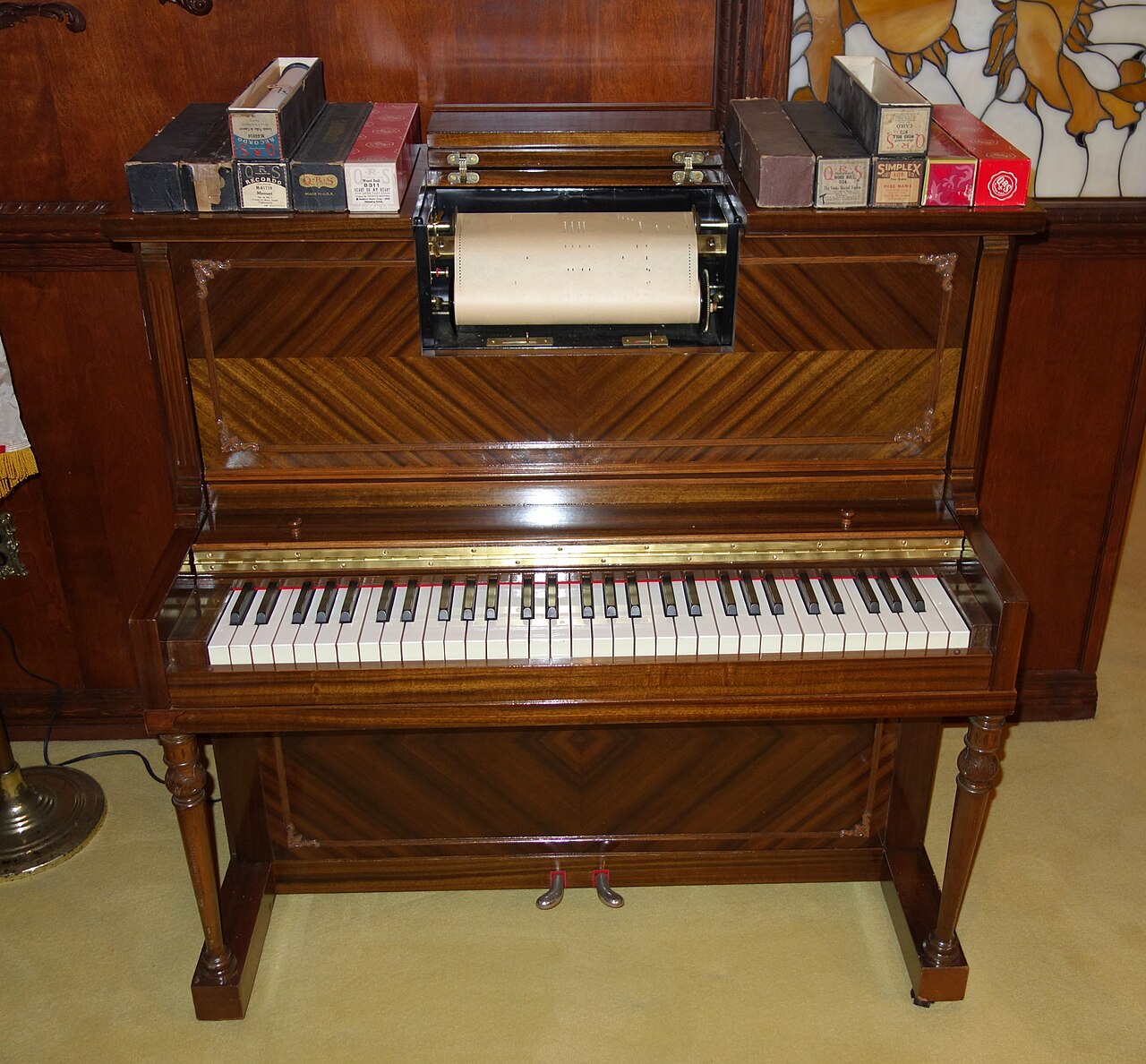
The paper roll is not native to street organs. It was engineered for the player piano and the orchestrion at the end of the nineteenth century, and only later shrank down to the busker organ. The pneumatic player piano — Aeolian’s Pianola (1898) and the reproducing pianos that followed (Ampico, Duo-Art, Welte-Mignon) — reads a perforated paper roll across a brass tracker bar, with each tracker hole connected to a small pneumatic motor that strikes a piano key (Ord-Hume, Player Piano; Bowers, Encyclopedia of Automatic Musical Instruments). The orchestrion — a self-contained mechanical band of pipes, percussion and sometimes piano — used the same roll principle at larger scale (Bowers).
The economics of paper were what made it win in the home and the arcade: a roll is light, cheap to duplicate by mass perforation, and holds a long piece of music on a compact spool, where a pinned barrel held only a handful of short tunes and had to be re-pinned by a craftsman to change the repertoire (Vol 02 §4). A music publisher could stamp thousands of identical rolls from one master; a customer could own a library of hundreds.
The standard 88-note home player-piano roll settled at roughly 286 mm (11¼ in) wide, with hole positions spaced 9 to the inch (≈ 2.82 mm centre to centre) — the so-called “88-note” or “standard” roll that superseded the earlier 65-note roll (which used the same 11¼ in paper but a coarser 6-holes- to-the-inch spacing) (Ord-Hume, Player Piano; Wikipedia, “Piano roll”). Those figures matter here only as ancestry: the busker-organ rolls treated below are direct descendants of this format, scaled down to the far smaller note-count a hand-cranked pipe organ needs.
4.2 The mechanism: roll, tracker bar, spool box
4.2.1 The three-station path
Every roll instrument, from a Duo-Art grand to a 20-note busker organ, runs the same three-station path (Bowers; and the John Smith case, its Vol 07 §3):
- Supply spool — the fresh roll is wound on a core (a wooden or cardboard tube) at one side of the spool box. The paper pays off the top.
- Tracker bar — a rigid bar, historically brass on player pianos, drilled with a straight row of small holes, one hole per note channel, spanning the paper’s width. The paper is drawn across the face of the bar under light tension so it seals against the bar’s ports.
- Take-up spool — a driven spool on the other side reels the played paper in. On a hand organ the crank drives this spool through a friction train, so the paper advances whenever the operator cranks (John Smith Vol 07 §2).
At the end of a roll the transport is disengaged and the paper is rewound back onto the supply spool for the next performance — by a motor and automatic rewind on a player piano, or by hand (a 5 mm hex key into the Raffin supply spool’s socket) on a simple busker organ (John Smith Vol 07 §3.2).
4.2.2 A hole is a note; a slot is a held note
The reading rule is the heart of the medium and is identical to the pin/bridge rule of the barrel (Vol 02) and the short/long punch of the book (Vol 03):
- A round hole in the paper, passing over its tracker hole, opens that channel for the brief instant the hole is under the bar — a short note.
- A long slot (a perforation elongated in the direction of travel) holds the channel open for as long as the slot takes to pass — a held/sustained note. Its length in millimetres, divided by the paper speed in mm·s⁻¹, is the note’s duration in seconds.
- Repeated short holes in one lane, separated by unpunched paper (a “tie bar” or bridge of paper), are separately articulated repeated notes, not one long note — the unpunched gap re-closes the channel so the note re-strikes.
On finely-perforated player-piano rolls a long note is often rendered not as one continuous slot but as a chain of closely-spaced round holes (a “chain perforation”), because a very long open slot weakens the paper across its width; the pneumatic action integrates the rapid chain into one sustained note (Ord- Hume, Player Piano). Busker-organ rolls, with far fewer channels and wider paper between lanes, more often use true elongated slots for held notes.
Because tempo is encoded purely as distance along the paper, the music’s speed is set by how fast the paper is drawn under the bar — which, on a hand organ, is set by crank cadence through the drivetrain (John Smith Vol 07 §6). A distinctive consequence, shared with all mechanical organs: cranking faster speeds the music up but does not raise its pitch (pitch belongs to the pipes), so the tune never goes “chipmunk,” unlike a sped-up phonograph.
4.3 Reading the hole: valveless (direct) vs pneumatic (pouch/valve)
Once a hole uncovers a tracker port, the port has to do something. There are two families, and the distinction defines the whole feel and cost of the instrument.
4.3.1 Valveless (direct) reading
In the simplest busker organs the tracker port is connected directly to the foot of a pipe (or a small group of pipes), fed from the pressurised wind box. While the paper hole is open, wind flows straight through the port and the pipe speaks; when unpunched paper re-covers the port, the wind is cut and the pipe stops. There is no valve and no relay — the paper perforation is itself the valve. This is the mechanism of the John Smith Busker and Senior 20 (the valveless siblings noted in that dive’s overview), and of many small German 20-note organs.
The virtues are simplicity and directness: fewer parts, nothing to leak or go out of adjustment, and an immediate response. The costs are that the paper must seal well against the bar (any leak weakly sounds the pipe or robs wind), the tracker port must pass enough air to blow the pipe (so bass ports are drilled larger — see §4), and every note the paper opens draws directly on the reservoir, so a big chord is a heavy simultaneous wind demand.
4.3.2 Pneumatic (pouch-and-valve) reading
Larger and more refined organs — including the John Smith Universal — treat the tracker hole as a low-power control signal, not the playing wind itself. Each tracker port feeds a small pouch (a leather diaphragm) under a chest that is held at wind pressure. The port normally leaks the pouch’s underside to atmosphere through a small bleed; when the paper hole uncovers the port, the pressure balance flips, the pouch inflates, and it lifts a valve that admits full playing wind to the pipe (Bowers; and the John Smith pouch/valve action, its Vol 06 §6). The paper thus only has to switch a tiny air signal; the heavy lifting is done by the valve. This is exactly the reproducing-piano principle scaled to organ pipes.
The pneumatic path buys amplification and isolation: a small, cleanly-sealed tracker hole can control a large bass valve; the paper never carries playing wind, so leaks are less punishing; and a “pillow pouch” can be tuned for crisp repetition. The price is complexity — a pouch board, valves, bleeds, all of which must be built and kept airtight (John Smith Vol 06 §6). The cross-reference for the full mechanical detail of pouches, bleeds and valves is that dive’s Vol 06; this volume only places the two reading methods side by side so the roll’s role is clear: in both cases the roll stores the same note-on/note-off information — what differs is only how the tracker hole is turned into pipe speech.
4.4 Roll scales and standards — and why they do not interchange
A roll is programmed for one specific scale: a fixed lateral layout of channels at a fixed spacing on a fixed paper width. A roll punched for one scale is mechanically meaningless on an organ built for another — the lanes do not line up with the tracker holes, the note assignment differs, and usually the width is wrong. This is exactly the book-scale incompatibility of Vol 03 (the 89-key Gavioli vs the rest), transferred to paper. The busker world has settled on a handful of de-facto standards, of which the German Raffin 20-note is overwhelmingly the most common because it lets rolls pass freely between makers (Raffin, Hofbauer, Stüber, Schlemmer, Hendrickx) — see the John Smith Vol 03 for the full pitch list and tracker-hole map.
The lateral order of the channels across the paper is not simply low-to-high pitch; it is set by the scale standard and must be matched exactly. Paper perforations on a commercial Raffin roll are about 3 mm in diameter, while the tracker-bar holes are drilled larger (typically 4 mm for melody and 6 mm for the slow-speaking bass) so that small tracking errors still uncover the perforation reliably (John Smith Vol 03; Venable Raffin gamma). The table below places the common roll scales in context. Widths and note counts marked “(est.)” are approximate where sources are informal.
Table 1 — 4. Roll scales and standards — and why they do not interchange
| Scale / standard | Roll width | Notes | Typical use |
|---|---|---|---|
| Raffin 20-note (German 20er) | 110 mm | 20 | The busker-organ standard; hand-cranked street organs (Raffin, Hofbauer, Stüber); John Smith Universal |
| John Smith Busker / Senior 20 | 140 mm | 20 | John Smith’s own 20-note format; wider spacing (16 × 6 mm + 3 × 9 mm gaps) |
| John Smith Universal (20/26) | 110 mm (Raffin) | 20 or 26 | Universal built to Raffin geometry; 26-note (Alderman) adds 6 channels in the roll margins, back-compatible with 20-note rolls |
| Raffin / fair-organ 31-note (German 31er) | 140 mm | 31 | Larger street & small fairground organs; more pitches, fuller harmony (Raffin; melright.com) |
| Player-piano “88-note” (standard) | 286 mm (11¼ in) | 88 | Home pneumatic player pianos; 9 holes/in spacing (ancestor format) |
| Player-piano “65-note” | 286 mm (11¼ in) | 65 | Earlier player-piano standard; 6 holes/in (coarser, obsolete) |
| Orchestrion / large organ rolls | varies, 300 mm+ (est.) | 50–100+ | Arcade orchestrions, band organs; wide multi-rank rolls, often maker-proprietary |
The lesson for a builder is blunt: fix the scale before cutting the tracker bar, because everything downstream — roll stock, spool sizes, arranging software, the library one can buy — follows from it. The Universal’s decision to adopt the 110 mm Raffin geometry (rather than John Smith’s own 140 mm format) was made precisely to inherit the large commercial Raffin roll library (John Smith Vol 03).
4.5 Getting music: buying, arranging, and punching rolls
4.5.1 Buying pre-punched rolls
The simplest path is to buy ready-punched rolls in one’s scale. In the busker world Ed Gaida (a long-standing US arranger and roll supplier) and Melvyn Wright (melright.com/busker, UK) are the community’s principal sources of 20- and 26-note rolls, and any standard 110 mm Raffin 20-note roll — new or second-hand — will play on any Raffin-scale organ (John Smith Vol 03; Wright). Commercial arrangers publish catalogues of hundreds of titles; a busker’s working repertoire is often a folder of a few dozen such rolls.
4.5.2 Arranging and roll-editor software
Anything not for sale must be arranged — fitted into the organ’s fixed, gapped scale (the 20-note Raffin scale is essentially F major plus an added E♭, with no B natural; see John Smith Vol 03 and this dive’s Vol 06 on arranging). Modern practice does this in software: a roll-editor / arranging program presents the familiar piano-roll grid, constrained to the target scale’s channels, and exports either a punching file or a MIDI file mapped to the scale. Community tools work from a “gamma” (scale-definition) file — for the Raffin 20-note, Wallace Venable’s 20-Raffin gamma (MIDI note numbers 53–86, 3 mm holes, 110 mm width, with roll-speed and internote-spacing parameters) — so the arranger works in the exact geometry the punch or the tracker bar will read (Venable, wallace-venable.name). The relationship between the arranging file and the MIDI representation of a roll is developed further in Vol 05.
4.5.3 Paper masters and DIY punching
Between “buy it” and “arrange it from scratch” sits the traditional busker path: a paper master. Arrangers such as Mel Wright publish printed masters — a full-size layout of every perforation for a tune — that a builder lays over blank roll stock and punches through, by hand punch or with a small perforating jig (Wright, melright.com/busker). This is how many builders grow a library cheaply without any electronics: the master is the score, the blank roll is the paper, and a punch turns one into the other.
Builders who want volume build or buy a roll-punching machine: a bar of punches (one per channel) over a die, advanced step-by-step past the paper, fired from the arranging file. These range from hand-cranked hobby perforators to computer-driven punches that read a MIDI or gamma file and pneumatically or electrically drive the punches. The same arranging software that targets a MIDI organ (Vol 05) can usually drive a punch instead — the file is the common currency; only the output device differs (punch paper vs fire a solenoid).

4.5.4 Paper choice, failure modes, and repair
Paper is the medium’s weakness. The stock must be strong enough not to tear at a perforation yet thin and supple enough to seal against the tracker bar and wind onto a small spool without cracking. Common failure modes:
- Damp. Paper is hygroscopic; a roll left in a humid case absorbs moisture, swells, and the tracks walk laterally off the tracker holes, so notes mis-read or drop out. Rolls are kept dry and are the first thing a busker protects from rain.
- Tears and edge fretting. A long unbridged slot, a rim of the spool holder dragging on the paper edge, or a snatch during rewind can tear the paper, usually starting at a perforation (the weakest line). Bridged/chain perforations (§2.2) exist partly to keep long notes from tearing.
- Creases and mis-tracking. A roll wound unevenly develops a crease that lifts the paper off the bar at that point, weakly sounding or dropping notes.
Repair is routine and low-tech: a tear is spliced with thin, low-tack archival tape or a paper patch that must not add thickness that would foul the bar or the spool; a mis-punched or added note is corrected by taping over an errant hole or punching a missing one; a worn leader is re-glued to the spool. The paper’s repairability is part of its charm — unlike a pinned barrel, a mistake in a roll is fixed with tape in minutes.
4.6 Trade-offs: roll vs book vs MIDI
The roll’s place among the four media (Vol 01) is defined by what it trades:
- Roll vs cardboard book (Vol 03). The roll is cheaper, lighter, and faster to duplicate — a spool of paper against a fan-folded stack of cardboard — and it holds long music compactly. The book is far more durable (stiff cardboard shrugs off handling and damp that would tear or swell paper) and is the choice for the big, hard-worked fairground and dance organs. The busker world chose paper for the same reason the player-piano industry did: economy and weight, accepting the fragility.
- Roll vs MIDI (Vol 05). A MIDI file is the “roll” made weightless and infinitely editable: an unlimited library on a memory card, trivial transposition and correction, no tearing or damp — but it needs power, electronics, and solenoid or pneumatic valves, and it removes the tactile, self-contained, “no batteries” character that is much of a busker organ’s appeal. Many builders keep both: a paper front-end for authenticity and a MIDI path for convenience, both targeting the same 20-note scale (John Smith Vol 03 §“Where the music comes from”). Vol 05 develops the MIDI encoding in full.
- Roll vs pinned barrel (Vol 02). The roll won on capacity and duplication — a barrel holds a handful of short tunes and must be re-pinned by a craftsman to change them, where a roll library is limitless and a new tune is another spool.
The perforated paper roll, then, is the pragmatic middle of the encoding family: lighter and cheaper than the book, more capacious and duplicable than the barrel, more tangible and self-sufficient than MIDI — and, on tens of thousands of hand-cranked organs from the 1900s to today, still the paper “program” a tracker bar reads note by note.
Sources
- Q. David Bowers, Encyclopedia of Automatic Musical Instruments — the player-piano, reproducing-piano and orchestrion roll traditions; tracker-bar and pneumatic-action principles; roll duplication economics.
- Arthur W. J. G. Ord-Hume, Player Piano: The History of the Mechanical Piano — the 65-/88-note roll standards (11¼ in width, 6 vs 9 holes/in), chain perforation for held notes, pneumatic reading.
- Wikipedia, “Piano roll” and “Player piano” — standard-roll dimensions and spacing (corroborating Ord-Hume).
- Melvyn Wright, melright.com/busker — busker-organ rolls, paper masters, punching, the Raffin/John Smith formats, roll suppliers.
- Ed Gaida — busker-organ roll arranger/supplier (community-standard source).
- Wallace Venable, 20-Raffin gamma file, wallace-venable.name — the Raffin 20-note scale definition for arranging software (MIDI 53–86, 3 mm holes, 110 mm width, roll-speed / internote-spacing parameters).
- MBSI / COAA (Musical Box Society Int’l; Carousel Organ Assoc. of America) and Mechanical Music Digest (mmdigest.com) — busker/street-organ practice.
- Sibling dive — John Smith Universal Organ: Vol 03 (the 20/26-note Raffin scale, tracker-hole map, roll geometry, arranging), Vol 06 (pouch/valve pneumatic action, the valveless contrast), Vol 07 (spool box, friction transport, rewind, crank-cadence → tempo).
Cross-references: the common note-vs-time abstraction in Vol 01 §1; pinned barrels in Vol 02; cardboard book music and scale incompatibility in Vol 03; MIDI/electronic encoding (the roll made editable) in Vol 05; arranging for a fixed, gapped scale in Vol 06. In the sibling John Smith dive: the Raffin/Alderman scales in its Vol 03, pouch/valve reading in its Vol 06, and the spool-box transport and crank-tempo coupling in its Vol 07.
Comments (0)