Encoding The Music · Volume 2
Pinned Barrels & Cylinders
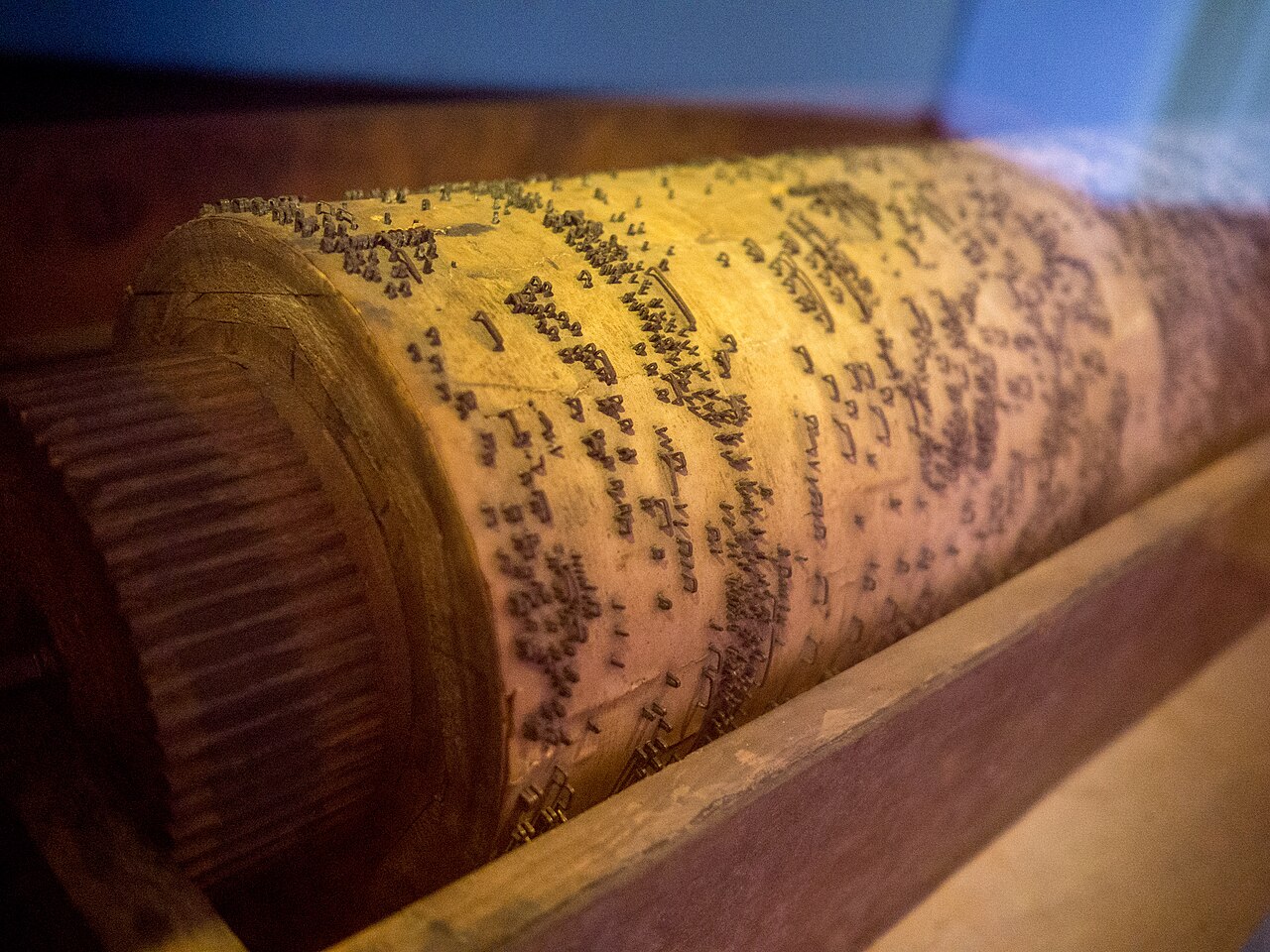
Vol 01 set out the abstraction every mechanical-music medium shares: a two-dimensional note-vs-time grid — one track per pitch, position along the medium standing for time — in which a mark (a pin, a punched hole, or a MIDI message) is read and converted into a mechanical action that lets a pipe speak, and in which note duration is the length of the mark. This volume treats the oldest realization of that grid, and the only one in which the “marks” are solid metal driven into wood: the pinned barrel (or cylinder). It is the medium of the carillon drum, the cylinder musical box, and the church, chamber, and street barrel organ. Where the later media (Vols 03–05) store the program on a consumable web of card or paper that is drawn past a stationary reader, the barrel is both the store and, by its own rotation, the transport: the program is machined permanently onto a rotating cylinder, and the reader — a bank of sprung keys or levers — rides on its surface. That single structural fact drives every strength and every limitation that follows: barrels are robust, need no paper, and read purely mechanically, but their repertoire is fixed at manufacture and dear to change, and their tune length is bounded by a circumference.
Units and terms. Barrel dimensions are given in millimetres (diameter, length) with the note count as tracks (one circumferential lane per key). A short note is a pin; a sustained note is a bridge or staple — a longer raised element spanning an arc of the barrel. “Pinning” is the craft of setting those elements; “re-pinning” is changing the repertoire by resetting them. Figures the sources do not fix are marked (est.).
2.1 Lineage: from the carillon drum to the musical box to the organ
The pinned cylinder is medieval. The technique of studding a rotating drum with pegs so that, as it turns, the pegs trip levers in a timed sequence appears in Flanders in the early 13th century, where a bell-ringer set pins in a cylinder to work cams that struck tuned bells — the carillon drum, the direct ancestor of every later pinned medium (Wikipedia, Music box; essentialvermeer, The Carillon). By 1598 the Flemish clockmaker Nicholas Vallin had built a weight-driven wall clock whose pinned barrel played a set of tuned bells, the pins separately placed in holes provided on the barrel’s surface — that is, already a re-programmable store, not a fixed casting (Wikipedia, Music box). The carillon tradition also fixed the vocabulary of the craft: setting the pins to match a melody is called versteken, done by the carillonneur (often with a clockmaker’s help), and the drum of a large carillon clock could be re-pinned to carry a different air for each quarter-hour — a task that “typically requires two full days” per re-set of four melodies (essentialvermeer, The Carillon). That figure is worth holding onto: the labour of re-pinning, not any limit of the principle, is what would make a barrel’s repertoire effectively permanent.
The same pinned drum, shrunk and married to a new reader, produced the cylinder musical box. The decisive step was the Geneva clockmaker Antoine Favre-Salomon’s replacement, in 1796, of a stack of small bells with a single steel comb of pre-tuned teeth (lamellae): pins on a horizontally mounted rotating cylinder pluck the tuned teeth in sequence, each tooth a fixed pitch (Wikipedia, Music box). The musical box is the pinned barrel in its purest form — the pin is the note, plucked directly, with no intervening wind — and it established the interchangeable-cylinder idea (a “table music box with six interchangeable cylinders” being a typical configuration) that the organ builders would answer with the lateral barrel shift (§4).
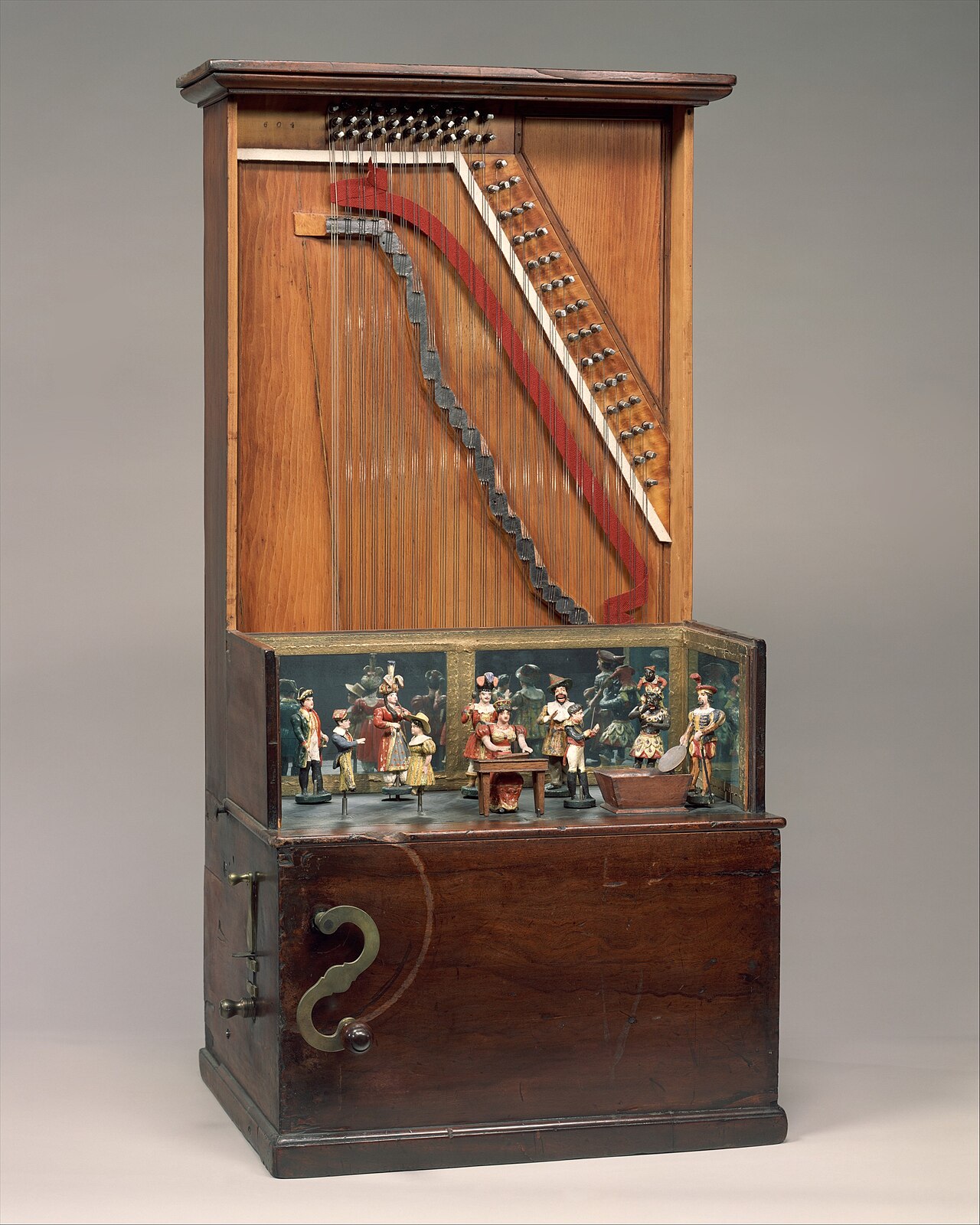
The barrel organ grafts that same pinned cylinder onto a pipe organ’s wind chest. Here the pin does not pluck a comb; it lifts a key or lever that opens a pallet valve, admitting wind to a pipe (Vol 01’s reader-to-pallet action; Wind-Systems Vol 01 for the pallet-and-chest chain). Because a pipe organ can sustain a note indefinitely as long as its pallet is held open, the barrel organ needs a way to encode held notes as well as short ones — the distinction between pin and bridge developed in §3 — which the plucked musical box, whose teeth ring and decay on their own, does not. The barrel organ flourished from the 18th century in three settings that recur throughout this volume: the church and chamber organ (a dignified self-player for psalm tunes where no organist was kept), and the portable street or “monkey” organ carried by the busker (Ord-Hume, Barrel Organ: The Story of the Mechanical Organ and its Repair, 1978; Wikipedia, Barrel organ).
2.2 Anatomy of the barrel
A barrel is a cylinder of close-grained hardwood — traditionally beech, maple, or fruitwood — turned true, its ends closed by discs (heads) carrying the arbor (axle) on which it rotates. Around its circumference the surface is divided into circumferential tracks, one lane for every key in the organ’s action: an organ with, say, 26 keys has 26 tracks laid side by side along the barrel’s length. The number of tracks therefore fixes the instrument’s note count — its vertical resolution on the note-vs-time grid of Vol 01 — and cannot be exceeded without re-building the action. Track pitch (the spacing between adjacent lanes) is of order a few millimetres; a 26-note barrel perhaps 250–300 mm long (est.) carries its tracks at roughly 8–10 mm centres (est.), enough to clear the width of each key tip riding in its lane.
Crossing those tracks at right angles is the time axis: angular position around the barrel. One full revolution is one pass through the tune (or, on a spiral-pinned barrel, one turn of a tune that advances laterally — §4). The barrel circumference thus sets the maximum tune length: a note that must fall a given fraction of the way through the tune sits at the corresponding angle, and once the barrel is full at 360° the tune is over. A larger diameter buys a longer tune; more length buys more notes. As the Encyclopædia Britannica barrel-organ entry puts it, “the more notes, the longer the barrel; the longer the tune, the greater the diameter” (Wikipedia, Barrel organ, paraphrasing the 1911 EB). This is the barrel’s defining trade: capacity is literally its surface area, and surface area is bounded by how large and heavy a cylinder the case and the crank can turn.
The surface itself is the storage medium. Into it are driven the two kinds of raised element that constitute the program:
- Pins — short lengths of hard brass or steel wire, driven radially into the wood so a few millimetres stand proud, each pin marking a short note. A pin is a point on the grid: the key rides up over it and immediately drops back.
- Bridges (also staples) — longer raised elements, effectively a wire or strip bent into a shallow arch or a staple with two legs driven into the wood so that a span of metal stands proud across an arc of the barrel. A bridge marks a held note: the key is lifted at the leading end of the bridge and held up for as long as the bridge passes beneath it, dropping only at the trailing end. “Pins are used for short notes, and staples of varying lengths for longer notes” (Wikipedia, Barrel organ).
Everything the medium can express — which pipe, when, and for how long — is encoded in the position (which track, what angle) and the length (pin versus bridge, and how long a bridge) of these elements. There is no other channel.
2.3 Reading the barrel: how a pin becomes a note, and a bridge a held note
The reader is a bank of keys — thin, pivoted levers, one per track, their tips resting on (or just clear of) the barrel’s surface, arrayed along a rail that spans the barrel’s length so each key sits in its own lane. As the barrel turns beneath them, any raised element in a key’s track lifts that key’s tip; the far end of the key, through a sticker, tracker, or roller, pulls open the pallet of the corresponding pipe (or, in a musical box, is the comb tooth being plucked). When the raised element passes, the key falls back — under its own weight, a light spring, or the pallet’s own return spring — and the pallet closes, silencing the pipe. This is the reader-to-action conversion of Vol 01, made purely mechanical: no wind, no electricity, only the barrel’s rotation doing work against the key springs.
Duration is encoded geometrically, as arc length. A pin subtends almost no angle, so it lifts the key and releases it in quick succession: a staccato note whose length is set only by the key’s fall time, not by the mark. A bridge subtends a real arc, and the key stays lifted — the pallet stays open, the pipe keeps speaking — for the whole time that arc takes to pass. Because the barrel turns at a set rate, arc length maps directly to time: a bridge spanning θ degrees of a barrel turning at ω degrees per second holds its note for θ/ω seconds. Doubling a note’s written value means doubling the bridge’s arc. This is exactly the same duration-as-mark-length rule that a punched slot obeys on a book or roll (Vols 03–04) and that a MIDI note-on→note-off pair obeys electronically (Vol 05) — the barrel simply machines the mark in brass instead of punching it in card. The distinction between an eighth-note and a whole-note is, on a barrel, literally the difference between a pin and a long bridge in the same track.
A subtlety the craft must manage is the key’s release and re-strike. Two short notes of the same pitch in quick succession need two separate pins with a gap between them wide enough for the key to fall fully and re-seat the pallet before the next pin arrives; if the pins are too close the key never drops and the two notes slur into one. Conversely a single long note is a single bridge, not a row of pins, precisely so the pallet stays open smoothly. The leading edge of every pin and bridge is usually given a slight ramp or the pin a rounded top, so the key rises without a jarring blow that would be heard as a click or would batter the key tip — the reason a well-pinned barrel plays cleanly and a worn or carelessly pinned one is noisy. “The quality of the music produced by a barrel organ is largely a function of the quality of its pinning” (Wikipedia, Barrel organ).
2.4 Many tunes on one barrel: the lateral shift
A single revolution of a single set of tracks plays one tune. A barrel organ carries several tunes — street organs usually 7 to 9, smaller or older instruments up to about 15 (Wikipedia, Barrel organ; commonly cited as ~8–10) — by the elegant expedient of the lateral shift. The tracks for the different tunes are interleaved: each key’s lane on the barrel actually contains several parallel sub-lanes, one per tune, and the whole barrel can slide a small distance along its own axis so that a different sub-lane comes to lie under each key. Shift the barrel one increment and every key now reads tune 2’s pins instead of tune 1’s; shift again for tune 3, and so on. The barrel is longer than the key rail by the total shift travel, so that whichever position it is set to, all keys still find barrel surface beneath them.
The shift is indexed by a notched disc or notch-pin on the barrel head, “furnished with as many notches as there are tunes,” which the operator advances by hand (or which advances automatically at the end of each revolution): dropping a detent into the next notch registers the barrel at the exact axial position where the next tune’s pins align with the keys (Wikipedia, Barrel organ, on the notch-pin). The registration must be precise to a fraction of a track pitch — a mis-shift reads two tunes at once, or the keys ride the boundary walls between sub-lanes and sound nothing. A refinement seen on orchestrions and some finer barrels is spiral pinning: instead of discrete parallel sub-lanes, the pins for one long tune run in a helix and “the barrel is gradually moved as it rotates so that the pins remain lined up with the keys,” trading multi-tune capacity for a single tune longer than one circumference (Wikipedia, Barrel organ).
2.5 The pinning craft: marking out, driving, and permanence
Pinning is where the arrangement (Vol 06) becomes hardware, and it is the most skilled operation in barrel-organ making. It begins not with metal but with a marking-out or pricking stage. The barrel is mounted in a pinning engine — a lathe-like frame that lets it be rotated by a precise, indexable amount and that carries a marker or drill that can be traversed accurately along the barrel’s length to any track. Working from the pinning plan — the arrangement transcribed onto the note-vs-time grid, giving for every note its track (pitch) and its start angle and, for held notes, its arc — the pinner marks each note’s position on the bare barrel: the track sets the axial coordinate, the indexed rotation sets the angular (time) coordinate. Getting this layout right is the whole game; an error of a degree in angle is an audible error in timing, and an error of a track is a wrong note. The carillon term versteken and the barrel-organ pinning plan name the same act — laying the tune onto the drum before a single pin is driven (essentialvermeer, The Carillon).
With the positions marked (and usually pilot-drilled), the elements are driven:
- Pins are cut from brass or steel wire, set into their drilled holes, driven to a consistent height — a few millimetres proud (est.) — and then often topped off (filed or ground to a uniform stand-off) so every key is lifted the same amount and the pallets all open the same. Uneven pin height means uneven key lift, which the ear hears as some notes weak and others banging.
- Bridges/staples are bent to length from wire or strip, their two legs driven into holes at the note’s start and end angles so the raised span bridges the arc between; a longer note is simply a longer bridge. Their crowns are set to the same height as the pins so that a held note lifts its key exactly as far as a short one.
The whole surface is then checked by turning the barrel slowly under the keys and correcting any pin that ticks, sticks, or lifts unevenly. The result is a store of remarkable permanence: brass in hardwood does not fade, tear, or absorb damp the way paper does, and a barrel pinned two centuries ago still plays. That permanence is the medium’s great virtue and its central limitation at once. Changing the repertoire means re-pinning — pulling the old pins and bridges, plugging the barrel where necessary, and marking out and driving an entirely new tune set. The carillon figure of “two full days” to re-pin four melodies (essentialvermeer) scales up alarmingly for a multi-tune organ barrel, which is exactly why most barrel organs kept the tunes they left the workshop with, and why a change of fashion tended to mean a new barrel rather than a re-pin. A common commercial answer was interchangeable barrels: a church organ might own three barrels of a dozen psalm tunes each, swapped in the case as needed — the physical-cylinder analogue of the musical box’s six interchangeable cylinders (§1), and the barrel medium’s only practical route to a larger library.
2.6 Capacity, and the hard limits of a cylinder
The pinned barrel’s limits all follow from the two axes of §2. Pitch resolution is the track count: an organ can sound only the notes it has keys and tracks for, and adding notes means a longer barrel and a wider action — there is no “extra channel” to be had without re-building. Time capacity is the circumference: one tune fills (at most) one revolution, and a longer tune needs a bigger, heavier barrel or the spiral-pinning compromise that sacrifices the multi-tune shift. Library capacity is the shift travel: the 7–15 tunes a barrel holds are fixed at manufacture, and expanding the library means interchangeable barrels. And editability is effectively nil: where a new arrangement is a cheap sheet on a book (Vol 03) or roll (Vol 04), or seconds of work in a MIDI file (Vol 05), a barrel’s program is machined in metal and wood, changeable only by the slow re-pinning of §5. Against these sit the medium’s real strengths — mechanical robustness, no consumable web to tear or damp, a program that survives centuries, and self-contained operation needing only the crank that turns the barrel and raises the wind (Wind-Systems Vol 02 §3.3). The balance is set out below.
2.6.1 Pinned-barrel strengths versus limitations
Table 1 — Pinned-barrel strengths versus limitations
| Dimension | Pinned barrel | Notes |
|---|---|---|
| Note (pitch) capacity | Fixed by track count — one track per key (e.g. ~26 tracks for a 26-note organ) | Cannot exceed the action’s key count; more notes ⇒ longer barrel + wider action |
| Tune length | Bounded by barrel circumference (one tune ≈ one revolution) | Longer tune ⇒ larger diameter/heavier barrel, or spiral pinning (gives up multi-tune shift) |
| Tunes per barrel | Typically 7–9 (street), up to ~15 (small/older) via lateral shift | Indexed by a notched head disc; whole library fixed at manufacture |
| Editability | Very low — re-pinning only | Machined in brass/wood; a re-pin of a few tunes is a multi-day skilled job |
| Durability | Very high — brass in hardwood | No paper to tear or absorb damp; centuries-old barrels still play |
| Reading mechanism | Purely mechanical (keys ride the surface) | No wind or power to read; needs only the crank turning the barrel |
| Cost to change repertoire | High — new barrel or full re-pin | Interchangeable barrels are the practical library route |
| Bulk / portability | Barrel is heavy; whole street organ ~25–50 lb, up to ~100 lb | The store is a solid cylinder, not a light web of card or paper |
Portable street organs “most weighed 25 to 50 pounds but some were as heavy as 100 pounds” (11–45 kg) (Wikipedia, Barrel organ), a weight dominated by the solid barrel and the wind system — a vivid contrast with the later media, whose program weighs almost nothing.
2.7 Where the pinned barrel sat, and where the story goes next
Three roles fixed the pinned barrel in music history, each exploiting a different face of the trade above. In the church and chamber barrel organ the medium’s permanence and dignity were the point: a parish without a paid organist could play its psalm and hymn tunes reliably from a barrel that never faltered and never needed re-learning, its fixed repertoire no drawback where the repertoire itself was fixed by liturgy (Ord-Hume, 1978). In the street or “monkey” organ the self-contained, powerless, weatherable robustness mattered most: a busker’s organ had to work in the rain, take knocks, and need nothing but a turning arm — a paper roll would have been a liability, and the barrel’s 7–9 tunes were a whole day’s busking repertoire (Wikipedia, Barrel organ). And in the cylinder musical box the pinned drum reached its most refined, plucking a steel comb directly for a domestic instrument of great delicacy (Wikipedia, Music box).

What ended the pinned barrel’s dominance was not any failure of the principle but the cost of its permanence. As mechanical organs grew — the fairground and dance organs wanting ever richer, longer, more frequently-changed arrangements — the barrel’s fixed, dear-to-change library became the binding constraint, and the industry moved to media where a new arrangement was a cheap, quickly-made sheet: Gavioli’s fan-folded cardboard book of 1892 (Vol 03) and the perforated paper roll of the player-piano tradition (Vol 04), both of which store the very same note-vs-time grid this volume began with — pitch across, time along, mark length as duration — but on a consumable web drawn past a stationary reader instead of machined into a rotating cylinder. The MIDI file (Vol 05) is the same grid again, weightless and instantly editable. The barrel’s pins and bridges, the book’s and roll’s punched holes, and MIDI’s note-on/note-off messages are one idea in four materials; the pinned barrel committed it to brass, and paid for its permanence in the coin of editability.
2.7.1 Cross-references
- Vol 01 — The Organ as a Programmed Machine — the note-vs-time grid, the four media at a glance, and the shared reader-to-pallet abstraction this volume realizes in pins and bridges.
- Vol 03 — Cardboard Book Music — Gavioli’s 1892 fanfold book and the keyframe reader; the medium that displaced the barrel where cheap, changeable arrangements were wanted.
- Vol 04 — Perforated Paper Rolls — the busker-organ roll, tracker bar, and spool box; punched slots for held notes (the roll’s answer to the bridge).
- Vol 05 — MIDI & Electronic Encoding — the same grid as MIDI note messages driving solenoid valves; instant editing, the barrel’s opposite.
- Vol 06 — Arranging & Making Music — the pinning plan as a special case of arranging for a fixed, gapped scale; transcribing a tune onto the grid before it is pinned, punched, or sequenced.
- Wind-Systems Vol 01–02 — the pallet-and-chest chain a lifted key opens, and the crank that both turns the barrel and raises the wind.
Sources
- Ord-Hume, Arthur W. J. G. Barrel Organ: The Story of the Mechanical Organ and its Repair (A. S. Barnes, 1978) — the standard history and repair reference for barrel construction, pinning, and the church/chamber/street traditions.
- Bowers, Q. David. Encyclopedia of Automatic Musical Instruments — barrels, makers, and the transition to book and roll media.
- Wikipedia, Barrel organ — pins for short notes and staples for held notes; 7–9 tunes (up to ~15) via lateral shift; the notch-pin/notched head; spiral pinning; “quality is a function of pinning”; street-organ weights (25–100 lb); paraphrasing the 1911 Encyclopædia Britannica barrel-organ entry on barrel size versus notes and tune length.
- Wikipedia, Music box — the 13th-century Flemish carillon drum; Vallin’s 1598 pinned-barrel clock; Favre-Salomon’s 1796 comb; the cylinder-and-comb mechanism and interchangeable cylinders.
- essentialvermeer.com, The Carillon: The Automatic Chiming System — versteken, the pinned drum’s re-programmability, and the labour of re-pinning (“two full days” for four melodies).
- MBSI (Musical Box Society International) and COAA (Carousel Organ Association of America) — mechanical-organ literature underlying the barrel and musical-box traditions.
Comments (0)