The Hobby Crank Organ · Volume 1
The Hobby Crank Organ — Vol 01: The Hobby Path
The rest of the Mechanical Organs program builds theory from the bottom up: what a mechanical organ is and where it came from (History of Mechanical Organs), how a pipe turns wind into a note (How Organ Pipes Make Sound), how that wind is raised and held flat (Wind Systems), and how the music is written onto a barrel, book, roll, or MIDI file (Encoding the Music). This dive turns that theory into a workbench. It follows the amateur-builder path — the route by which an ordinary person with a small shop, ordinary tools, and a published plan actually makes a hand-cranked pipe organ that plays in the street — and it uses one community’s documented output as its spine: hobbycrankorgan.com, the English mirror of the Dutch hobbydraaiorgel.nl (hobbycrankorgan.com/subdir/en_hfdpag.htm).
This first volume orients rather than instructs. It defines what a “hobby crank organ” is and is not, sets out why an amateur builds one, surveys the landscape of amateur designs (with Walter Höffle’s 20-note organ as the standard first build), points to the community and its resources, names the scale that dominates small organs, offers a framework for choosing a first build, and lays out how the eight volumes of this dive fit together and sit on top of the program’s Track-1 theory. The Höffle design gets its full treatment in Vol 2; the build sequence in Vol 3; pipework, music medium, bigger builds, and the professional benchmark in Vols 4–7. Here the job is the map, not the territory.
Framing note (hard rule). hobbycrankorgan.com is an amateur-builder community site run by a Dutch hobbyist. It is not the site of Wolfgang Brommer, and none of the hobby designs below are his. Brommer is a professional master builder (Waldkircher Orgelbau Jäger & Brommer) profiled separately in Vol 7 as the professional benchmark. The two are kept strictly apart throughout this dive.
1.1 What a hobby crank organ is
A hobby crank organ is a small hand-cranked mechanical pipe organ that an amateur can build at home from published plans. Turning the crank does two jobs at once through one shaft: it drives the feeders and reservoir that raise and regulate a low-pressure supply of air (the wind), and it advances the music medium — a folding cardboard book, a punched paper roll, or, increasingly, a MIDI file read by a small controller — past a tracker/valve mechanism that opens the right pipes at the right time. Everything the instrument does hangs off that single turning input, which is what makes the format both mechanically honest and buildable in a spare room.
Three characteristics fix the type:
- It is a pipe organ, not a reed organ. The sound comes from flue (and occasionally reed) organ pipes blown by a steady column of pressurised air at roughly 5 in H₂O (127 mm ≈ 1.245 kPa) — the small-organ working pressure developed at length in the Wind Systems dive (see Wind Systems Vol 06) and in John Smith Universal, Vol 04. This pressure-wind pipe organ is the norm the whole dive assumes. It stands in contrast to suction/vacuum reed instruments (the harmonium and melodica family), where air is drawn through vibrating reeds rather than blown into pipes — and a crank organ is never one of those. Separately, the hobby site documents one unusual pressure-release (“underpressure”, onderdruk) variant (hobbycrankorgan.com/subdir/en_onderdruk.htm) that is still a pressure-wind pipe organ — only its note valves are actuated by releasing pressure above a membrane, not by a conventional pallet; that branch is surveyed in Vol 6, and the underlying acoustics live in How Organ Pipes Make Sound. When this dive says “crank organ” without qualification, it means the pressure-wind pipe organ.
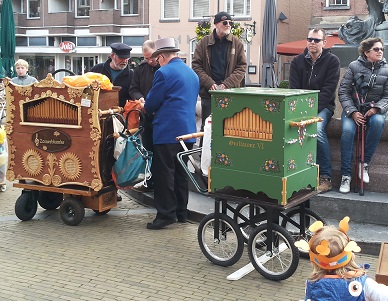
- It is small. Hobby crank organs are counted in notes (the number of distinct tonal steps the medium can call, equivalently the number of tracker-bar channels), and the amateur range runs from about 20 notes up to the low 40s. Twenty notes is the accepted entry point; past roughly 40 the instrument grows from a shoulder-slung or trolley-borne “busker” organ toward a small fairground organ, with the pipe count, wind demand, and cost climbing accordingly.
- It is built from a plan, by hand. The defining social fact of the hobby is that the knowledge is packaged as buildable plans and construction reports, not passed down through a professional apprenticeship. A retired engineer, a woodworker, or a determined beginner buys a plan, follows it, asks the community when stuck, and ends up with a playing instrument.
Note — note count is not pipe count. A note is a channel of the music medium; a pipe is one physical sounding tube. A single note usually feeds several pipes at once through the registers (a stopped flute, a violin/string pipe, a piccolo), and the bass may double a pipe per note for body, so a 20-note organ carries far more than 20 pipes and a 42-note organ can carry 80-plus. Keep the two counts separate; the dive always states which it means.
1.2 Why build one — the amateur tradition
The crank organ is unusually hospitable to the amateur, and for concrete reasons.
The entry cost of understanding is low. Every subsystem is mechanical and visible: a bellows either holds air or it does not, a pipe either speaks or it does not, a valve either seals or it leaks. There is no hidden electronics to instrument-troubleshoot (until one chooses to add MIDI), and the failure modes are the kind a patient builder can see, hear, and chase — exactly the leak-hunting and voicing work laid out in Wind Systems Vol 06 and How Organ Pipes Make Sound. The instrument rewards care over capital.
The entry cost of materials is low relative to the result. A first 20-note organ is built largely from wood, leather (or, in the John-Smith economy tradition, rubberised curtain cloth), glue, and small hardware. The single most respected strand of the hobby — John Smith’s “readily-available-materials” ethos, carried forward by Melvyn Wright and the John Smith Universal dive — exists precisely to bring a real, playing pipe organ within reach of someone unwilling to spend professionally.
The tradition is documented and generous. The origin story on the community site is telling: its author began not as a musician or a joiner but as a parent answering a child’s “Can you make a flute for me?”, progressed from flutes to a first 38-note book organ built over about a year, and then organised hobby meetings at the De Locht regional museum in Melderslo and put the whole accumulated method online for others to copy (hobbycrankorgan.com/subdir/en_geschiedenis.htm). That arc — curiosity → one finished organ → teaching the next builder — is the amateur tradition in miniature, and it is why a beginner today starts with a shelf of plans, construction reports, forums, and photo galleries rather than a blank sheet.
1.3 The landscape of amateur designs
Amateur crank organs cluster around a handful of well-documented designs and note counts. The point of this section is orientation, not detail; each design named here is either treated later in this dive or in a sibling dive.
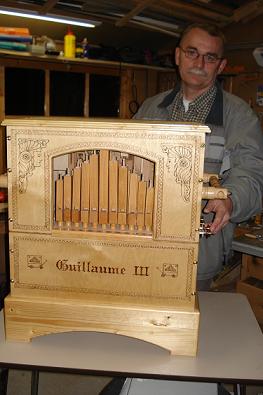
1.3.1 The 20-note standard: Walter Höffle
The de-facto standard first build is Walter Höffle’s 20-note (20-key) crank organ. Höffle — by the site’s account a retired Mercedes-Benz truck-division manager who took up organ building around age 55 and applied a career’s worth of design-and-modelling discipline to it — authored a widely used amateur build book/plan for a 20-note organ, sold (not free) through hobbycrankorgan.com and by direct message (hobbycrankorgan.com/subdir/en_walterhoeffle.htm, hobbycrankorgan.com/subdir/en_hoeffle.htm).
The plan’s stated particulars:
- Scale: the 20-note Carl Frei scale (also known as the Raffin / Stüber 20-note scale) — the de-facto small busker/street scale in Europe.
- Registers: four registers, built from stopped (gedeckt) flutes, a violin (string) pipe, and piccolo / wooden pipes.
- The book: more than 60 pages, plus 8 additional pages aimed at beginners, with detail drawings, measurement tables, building-problem notes, alternative methods, and tuning information. It is published in Dutch, German, Spanish, and English.
- A MIDI edition: a separate companion book, How to build a MIDI-driven 20-note crank organ (English, Dutch, German), recently re-edited with modern components and an added chapter on making the MIDI files.
The pipe-count split across the four registers is on the plan pages / in the book;
this volume does not restate it (per-register counts are (est.) wherever not
directly quoted, and the register/scale layout is Vol 2’s subject). What matters
here is why it is the reference: a documented, four-register, standard-scale
organ small enough to finish, with a plan detailed enough to follow, a photo
gallery of 40-plus realised builds worldwide, and two published construction
reports walking through the work (hobbycrankorgan.com/subdir/en_bouwhoeffle.htm and
/en_20Hoffle2.htm).
Tip — register naming varies; the count of four does not. Different pages and different realised Höffle organs describe the voices with slightly different names (some builders add or rename a rank, and the MIDI edition’s example organ is sometimes listed with five voices). The plan’s canonical specification is four registers on the 20-note Carl Frei/Raffin scale (hobbycrankorgan.com/subdir/ en_hoeffle.htm); treat any five-voice listing as a builder’s variant, not the base design, and see Vol 2 before quoting a register roster.
1.3.2 Scaling up: the community builder’s own organs
The same site documents its author’s progression past the entry design — a useful map of where amateurs go after 20 notes, surveyed here and detailed in Vol 6:
- 31-note organ (hobbycrankorgan.com/subdir/en_31toets.htm) — built to a plan by Ulrich Stille (a German designer), documented in a 180-plus-page manual. 31 notes, 5 registers (later expanded to 6 with an added trumpet), beech-wood pipes, two pipes per tone in the bass for body, sheep-leather bellows, and — the significant divergence — MIDI-driven (solenoid valves on custom-wound spools) rather than paper roll, chosen to save time and cost. Brass valve-chest tubing was replaced with soft plastic to cut mechanical noise. The manual carries a dedicated pipe-making chapter by Klaus Ospelt, and the organ is finished with Bauernmalerei (folk painting) and a trumpet register voiced with melodica reed tongues. This is an intermediate build, and it shows the two axes an amateur scales along at once: more notes, and a shift from mechanical book/roll to electronic MIDI action.
- 38-note book organ (hobbycrankorgan.com/subdir/en_fotogal1.htm) — the site author’s first instrument, a cardboard-book (not MIDI) organ, documented as a construction photo sequence.
- 42-note “Little Mary” (Marietje) (hobbycrankorgan.com/subdir/en_marietje.htm) — a hybrid that plays both MIDI files and paper rolls (a hardwood block on each chest connection makes both media possible), carrying 86 pipes across 42 keys (three 22-pipe melody registers plus 12 accompaniment and 8 bass pipes) on a 51-key Limonaire tonal scheme, MIDI-driven from an SD card, run from a 12 V 7 A battery. It shows the top of the amateur range shading toward small fairground practice.
1.3.3 The sibling in this program: John Smith Universal
Running alongside the Höffle line is the design already covered in the program’s John Smith Universal dive: a 20/26-note organ that plays both the 20-note Carl Frei/Raffin scale and the 26-note Alderman scale (John Smith Universal Vol 03). It shares the Höffle organ’s role as an accessible, heavily documented first (or second) build, and it is the program’s worked reference for the wind system (its Vol 04) and much of the small-organ bench practice cross-referenced throughout this dive. Where this volume needs a second concrete data point beside Höffle, John Smith Universal is it.
1.3.4 A note-count map of the amateur range
1.4 The community and its resources
An amateur builder is never building alone, and knowing the map of the community is part of choosing well.
hobbycrankorgan.com / hobbydraaiorgel.nl is the spine used throughout this dive:
one Dutch hobbyist’s accumulated method, in English translation. Beyond the design
pages already cited, it carries how-tos that this dive draws on directly — how to
make an organ pipe (/en_pijp.htm), violin-pipe intonation (/en_vioolpijp.htm),
making a paper roll/reel (/en_paprol.htm), a computer-driven punching
machine (/en_ponsmachine.htm), a cardboard-book scanner (/en_scanner.htm),
self-arranging (/en_arrangementen.htm), and the Midiboek10 book/MIDI
software for Windows (/en_midiboek10.htm) — plus a fellow-hobbyists gallery
(/en_collegas.htm) and a links page (/en_links.htm). The colleagues page
lists builders across Europe, North America, and the Antipodes (among them Klaus
Ospelt in Liechtenstein, Ian Dickinson’s 20-note Höffle work in the UK, and
plan-designer Ulrich Stille), and the links page points to European clubs and
forums — the Gesellschaft der Orgelfreunde (GDO) home-organ-builders
association, the drehorgelbauen.de German crank-organ forum, the Australian
Mechanical Organ Society, Berlin builder Axel Stöber, and plan publisher
Johan de Vries (hobbycrankorgan.com/subdir/en_links.htm).
Beside that Dutch/German-language hub sits the English-speaking busker-organ community this program leans on elsewhere: Melvyn Wright’s John Smith pages (the reference for the John-Smith economy tradition — bellows, springs, leak-curing), the Carousel Organ Association of America (COAA) and its journal Carousel Organ (the source of the John Smith build articles cited across the Wind Systems and John Smith dives), and the Busker Organ Forum (tapatalk.com/groups/buskerorgan), where day-to-day questions on leather, glue, tuning, and mechanism get answered. A beginner does well to read across both worlds: the hobbycrankorgan site for complete documented designs and pipe/medium how-tos, and the Melvyn Wright / COAA / Busker Organ Forum strand for the readily-available-materials approach and English-language troubleshooting.
1.5 Scales, in one paragraph
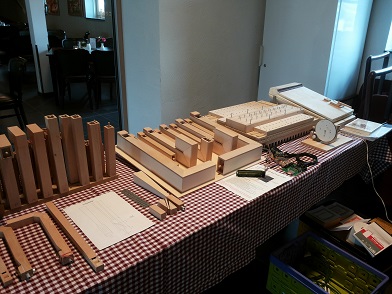
A scale in this world is the fixed roster of pitches a given note count makes available and the order in which the tracker-bar channels are assigned to them; it is what makes music arranged for one 20-note organ play correctly on another. The one that matters most to the beginner is the 20-note Carl Frei scale — the same roster called the Raffin or Stüber scale — which is the de-facto standard for small busker and street organs across Europe and the scale the Höffle plan (and the John Smith 20-note organ) uses. Standardising on it means a builder inherits a large existing library of arrangements and can trade music with other 20-note owners. The next rung up in this program is the 26-note Alderman scale of the John Smith Universal; larger amateur organs move to their own schemes (the 31-note Stille layout, the 42-note “Little Mary” borrowing a 51-key Limonaire scheme). The full scale-and-register layout of the 20-note Carl Frei scale is Vol 2’s subject, and the program’s cross-organ scale comparison is in John Smith Universal, Vol 03; this paragraph only fixes the vocabulary so the survey above reads cleanly.
1.6 Choosing a first build
The first real decision a builder makes is which organ, and it is worth making deliberately because the choice sets the tools, the budget, and the odds of finishing. Four axes matter.
Note count vs. effort. More notes means more pipes, a bigger chest and more valves, a larger wind system, more music to arrange, and more that can go wrong — effort climbs faster than note count. Twenty notes is the accepted floor precisely because it is the smallest count that plays satisfying arrangements while staying finishable by a first-timer.
Medium: mechanical (book/roll/pinned) vs. MIDI. A cardboard book or paper roll keeps the whole instrument mechanical and self-contained — no electronics, no batteries, and the medium is part of the craft — at the cost of building (or buying) a punching/arranging workflow and a robust key frame. MIDI action (solenoid valves driven from a controller, as on the 31-note Stille build) removes the mechanical read mechanism and makes new music a file rather than a punched book, but it adds electronics, solenoids, wound spools, a power source, and a new class of debugging. The choice is a genuine trade, treated in full in Vol 5 and cross-referenced to Encoding the Music.
Documentation depth. Favour a design with a complete published plan plus construction reports and a gallery of finished examples over a thinly documented one. The value of the Höffle 20-note and the John Smith organs to a beginner is precisely that someone has already made every mistake in print.
Budget and skills. Leather-and-hide bellows, bought pipes, and a MIDI stack cost more than curtain-cloth bellows and shop-made wooden pipes; solenoid action needs soldering and a little electronics comfort that a purely mechanical book organ does not. Match the design to the skills already in hand, and plan to acquire the rest in the order the plan needs them.
Table 1 — 6. Choosing a first build
| Decision axis | Easier / lower-risk first build | Harder / higher-reward | Where covered |
|---|---|---|---|
| Note count | 20 notes (Höffle; John Smith 20) | 26 → 31 → 38 → 42 | Vols 2, 6; John Smith Vol 03 |
| Music medium | Cardboard book or paper roll (mechanical, self-contained) | MIDI action (solenoids, controller, power) | Vol 5; Encoding the Music |
| Bellows material | Rubberised curtain cloth (John-Smith economy) | Leather / sheep-hide bellows | Vol 3; Wind Systems Vol 06 |
| Pipework | Shop-made wooden stopped flutes | Violin pipes, beech pipes, reed/trumpet ranks | Vol 4; How Organ Pipes Make Sound |
| Documentation | Full plan + construction reports + gallery (Höffle 20, John Smith) | Sparsely documented one-off designs | Vols 2–3; community (§4) |
| Skills needed | Woodworking, patient gluing, basic tuning | Above + electronics, solenoid winding, arranging | throughout |
Tip — the default first build. For most beginners the lowest-risk, best- documented path is a 20-note, mechanical (book or roll), Carl Frei/Raffin-scale organ built from a complete plan — the Höffle 20-note or the John Smith 20-note. It finishes, it plays a real library of music, and every subsystem is visible and mechanical. Scale up (Vol 6) or go MIDI (Vol 5) as a second project, once the first one plays.
1.7 Roadmap — how this dive is organised
This dive is Dive 8 of the Mechanical Organs program (Track 2, “The Builds”). It sits on top of the Track-1 theory dives and beside the John Smith Universal build, converting general theory into the specific craft of the amateur pipe organ. The eight volumes:
- Vol 1 — The Hobby Path (this volume): what a hobby crank organ is, why build one, the landscape of designs, the community, scales, choosing a first build, and this roadmap.
- Vol 2 — The Höffle 20-Note Organ: Design & Scale. The flagship design in detail: the 20-note Carl Frei (Raffin/Stüber) scale, the four registers and their pipe layout, the book, and what makes it the reference first build.
- Vol 3 — Anatomy & Build Sequence. Following the two Höffle construction reports: the subsystems at hobby scale (case, wind, chest and valves, drivetrain/ crank, register slides) and the order of assembly, with the common build problems and fixes.
- Vol 4 — Pipework the Hobby Way. Making pipes at home: wooden stopped/open flutes, the violin pipe and its intonation, beech pipes, the melodica-tongue trumpet trick, and bench tuning and voicing.
- Vol 5 — The Music Medium. Cardboard book vs. paper roll vs. MIDI at hobby scale: folding books, making a paper roll, the punching machine, the book scanner, Midiboek10 software, self-arranging, and the MIDI/solenoid approach.
- Vol 6 — Bigger Builds & Variants. Scaling past 20 notes: the 31-note Stille build, the 38-note book organ, the 42-note “Little Mary” hybrid, and the vacuum/ “deairing” (onderdruk) pressure-release valve-logic variant.
- Vol 7 — The Professional Benchmark: Jäger & Brommer. The professional end of the same craft — the Waldkirch tradition, the firm, its Drehorgel range, and the Karakuri organ — framed as the benchmark the amateur measures against, never as the source of the hobby designs.
- Vol 8 — Reference & Cheatsheet. Plans/books/software/suppliers directory, the note-count and scale comparison table, glossary, cross-index, and bibliography.
The relationship to the rest of the program is worth seeing whole. The Track-1 dives supply the physics and the vocabulary; this dive supplies the workshop that uses them; the John Smith Universal dive is the parallel worked build. The diagram below is the intended reading order and the load-bearing cross-references.
Read in order, the eight volumes take a builder from “should I?” (this volume) through a specific, finishable design and its parts, to the media that drive it and the ways to grow, closing with the professional bench as a horizon. Read out of order, each volume still stands as a reference on its own subsystem. Either way, the theory it leans on is one dive away, and the sibling John Smith build is the second data point whenever a single documented example is not enough.
1.7.1 Cross-references
- Vol 2 — The Höffle 20-Note Organ: Design & Scale — the four-register layout, the 20-note Carl Frei/Raffin scale, and the pipe/register split deferred from §3.1 and §5.
- Vol 3 — Anatomy & Build Sequence — the subsystems and assembly order behind the “note count vs. effort” and bellows-material choices in §6.
- Vol 4 — Pipework the Hobby Way — making the stopped flutes, violin pipes, and reed/trumpet ranks named in §3.
- Vol 5 — The Music Medium — book vs. roll vs. MIDI in full, behind the medium choice in §6.
- Vol 6 — Bigger Builds & Variants — the 31/38/42-note builds and the onderdruk variant surveyed in §3.2 and §1.
- Vol 7 — The Professional Benchmark: Jäger & Brommer — the professional end of the craft; strictly separate from the hobby designs (see the framing note).
- How Organ Pipes Make Sound (Dive 2) — the flue-pipe acoustics behind the pressure-wind-vs-suction distinction in §1 and the pipework in §3/§6.
- Wind Systems (Dive 3), esp. Vol 06 — the ~5 in H₂O small-organ wind system the crank raises and regulates (§1).
- Encoding the Music (Dive 4) — the theory of barrels/books/rolls/MIDI behind the medium choice in §6 and Vol 5.
- John Smith Universal, Vol 03 — the sibling 20/26-note build; the Carl Frei/ Raffin (20) and Alderman (26) scales referenced in §3.3 and §5.
Sources
- hobbycrankorgan.com / hobbydraaiorgel.nl (English pages under
hobbycrankorgan.com/subdir/en_*.htm) — the amateur-builder community site and the spine of this dive:en_hfdpag.htm— English index / what the site offers.en_geschiedenis.htm— the builder’s origin story and progression (flute → 38-note book organ → the site and the Melderslo De Locht meetings).en_walterhoeffle.htm— Walter Höffle’s background.en_hoeffle.htm— the 20-note Höffle plan: >60 + 8 pages; Dutch/German/Spanish/ English; 20-note Carl Frei (Raffin/Stüber) scale; four registers (stopped flutes, violin, piccolo/wooden); the companion MIDI-driven 20-note book.en_31toets.htm— the 31-note Ulrich Stille build: 180+ page manual; 5→6 registers; beech pipes; two pipes per bass tone; sheep-leather bellows; MIDI/ solenoid action; Klaus Ospelt pipe-making chapter; Bauernmalerei; melodica-tongue trumpet.en_fotogal1.htm— the 38-note cardboard-book organ (photo build sequence);en_fotogal2.htm— the builds gallery.en_marietje.htm— “Little Mary,” the 42-note book/MIDI hybrid: 86 pipes, 51-key Limonaire scheme, SD-card MIDI, 12 V 7 A battery.en_onderdruk.htm— the pressure-release / “underpressure” variant (detail in Vol 6).en_collegas.htm— fellow hobbyists (Klaus Ospelt, Ian Dickinson, Ulrich Stille, and others across Europe / N. America / Australasia).en_links.htm— external resources: GDO home-organ-builders association, drehorgelbauen.de forum, Australian Mechanical Organ Society, Axel Stöber, Johan de Vries, and other builder sites.
- Melvyn Wright, John Smith Busker Organ pages (melright.com/busker), the Carousel Organ Association of America (COAA) and Carousel Organ journal, and the Busker Organ Forum (tapatalk.com/groups/buskerorgan) — the English-speaking busker-organ community and the John-Smith economy tradition referenced in §2 and §4 (as carried into the program’s Wind Systems and John Smith Universal dives).
Marked estimates / unverified. Per-register pipe counts for the Höffle 20-note organ are not restated here and are (est.) wherever the plan does not state them (they are Vol 2’s subject). Register names beyond the plan’s “four registers” vary between realised organs and are treated as builder variants, not the base spec (§3.1). The onderdruk variant — a pressure-wind pipe organ with pressure-release valve logic, not a reed instrument — is described only in outline and deferred to Vol 6, where the page’s mechanism is examined directly rather than characterised second-hand.
Comments (0)