The Hobby Crank Organ · Volume 2
The Hobby Crank Organ — Vol 02: The Höffle 20-Note Organ — Design & Scale
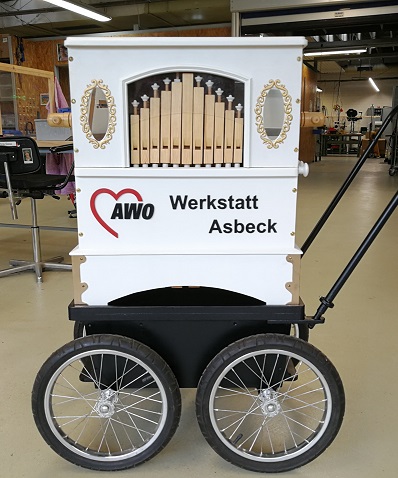
Vol 01 mapped the amateur landscape and placed Walter Höffle’s 20-note crank organ at the centre of it — the design an ordinary builder is pointed to first. This volume characterises that instrument: what it is — its scale, its four registers, its pipework and voicing intent, and why it has become the reference first build for European amateurs. It deliberately stops short of how to build it: the anatomy, the assembly order, and the two published construction reports are the subject of Vol 03, and making the pipes themselves is Vol 04. The intent here is to let a reader understand the design well enough to decide whether it is their first build before they cut a single board.
The instrument is small by any organ standard — twenty notes, four registers, one crank, wind at roughly 5 in H₂O (127 mm ≈ 1.245 kPa) — and that smallness is the point. It is large enough to sound like a real street organ and small enough to be finished on a home bench, and it plays the same commercial scale as the German factory 20er organs, so a builder inherits a ready music library the day the wind holds.
Units and naming note. Note counts are keys/tonal channels; pipe counts are the physical pipes on the chest, which need not equal the note count once a register is only partly ranked (a distinction kept crisp throughout). The scale is named consistently with the sibling dives: the 20-note Carl Frei scale, also sold as the Raffin / Stüber 20-note scale — one scale, three trade names. Anything the source pages do not state directly — pipe-count-per-register above all — is marked (est.) and never invented.
2.1 Walter Höffle and the standing of the design
Walter Höffle came to organ building from engineering, not from music. He was a former manager of the truck division of Mercedes-Benz, where he ran a design department, and he brought that discipline — technical drawing, method, tolerancing — with him when he retired at 55 and took up organ building as a hobby. He built home (electronic) organs first, then turned to mechanical crank organs and set out to document one properly (hobbycrankorgan.com/subdir/en_walterhoeffle.htm).
The result is the thing that carries his name in the amateur world: a 20-key (20-note) crank-organ building book, sold — not free — through the Dutch hobby site hobbycrankorgan.com (the English mirror of hobbydraaiorgel.nl) and by direct message. The book runs over 60 pages of detailed drawings, plus 8 additional pages written specifically for beginners that cover “problems which can happen during building, alternative ways to make several parts, more info about tuning etc.” (hobbycrankorgan.com/subdir/en_hoeffle.htm). Those eight added pages are the tell that this is a teaching document rather than a set of factory prints: they anticipate the beginner’s failures, offer more than one way to make the hard parts, and carry the tuning guidance a first-timer will not find elsewhere. A suitable cart is described in the plans as well, so the finished organ has somewhere to live and be pushed to a pitch.
Two facts establish the design’s standing. First, its reach: the book is published in Dutch, German, Spanish and English, and a companion MIDI-driven edition — “How to build a midi driven 20 note crank organ” — exists in English, Dutch and German, recently re-edited around modern components and with an added chapter on making MIDI files (en_hoeffle.htm). A hobby plan does not get translated into four languages unless people are building from it across borders. Second, its built record: the site’s Höffle photo pages show on the order of 40-plus completed organs (est.) built to these plans by different makers (en_hoeffle.htm; en_hoefflefoto.htm, “Photos of a 20 key Walter Höffle crank organ”). A design with dozens of documented realisations by amateurs is, by definition, buildable by amateurs — which is exactly the property a reference first build must have.
Note — two Höffle instruments, don’t conflate them. The widely-built flagship is the four-register, Carl Frei-scale 20-note book described in this volume. Separately, Höffle’s own personal instrument is described as a 20-key MIDI-driven crank organ with five registers — stopped, stopped vibrato, wood piccolo, violin and quint — documented in a book available in German only (en_walterhoeffle.htm). The five-register MIDI instrument is background; the reference first build is the four-register design, and this volume keeps the two distinct. (This is also distinct from the 31-note Stille build the hobby-site author made himself — see Vol 06 — and from Wolfgang Brommer’s professional Jäger & Brommer instruments in Vol 07; none of these should be cross-attributed.)
2.2 The 20-note scale: Carl Frei (Raffin / Stüber)
The Höffle organ plays “the common used 20 note Carl Frei (Raffin/Stüber)” scale (en_hoeffle.htm) — the de-facto standard small busker/street-organ scale in Europe. Choosing it is the single most consequential design decision in the whole instrument, and it is chosen for compatibility: because Raffin, Stüber, Hofbauer, Schlemmer and Hendrickx all cut rolls to this same 20-note gamut, a Höffle organ built to it can read the large commercial and hobbyist library of 20-note music that already exists, rather than a format the builder would have to populate from scratch. The scale, not the maker, defines the music.
This volume does not reprint the full pitch table; the sibling John Smith Universal, Vol 03 (The Scales & Musical Design) develops it in detail — the authoritative pitch list, the tracker-hole map, the arranging consequences — for exactly this same 20-note scale (there called the Raffin 20-note scale, its other trade name), alongside the 26-note Alderman extension the John Smith instrument can also play. A reader who wants the note-by-note table, the frequencies, and the arranging rules should read that volume; the summary needed here is what the scale means for the Höffle design.
2.2.1 What the twenty notes are, in brief
The 20-note Carl Frei/Raffin scale spans roughly F3 up to D6 and resolves to just eight distinct pitch classes: C, D, E♭, E, F, G, A, B♭ (see John Smith Vol 03 §“The Raffin 20-note scale” for the full gamma and MIDI numbers). That set is an F-major scale (F G A B♭ C D E) with an added E♭ — the flat seventh that lets the organ voice a dominant-seventh colour and modulate comfortably down to B♭ major. The practical shape of the palette, and its limits:
- Home key F major, with B♭ major and the relative D minor / G minor close at hand.
- No B natural anywhere — so true C major is compromised (its leading tone is simply absent), and no F♯ or C♯, so sharp keys and chromatic passing tones are off the table. The scale is diatonic-plus-one, not chromatic.
- Twenty channels are asked to carry bass, harmony and melody at once, which makes arranging an exercise in register economy — the reason the pitches cluster as they do (three low bass channels, then a run of accompaniment and melody channels up top).
For the builder these are not academic points. They determine which music will sound right on the finished organ (folk, march, waltz and popular tunes that sit in F and B♭), and they are baked into the instrument the moment the twenty pipes per rank are cut to these twenty pitches — there is no re-tuning your way to a missing B.
2.2.2 Why the keys are laid out as they are
A crank organ has no keyboard: every note it can ever sound is one fixed channel — one key in the keyframe (or one tracker hole on a roll instrument), feeding one valve, feeding the pipe(s) of that pitch. “20-note” is therefore a literal hardware count: twenty keys, twenty valves, twenty channels. The layout groups them by musical job — a few large, slow-speaking bass channels at the bottom, then the accompaniment middle, then the melody channels on top — because the pipes for each job differ in size and air appetite, and grouping them simplifies the chest and the wind runs. The lateral order of the keys across the keyframe is fixed by the Carl Frei/Raffin standard so that standard music plays; the diagram below is pitch-ordered for legibility, not laid out in physical key order.
2.3 The four registers and the three pipe types
The Höffle 20-note design is described as “a 20 key crank organ with four registers” built from three pipe types: stopped (gedeckt) flutes, violin (string) pipes, and piccolo pipes — the latter of wood (en_hoeffle.htm). Four registers on twenty notes is a genuinely musical specification for so small an instrument; a minimal busker organ often has one or two ranks, and four gives the crank operator real timbral variety. Understanding the design means understanding what each pipe type contributes and how four registers are derived from three pipe types.
Verification note — register-to-pipe-type mapping is (est.). The plan page states four registers and lists the three pipe types, but it does not enumerate which register is which, does not give a pipe count per register, and does not state the compass of each rank (en_hoeffle.htm, confirmed by direct fetch). The four-register breakdown below is therefore an (est.) reconstruction, grounded in two facts and flagged as such: (a) Höffle’s own five-register MIDI instrument lists its registers explicitly as stopped, stopped vibrato, wood piccolo, violin and quint (en_walterhoeffle.htm) — drop the quint and the remaining four map exactly onto the three pipe types named for the book design; and (b) the sibling John Smith Universal likewise builds a slightly-sharp beating rank alongside its stopped and open flutes to fake a tremolo (John Smith Vol 05). The register names and roles are thus well-founded; the exact pipe counts are not stated and must not be invented.
2.3.1 The three pipe types and their voices
Each pipe type is a flue pipe — air across a mouth, no reed (except the piccolo, still a flue; the reed tricks belong to bigger builds, Vol 06). Their acoustics — how a flue mouth sets up the standing wave, why a stopped pipe sounds an octave below an open pipe of the same length, and where the overtones come from — are developed in the program’s “How Organ Pipes Make Sound” dive (Dive 2); the summary needed here is timbre and role.
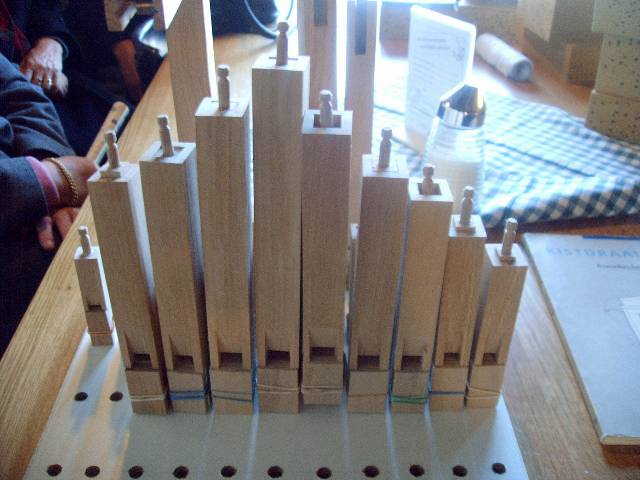
- Stopped (gedeckt) flute — the foundation. A wooden pipe closed at the top by a plug or cap. Closing the far end halves the effective acoustic length, so a stopped pipe sounds roughly an octave lower than an open pipe of the same physical length — which is precisely why it is the small organ’s friend: it buys bass and body from short, easily-made wooden pipes. Its tone is round, mellow and slightly hollow (the stopped end suppresses the even harmonics, leaving a hooty, clarinet-tinged fundamental-heavy voice). This is the foundation register — the sound the organ makes when nothing else is drawn, the rank that carries the bass and fills the harmony.
- Violin (string) pipe — the singing voice. A narrow, tall open pipe of the string (viol) family. Its small scale (narrow bore relative to length) makes it “more overtones and violin like” and “normally not as loud as, for instance, the stopped pipes” (en_vioolpijp.htm) — a bright, keen, overtone-rich tone that cuts through and adds the “singing” line a stopped rank alone cannot. Its narrowness is also its difficulty: “Because of their tall shape the danger exists that these pipes will sound one octave higher” — the pipe wants to overblow to its second mode. The classic cure, credited to Gavioli, is the frein (beard/roller): a strip of 0.5-1 mm brass plate set across the mouth. “By changing the distance between the brass plate and the body of the pipe, the original base tone will be found and the pipe will play one octave lower” — the beard bleeds off the excess mouth air and holds the pipe on its fundamental. Höffle’s violin pipes are made over-length with a tuning slide at the top, with the labium and core cut at 9 degrees and air trimmed by a screw in the brass foot (en_vioolpijp.htm). This is the register that turns a toy into a street organ, and it is the one that most rewards careful voicing — the full treatment is Vol 04 and the program’s “Tuning & Voicing” dive (Dive 10).
- Piccolo (wooden) — the bright top. A small, high-pitched open wooden pipe giving a bright, penetrating piccolo/fife voice at the top of the compass. Drawn with the foundation it adds brilliance and “carry” — the sparkle that lets a melody read across a crowded street — without the body having to be voiced loud.
2.3.2 How four registers come from three pipe types
Three pipe types, four registers: the extra register is not an extra pipe type but a second use of the stopped rank, tuned slightly sharp to beat against the first — the small organ’s way of manufacturing a tremolo without a mechanical tremulant. Two stopped ranks a few cents apart, sounded together, produce a slow beating (undulating) “vibrato” as their waves drift in and out of phase, which the ear reads as warmth and motion. Höffle names exactly this register — “stopped vibrato” — on his five-register MIDI instrument (en_walterhoeffle.htm), and the same undulating-stop trick is used on the John Smith Universal’s slightly-sharp rank (John Smith Vol 05). The most likely four-register set for the book design is therefore (est.):
Table 1 — book design is therefore (est.)
| # | Register | Pipe type | Voice / role |
|---|---|---|---|
| 1 | Gedeckt (stopped) | Stopped flute | Foundation: round, mellow body; carries bass + harmony |
| 2 | Gedeckt vibrato (undulating) | Stopped flute, slightly sharp (est.) | A second stopped rank a few cents sharp, beating against #1 for a warm tremolo |
| 3 | Violin (string) | Violin pipe | Bright, keen, overtone-rich singing line; the “street organ” voice |
| 4 | Piccolo | Wooden piccolo | Bright, penetrating top; brilliance and carry |
The counterpart on the reed-and-quint end — Höffle’s fifth quint register on the MIDI instrument — sounds a pipe a fifth above the played note to add a synthetic upper harmonic (a mutation), and is dropped from the four-register book design. Reading the two Höffle specifications side by side is the clearest evidence for the mapping above: the book keeps the four registers that any small street organ wants, and the larger personal instrument adds the quint mutation on top.
2.4 Register/pipe layout & voicing intent
2.4.1 The ranks on the chest
Physically, each register is a rank — a row of pipes, one per note it covers, standing on the wind chest and admitted (or not) by that register’s stop slider (or on/off control). Drawing a register slides its rank into play across the compass; sounding a key then admits wind to every drawn rank’s pipe of that pitch at once, so the operator hears the selected timbres stacked. How the four ranks sit on the chest of a Höffle organ is not dimensioned on the source page, but the general order follows the pipes’ size and speech: the large, slow bass gedeckt pipes stand where they have room and can be fed generously (typically at the back or along one side), with the melody gedeckt, violin and piccolo ranks forward, the tall violin pipes taking the most height. The register-switching mechanism itself — how many controls, sliders vs on/off pallets, and where they fall to hand — is a build detail the plan page does not describe (est.); Vol 03 follows the two construction reports for the chest and register hardware.
2.4.2 Unison ranks, the beating stop, and the overall voice
Three of the four ranks are unison — gedeckt, violin and piccolo all sound their pitch of a played note, differing in octave placement and timbre rather than in tuning. The piccolo typically sits an octave (or a bit more) above the foundation in effect, so drawing it does not add a second note at the same pitch but a brighter partial above the tune; the violin sings at or near unison with a keener spectrum. The fourth rank is the deliberate exception: the gedeckt vibrato rank is tuned a few cents sharp of the foundation so that, sounded together, the two stopped ranks beat — the undulating “vibrato/céleste” effect. This is the small organ’s substitute for a mechanical tremulant (the program’s Wind Systems dive, Vol 05, treats how a slightly-sharp rank fakes a tremolo in place of shaking the wind): rather than modulate the whole wind supply, the builder simply mistunes one rank and lets acoustic beating do the work. The beat rate is set by how far sharp the rank is voiced — a voicing choice made at the tuning stage, not a fixed number, and one of the judgement calls Vol 04 and Dive 10 develop.
The overall voice the four registers are aiming at is a compact street organ: a warm gedeckt foundation for body and bass; the undulating stop for a singing, “live” warmth on sustained passages; the violin rank for a keen melodic line that carries; and the piccolo for brilliance on top. Any subset can be drawn, so the crank operator moves from a quiet, mellow gedeckt-only texture to a full, bright four-register tutti — real registrational variety on twenty notes and one crank. Everything speaks on regulated low-pressure wind of roughly 5 in H₂O (the wind chain — feeders, reservoir, spring, spill valve — is the subject of the Wind Systems dive and John Smith Vol 04, cross-referenced rather than repeated here); at that pressure the pipes are voiced to speak promptly and blend, not to shout.
2.5 Why it’s the reference first build
Every property covered above adds up to one conclusion: the Höffle 20-note organ is the design an amateur should build first, and the reasons are worth stating plainly because they are the reasons a reader will or won’t choose it.
- Scope sized to a home bench. Twenty notes and four registers is enough instrument to be worth finishing and not so much that it defeats a first-timer. The pipes are wooden and short (the stopped ranks especially), the wind system is a small crank-and-reservoir set at 5 in H₂O, and the whole thing rides on a described cart. It is a project of months, not years.
- A book that teaches, not just prints. Over 60 pages of drawings plus 8 pages aimed squarely at the beginner — building problems, alternative methods, tuning — in four languages (en_hoeffle.htm). That pedagogical layer is exactly what a first build needs and what raw factory plans lack.
- A proven, de-risked design. On the order of 40-plus documented builds (est.) by different amateurs (en_hoeffle.htm; en_hoefflefoto.htm) means the design is known to work and the common failures are known and answered. A first-timer is not also a test pilot.
- An inherited music library. Because it plays the standard 20-note Carl Frei/Raffin/Stüber scale, the finished organ reads the large commercial and hobbyist 20-note roll/book library from day one — the builder is not obliged to arrange their own music before the organ can perform (John Smith Vol 03 for the music sources on this scale).
- A clear growth path. Building it teaches every subsystem — pipes, chest, wind, drivetrain, music medium — at a manageable scale, which is the right preparation for scaling up. The community’s own progression runs straight through it: the hobby-site author went on to a 31-note Stille build (Vol 06), and larger 38- and 42-note projects exist, all built on the understanding a 20-note first organ gives.
Where it sits on the spectrum is the final point. A minimal busker organ (one or two ranks, valveless, the cheapest way to make a crank organ speak) is easier but musically thin; a 31-note concert build (five or six registers, often MIDI-driven, hundreds of pipes) is a far larger undertaking. The Höffle 20-note sits deliberately between them: four real registers and a full standard scale for genuine musicality, at a scale a determined amateur can actually complete. That middle position — maximum musical return for the first buildable amount of work — is precisely what makes it the reference first build, and the reason Vol 03 turns from what it is to how to build it.
2.5.1 Cross-references
- The Hobby Crank Organ, Vol 01 — The Hobby Path — where the Höffle 20-note sits in the landscape of amateur designs, and choosing a first build.
- The Hobby Crank Organ, Vol 03 — Anatomy & Build Sequence — the two Höffle construction reports (en_bouwhoeffle.htm, en_20Hoffle2.htm): case, chest, register hardware, drivetrain, and the order of assembly this volume deliberately leaves out.
- The Hobby Crank Organ, Vol 04 — Pipework the Hobby Way — making the stopped, violin and piccolo pipes; the frein/beard and violin-pipe intonation; bench voicing of the ranks.
- The Hobby Crank Organ, Vol 06 — Bigger Builds & Variants — scaling past 20 notes (the 31-note Stille build’s 5→6 registers, the 38- and 42-note organs).
- John Smith Universal, Vol 03 — The Scales & Musical Design — the full 20-note Raffin (= Carl Frei/Stüber) pitch table, tracker-hole map, arranging rules, and the 26-note Alderman extension; this volume summarises and cross-refs it rather than reprinting it.
- John Smith Universal, Vol 05 — Pipework & the Four Stops — the sibling four-stop design (open flute, stopped flute, octave, slightly-sharp beating rank), the closest analogue to Höffle’s four registers.
- Program Dive 2 — How Organ Pipes Make Sound — flue-pipe acoustics behind the gedeckt, violin and piccolo voices (why a stopped pipe sounds an octave low; where the string overtones come from).
- Program Dive 3 — Wind Systems (esp. Vol 05 tremulant; Vol 06 small wind system) — the ~5 in H₂O wind chain and how a slightly-sharp rank fakes a tremolo.
- Program Dive 10 — Tuning & Voicing — voicing the ranks and setting the beat rate of the undulating stop.
Sources
- hobbycrankorgan.com/subdir/en_hoeffle.htm — the Höffle 20-key plan/book: “a 20 key crank organ with four registers”; pipe types “stopped flutes … also violin and picolo (wood) pipes”; “the common used 20 note Carl Frei (Raffin/Stuber)” scale; over 60 pages + 8 beginner pages (“problems which can happen during building, alternative ways to make several parts, more info about tuning etc.”); “in Dutch, German, Spanish and English”; the MIDI-driven companion edition; the described cart; ~40+ builder photos (est.). (Register-to-pipe mapping and pipe counts are not stated — marked (est.) throughout.)
- hobbycrankorgan.com/subdir/en_walterhoeffle.htm — Höffle’s background (former Mercedes-Benz truck-division design manager; retired at 55; home organs then crank organs); his own 20-key MIDI-driven organ with five registers: stopped, stopped vibrato, wood piccolo, violin and quint (German-only book) — the basis for the (est.) four-register mapping.
- hobbycrankorgan.com/subdir/en_hoefflefoto.htm — “Photos of a 20 key Walter Höffle crank organ”; the gallery of built examples (image index, no per-photo captions).
- hobbycrankorgan.com/subdir/en_vioolpijp.htm — violin-pipe character (“more overtones and violin like,” quieter than stopped pipes) and intonation: the tall shape’s tendency to “sound one octave higher,” over-length pipe with a top tuning slide, Gavioli’s frein/beard of 0.5-1 mm brass (“By changing the distance between the brass plate and the body of the pipe, the original base tone will be found and the pipe will play one octave lower”), 9° labium/core, foot air screw.
- Cross-referenced (not re-derived here): John Smith Universal Vol 03 (the 20-note Raffin/Carl Frei pitch table, frequencies and arranging; the 26-note Alderman extension) and Vol 05 (the sibling four-stop pipework); the Mechanical Organs program’s Wind Systems dive (≈ 5 in H₂O = 127 mm ≈ 1.245 kPa; the beating-rank tremolo) and How Organ Pipes Make Sound dive (flue-pipe acoustics).
Comments (0)