The Hobby Crank Organ · Volume 4
The Hobby Crank Organ — Vol 04: Pipework the Hobby Way
Vol 02 laid out the Höffle 20-note design — the Carl Frei / Raffin scale and the four registers that give the organ its voice; Vol 03 followed the case, wind, and chest into a mechanically finished instrument. This volume is the part a builder often dreads and then discovers is the most satisfying bench work in the whole project: making the pipes and coaxing each one to speak. A crank organ with perfect wind and a silent or sour rank is not an organ. The pipes are where the sawdust turns into music.
The acoustics of why a pipe sounds — the air jet, the edge tone, the standing wave, why a stopped pipe drops an octave, how scale sets timbre — belong to the program’s “How Organ Pipes Make Sound” dive (Dive 2) and are not re-derived here. This volume stays on the workshop side of the line: which boards to cut from what wood, how to glue a square airtight box, how to form a mouth that speaks, the peculiar trouble of the string pipe, the hobbyist’s melodica-reed shortcut to a trumpet voice, and how to voice and tune a rank at the bench at the organ’s own working pressure. Where the acoustics matter, they are cross-referenced; where the craft matters, it is spelled out.
Units and sourcing note. Dimensions are in millimetres (the hobby-site pages are metric); pitch errors in cents (100 cents = one equal-tempered semitone); wind pressure in inches of water column with the metric equivalent. The worked pressure throughout is the small-organ standard of ~5 in H₂O (127 mm ≈ 1.245 kPa) — see the Wind Systems dive and John Smith Universal, Vol 04; it is not re-derived here. Facts drawn directly from a hobbycrankorgan.com page are cited inline as
hobbycrankorgan.com/subdir/en_<page>.htm; anything the pages do not pin down is marked (est.) and never invented. Note count ≠ pipe count — the caution runs through this whole volume.
4.1 What pipes a hobby organ needs
A 20-note Höffle organ is described as four registers built from three pipe
types — stopped (gedeckt) wooden flutes, open wooden flutes / piccolo,
and violin (string) pipes — with the bass often doubled (two pipes per
bottom note for body). The exact pipe-count-per-register lives on the Höffle plan
pages and in the book and is not to be inferred: the four registers do not
simply multiply 20 × 4, because registers need not run the full compass and the
doubled bass shares notes across ranks. What is certain is that a 20-note organ
carries well more than 20 pipes — realistically several dozen once the four
registers and the doubled bass are counted (est.; verify the split against
en_hoeffle.htm).
The three types divide the tonal labour cleanly, and each is voiced, tuned, and troubled differently:
Table 1 — troubled differently
| Register type | What it is | Tone | Length vs pitch | Tuning control |
|---|---|---|---|---|
| Stopped / gedeckt flute | Square wooden box, closed at the top by a sliding stopper | Round, hollow, quiet; odd harmonics dominate | Sounds ~one octave lower than an open pipe of the same length (half the length) | Slide the stopper in (sharp) / out (flat) |
| Open flute / piccolo | Square wooden box, open at the top | Fuller, brighter, full harmonic series | Sounds at the length’s own pitch | Cut / slide the top; tuning flap or ears |
| Violin / string pipe | Tall, narrow-scale open box with a mouth beard (frein) | Keen, reedy, string-like — many overtones | Open-pipe pitch, but the narrow scale makes it want to over-blow the octave | Tuning slide at the top; the frein sets which octave it speaks |
The stopped rank is the workhorse and the easiest to build and tune, which is why it forms the backbone of the small organ; the open flute/piccolo adds brightness and a proper octave of harmonics; the violin pipe supplies the singing edge that makes a busker organ sound like more than a music box — and is, by a wide margin, the hardest of the three to make speak (§3). The four registers are drawn from these three types by scaling and by doubling; the register scheme and which notes each covers is Vol 02’s subject and is not repeated here. For why a stopped pipe halves in length and sounds hollow, and why a narrow string pipe over-blows, see How Organ Pipes Make Sound, Vol 03 (Open vs Stopped) and Vol 04 (Scaling).
4.2 Making a wooden flue pipe
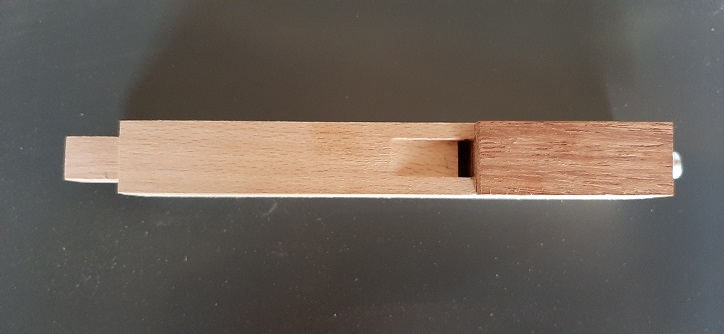
The hobby organ’s flute pipes — stopped and open alike — are wooden boxes of
square section, built up from flat boards, with a block (languid) plugging
the foot and a mouth cut into the front. The community how-to
(hobbycrankorgan.com/subdir/en_pijp.htm) describes the amateur method in enough
detail to follow at the bench; the specific mould for the upper lip is documented
in Walter Höffle’s book rather than on the page.
4.2.1 The boards and the wood
The pipe body is essentially five pieces of wood plus the internal block:
- the back — the broadest board, running the full length of the pipe;
- two sides, glued to the edges of the back to form three walls of the tube;
- the cap — the short front board below the mouth;
- the front — the board above the mouth that carries the upper lip;
- the block (languid) — a solid plug that fills the foot and, with the cap, forms the windway and the lower lip.
The hobby-site pages call the block the core and cut it from beech,
roughly 100 mm (≈ 10 cm) long for the range of pipes shown; the front board
is also beech, chosen because “it looks more decorative and makes the pipe
stronger” (en_pijp.htm). The remaining boards (back, sides, cap) can be beech
too, or the traditional softwood pipe woods — fir or pine — which are lighter,
cheaper, and easy to plane true (general wooden-pipe practice; the site’s own pipes
lean on beech — treat fir/pine as the classic alternative, est. for this build).
Board thickness is not given on the page; for small-organ flutes it runs on the
order of 6–10 mm (est.), scaled thicker for the bass and thinner for the
treble so the walls stay rigid without adding needless mass.
4.2.2 Squareness and airtight glue lines
The one rule that governs the whole box is that it must be square and airtight.
A wooden flue pipe is a resonator; a wall that bows, a joint that leaks, or a
racked-over section bleeds wind and dulls or kills the tone. The hobby method is
plain hand-work: plane every board smooth and free of splinters, glue the box
up true, and then file every internal surface where the air flows until it is
clean, “so the pipe becomes airtight” — glue squeezed out of the joints is
deliberately spread thin along the inside walls with a narrow stick to seal the
end grain and any gaps (en_pijp.htm). The upper surfaces are sanded back “until
every part becomes equal,” i.e. until the mouth components line up flush. There is
no magic here and no expensive tooling — the airtightness is won with a plane, a
file, a sanding block, and patience, exactly as the small wind system’s tightness
is won with thin even glue lines (Wind Systems, Vol 06 §3).
4.2.3 The mouth: block, windway, and the two lips
The mouth is where wind becomes sound, and its three parts must be formed together:
- The block (languid) and the cap leave a thin slot between them — the windway (flue gap) — that shapes the wind into a flat sheet and aims it at the upper lip. On a hobby wooden pipe the windway is set by the fit of the cap against the block; a paper or thin-card shim laid on the block while the cap is glued, then withdrawn, gives a uniform slot across a rank (the John Smith practice of a cereal-box-cardboard shim ~0.4–0.5 mm is the same idea — see John Smith Universal, Vol 10 §2.4).
- The lower lip is the top edge of the cap, across which the air-sheet emerges.
The hobby tip is to darken the lower lip with a pencil, which the page frames
as a way to “increase the air flow” — the graphite very slightly smooths and seals
the edge so the sheet forms cleanly (
en_pijp.htm). - The upper lip is the edge on the front board that the sheet strikes; its exact
profile is formed with a special mould described in Höffle’s book
(
en_pijp.htm). The cut-up — the height of the upper lip above the block line — is the single most important voicing dimension and is set later (§5), which is why the front board is fitted so it can be adjusted before final gluing.
The relationship of block, windway, and lips is the whole flue-pipe principle; its physics — the jet, the edge tone, and the feedback that sustains the note — is How Organ Pipes Make Sound, Vol 02, and is not repeated here.
4.2.4 Ears
Small wooden flaps — ears — glued to the two vertical edges of the mouth are standard on the lower pipes. They shelter the air-sheet from side draughts, stabilise speech, help a long or reluctant pipe start promptly, and load the mouth so the pipe speaks a little flatter for its length — buying back length in a case that has none to spare. On the small organ ears earn their keep on the bass flutes and on the string pipes (§3), where prompt speech is hardest. Their pitch- and speech-shaping physics is How Organ Pipes Make Sound, Vol 06 (Voicing); their use on the sibling build is John Smith Universal, Vol 10 §2.5.
4.2.5 Stoppers — making a gedeckt pipe
A stopped (gedeckt) pipe is simply an open pipe closed at the top by a stopper, and the payoff is dramatic: a stopped pipe sounds about an octave lower than an open pipe of the same length (equivalently, it is roughly half the length for a given pitch), and its tone is rounder and quieter. For a small organ short on internal height this is decisive — the bass is stopped so it fits the case.
The hobby method makes the stopper from the offcut left over from cutting the
block/core, filed with slightly oblique (tapered) ends so it will slide, and
faced with a piece of leather cut octagonal and glued to the end. The leather is
sized so it clamps against the inner walls, giving an airtight seal that still
slides under hand pressure (en_pijp.htm). That sliding fit is not just for
assembly: the stopper is the tuning control for the whole stopped rank (§6). It
must stay airtight across its travel — a stopper that leaks past its leather lets
the pipe hunt between the stopped and open pitch and never settles.
4.3 The violin (string) pipe and its intonation
The violin pipe is the small organ’s problem child. It is a narrow-scale
open pipe — tall and thin relative to a flute — and the narrow scale is exactly what
gives it its keen, overtone-rich, string-like voice (en_vioolpijp.htm, which
places it in the “strings” group with “more overtones and violin-like” tone than a
principal). But the same slenderness is a curse at the bench: “because of their
tall shape the danger exists that these pipes will sound one octave higher”
(en_vioolpijp.htm). A narrow pipe couples weakly to its fundamental and readily
jumps to the first over-blown mode — the octave — instead of speaking its intended
note. Left alone, a string pipe is as likely to scream the octave as to sing.
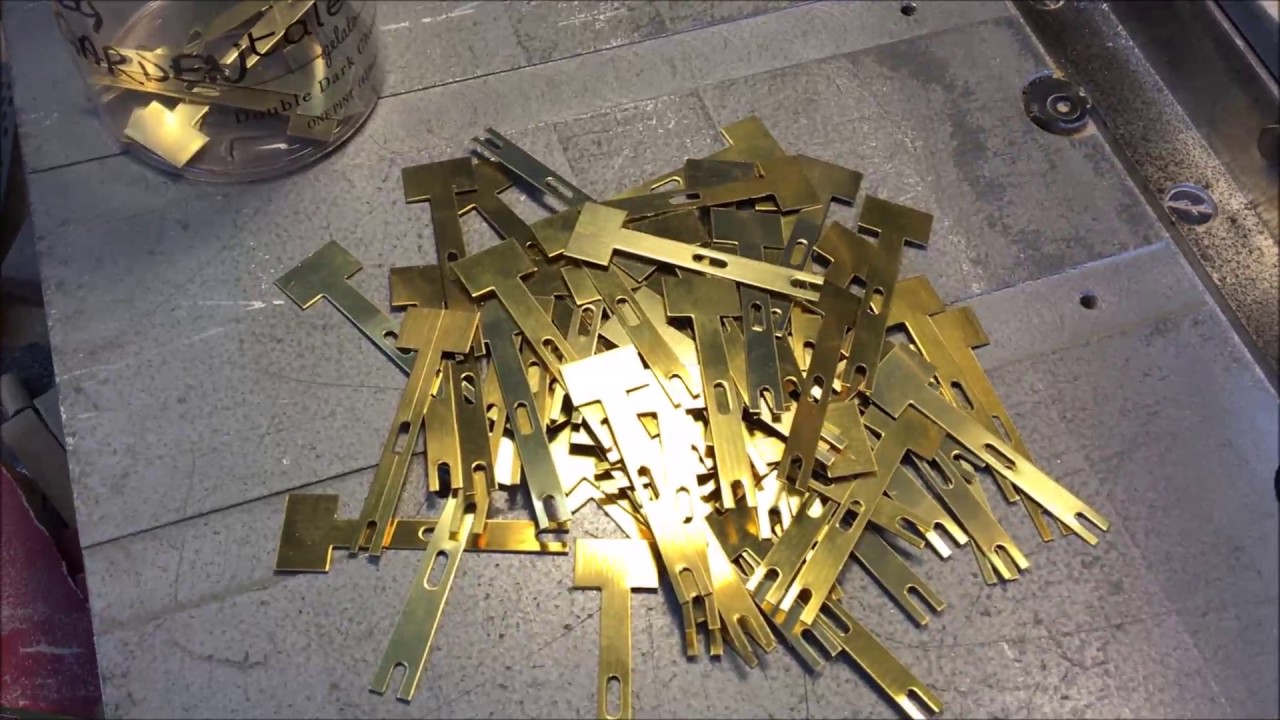
4.3.1 The frein (beard) — Gavioli’s fix
The classic cure, credited on the page to the fairground-organ builder Gavioli,
is the frein — French for “brake,” and known in Dutch/German building as the
beard (Bart). It is a flat plate of brass (or aluminium), 0.5–1 mm thick,
mounted across the front of the mouth a small distance out from the lips
(en_vioolpijp.htm). Aerodynamically the frein disturbs the region just outside the
mouth so that, in the page’s words, “the air will be pulled out of the pipe” —
it loads and steadies the air-sheet enough to hold the pipe on its fundamental
instead of letting it flip to the octave. A common variant seen on string pipes is
the roller beard (Rollbart) — a cylindrical rod in place of the flat plate, or a
pair of side beards — but the flat brass plate is the form the hobby page describes.
4.3.2 Voicing the string pipe: build high, then pull it down
The intonation procedure on the page is elegant and worth following exactly, because it turns the octave-jumping fault into the tuning method:
- Make and voice the pipe without the frein, deliberately letting it speak one octave too high — the pipe’s natural inclination.
- Fit the frein, then adjust the distance between the brass plate and the
body of the pipe. As the plate is brought to the right gap, “the original base
tone will be found and the pipe will play one octave lower” (
en_vioolpijp.htm).
In other words the frein gap is dialled until the pipe drops from the octave to its
proper note, and that gap is the pipe’s voicing setting. Two supporting details from
the page complete the string pipe: the labium and the core angles are both set to
9 degrees (en_vioolpijp.htm) — a keener, more angled mouth than a flute’s — and
the foot carries a screw fitted in the brass foot pipe to regulate the wind
admitted, with a tuning slide at the top for pitch (§6). Ears on the mouth
edges (§2.4) further steady the speech, and are common on string pipes for exactly
that reason.
4.3.3 Why string pipes are the hardest to voice
Everything about a string pipe fights prompt, stable speech. The narrow scale wants the octave; the keen mouth is fussy about windway and cut-up; and the frein gap interacts with all of it, so a change to one setting un-does another. The consequence at the bench is that string pipes are slow to speak — they take a perceptible instant to settle onto the fundamental — and the frein, ears, and windway must be trimmed together, patiently, until the pipe starts cleanly on its note every time rather than yodelling to the octave on a hard-cranked chord. This is why the string rank is voiced last and why a first-time builder is well advised to get the stopped and open flutes singing before tackling it. The underlying acoustics — why a narrow scale over-blows and how the frein re-establishes the fundamental — are How Organ Pipes Make Sound, Vol 04 (Scaling) and Vol 06 (Voicing).
4.4 The melodica-tongue trumpet trick
A reed (trumpet) voice is the one register that most tempts a builder and most
frustrates a hobbyist. A conventional organ reed pipe is a small assembly — a brass
tongue beating against a shallot, its length set by a tuning wire — and
it is fiddly to make, fiddly to keep in tune, and demands metalworking a home
builder may not want (see How Organ Pipes Make Sound, Vol 05 (Reed Pipes) for
the real thing). The author of the site’s 31-note organ (built to Ulrich
Stille’s plan) sidestepped the whole problem with a hobbyist’s substitution worth
recording (en_31toets.htm).
Rather than build traditional trumpet pipes with metal-wire adjustment — “deemed
impractical for hobby builders” — he harvested the reed tongues from a melodica
and used them as the sound-producing element inside a pipe. The key enabling fact is
pressure: a melodica “uses about the same air pressure as the organ”
(en_31toets.htm), so its free reeds speak happily on the organ’s ~5 in H₂O
wind without redesign. The reeds are freed from the melodica (“just fifty screws,”
the page notes drily) and mounted into pipe housings based on designs from Walter
Höffle, giving a reed-timbred rank for a fraction of the work of true beating-reed
trumpets.
Two points keep this honest. First, a melodica tongue is a free reed (it swings
through its slot, like a harmonica or accordion), not the striking/beating reed
on a shallot that a classical organ trumpet uses — so the result is a reed voice
obtained by a shortcut, not a scratch-built organ reed pipe; the timbre and speech
differ accordingly (How Organ Pipes Make Sound, Vol 05 distinguishes striking
from free reeds). Second, this is a documented individual builder’s solution on
the 31-note organ, not a feature of the standard 20-note Höffle design — a
hobbyist option to know about, not a spec of the flagship build. The same 31-note
build is where the beech-pipe practice and the doubled bass (two pipes per
tone in the bass, “for more body in the tone”) are recorded, and where Klaus
Ospelt’s dedicated pipe-making chapter in the Stille manual is singled out as the
clearest amateur pipe reference (en_31toets.htm) — a pointer for any builder who
wants a book-length treatment beyond this volume.
4.5 Voicing at the bench
Voicing is adjusting a pipe’s mouth until it speaks promptly, cleanly, and in the intended tone — and it is a separate operation from tuning, done first, because the voicing adjustments (cut-up above all) shift pitch as a side effect. The governing rule is absolute and worth stating before any adjustment: voice every pipe at the pressure the organ actually holds — the small-organ standard ~5 in H₂O (127 mm). A pipe voiced on a shop compressor at some other pressure will over-blow or go dull once it is on the organ’s own wind (John Smith Universal, Vol 10 §2.1; Wind Systems dive for the pressure).
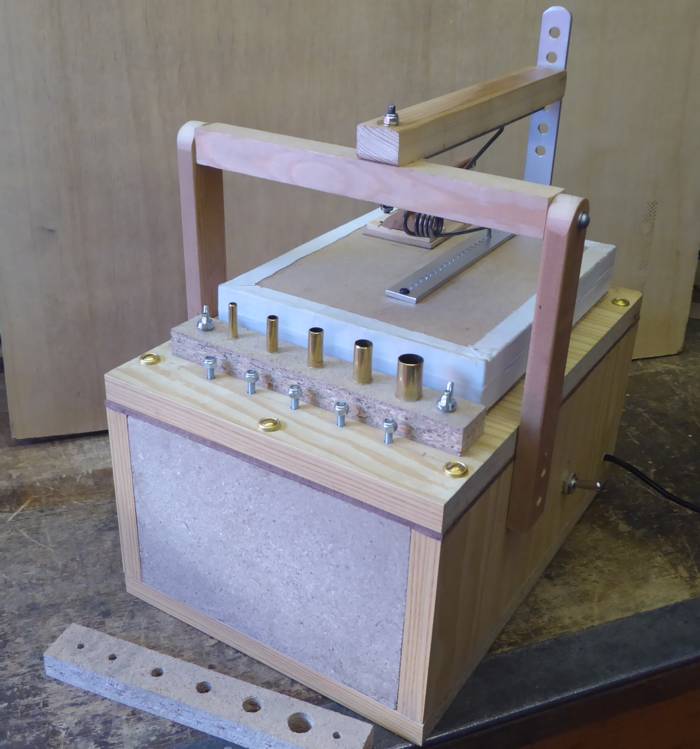
4.5.1 The bench setup and the voicing jig
The cleanest way to voice at working pressure is a small voicing machine (jig) — a single valved wind outlet fed from a reservoir trimmed to 5 in H₂O against a manometer, into which one pipe at a time is seated so its mouth can be dialled in on the bench before final assembly. John Smith’s community documents exactly such a jig (Melvyn Wright, “Making a Pipe Voicing Machine”), and it is cross-referenced in detail at John Smith Universal, Vol 10 §1. The hobbyist without a jig voices each pipe in place on the organ’s own chest; either works, provided the manometer confirms 5 in H₂O at the pipe.
4.5.2 The controls, in order of authority
- Cut-up — the height of the upper lip above the block/windway line — is the dominant control. Higher cut-up → rounder, slower, breathier, weaker fundamental; lower cut-up → brighter and louder, until it chokes, hisses, or over-blows to the octave. The best tone sits in a window between. Because cut-up is decisive and hard to reverse, the front board (or a sliding cover) is left adjustable so the cut-up can be swept and marked before gluing — the sliding- cover method is spelled out at John Smith Universal, Vol 10 §2.2.
- Windway (flue gap) — the slot between block and cap — aims and thickens the air-sheet. Narrower → thinner, faster sheet, brighter and more harmonic but hiss-prone; wider → thicker, slower sheet, rounder but sluggish and wind-hungry. Set uniformly across a rank with a card shim (§2.3) and treated as a rank-wide character decision, not a per-pipe fiddle.
- Foot / toe hole — the opening at the foot that admits wind — meters how much wind reaches the mouth. On the hobby string pipe this is literally a screw in the brass foot (§3.2); on flute pipes the foot-hole size does the same job. Opening it gives more wind (louder, but can over-blow); closing it starves the pipe (quieter, but can go dull or fail to speak). It is the primary loudness-regulation control across a rank — the tool for making a bright treble pipe and a lazy bass pipe sit at a matched volume.
- Lower-lip treatment — the hobby page’s pencil-darkening of the lower lip (§2.3) is a small speech aid; on metal pipes the equivalent is a lightly rounded or dressed lower-lip edge.
- Nicking — small notches filed into the block edge or lower lip to break up the air-sheet and steady speech — is a classical voicer’s tool, especially for taming chiff and stabilising a difficult pipe. The hobby pages emphasise the pencilled lip and the windway/cut-up over aggressive nicking, and many small wooden flute ranks are voiced with little or no nicking; treat it as an available fix for a pipe that will not settle rather than a routine step (general voicing practice; How Organ Pipes Make Sound, Vol 06).
4.5.3 Regulating the rank
Voicing a single pipe is only half the job; the rank must be regulated so all pipes match in loudness and promptness up the compass. Bass pipes are naturally lazy and quiet, trebles naturally shrill and eager, so the foot-holes are trimmed pipe by pipe — opening the bass, easing the treble — until a scale run sounds even. The bench sequence is: get the windway right rank-wide, sweep and mark each cut-up for best tone, then regulate loudness with the foot-holes, checking a full scale by ear. Only when the whole rank speaks promptly and evenly at 5 in H₂O is it ready to tune (§6).
4.5.4 Voicing symptom → cause → fix
Table 2 — 5.4 Voicing symptom → cause → fix
| Symptom | Likely cause | Fix |
|---|---|---|
| Won’t speak / very slow to start | Cut-up too high; windway blocked; foot-hole too small (wind-starved) | Lower the cut-up toward the window; clear/re-shim the windway; open the foot-hole; confirm 5 in H₂O at the pipe |
| Thin, breathy, no body | Cut-up too high; windway too narrow | Lower the cut-up; widen the windway shim rank-wide |
| Hiss / wind noise over the tone | Windway too narrow; air-sheet not meeting the lip cleanly | Widen the windway; dress/darken the lower lip; check upper-lip edge |
| Choked, strangled, reedy | Cut-up too low; foot-hole too large | Raise the cut-up; reduce the foot-hole |
| Over-blows to the octave; pitch flies sharp | Cut-up far too low, or wind/foot-hole too high; on a string pipe, no/mis-set frein | Raise cut-up; reduce wind; set the frein gap (§3.2) |
| String pipe yodels between note and octave | Frein gap wrong; ears missing; windway off | Trim the frein gap; add/adjust ears; re-shim windway; voice patiently, last |
| Bass lazy / treble shrill across the rank | Unregulated foot-holes | Open the bass foot-holes, ease the treble, match by ear over a scale |
| Speaks but pitch unstable / warbles | Wind bouncing (a wind fault, not the pipe) | Steady the wind first (Wind Systems dive), then re-judge |
4.6 Tuning and temperament at hobby scale
Voicing sets tone; tuning sets pitch — and because voicing moves pitch, tuning is done after voicing is finished, and at the same 5 in H₂O the organ will play at (pipe pitch tracks pressure; John Smith Universal, Vol 10 §3.1). Tune one pipe at a time on the organ’s own air.
4.6.1 What to adjust, by pipe type
- Stopped (gedeckt) pipes are tuned by sliding the stopper: push it in to shorten the effective column and sharpen; pull it out to lengthen and flatten (§2.5). This is why stopped pipes are cut slightly long — every one is tuned down to pitch by pulling its stopper. The leather facing must stay airtight as it slides.
- Open flute / piccolo pipes have no stopper and are tuned at the top, by length: shortening raises the pitch, so open pipes are cut a little long (flat) and trimmed up to pitch, with a small tuning flap or slide at the top for fine, reversible adjustment (closing the flap flattens the pipe). Ears also nudge an open pipe’s pitch and are set during voicing.
- Violin (string) pipes are tuned by the tuning slide at the top (§3.2); the frein gap is a voicing setting (which octave the pipe speaks), not the fine tuning — set the frein first, then take pitch at the slide.
4.6.2 Tuning to a reference
The pitch of each pipe is read against a reference and brought to zero error. The practical hobby tool is an electronic tuner — a chromatic strobe-class tuner or an organ-tuning app/software driven by a small microphone at the pipe mouth (the John Smith community’s tool of record is TUNE!IT by Detlef Volkmer; any organ-tuner app serves). The essentials are a mic, a display reading in cents against a chosen temperament and A-reference, and a space quiet enough that the tuner hears the pipe, not the crank. Because a busker organ plays alone, absolute concert pitch matters far less than being in tune with itself — the organ need not sit exactly at A4 = 440 Hz, only be internally consistent. The full tuning rig and workflow are John Smith Universal, Vol 10 §3, and the program’s “Tuning & Voicing” dive (Dive 10) treats the subject at length; they are cross-referenced rather than duplicated.
4.6.3 Temperament, briefly
A temperament is how the twelve semitones are spaced. For a solo crank organ the choice is simple: equal temperament (every semitone 100 cents) is the default and the sane pick, because a busking repertoire wanders across keys and rolls are arranged without regard to a home key. Historical temperaments (meantone, well) are possible and occasionally chosen for a period sound, but they constrain the repertoire and are not recommended for a first organ. The reasoning is developed in How Organ Pipes Make Sound, Vol 07 (Pitch, Temperament & Tuning) and John Smith Universal, Vol 10 §3.4.
4.6.4 The weather: temperature drift
A flue pipe’s pitch is governed by the speed of sound in its air column, and the speed of sound rises with temperature — so a pipe runs sharp when warm and flat when cold, on the order of ~3 cents per °C (est.; general pipe-organ behaviour). An organ tuned in a 20 °C workshop can sound noticeably flat played on a 10 °C morning, and “come into tune” as the sun warms the case. The saving grace is that the drift is uniform — every pipe shares the same air and moves together, so the organ stays in tune with itself and a solo listener hears a slightly low organ, not a sour one. Practical consequences: do not chase pitch for weather in the field (re-tuning cold would un-tune it warm); let the organ acclimatise before judging its tuning; and expect a small seasonal touch-up (stopper nudges, not a re-voice) as normal maintenance. The mechanism and numbers are John Smith Universal, Vol 10 §5 and How Organ Pipes Make Sound, Vol 07.
4.7 The measure of a good hobby rank
A well-made hobby rank disappears into the music: every note speaks the instant its valve opens, the scale is even from bass to treble, the string pipes sing on their fundamental instead of screaming the octave, and the whole organ holds its tuning season to season because it was voiced and tuned at its own working pressure. That is bought with cheap materials and patient hand-work — square airtight beech and softwood boxes, a clean mouth with a pencilled lower lip, an airtight sliding stopper, a frein trimmed until the string pipe settles, foot-holes regulated across the rank, and a stopper or slide nudged to pitch against a tuner. None of it needs a professional’s shop; all of it needs care. Get the pipes right and the crank organ stops being a machine that makes noise and becomes an instrument that plays.
4.7.1 Cross-references
- Vol 02 — The Höffle 20-Note Organ: Design & Scale — the register scheme and which notes each register covers; the pipe-count-per-register split this volume deliberately leaves to the plan (§1).
- Vol 03 — Anatomy & Build Sequence — where the pipework sits in the build order, and the chest the pipes stand on.
- How Organ Pipes Make Sound (Dive 2) — the acoustics this volume does not re-derive: Vol 02 (jet, edge tone, speech), Vol 03 (open vs stopped, the octave drop), Vol 04 (scaling and why a narrow string pipe over-blows), Vol 05 (reed pipes — the real trumpet the melodica trick substitutes for), Vol 06 (voicing physics — cut-up, windway, ears, nicking), Vol 07 (pitch, temperament, and temperature drift).
- John Smith Universal, Vol 05 (Pipework) & Vol 10 (Setup, Voicing & Tuning) — the sibling build’s pipe rank, the sliding-cover cut-up method, the voicing jig, the TUNE!IT/manometer tuning rig, ears on the bass, and stopper-vs-length tuning.
- Wind Systems dive — the ~5 in H₂O working pressure every pipe is voiced and tuned against, and why pipe pitch and loudness track it.
- “Tuning & Voicing” (Dive 10) — the program’s dedicated treatment of voicing and tuning at length, of which §5–6 here are the hobby-bench summary.
Sources
- hobbycrankorgan.com/subdir/en_pijp.htm — “How to make an organ pipe”: beech block/core (~100 mm) and beech front board (decorative + stronger); side and bottom boards; filing walls smooth and spreading squeezed-out glue thin along the inside for airtightness; the upper-lip mould “described in the book of Walter Höffle”; the pencil-darkened lower lip “to increase the air flow”; and the stopper made from the core offcut with oblique ends and an octagonal leather facing clamped airtight to the walls.
- hobbycrankorgan.com/subdir/en_vioolpijp.htm — “Intonation of the violin pipe”: the strings-group timbre; the tall-shape tendency to sound an octave too high; Gavioli’s frein (beard) of 0.5–1 mm brass/aluminium that “pulls the air out of the pipe”; the voice-high-then-fit-the-frein method (adjust the plate-to-body gap to drop the pipe an octave to its base tone); labium and core angles both 9°; the screw in the brass foot for wind and the tuning slide at the top.
- hobbycrankorgan.com/subdir/en_31toets.htm — “The making of my 31-note organ” (Ulrich Stille plan): beech pipes; two pipes per tone in the bass “for more body”; Klaus Ospelt’s detailed pipe-making chapter in the manual; and the melodica-tongue trumpet substitution (melodica reeds “use about the same air pressure as the organ,” mounted into pipe housings after Höffle designs) in place of impractical wire-tuned trumpet reeds.
- hobbycrankorgan.com/subdir/en_materiaal.htm — “Material”: membrane leather thinner than 0.5 mm and related hardware (context for the small-organ material scale; the page lists mechanical parts, not pipe woods).
- Melvyn Wright, John Smith Busker Organ pages (melright.com/busker), incl. “Making a Pipe Voicing Machine” (jsart115.htm) — the voicing jig fed from a reservoir at 5 in H₂O against a manometer.
- General pipe-organ practice — the ~3 cents/°C temperature drift of flue pipes (uniform across the rank), equal-vs-historical temperament trade-offs for a solo instrument, foot-hole loudness regulation, and nicking as a speech-steadying tool — developed with sources in the sibling How Organ Pipes Make Sound and John Smith Universal dives; unverified small-organ specifics are marked (est.).
Comments (0)