The Hobby Crank Organ · Volume 7
The Hobby Crank Organ — Vol 07: The Professional Benchmark — Jäger & Brommer
The first six volumes of this dive follow the amateur-builder path: Walter Höffle’s 20-note entry design (Vol 02), the anatomy and build sequence (Vol 03), home-made pipework (Vol 04), the music medium at hobby scale (Vol 05), and the step up to 31-, 38-, and 42-note projects (Vol 06). This volume steps off that path deliberately to look at the professional end of the same craft — the workshop of Waldkircher Orgelbau Jäger & Brommer in Waldkirch, Germany — so that a hobby builder can see clearly what the top of the field looks like, and which of its disciplines carry back down to the home bench.
It is a shorter, sidebar volume by design. It is not a build guide, and it makes no attempt to match the length of the construction volumes.
Framing (read once). The spine of this dive — the community site hobbycrankorgan.com (English mirror of the Dutch hobbydraaiorgel.nl) — is an amateur-builder community site run by a Dutch hobbyist. It is unrelated to Jäger & Brommer. Wolfgang Brommer is neither its author nor mentioned on it, and the hobby designs described in Vols 01–06 are not his. This volume profiles Jäger & Brommer purely as the professional benchmark — the reference point against which the amateur work can be measured — never as the origin of the hobby plans. Where the two ends of the craft rhyme (the 20-note belly organ and the 31-note concert organ have obvious hobby analogues), that is because both draw on the same Waldkirch tradition and the same standard scales, not because one copies the other.
7.1 Waldkirch — the organ-building town
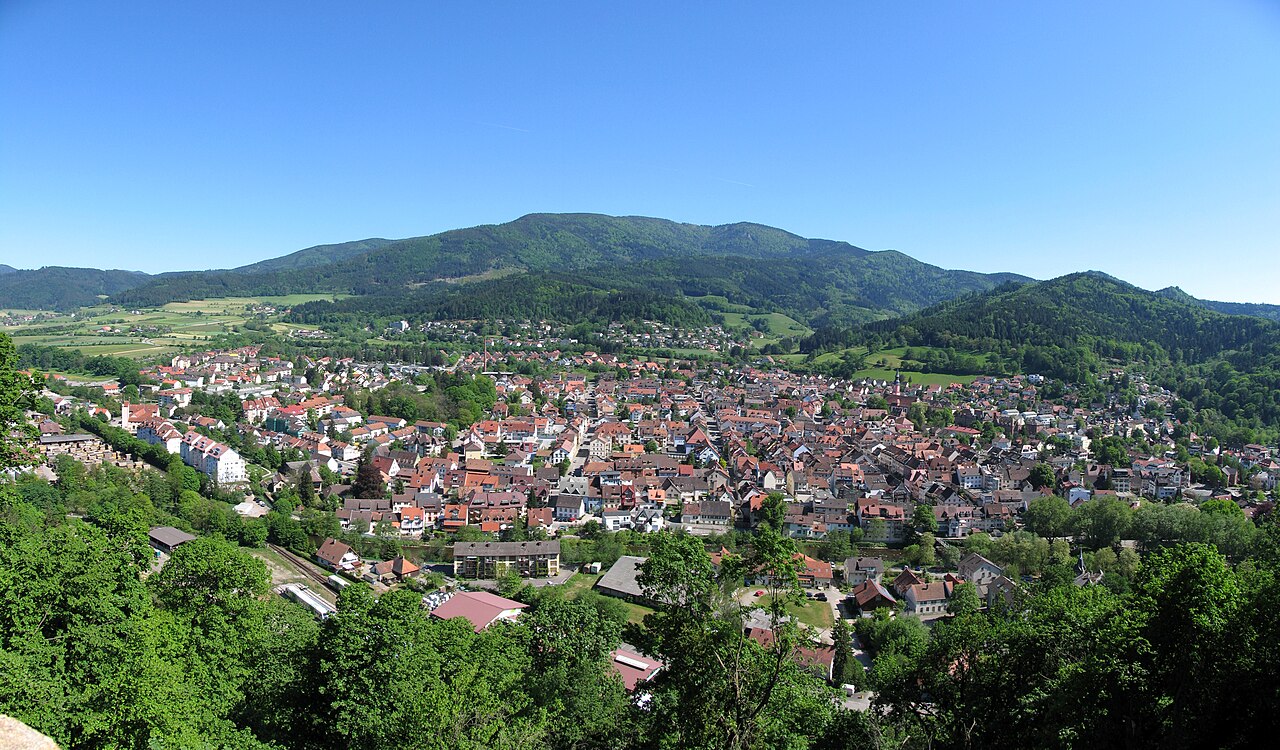
Waldkirch is a town of roughly 22,000 in the Black Forest (Baden-Württemberg), and for more than two centuries it has been Germany’s — arguably the world’s — capital of mechanical organ building. The local trade dates to 1799, when Matthias Martin established organ building in the town (de.wikipedia.org, “Waldkircher Orgelbau Jäger & Brommer”; Stadt Waldkirch, “Orgelstadt”). The mechanical-organ line that made Waldkirch famous worldwide begins a few years later: Ignaz Blasius Bruder built the town’s first street organ in 1806, founding a dynasty that ran until the last Bruder firm was struck from the commercial register in 1941 (Stadt Waldkirch, “Orgelstadt”).
From the early 19th century until the 1920s, Waldkirch enjoyed worldwide renown (de.wikipedia.org). Barrel organs, fairground organs, and orchestrions from Waldkirch workshops — the names Bruder, Ruth, Gavioli, Limonaire Frères, Frei, and Weber — were shipped across Europe and to the Americas (Stadt Waldkirch, “Orgelstadt”). Two of those names matter directly to the hobby builder. Gavioli perfected the folding-cardboard-book music medium that descends to the hobby cardboard book (cross-ref this dive’s Vol 05 and the program’s Encoding the Music dive). And Carl Frei — the “Frei” of that list — is the author of the 20-note scale that Höffle’s amateur design and almost every European busker organ still use today (cross-ref Vol 02; the John Smith Universal dive, Vol 03, treats the same Carl Frei / Raffin 20-note scale and the 26-note Alderman scale). The standard the amateur builds to, in other words, was set in this town.
Why a small Black-Forest town became the mechanical-organ capital is a story of raw materials and clustering: seasoned local hardwoods, a wood-carving and clock-making culture in the surrounding valleys, water power, and — once the first workshops proved the export trade — a dense community of pipe-makers, carvers, and voicers who trained one another for generations. That cluster never fully dissolved. Waldkirch today still has four organ-building workshops and a planning office, celebrates the tradition every three years with an International Organ Festival, and houses a collection of some 80 historic instruments in the organ-builders’ hall of the Waldkirch Organ Foundation (Stadt Waldkirch, “Orgelstadt”; the program’s History of Mechanical Organs dive covers the broader lineage).
7.2 The firm: Waldkircher Orgelbau Jäger & Brommer
Waldkircher Orgelbau Jäger & Brommer was founded in 1988 by two master organ builders, Wolfgang Brommer and Heinz Jäger (de.wikipedia.org). Their Opus 1, also 1988, was a new organ for the pilgrimage church Berghauser Kapelle near Ebringen — a church instrument, not a street organ, which is the first thing to understand about the firm: it is a full-line organ builder, and its mechanical-music work sits alongside a serious pipe-organ practice.
The firm runs on two arms:
- Church organs. New-build and the historical restoration of existing instruments. For smaller churches the firm developed the ÖK-Orgel-Konzept, an economical modular system built around a one-manual Positiv base module that can be extended — the pipe-organ equivalent of a scalable product line (de.wikipedia.org).
- Mechanical music. Street and barrel organs (Drehorgeln), fairground organs, children’s organs, and the restoration of historic barrel organs and music boxes — the direct professional counterpart to the hobby crank organ.
The reach is genuinely international: Jäger & Brommer instruments stand in Europe, the USA, Japan, Korea, and China (de.wikipedia.org). Beyond the workshop, Brommer and Jäger are co-founders of the Waldkirch Organ Foundation and the Sulzmann Archive — i.e. custodians of the town’s tradition as much as practitioners of it. The firm’s recognition includes the German Foreign Trade Prize (2007) and the “Grand Prize of the Mittelstand” (2007), and it was named “Handicraft Business of the Year” (2013) (de.wikipedia.org).
For the hobby reader, the point of this résumé is calibration. The organ on the home bench and the concert street organ from Waldkirch are made by the same methods — flue pipes on a windchest fed by a bellows, cut and voiced by hand — but one is made by a master who also builds and restores church organs to a national standard, in a shop that has trained on that tradition for decades. The gap is not one of principle; it is one of discipline, materials, and hours.
7.3 The Drehorgel range: 20 notes to 31
Jäger & Brommer’s street-organ program spans, in their own description, “from the belly organ with 20 note steps and 20 finest wooden pipes to the concert street organ with 31 note steps” (waldkircher-orgelbau.de, “Drehorgeln”) — the professional analogue of the exact 20 → 31 progression the hobby builder follows across this dive’s Vols 02 and 06.
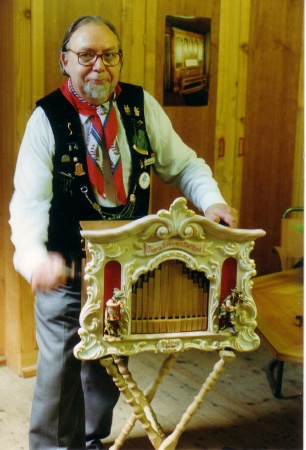
At the entry point is the 20er Bauchorgel (“belly organ” — so called because it hangs at the player’s belly on a strap and is cranked in front of the body). It carries 20 stopped wooden pipes (20 gedeckte Holzpfeifen) in a case of solid cherry (massiv Kirschbaum-Holz), the pipes built in traditional construction (waldkircher-orgelbau.de, “Drehorgeln”). Its 20 note steps are the same tonal compass as Höffle’s amateur design, and it plays the same class of standard European 20-note scale (cross-ref Vol 02). This is the cleanest possible comparison the hobby builder has: an instrument of the identical note count and voice type, built to a professional standard, against which a home build can be judged directly.
At the top of the street range is the konzertante Straßenorgel mit 31 Tonstufen — a 31-note concert street organ carrying multiple registers, the professional sibling of the 31-note Stille/MIDI project in Vol 06. Above the hand-cranked range the firm builds large concert and fairground organs and special instruments (its restoration work extends to a 58-note, fully chromatic historic organ), but those leave the hand-crank world the amateur inhabits.
What separates the professional 20-note belly organ from a competent home-built 20 is not the design — it is the execution, and the difference is worth naming because each item is something the amateur can chase:
Table 1 — because each item is something the amateur can chase
| Dimension | Professional bench (Jäger & Brommer) | Hobby bench (typical) |
|---|---|---|
| Pipe stock | Seasoned solid cherry / hardwood, traditional construction | Beech, pine, ply; whatever is to hand (Vol 04) |
| Voicing | Every pipe hand-voiced to a house tone, rank blended | Voiced by the builder to taste; blend varies |
| Registration | Multiple registers, balanced by the maker | 4 registers on the Höffle 20 (Vol 02); balance is DIY |
| Wind | Shop-standard reservoir, pressure held flat | Home reservoir + spring, tuned on a manometer (Wind Systems Vol 06) |
| Case & façade | Solid cabinetwork, carved/painted façade | Ply case, folk-painted (Bauernmalerei) or plain (Vol 03) |
| Music medium | Professional arrangements, precise books | Home-punched books/rolls or MIDI (Vol 05) |
The table is deliberately not a verdict. A hobby 20 built with care — supple airtight bellows, pipes voiced patiently, a case finished honestly — closes most of this gap; the residue is the last few percent of tone-matching and finish that a professional’s hours buy. Reading the columns is itself the exercise: each row is a place the amateur can decide to spend effort.
7.4 The Karakuri organ — the showpiece
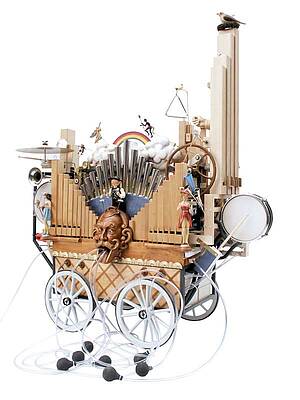
The single instrument that best shows what the top of the hand-crank craft looks like is the firm’s Karakuri organ, built for the World Karakuri Contest 2005. “Karakuri” is the Japanese tradition of mechanical automata; the contest, held on 18 September 2005 on the EXPO grounds in Nagoya, Japan, invited makers to build an instrument in that spirit. From over 600 applications worldwide, Jäger & Brommer was selected as one of twelve international makers (the firm “alongside eleven further international artists”) to build for the event (waldkircher-orgelbau.de, “Karakuri”).
The instrument the firm built is, in its own listing, a 31-note hand-crank street organ with 5 registers (31er Handdrehorgel mit 5 Registern), carrying 10 additional controls beyond the ordinary playing controls and — the Karakuri feature proper — an automatic “bird” figure that animates with the music (waldkircher-orgelbau.de, “Karakuri”). It is, in effect, the 31-note concert street organ of §3 taken to its expressive limit and dressed as an automaton: the five registers give it a full palette of tone colours, the ten controls let the operator combine and switch them live, and the mechanical bird is the automaton flourish that answered the contest’s brief.
Verification note — the “111 pipes” figure. Secondary press about the Karakuri organ is sometimes cited as reporting a pipe count of 111 pipes. That number does not appear on the firm’s own Karakuri page, which states the note count (31), register count (5), control count (10), and the bird, but gives no pipe count. It is therefore treated here as unverified (est.) and is not asserted as fact. It is, however, entirely plausible in kind: note count is not pipe count (a five-register 31-note organ can carry several pipes per note across its registers), so a total well above 31 is expected — only the specific figure is unconfirmed.
The Karakuri is worth the hobby builder’s attention precisely because it is not a different machine in principle. It is a hand-cranked flue-pipe organ on a windchest — the same object as the belly organ, the same object as the home build — carried to the far end of every dimension the §3 table lists: more registers, more control, finer pipework, and a carved, animated façade that turns the instrument into a piece of theatre. The distance from a first 20-note build to the Karakuri is not a change of kind; it is that table’s residue, paid in full.
7.5 What the amateur takes from the professional bench
A hobby builder cannot buy a Waldkirch training or a shop full of seasoned cherry. What can be taken from the professional bench is a set of disciplines, each of which the earlier volumes already touch and each of which the professional simply does more rigorously.
- Voicing discipline. The professional’s edge is least about materials and most about the patience to voice every pipe to a common tone and blend the rank so no pipe shouts or hides. This is free to the amateur — it costs only time and a good ear (cross-ref Vol 04 and the program’s Tuning & Voicing dive). The single highest-return habit to import from Waldkirch is to keep voicing each pipe until the rank speaks as one instrument, not twenty.
- Materials, honestly chosen. The belly organ’s solid-cherry case and traditionally-built stopped pipes are a reminder that stable, seasoned wood and clean construction pay off in tone and longevity. The amateur need not match cherry, but the lesson — season the wood, build it true, do not fight warped or green stock — transfers exactly (cross-ref Vol 04).
- Scale and registration as deliberate choices. The professional 20 → 31 range is a considered ladder of note count against register palette. The amateur choosing between a 20-note Höffle and a 31-note Stille build is making the same decision at smaller stakes (cross-ref Vols 02 and 06); the value is in treating it as a design choice, not an accident of ambition.
- Façade and decoration as part of the instrument. The Karakuri’s animated bird and carved case, and the belly organ’s cabinetwork, say that the visible craft is not decoration bolted on — it is part of what a street organ is. The hobby tradition of Bauernmalerei (folk painting) on a home build (Vol 03) is the amateur’s honest version of the same instinct.
- The tradition itself. The most practical thing the amateur inherits from Waldkirch is the standard everyone builds to: the Carl Frei 20-note scale, the folding-book medium, the flue-pipe-on-a-windchest architecture. Because the professionals and the hobbyists share that standard, a home build and a Jäger & Brommer belly organ can play the same books — which is exactly why the benchmark is worth studying. In the English-speaking world the equivalent living community is the Carousel Organ Association of America (COAA) and the busker-organ forums, which carry the same tradition to the amateur bench.
The through-line back to the hobby builder is simple. The professional bench does not do anything the amateur cannot begin: it voices more patiently, chooses wood more carefully, balances registers more surely, and finishes more beautifully — but every one of those is a discipline, not a secret. A first 20-note organ built with a professional’s attitude toward voicing, materials, and finish will be a good instrument. The Karakuri simply shows how far that same attitude, given decades and a master’s hand, can be carried. That is what a benchmark is for.
7.5.1 Cross-references
- Vol 02 — The Höffle 20-Note Organ — the amateur 20-note design and its Carl Frei / Raffin scale, the direct analogue of the professional 20-note belly organ in §3.
- Vol 03 — Anatomy & Build Sequence — the hobby case and Bauernmalerei decoration referenced against the professional façade craft in §4–§5.
- Vol 04 — Pipework the Hobby Way — home pipe-making and voicing, against which §3 and §5 measure the professional’s materials and voicing discipline.
- Vol 05 — The Music Medium — the hobby folding book / roll / MIDI, the amateur version of the professional arrangements in §3.
- Vol 06 — Bigger Builds & Variants — the 31-note Stille build, the hobby sibling of the professional 31-note concert street organ and the Karakuri.
- John Smith Universal dive, Vol 03 — the 20-note Carl Frei / Raffin scale and 26-note Alderman scale, the shared standard §1 traces back to Waldkirch.
- Wind Systems dive, Vol 06 — building and tuning a small reservoir to flat pressure, the wind row of the §3 comparison table.
- History of Mechanical Organs dive — the Waldkirch / Bruder / Gavioli lineage summarised in §1.
- Encoding the Music dive — the folding-book medium Gavioli perfected, referenced in §1 and §3.
Sources
- de.wikipedia.org, “Waldkircher Orgelbau Jäger & Brommer” — firm founded 1988 by Wolfgang Brommer and Heinz Jäger; Opus 1 (1988) the Berghauser Kapelle organ near Ebringen; Waldkirch tradition founded 1799 by Matthias Martin, with worldwide renown from the early 19th century to the 1920s; two arms (church organs incl. the ÖK-Orgel-Konzept; mechanical music); instruments in Europe, the USA, Japan, Korea, China; co-founders of the Waldkirch Organ Foundation and the Sulzmann Archive; German Foreign Trade Prize and Grand Prize of the Mittelstand (2007), “Handicraft Business of the Year” (2013).
- waldkircher-orgelbau.de, “Drehorgeln” — the street-organ range “from the belly organ with 20 note steps and 20 finest wooden pipes to the concert street organ with 31 note steps”; the 20er Bauchorgel with 20 stopped wooden pipes in a solid-cherry case, traditional construction; large concert, fairground, and children’s organs; a 58-note fully-chromatic historic instrument.
- waldkircher-orgelbau.de, “Karakuri” (sonderinstrumente/karakuri.html) — the Karakuri organ as a 31-note hand-crank street organ with 5 registers, 10 additional controls, and one automatic bird figure; built for the World Karakuri Contest 2005, 18 September 2005, EXPO grounds, Nagoya; Jäger & Brommer one of 12 international makers chosen from over 600 applications. No pipe count is stated on this page — the frequently-cited “111 pipes” figure is therefore recorded here as unverified (est.).
- jaegerbrommer.de — the firm’s Drehorgel and Karakuri pages (belly organ and Karakuri detail); noted for completeness (site TLS certificate expired at time of writing, so specifics above are taken from waldkircher-orgelbau.de and de.wikipedia.org).
- Stadt Waldkirch, “Orgelstadt” (stadt-waldkirch.de) — Waldkirch as “Orgelstadt”; Ignaz Blasius Bruder’s first street organ (1806); the 19th- to mid-20th-century export makers (Bruder, Ruth, Gavioli, Limonaire Frères, Frei, Weber); four surviving workshops; the International Organ Festival; the Organ Foundation collection of ~80 instruments.
- Secondary press (Badische Zeitung; Deutsche Handwerks Zeitung) — background colour on the firm and the Karakuri contest; any specific figure not confirmed on the firm’s own pages (notably the “111 pipes” count) is marked (est.) and not asserted.
Comments (0)