The Hobby Crank Organ · Volume 6
The Hobby Crank Organ — Vol 06: Bigger Builds & Variants
Vols 02–03 pinned down the entry-level target: Walter Höffle’s 20-note organ on the Carl Frei / Raffin (Stüber) scale, four registers, a folding cardboard book or a paper roll, cranked by hand. It is the reference first build precisely because it is small — few pipes, a modest wind demand, a music medium a beginner can cut on a kitchen table. This volume is about what happens after that first organ plays: how an amateur scales past 20 notes, and the interesting places the design diverges when they do. The community site behind this dive (hobbycrankorgan.com, the English mirror of the Dutch hobbydraaiorgel.nl) is itself a record of one builder scaling up — a 38-note book organ, a 31-note MIDI-driven organ built to a German plan, a 42-note hybrid, and an underpressure variant whose note-action runs backwards from the norm. Those four builds are the spine of this volume.
The register throughout is deliberately comparative and practical: what each step up the note ladder actually buys musically, what it costs in pipes, wind, and labour, and where the sensible amateur switches media — from punched card to MIDI and solenoids — because the mechanical bookwork no longer scales. The deep wind arithmetic belongs to the sibling Wind Systems dive and the deep encoding theory to program Dive 4 (Encoding the Music); this volume gives the builder’s-eye view and cross-refers the theory rather than restating it.
Units note. Note count is the number of playable tonal steps (keys / scale positions); pipe count is a separate quantity — a bass octave or a doubled register puts more than one pipe on a note. The two are kept strictly distinct below. Registers are counted as tonal ranks the operator can switch. Anything not stated directly on the cited source page is marked (est.) and never invented. Wind pressure at this scale is the small-organ ≈ 5 in H₂O (127 mm ≈ 1.245 kPa) figure established in the Wind Systems dive and the John Smith Universal dive — not re-derived here.
6.1 What changes when you scale up
A 20-note organ and a 42-note organ are the same idea at very different sizes, and almost everything that grows does so faster than the note count. Four things move together as ambition climbs.
More pipes, and a wider chest to hold them. Note count sets the minimum pipe count — one pipe per note per register — but registers multiply it and the bass doubles it. A four-register 20-note organ already carries on the order of 70–80 pipes (est., register splits per Vol 02); the 31-note build below runs five-then-six registers with two pipes per tone in the bass, and “Little Mary” packs 86 pipes onto 42 notes (§4). Each pipe needs its own valve, its own slot on the chest, and its own channel in the groundboard, so the wind chest widens and deepens roughly in step with the pipe count, not the note count. The pipe-scaling and voicing consequences are the subject of program Dive 2 (How Organ Pipes Make Sound) and Dive 10 (Tuning & Voicing); the point here is only that the carpentry grows fast.
More wind, sooner sagging. Every added pipe is another mouth drawing on the same reservoir. A 20-note organ rarely sounds more than 4–6 pipes on a busy beat (Wind Systems Vol 04); a 31- or 42-note organ with fuller registration can put a dozen or more pipes on a chord, so peak flow climbs and the reservoir and feeders that were comfortable at 20 notes must be sized up or the wind sags on the big chords (the “running out of wind” failure of Wind Systems Vol 04 §5; est. that peak demand roughly tracks the sounded-pipe count). Scaling up is, in wind terms, mostly a reservoir-and-feeder problem — cross-ref Wind Systems Vol 06 for the sizing method.
More registers, more control clutter. Extra ranks are how a builder turns raw note count into musical variety — a quint for weight, a piccolo for brightness, a trumpet for cut. But each register adds a slider, a rank of pipes, and a wind demand, and past a handful of ranks the register controls, couplers, and (on the professional instruments of Vol 07) percussion and figures start to crowd the console.
A pull toward MIDI over punched media. This is the decisive scale-up change. A cardboard folding book or a paper roll is a physical object whose width grows with the note count and whose punching labour grows with the number of tracks. At 20 notes a book is easy; at 31 notes and up, cutting and managing books becomes the bottleneck, and the amateur’s attention swings toward MIDI files driving solenoid valves — no punching, effectively unlimited library, and a note-action that does not care how many tracks there are. The 31-note build below made exactly that jump; “Little Mary” hedged by playing both MIDI and paper rolls. The medium theory is program Dive 4; the hobby workflow is this dive’s Vol 05 (The Music Medium).
The four builds follow in the order an amateur is likely to meet them, and closes with an underpressure variant that shows how far the basic recipe can be bent while still making organ tone.
6.2 The 31-note organ (Ulrich Stille plan)
The community builder’s own flagship is a 31-note organ built to a plan by the German designer Ulrich Stille — not Höffle and not Brommer; the attribution matters, because the 20-note plans are Höffle’s and the professional 31-note concert organs of Vol 07 are Jäger & Brommer’s, and the three must not be crossed (hobbycrankorgan.com/subdir/en_31toets.htm). It is an intermediate-level project, and it is where this builder made the two jumps that define a serious scale-up: from four registers to five (then six), and from punched media to MIDI-driven solenoid valves.
6.2.1 Pipework: beech, doubled bass, and added ranks
The pipes are beech wood throughout, and the bass carries two pipes for each tone — the first concrete illustration in this dive of note count diverging from pipe count, since the bass notes each sound a doubled rank for weight and presence. The organ began at five registers and was later expanded to six with the melodica-tongue trumpet rank; the instrument’s ranks include quint, piccolo, and trumpet voices (en_31toets.htm). A quint adds a fifth-sounding rank that thickens the tutti; a piccolo rank adds octave-up brilliance; the trumpet is the reed voice that gives the organ its cut.
The trumpet rank is the build’s signature trick, and it ties straight back to this dive’s Vol 04 (Pipework the Hobby Way): rather than fabricate brass reed tongues, the builder used the reed tongues of a melodica, chosen because a melodica reed speaks at roughly the organ’s own wind pressure (en_31toets.htm). It is a characteristic hobby move — repurpose a mass-produced free reed instead of machining a new one — and it is described in full as a pipe-making technique in Vol 04; here it is simply the sixth register’s voice. Cross-ref program Dive 2 for why a free reed and a flue pipe make sound by different mechanisms, and Dive 10 for voicing the result.
6.2.2 The MIDI note-action: solenoids the builder wound himself
The defining scale-up decision was to abandon a punched book or roll and drive the note valves electrically from MIDI files. Each note is opened by a solenoid valve, and the builder wound the solenoid spools himself from copper wire, using a motor turning the spool with a variable-voltage power supply to control the winding (en_31toets.htm) — a home-wound electromagnet per note, the same make-it-yourself instinct that runs through the whole site (and a neat parallel to home coil-winding practice generally).
Two details matter to any amateur contemplating a solenoid organ. First, noise: a bank of solenoids firing is a percussive clatter that can intrude on quiet passages, and the builder’s fix was to replace the brass valve tubes with soft-plastic parts, which cut the mechanical noise “significantly” (en_31toets.htm). A solenoid organ’s enemy is not getting the note to sound but getting it to sound quietly, and softening the moving valve parts is the standard answer. Second, library: freed from punching, the builder created over 1,000 MIDI files for the instrument (en_31toets.htm) — the practical payoff of the switch, and the single clearest argument for MIDI at this scale. A 1,000-title book library would be a wall of cardboard; on MIDI it is a memory card.
6.2.3 Construction: layered groundplate, the manual, and the finish
The wind chest is built as a layered groundplate — the air channels are cut with a jigsaw and glued between walls/layers, then covered with paper and pressure-tested through a hose to prove them airtight before the pipes go on (en_31toets.htm). This is the small-organ analogue of the leak-hunt discipline in Wind Systems Vol 06 §7: a channel that leaks between layers robs wind from every note downstream, so it is proved with pressure and paper before it is closed up. Building the wind path in glued layers, rather than boring it through solid stock, is the practical way an amateur makes a many-channel 31-note chest.
The project is documented in a manual of over 180 pages, which includes a dedicated pipe-making chapter by Klaus Ospelt (en_31toets.htm) — the reference that this dive’s Vol 04 draws on for making beech pipes. A 180-plus-page manual for a single amateur build is itself a marker of the step up from the ~60-plus-8-page Höffle book (Vol 02): more notes, more registers, and a MIDI drive is simply more to document.
The case is finished in Bauernmalerei — South-German / Black-Forest folk painting — applied here by a shortcut: laser-printed designs transferred onto the wood using a thinner/solvent, rather than painted freehand (en_31toets.htm). The decoration is not incidental. A crank organ is a street instrument as much as a musical one, and the painted case is part of what an audience is paying attention to; the professional Waldkirch instruments of Vol 07 carry the same tradition at a higher level of finish.
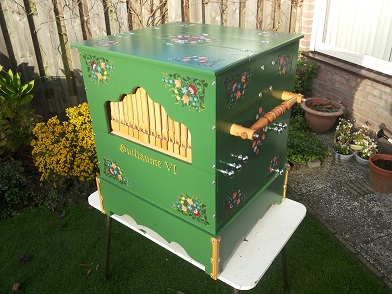
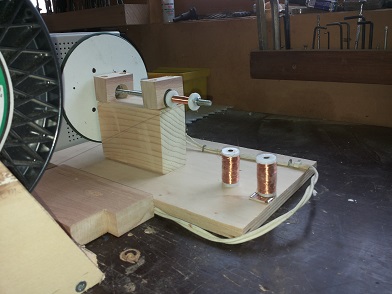
The 31-note organ is the volume’s centre of gravity because it shows all four scale-up changes at once: more pipes (doubled bass, six registers), more wind (a layered multi-channel chest), more registers (quint / piccolo / trumpet), and the decisive move to MIDI and self-wound solenoids. An amateur who has built a 20-note Höffle and wants to grow is, in effect, choosing whether to follow this path.
6.3 The 38-note cardboard-book organ
Chronologically the builder’s 38-note organ came before the 31-note one, and it took the opposite technological choice: it is a book-driven organ, playing a cardboard folding book, not MIDI (hobbycrankorgan.com/subdir/en_fotogal1.htm). The page that documents it is a photo gallery rather than a written specification — its images run the cardboard book, the pipes, the case, and the finished organ (the file names 38_cblok, 38_pyp1/2, 38_kst1–5, 38_orgel map to book → pipes → case → organ) — so the musical specifics below the note count are not stated on the page and are marked (est.) accordingly.
What 38 notes buys musically, over the 20-note entry organ, is mainly melodic range and chordal fullness. Twenty notes on the Carl Frei scale is a real but tight compass — arrangements are constantly folded to fit, dropping or transposing notes that fall outside the scale (the arranging problem of Vol 05 and program Dive 4). Thirty-eight notes roughly doubles the available steps, which lets an arranger keep more of a tune’s original contour, carry a wider bass, and voice fuller accompaniment chords without collisions. The cost is a wider book: more tracks means a physically wider folding book and more punching per title, which is exactly the pressure that later pushed the same builder to MIDI for the 31-note organ (§2.2). The 38-note book organ and the 31-note MIDI organ, taken together, are a single builder’s two answers to the same question — how many notes, on what medium — and the fact that the larger-compass instrument stayed on cardboard while the smaller-compass one went to MIDI shows the decision is about labour and library management, not note count alone. Register count, pipe types, and dimensions for the 38-note organ are not given on the source page (est.: unspecified); the build is presented as photographs, not a plan.
6.4 The 42-note hybrid “Little Mary”
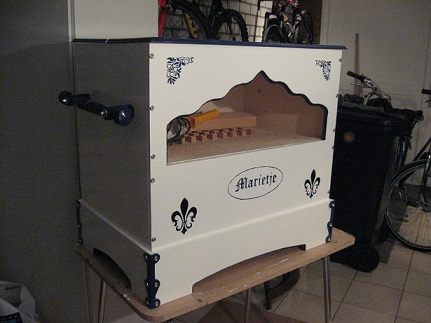
“Little Mary” (Dutch Marietje) is a 42-note hybrid organ, and the word hybrid here has a specific and slightly unusual meaning that must be stated carefully: it is not a mix of pipes and electronic/sampled sound, and it is not a mix of pipe types. It is a medium hybrid — a pipe organ that can be played from both MIDI files and paper rolls (hobbycrankorgan.com/subdir/en_marietje.htm). The sound is made by real pipes throughout; what is dual is the control path feeding the note valves.
6.4.1 The scale and the pipework
The 42 notes are derived from a 51-key Limonaire organ scheme with the percussion and register tracks removed (en_marietje.htm) — i.e. the builder took a standard continental 51-key book scale, stripped the tracks that would have driven drums and register changes, and kept the 42 that play notes. The Limonaire scale is a French dance-organ tradition, which is why “Little Mary” reads as a small street/ dance organ rather than a busker organ.
The pipe count is the volume’s sharpest note-vs-pipe illustration: 86 pipes on 42 notes, made up of 3 × 22 melody pipes, 12 accompaniment pipes, and 8 bass pipes (en_marietje.htm). The “3 × 22” is three melody registers of 22 pipes each, built as wooden mahogany pipes; the lowest six bass pipes are mounted on the underside of the chest with slanted (angled) beards to improve their speech, and the accompaniment pipes are tucked into the corners of the case (en_marietje.htm). Three melody registers on a 42-note dance scale is a fuller, brighter voice than a four-register 20-note busker organ — more melodic range and more registration colour — at the price of the 86-pipe chest and its wind.
6.4.2 What makes it a hybrid
The dual-medium action is the clever part. Each note’s valve can be commanded two ways. On a paper roll, the roll’s holes work the note in the site’s usual pneumatic manner. To add MIDI, the builder fitted a small hardwood block per note in which the command-wind can escape through a second channel opened by an electromagnet (en_marietje.htm): the electromagnet, driven from a MIDI player and driver card, vents the same command-wind that a roll hole would have vented, so a MIDI event and a roll hole reach the note valve through a shared final path. The result is one pipe organ playable from either medium — punched paper for traditional rolls, or MIDI for the modern library.
The MIDI side is a full modern player: an SD card storing up to 80,000 songs/rolls, and a 12 V 7 A battery giving about 14 hours of uninterrupted playing (en_marietje.htm) — a self-contained busking loadout. The case is finished in a Dutch “Delft-blue” white-and-dark-blue hand-painted scheme (en_marietje.htm), the Netherlands counterpart to the 31-note organ’s South-German Bauernmalerei.
“Little Mary” is the instructive endpoint of the scale-up story because it refuses to choose a medium. The 20-note Höffle organ is book-or-roll; the 31-note organ went all-MIDI; “Little Mary” carries both, so a builder can play the historic paper-roll repertoire and an 80,000-title MIDI library on the same 86 pipes. The hybrid, in other words, is the answer to “do I give up paper rolls when I go to MIDI?” — and the answer is no, at the cost of an extra vented channel and electromagnet per note.
6.5 The underpressure (“onderdruk”) variant
The most divergent build on the site is the underpressure organ — Dutch onderdruk, “under-pressure,” the site’s English pages calling the principle “de-airing” (hobbycrankorgan.com/subdir/en_onderdruk.htm). The name invites a wrong assumption, so the correction comes first: this is not a suction-reed / harmonium instrument. It makes its sound with pipes on positive wind, exactly like every other organ in this dive. What is inverted is only the note-action control logic — the way a paper-roll hole decides to open a note.
6.5.1 How the note-action works
The wind is supplied by a pair of opposite-acting bellows providing a constant air pressure, with a pressure-relief valve at the top of the bellows to prevent over-inflation (en_onderdruk.htm) — a conventional positive-pressure supply, described in general terms in Wind Systems Vol 03. The pipes below their valves sit on that positive wind.
The inversion is in the valve. Each note valve has a membrane with wind-chamber pressure beneath it and a small control space above it, and a bypass channel that, when no note is to be played, keeps the air pressure equal on both sides of the membrane (en_onderdruk.htm). With equal pressure across it, the membrane stays put and the note is silent. To sound a note, the hole in the paper roll releases (vents) the air pressure on the upper side of the membrane, and the membrane moves upward under the wind-chamber pressure below it, opening the valve and admitting wind to the pipe (en_onderdruk.htm). The control action is therefore subtractive: a roll hole does not admit control pressure to push a valve open (the direct-pressure logic of a typical German book action, which the page contrasts itself against) — it bleeds off pressure above the membrane so the standing wind below can lift it. That local reduction of pressure on the upper side is the “underpressure” the build is named for; it is a pressure-release / exhaust logic, not a whole-instrument vacuum. The precise membrane and bypass geometry beyond this outline is not fully detailed on the page (est.).
6.5.2 Contrast with the normal positive-pressure chest
The distinction is worth drawing crisply, because it is easy to blur. In the normal hobby chest (Vol 03; Wind Systems Vol 06), the note valve is held closed and the medium (roll hole, book slot, or solenoid) acts to let wind in — pressure applied opens the note. In the underpressure chest, the valve is held balanced by a bypass, and the medium acts to let control-pressure out — pressure released opens the note. Both chests run on the same positive reservoir wind and both sound pipes; only the sign of the control signal differs. The payoff of the exhaust logic (est., not stated as a rationale on the page) is the same one that made vacuum actions attractive in player pianos — a small, easily-vented control leak can be quicker and quieter to actuate than admitting a pressure pulse, and a bypass-balanced membrane is a sensitive, low-force valve. It is included here as the site’s proof that even the note-action’s control polarity is a design variable an amateur can flip.
6.6 How to choose your scale-up
The four builds above map a decision space, and an amateur standing at the end of their first 20-note organ can locate themselves in it by weighing four things against each other: note count, effort, cost, and medium.
-
Note count is bought with pipes, wind, and width — nonlinearly. Going from 20 to 31 to 42 notes roughly doubles the pipe count once registers and doubled bass are counted (70–80 → six-register → 86 pipes), and the chest, wind chest, and reservoir grow with the pipes, not the notes. Budget the wind system for the bigger chord (Wind Systems Vol 06), not for the note count.
-
More notes mainly buys arranging freedom. Twenty notes forces constant folding of arrangements to the scale; 31–42 notes let a tune keep its contour and a fuller bass and accompaniment. If the frustration with a first organ is “I keep having to drop notes,” that is the argument for scaling up. If it is “I want a different sound,” the cheaper answer is another register, not more notes.
-
Effort and cost scale with pipes and finish, not glamour. Each added pipe is a pipe to make, voice, tune, valve, and channel; each added register is a rank and a slider; the painted case (Bauernmalerei or Delft-blue) is real labour on top. The 31-note organ needed a 180-plus-page manual to document precisely because it is that much more instrument than the ~60-page Höffle.
-
Move to MIDI when the bookwork stops scaling. This is the clearest single rule the site teaches. A cardboard book is comfortable at 20 notes and merely wide at 38; but a large library, or a many-track scale, makes punching and storing books the bottleneck. The 31-note organ’s 1,000-plus MIDI files and “Little Mary’s” 80,000-title SD card are the payoff of switching. The switch has its own costs — solenoids to wind, a driver board, and solenoid clatter to silence with soft-plastic valve parts — and a builder who values the historic paper-roll repertoire can, like “Little Mary,” build a hybrid and keep both. Choose MIDI for library and scale; keep (or add) rolls for tradition and the pleasure of the medium.
The formal side-by-side of all these builds — note count, scale name, register count, pipe count, and medium, alongside the 20-note Carl Frei/Raffin and 26-note Alderman references — belongs to this dive’s Vol 08 (Reference & Cheatsheet) and should be read next to this volume. And the first-build decision that precedes any scale-up is Vol 01 (The Hobby Path)‘s subject: most builders should still start at 20 notes, get one organ singing, and then consult this volume about where to grow. The professional benchmark for a fully-realised 31-note concert organ — five registers, added controls, an automatic figure, at a level of finish the amateur aspires to — is the Jäger & Brommer profile in Vol 07.
6.6.1 Cross-references
- Vol 01 — The Hobby Path — choosing a first build; why most builders should start at the 20-note Höffle before scaling up with this volume.
- Vol 02–03 — The Höffle 20-Note Organ / Anatomy & Build Sequence — the entry-level baseline (20 notes, Carl Frei/Raffin scale, four registers, book or roll) that this volume scales past; the layered-chest and leak-proving discipline.
- Vol 04 — Pipework the Hobby Way — beech pipes and the melodica-tongue trumpet reused as the 31-note organ’s sixth register; making the mahogany melody pipes of “Little Mary.”
- Vol 05 — The Music Medium — the book-vs-roll-vs-MIDI workflow behind every medium choice in this volume; punching, the solenoid/MIDI approach, and self- arranging.
- Vol 07 — The Professional Benchmark: Jäger & Brommer — the professional 31-note concert street organ (five registers, added controls, automatic bird) the amateur 31-note build aspires to; keep the hobby builds and Brommer strictly separate.
- Vol 08 — Reference & Cheatsheet — the note-count / scale / register / pipe / medium comparison table for 20 · 26 · 31 · 38 · 42 note organs.
- Wind Systems Vol 03, Vol 06 — the positive-pressure reservoir and relief valve the underpressure variant still uses; sizing the feeders and reservoir and leak-hunting the bigger chest that scaling up demands.
- John Smith Universal, Vol 04 — the concrete small-organ wind numbers (≈ 5 in H₂O) carried through this dive.
- Program Dive 2 — How Organ Pipes Make Sound — flue vs reed sounding, behind the melodica-tongue trumpet.
- Program Dive 4 — Encoding the Music — the theory of book / roll / MIDI the hobby workflow of §1 and Vol 05 sits on.
- Program Dive 10 — Tuning & Voicing — voicing the added quint, piccolo, and trumpet ranks and the doubled bass.
Sources
- hobbycrankorgan.com/subdir/en_31toets.htm — “The making of my 31-note organ”: 31 notes; 5 registers expanded to 6 (the added sixth is the melodica-tongue trumpet); beech pipes; two pipes per tone in the bass; sheep-leather bellows; MIDI-driven with home-wound copper solenoid spools (wound on a motor with a variable-voltage supply); soft-plastic valve parts replacing brass to cut noise; layered groundplate with jigsaw-cut air channels, paper-covered and pressure-tested; a 180-plus-page manual with Klaus Ospelt’s pipe-making chapter; Bauernmalerei (laser-transfer) decoration; melodica-reed-tongue trumpet; 1,000-plus MIDI files.
- hobbycrankorgan.com/subdir/en_fotogal1.htm — “Photos: making a 38-note cardboard-book crank organ”: 38 notes, book-driven; photo gallery (cardboard book, pipes, case, finished organ) — register/pipe/dimension specifics not stated on the page (marked est.).
- hobbycrankorgan.com/subdir/en_marietje.htm — “Little Mary” (Marietje): 42-note hybrid; 42 notes from a 51-key Limonaire scheme minus percussion/register tracks; 86 pipes (3 × 22 mahogany melody, 12 accompaniment, 8 bass; lowest six bass under the chest with slanted beards); hybrid = plays both MIDI files and paper rolls via a per-note hardwood block whose command-wind is vented by an electromagnet; SD card up to 80,000 songs; 12 V 7 A battery, ~14 h; Delft-blue painted case.
- hobbycrankorgan.com/subdir/en_onderdruk.htm — the underpressure (“onderdruk” / de-airing) variant: a pipe organ (not a reed/harmonium) whose note valves work on a pressure-release principle — a pair of opposite-acting bellows with a pressure-relief valve provide constant positive wind; a bypass channel keeps a membrane balanced when silent; a paper-roll hole releases the pressure above the membrane so wind-chamber pressure lifts it open; contrasted by the page with the direct-pressure (German) book action.
- Wind Systems dive (Vols 03, 06) and John Smith Universal dive (Vol 04) — the small-organ positive-pressure wind figures and reservoir/relief-valve practice cross-referenced throughout; not re-derived here.
Comments (0)