The Hobby Crank Organ · Volume 5
The Hobby Crank Organ — Vol 05: The Music Medium
An organ built and voiced (Vols 02–04) is a machine that can make sound but has nothing to say. The music medium is what tells it which of its twenty-odd notes to sound and when — the crank organ’s program, the physical embodiment of an arrangement. For the amateur this is a workflow problem as much as a theory problem: a first-time builder has to choose a medium, make the medium, and arrange music that a small gapped scale can actually play, using tools an ordinary workshop and PC can run.
This volume is the hobby workflow. The theory of how each medium encodes “note on / note off over time” — pinned barrels, Gavioli’s fanfold book, the perforated roll and its tracker bar, MIDI note messages — is the whole subject of the program’s sibling dive “Encoding the Music” (Dive 4), and is not repeated here. What follows is the maker’s side: the three media a hobbyist actually uses, how each is read, and the specific bench tools published on hobbycrankorgan.com (the English mirror of the Dutch amateur-builder site hobbydraaiorgel.nl) for making and editing music at home. The worked scale throughout is the 20-note Carl Frei / Raffin scale covered in Vol 02 §2 (the de-facto small busker/street standard), with the site author’s own 31-note MIDI organ as the scaled-up electronic case.
Units note. Roll and hole dimensions are given in millimetres (the trade’s own unit on the Continental hobby scene); note counts are tonal steps, not pipe counts (Vol 02); MIDI note numbers follow the convention that note 60 = middle C (Encoding Dive Vol 05). Figures a source states directly are cited inline; anything scaled or inferred for the small-organ case is marked (est.) and never invented.
5.1 The three hobby media, and choosing among them
At hobby scale a builder has three practical ways to store an arrangement, and the choice shapes the whole instrument — its cost, its noise, whether it needs electronics, and how easily music can be corrected once made.
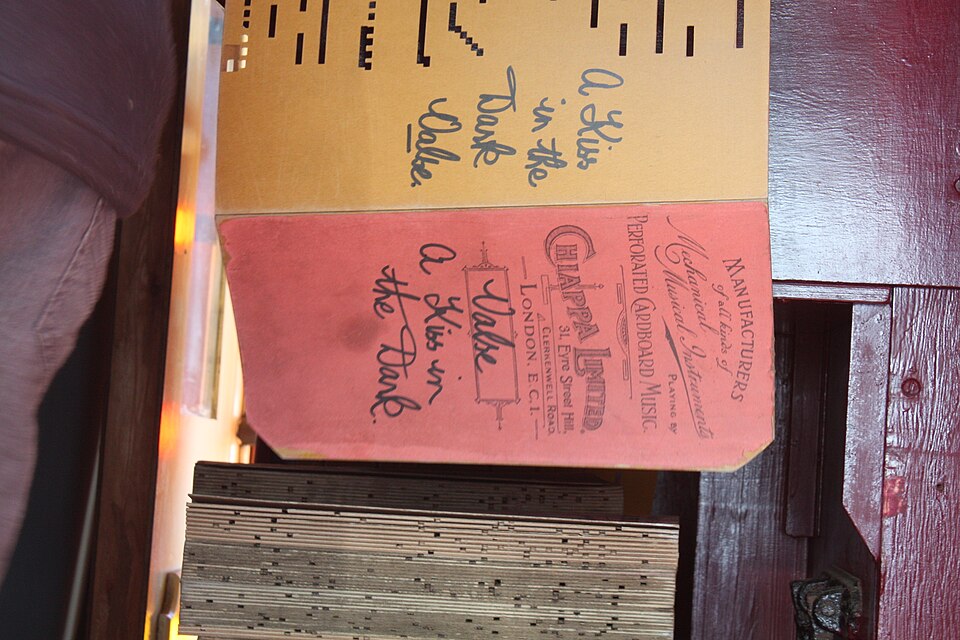
- Cardboard folding book. Zig-zag-folded strips of stiff cardboard, perforated with slots, folded fanfold-style into a compact block that opens out and feeds edge-first through a key frame. This is the fairground and larger street-organ tradition (Gavioli, 1892 — Encoding Dive Vol 03) scaled down. It is durable (cardboard survives thousands of passes), editable (a wrong slot can be taped over and a new one cut), and it lies flat for storage — but a tune is bulky, a book of any length is a physical object to carry, and cutting a book by hand is slow.
- Punched paper roll (reel). A continuous strip of paper wound on a spool, perforated with round holes, drawn across a tracker bar by a take-up reel. This is the busker-organ and player-piano tradition (Encoding Dive Vol 04; John Smith Universal Vol 07 covers the drive/roll and Vol 11 the music). A roll is compact — a long tune fits on a small reel — and cheap to make, but paper wears: it tears at the spool ends, the holes fret and enlarge with use, and humidity makes it curl and mis-track. It is the least durable of the three and the hardest to edit cleanly (a re-punch usually beats patching).
- MIDI (solenoid drive). No consumable medium at all: a MIDI file on a microcontroller drives one solenoid valve per note directly, the file standing in for the roll or book (Encoding Dive Vol 05). It is infinitely editable (edit the file, not the medium), stores a thousand tunes on a memory card, and never wears — but it demands electronics the other two do not (a decoder board, valves, a power supply, wound solenoid coils), it is the least authentic to a purist’s eye and ear (no whir of paper, no visible program), and a dead board silences the whole organ where a torn roll only spoils one tune. The site author took exactly this path for his 31-note build “for time and cost saving reasons” (§8; hobbycrankorgan.com/subdir/en_31toets.htm).
These are not ranked; they are a genuine three-way trade. The decision graph below is the practical way to land on one.
The graph hides one liberating fact that the rest of this volume turns on: the three media are not isolated islands. A MIDI file is the common intermediate for all of them. The same arrangement, held as a MIDI file, can drive solenoids directly, or be turned into a printed cardboard-book template, or be punched onto a paper roll, using the site’s software (§6) and punching machine (§4). The book scanner (§5) runs the arrow the other way, turning an existing physical book back into a MIDI file. So the modern hobby answer to “which medium?” is often “decide the output medium last” — arrange once in MIDI, then commit to card, paper, or solenoids as the instrument and the occasion demand.
5.2 The reading interface: how the medium is read
Whatever the medium, a reader converts stored perforations (or MIDI bytes) into a valve action that admits wind to a pipe. At hobby scale the three readers are:
- Key frame (cardboard book). The book feeds edge-first between a fixed lower bar and a hinged upper frame carrying one sprung key per note. Where the card is solid the key rides on the surface, held up, and the note is off; where a slot passes, the key drops into it, and that motion opens the note valve for as long as the slot is long. Long notes are long slots; repeated notes are a slot broken by short bridges of card. The book advances by a toothed drive that engages register/index perforations or a friction feed. Because the keys read a slot’s length, a book gives clean legato and is forgiving of small alignment errors — the reason the medium scaled to big fairground organs.
- Tracker bar (paper roll). The paper is drawn across a fixed bar drilled with one small port per note (plus register/control ports). A hole in the paper uncovers its port; the resulting signal — a puff of vacuum or pressure in a pneumatic organ, or direct atmospheric admission in the simplest builds — opens the note valve. The tracker-bar pitch (the centre-to-centre spacing of the ports) is the scale definition in physical form: it must match the hole spacing punched into the roll exactly, or notes read on the wrong port. On the hobby 20-note rolls this pitch is small — the punching machine (§4) works to a 5 mm heart distance (centre-to-centre) on one common 20-note format and 3 mm holes on the standard 20-note roll (hobbycrankorgan.com/subdir/ en_ponsmachine.htm). Round holes read as instantaneous note-on/off; a held note is a chain of holes or an elongated slot so the port is never re-covered mid-note.
- Electronic reader / direct MIDI (solenoid drive). Two sub-cases. A physical medium can be read optically: an IR LED shines through (or reflects off) the card or paper onto a phototransistor per track, and a perforation lets light through — exactly the principle of the book scanner in §5, which can serve as a live reader as well as a digitiser. Or the medium is dispensed with entirely: a microcontroller plays a MIDI file, and each note-on message energises the corresponding solenoid valve directly (§8; Encoding Dive Vol 05). Here there is no tracker geometry at all — the “reading” is a table lookup from MIDI note number to valve channel.
In every case the arrangement must distinguish note holes from register / control holes. Note holes sound pipes; register holes switch whole ranks on or off (the four registers of the Höffle design — Vol 02), trigger a bell or drum, or index the medium. On a book or roll these control perforations occupy their own tracks at the edges of the note field; in MIDI they are separate note numbers or a separate channel (General MIDI channel 10 conventionally carries percussion — Encoding Dive Vol 05). Mixing a control track into the note field is the classic first-arrangement error: a “note” that switches a register instead of sounding a pipe.
5.3 Making a paper roll (reel)
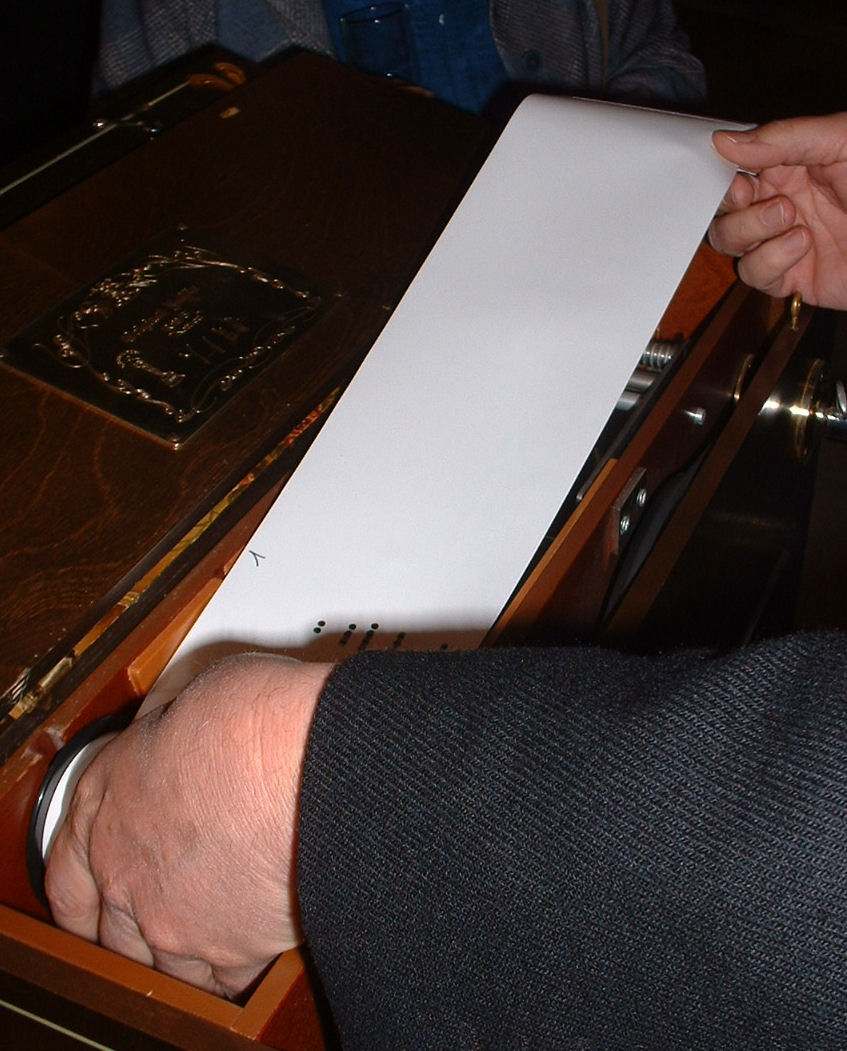
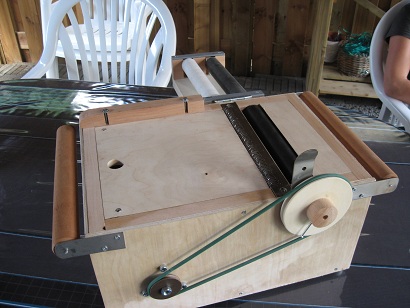
The roll itself is two parts: the perforated paper strip (whose layout is the scale, and whose holes are cut by the punching machine of §4 or by hand) and the reel/spool it winds on. The site’s paper-reel how-to (hobbycrankorgan.com/subdir/en_paprol.htm) notes that most published crank-organ plans omit the reel entirely, treating it as either a bought item or a trivial turning — so it documents a simple shop-made reel to fill the gap.
5.3.1 The reel
The published reel is built from ordinary shop stock (hobbycrankorgan.com/subdir/en_paprol.htm):
- A 111 mm-wide PVC tube of about 25 mm diameter forms the core. The 111 mm width is chosen deliberately as “1 mm more than the paper width” — so the strip is 110 mm wide (est., by that stated logic) and the tube gives it 1 mm of side clearance to feed without binding.
- Two 80 mm-diameter plywood discs (from 4 mm plywood), each drilled with a 5 mm centre hole, form the flanges that keep the strip stacked square on the core.
- Small wheels turned to the tube’s inner diameter (from 20 mm-thick beech) plug and register the flanges to the tube; everything is set with wood glue, and two M6 × 16 hexagonal socket screws (DIN 912 / ISO 4762) lock the whole assembly — “eventually with glue so that it fits very well. This is necessary for the forces being used during rewinding the paper strip.”
That last remark is the design driver: the reel is not decorative — rewinding a long roll puts real torque through the core, and a flange that spins on the tube or a screw that works loose will let the roll telescope and jam. Glue-and-screw belt-and-braces is the fix.
5.3.2 Laying out the scale onto the strip
The strip’s hole positions are the scale. Across the 110 mm width sit one track per note plus the register/control tracks, at the tracker-bar pitch the reader uses. For the hobby 20-note formats the working pitch is the 5 mm heart distance (centre-to-centre) with 3 mm holes noted for the standard 20-note roll (hobbycrankorgan.com/subdir/en_ponsmachine.htm); a builder does not lay this out by eye but takes it from the Gamma file that defines the chosen scale inside Midiboek10 (§6), which knows the exact track-to-note mapping and hole geometry. The golden rule is that the roll’s hole spacing and the organ’s tracker-bar port spacing are the same number — the roll is cut to fit the bar, not the reverse.
5.3.3 Splicing, wear and durability
Paper is the weak link. Rolls are spliced end-to-end (and to their leader and trailer tabs) with thin, flexible tape or glued lap joints; a splice must be thin enough to pass under the tracker bar without lifting the paper off its ports and square enough not to skew the tracking. In use the paper wears three ways: the hole edges fret and enlarge as the bar’s ports abrade them (a worn hole reads early and long, blurring the rhythm); the strip tears at the flanges if it is run off-square or rewound under snatching torque; and humidity curls the strip so it mis-tracks or creeps sideways off the bar. None of this is fatal — a paper roll is cheap to re-punch — but it is why the roll is the least durable of the three media (§1) and why a builder who values a favourite arrangement often keeps its MIDI master (§6) and simply re-punches a fresh roll when the old one frets out.
5.4 The computer-driven punching machine
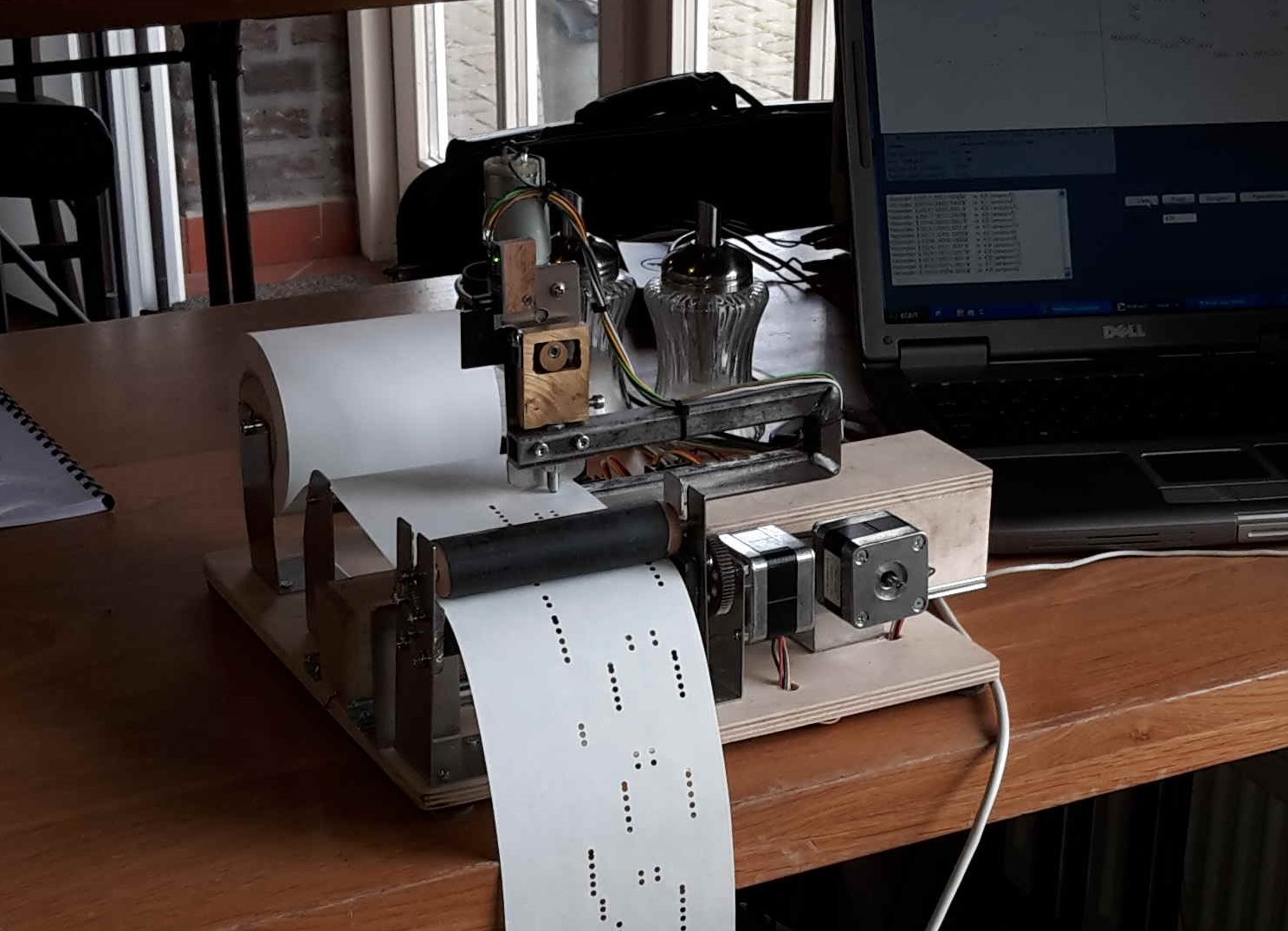
Cutting a roll or book by hand is the bottleneck the site’s builder solved with a small computer-driven punching machine (hobbycrankorgan.com/subdir/en_ponsmachine.htm): an X–Y table that positions a paper strip under a punch and drives the punch from a computer file, so an arrangement held as G-code (produced by Midiboek10, §6) is perforated automatically.
5.4.1 What it makes and how it is driven
The machine punches paper strips 100–140 mm wide — covering the 110 mm hobby 20-note width (§3) and the wider 31/36/42-note formats. It reads a G-code file (the numerically-controlled-machine standard that Midiboek10 exports, §6) and steps the paper and punch to each hole coordinate. It is documented as making rolls for at least three concrete formats: 16-note Deleika organs, a 20-note roll at 5 mm heart distance, and the standard 20-note roll with 3 mm holes (hobbycrankorgan.com/subdir/en_ponsmachine.htm) — the same formats §2–3 describe.
5.4.2 The DIY mechanics
The build is a lesson in hobby-CNC salvage and iteration:
- Control: an Arduino Nano running the motion, with A4988 stepper drivers on a CNC shield — the driver currents “should be adjusted and cooled.” (This is the standard hobby 3-axis stepper stack; Encoding Dive Vol 05 covers the same microcontroller-plus-driver idea for solenoid organs.)
- Motion: two stepper motors for X–Y positioning — one advancing the paper, one placing the punch across the width. Early attempts reused matrix (dot-matrix) printer mechanisms and gave poor accuracy; switching to drawer slide rails “improved accuracy significantly.”
- The punch head: first driven by “an analog motor with an eccentric” (a rotating cam that drives the punch down once per revolution), later replaced with a stepper motor for reliability. A massive aluminium arm carries the punch “so that vertical movement in the arm was minimalized” — flex in the arm would give shallow or ragged holes.
- Paper feed: a transport roller faced with “special rubber which was applied in printers” grips the strip without slipping, and the roller has an iron core “to avoid wear.”
- Performance: the site reports “8000 [punches] are satisfying” at a 12 V supply, with higher supply voltage giving higher punching rate (the source’s wording is “8000 munches”; read as 8000 punches — est.). At 12 V that is a workable throughput for cutting a full tune in one unattended run.
The through-line is that the machine turns the arranging effort into the whole job: once the arrangement exists as a file, cutting the physical roll is a push-button, repeatable operation — which is precisely what makes re-punching a worn roll (§3.3) painless.
5.5 The cardboard-book scanner
The punching machine turns a file into a medium; the book scanner (hobbycrankorgan.com/subdir/en_scanner.htm) turns a medium back into a file. It reads an existing cardboard book optically and writes a MIDI file, so a book can be preserved (an original that is wearing out is captured before it fails), shared (a rare arrangement circulates as a file), and re-punched or converted to any other medium via the pipeline of §4 and §6.
5.5.1 How it reads the perforations
The scanner draws the book through on a transport and looks through it with infrared, one detector per track:
- Transport: “rubber rolls from a copier and a windscreen wiper motor, which is strong enough for this job” pull the book past the sensor bar at a steady rate.
- Sensing: an array of IR LEDs (Kingbright L-934F3BT) faces an array of phototransistors (L-932P3C) across the paper path (both sourced from Conrad Netherlands). Where the card is solid it blocks the beam; where a slot passes, IR reaches the phototransistor and that track reads a hole. The components are 3 mm in diameter and set at a 3.5 mm centre distance — matching the fine track pitch of the book (compare the 3 mm holes / 5 mm heart distance of the 20-note roll, §2). The beam is strong: “even on a distance of 10 cm the photo cell react[s] on the LED,” so alignment is forgiving.
- Mounting: the sensor rows are set into a 7 mm-thick high-pressure laminate plate, precision-drilled so each LED aims squarely at its phototransistor.
- Electrical: the LEDs run in series with a 330 Ω resistor, off a 12 V 7 A battery; each phototransistor’s collector feeds a track input on the reader module.
5.5.2 The interface module and the output
The tracks are gathered by a “mkc64u” module from midiboutique.com — a USB board that “can read up to 64 tracks,” ample for any hobby book (≈ 180 EUR including shipping). The phototransistor collectors wire to the module’s diode matrix per its documentation, and the module streams the on/off states out over USB. The captured data is written as a MIDI file and opened in Noteur — a free editor that “displays scan results visually with editable note tracks,” so a mis-read hole or a dirty-card glitch can be corrected before the file is committed back to the pipeline. That the scanner’s native output is a MIDI file is what closes the loop in the §4 pipeline diagram: scanned book → MIDI → (edit in Noteur) → re-punched roll, printed book, or solenoid playback.
5.6 Software: Midiboek10
The hinge of the whole workflow is Midiboek10, a Windows program by the site (hobbycrankorgan.com/subdir/en_midiboek10.htm) that turns a MIDI arrangement into a physical-medium template. It is the piece that lets a builder “arrange once, output any medium” (§1, §4).
5.6.1 What it does
Midiboek10 “is a utility for creating templates used to print cardboard books and music rolls from MIDI files.” Its workflow is a short numbered pipeline: “selecting a midi file, selecting the corresponding Gamma file, the translation and finally the printing of the file including a preview.” The Gamma file is the load-bearing concept: it is the scale definition — the map from MIDI note number to physical track position and hole geometry for a particular organ’s scale (the 20-note Carl Frei/Raffin layout, a 31-note layout, and so on). Choosing the right Gamma file is what makes the same MIDI arrangement come out correctly for a 20-note roll versus a 31-note book. This is the software embodiment of the “the roll must fit the tracker bar” rule of §2–3.
5.6.2 Formats and features
- Input: MIDI Format 0 and Format 1 files, with a built-in “tool to change midifiles from format1 to format0” (many decoders and tools expect the single-track Format 0).
- Output: a printable template (print the book/roll and cut by hand), a G-code file (“a standard for computer driven machines” — this is what drives the §4 punching machine), and a DXF file (“for plotters and cutting machines”).
- Utilities: a MIDI preview; a MIDI summary showing “format, duration, length in mm, copyright etc.” — note the length in millimetres, i.e. how long the finished roll/book will physically be, a genuinely useful check before committing paper or card.
- Platform: Windows XP through Windows 10, requiring .NET 2.0 or newer and Adobe Reader (the templates render as PDF).
Midiboek10 is thus the exact inverse of the scanner: the scanner takes a physical book to MIDI; Midiboek10 takes MIDI to a physical book or roll (or the file a machine cuts them from). Between the two, the arranging work (§7) and the physical medium are fully decoupled.
5.7 Self-arranging for 20 notes
The hardest part of the hobby music workflow is not making the medium but arranging music the medium can play. A 20-note Carl Frei/Raffin organ (Vol 02) has a fixed, gapped scale: twenty pipes spanning roughly two-and-a-bit octaves, with only some of the chromatic notes present — the low register has bass and accompaniment notes chosen for common keys, and several accidentals simply do not exist anywhere on the instrument. A tune written for a full chromatic keyboard will, played straight, hit notes the organ does not have. Arranging is the craft of rewriting the tune so every sounding note lands on a pipe the scale owns. (The site itself, at hobbycrankorgan.com/subdir/en_arrangementen.htm, offers finished arrangements for 20-, 31-, 36- and 42-note organs rather than a written method; the general arranging theory is the subject of Encoding Dive Vol 06, which this section applies to the specific 20-note case.)
The constraints and their standard answers:
- Transpose to a friendly key first. The 20-note scale is voiced to favour a couple of keys (typically the ones with the fewest missing accidentals). The first move on any tune is to transpose it into a key the scale supports, so the melody’s accidentals fall on notes that exist. A tune that is unplayable in its original key is often trivial a whole tone up or down.
- Reharmonise around missing accidentals. Where a melody note or a chord tone falls on an absent semitone, the arranger substitutes — a chromatic passing note is replaced with a scale tone or dropped; a chord voiced with a missing third is re-voiced onto the notes that are present (often omitting the offending tone or moving it to another octave that has it). The ear tolerates a surprising amount of this on a small organ.
- Split the twenty notes into three jobs. A convincing arrangement uses the scale as bass, accompaniment (an “oom-pah” chordal middle), and melody — the same three-part texture a busker organ is built to project. The bass notes live in the low pipes, the accompaniment fills the middle on the off-beats, and the melody sits on top. Keeping the parts in their registers stops them from colliding on the few shared pipes and keeps the polyphony within the wind budget (a small organ’s reservoir sags if too many pipes sound at once — Wind Systems Dive; cross-ref Vol 03).
- Avoid notes the scale lacks — check against the Gamma file. The mechanical test is simple: an arrangement is finished only when every note in the MIDI file maps to a pipe in the target organ’s Gamma file (§6). A note outside the scale either does not print (Midiboek10 has no track for it) or, worse, prints on the wrong track. Proofing the MIDI against the scale map before punching is the 20-note arranger’s equivalent of a spell-check.
Done well, the result does not sound impoverished — the 20-note Carl Frei scale was designed by working street organists precisely so that skilful arranging yields full, dance-able music from twenty pipes. The limitation is real but it is a compositional discipline, not a defect (Encoding Dive Vol 06; Vol 02 for the scale itself).
5.8 The 31-note MIDI path
The site author’s own organ is the scaled-up, electronic alternative to punched media, and the concrete hobby example of the MIDI branch of §1: a 31-note organ to Ulrich Stille’s plan (5 registers, later expanded to 6 with trumpet pipes — Vol 06 covers the instrument), driven not by roll or book but by MIDI (hobbycrankorgan.com/subdir/en_31toets.htm). He chose MIDI “for time and cost saving reasons” — no medium to cut, no medium to wear out, and a growing library that now runs to “over the 1000 files.”
5.8.1 Solenoid valves and home-wound spools
In place of a tracker bar and pneumatics, each note has a solenoid valve: a MIDI note-on energises a coil, the coil pulls a valve open, and wind reaches the pipe (Encoding Dive Vol 05 for the note-message-to-valve mechanism). The non-obvious hobby detail is that the coils are wound at home: “you have to make the spools with cupper [copper] wire of your own.” For that, the builder made “a simple machine with a motor with delay” and “a power supply on which you can vary the voltage and so the speed of the motor” — a variable-speed coil winder, so all 31 (or more) solenoid spools come out consistent. (The winding of coils and the homemade winder are a workshop topic in their own right; the wound-solenoid idea recurs across the program’s electronic builds.)
5.8.2 Soft-plastic valve parts — a noise fix
A telling refinement: the Höffle-derived valve construction “was noisy… caused by using a brass tube in the valve chest,” and the builder “replaced them with a soft plastic one which reduced the noise significant[ly].” On a MIDI organ the valves click 31 ways at once with none of the paper whir to mask them, so mechanical valve noise that a roll organ would hide becomes audible; swapping the hard brass seat/guide for a soft-plastic part damps the impact. This is the kind of trade the solenoid path forces that the punched-media path never raises — the absence of a consumable buys silence of the medium but exposes the noise of the valves.
5.8.3 Making the music for it
Because the medium is a file, the arranging tools are the same free ones the rest of the workflow uses: the builder makes his MIDI files with Noteur (the same editor the scanner outputs to, §5) plus “a self written translation module,” and “it was easy for me to make midi files for a 31 note organ,” hence the 1000-plus library. The 31-note scale is wider than the 20-note (more accidentals present, so arranging §7 is less constrained), but the workflow is identical: arrange in MIDI, map to the organ’s scale, play. The only difference from §1–7 is the last step — instead of Midiboek10 exporting a template to cut, the MIDI file goes straight to the solenoid decoder. Same arrangement, no consumable, at the cost of the electronics and the wound coils.
5.9 The measure of a good hobby music medium
The medium the amateur should choose is the one whose failure mode he can live with. A cardboard book fails gracefully — it wears slowly, edits with tape and a knife, and its worst day is bulk. A paper roll is the cheapest and most compact to make and re-make, at the price of tearing, fretting, and curling — a medium to keep as a MIDI master and re-punch when it frets out. MIDI/solenoids never wear and edit perfectly, but move the whole reliability question into electronics and expose valve noise the others hide. The modern hobby answer, enabled by Midiboek10, the punching machine, and the scanner, is to stop treating the choice as permanent: arrange once in MIDI, keep that file as the master, and print a book, punch a roll, or drive solenoids as the instrument and the day require — with the scanner standing ready to pull any surviving physical book back into the same pipeline. Get the arrangement right for the twenty notes the scale owns (§7), and every medium downstream is a push-button away.
5.9.1 Cross-references
- Vol 02 §2 — The Höffle 20-Note Organ: Design & Scale — the 20-note Carl Frei/Raffin scale whose fixed, gapped layout §7 arranges for and §6’s Gamma file encodes.
- Vol 03 — Anatomy & Build Sequence — the chest, valves, and register slides the note holes and register holes of §2 actuate; the wind budget that caps polyphony in §7.
- Vol 04 — Pipework the Hobby Way — the pipes the medium ultimately sounds.
- Vol 06 — Bigger Builds & Variants — the 31-note Stille build whose MIDI/ solenoid music path is the subject of §8.
- Encoding the Music (Dive 4), Vol 03 — Cardboard Book Music — the theory of the fanfold book and its key-frame reader that §1–2 apply at hobby scale.
- Encoding the Music (Dive 4), Vol 04 — Perforated Paper Rolls — the roll + tracker bar + spool box theory behind §2–3.
- Encoding the Music (Dive 4), Vol 05 — MIDI & Electronic Encoding — MIDI note messages → solenoid valves and the microcontroller decoder behind §8.
- Encoding the Music (Dive 4), Vol 06 — Arranging & Making Music — the general arranging-for-a-gapped-scale theory that §7 applies to the 20-note case.
- John Smith Universal, Vol 07 (drivetrain / roll) and Vol 11 (music) — the sibling build’s concrete take-up drive and roll music.
- Wind Systems Dive, Vol 06 — Building a Small Wind System — why sounding too many pipes at once sags a small reservoir, the constraint behind §7’s three-part voicing.
Sources
- hobbycrankorgan.com/subdir/en_paprol.htm — the shop-made paper reel: 111 mm PVC core (1 mm over the 110 mm paper width), ~25 mm tube diameter, 80 mm × 4 mm plywood flanges with 5 mm centre holes, 20 mm beech wheels, M6 × 16 (DIN 912) screws, glued for rewinding torque.
- hobbycrankorgan.com/subdir/en_ponsmachine.htm — the computer-driven punching machine: paper 100–140 mm; Arduino Nano + A4988 drivers on a CNC shield; two steppers for X–Y; punch head (analog eccentric → stepper) on a massive aluminium arm; drawer-slide rails; printer-rubber transport roller with iron core; “8000 [punches] satisfying” at 12 V; formats — 16-note Deleika, 20-note 5 mm heart distance, standard 20-note 3 mm holes.
- hobbycrankorgan.com/subdir/en_scanner.htm — the cardboard-book scanner: copier rubber rolls + windscreen-wiper transport; Kingbright L-934F3BT IR LEDs vs L-932P3C phototransistors (Conrad), 3 mm dia at 3.5 mm centres, in a 7 mm HPL plate; LEDs in series with 330 Ω on a 12 V 7 A battery; mkc64u USB reader (midiboutique.com, up to 64 tracks, ≈180 EUR); output MIDI, edited in Noteur.
- hobbycrankorgan.com/subdir/en_midiboek10.htm — Midiboek10 (Windows XP–10, .NET 2.0+, Adobe Reader): MIDI Format 0/1 in (with a 1→0 converter); Gamma (scale) file; outputs printable template, G-code, DXF; MIDI preview and summary (format, duration, length in mm, copyright).
- hobbycrankorgan.com/subdir/en_arrangementen.htm — the site’s “self-made arrangements”: finished MIDI arrangements offered for 20-, 31-, 36- and 42-note organs (a service listing, not a method).
- hobbycrankorgan.com/subdir/en_31toets.htm — the author’s 31-note Stille organ, MIDI-driven “for time and cost saving reasons”: home-wound copper solenoid spools on a variable-speed motor winder; soft-plastic valve parts replacing brass to cut noise; MIDI files made in Noteur + a self-written translation module (1000+ files).
- hobbycrankorgan.com/subdir/en_hfdpag.htm — the site index confirming the 20/31/38/42-note organ scope of the amateur-builder community.
Comments (0)