History Of Mechanical Organs · Volume 1
A History of Mechanical Organs — Overview & Timeline
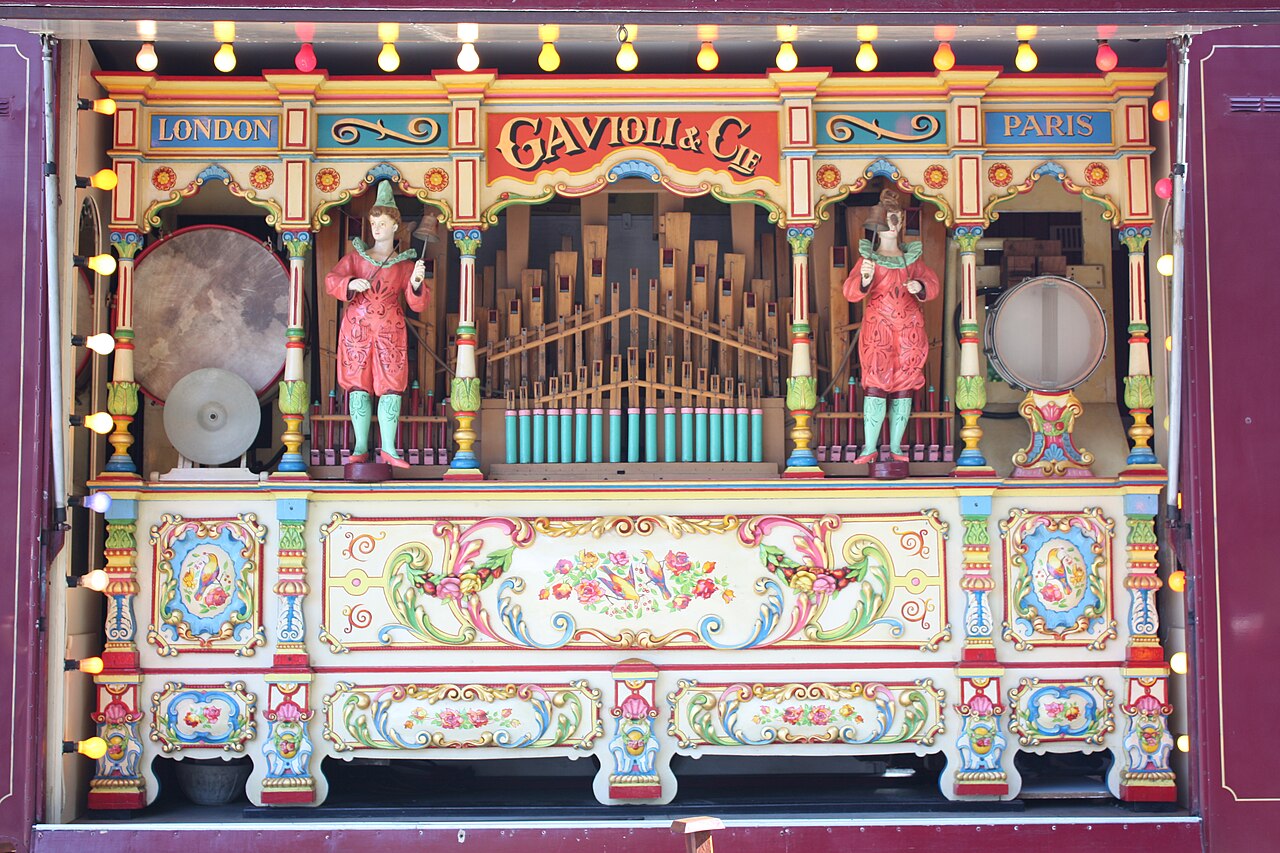
A mechanical organ is a wind-blown pipe organ whose notes are chosen not by a living player at a keyboard but by a stored program — a pinned barrel, a folded cardboard book, a perforated paper roll, or, latterly, a MIDI file — that a reading mechanism scans and converts into wind. Strip away the cabinet carving, the drum and cymbal, the animated figures and the fairground gilt, and every instrument in this history reduces to the same two-part machine: a set of pipes that can sound a fixed palette of pitches, and a program that decides which of those pitches sound, and when. That separation — instrument on one side, program on the other — is the through-line of the whole series, and it runs unbroken from a Baghdad water-organ of the ninth century to a hobbyist’s twenty-note busker box punched from paper on a kitchen table.
This volume is the map. It defines what the term spans, lays out the master timeline from antiquity to the modern revival, sorts the instruments into a family tree of types, and previews the ground each later volume covers in depth. The deep per-era detail — the pinning craft, the Gavioli keyframe, the great Waldkirch and Antwerp firms, the orchestrion cousins, the decline and revival — belongs to Vols 2–8. Here the object is orientation: to see the lineage whole.
1.1 What counts as a mechanical organ
Three conditions, taken together, define the subject and keep it distinct from its many cousins.
- It is a pipe organ. Sound is made by wind driving flue or reed pipes, fed from a bellows and reservoir through a windchest — the acoustic principle Ctesibius established with the hydraulis (see below). This excludes the plucked comb of a musical box, the struck strings of a player piano, and the free reeds of a player harmonium or reed organ, even though all of them borrow the same programming media and are studied alongside organs by the same societies.
- It plays itself. The choice and timing of notes come from a stored, physical program, not a performer’s fingers. A church pipe organ with a barrel attachment counts; the same organ played by an organist does not.
- The program is separable and interchangeable. Swap the barrel, book or roll and the same pipework plays a different tune, with nothing about the wind supply or pipes altered. This is the property the sibling Encoding the Music dive (Vol 1 §“The common abstraction”) builds its whole account on: every medium stores one thing — a two-dimensional grid of pitch against time — and differs only in physical form and in how a reader turns a mark back into wind.
By that definition the family reaches from the domestic chamber barrel organ and the street grinder’s “monkey organ” through the great fairground and dance organs to the modern DIY busker organ — while the orchestrion, the nickelodeon and the photoplayer sit just outside it as close relatives that mix organ pipes with piano, percussion and other ranks. Vol 6 treats those cousins on their own terms; this series keeps organ pipes at its centre.
The boundary is worth holding firmly, because the history is easy to blur. The musical box, the player piano and the player reed organ all use the very same storage media — pinned cylinders, punched books, perforated rolls — and all are collected, restored and written up by the same societies (MBSI, COAA) that steward the organs. They are studied here as context and as media relatives, but none is a mechanical organ: the musical box plucks a tuned steel comb, the player piano strikes strings with hammers, and the reed organ or harmonium sounds free reeds rather than pipes. What unites the true family, and what this series tracks, is the wind-blown pipe under the program. The orchestrion is the genuine borderline case — many orchestrions contain a full rank of organ pipes alongside a piano and percussion — and so it is admitted to the tree as a distinct branch (Vol 6) rather than excluded outright.
1.2 The master timeline
The lineage is long but its landmarks are few and well dated. The hazard in telling it is that several of the earliest and most-repeated claims are part legend, and the temptation is to round dates and inflate priority. The timeline below marks established history in solid dates and flags the disputed or traditional points as such; each is developed, with its caveats, in the volume noted.
<text x="255" y="120" font-weight="bold">1502</text>
<text x="255" y="134" font-size="10">Salzburg Hornwerk</text>
<text x="255" y="147" font-size="10">commissioned</text>
<text x="255" y="160" font-size="9" fill="#666">(barrel organ added c.1640; Vol 2)</text>
<line x1="255" y1="168" x2="255" y2="340" stroke="#9aa" stroke-width="0.7"/>
<text x="400" y="120" font-weight="bold">18th–19th c.</text>
<text x="400" y="134" font-size="10">Barrel organ in English</text>
<text x="400" y="147" font-size="10">parish churches & homes</text>
<text x="400" y="160" font-size="9" fill="#666">(Vol 3)</text>
<line x1="400" y1="168" x2="400" y2="340" stroke="#9aa" stroke-width="0.7"/>
<text x="530" y="120" font-weight="bold">1892</text>
<text x="530" y="134" font-size="10">A. Gavioli patents</text>
<text x="530" y="147" font-size="10">cardboard BOOK music</text>
<text x="530" y="160" font-size="9" fill="#666">(Vol 5; Encoding Vol 3)</text>
<line x1="530" y1="168" x2="530" y2="340" stroke="#9aa" stroke-width="0.7"/>
<text x="730" y="120" font-weight="bold">1949 · 1957</text>
<text x="730" y="134" font-size="10">MBSI founded 1949;</text>
<text x="730" y="147" font-size="10">FOPS (UK) 1957</text>
<text x="730" y="160" font-size="9" fill="#666">preservation (Vol 7)</text>
<line x1="730" y1="168" x2="730" y2="340" stroke="#9aa" stroke-width="0.7"/><text x="330" y="400" font-weight="bold">c.1650</text>
<text x="330" y="414" font-size="10">Kircher, Musurgia;</text>
<text x="330" y="427" font-size="10">water-garden automata</text>
<text x="330" y="440" font-size="9" fill="#666">(carillon drums; Vol 2)</text>
<line x1="330" y1="380" x2="330" y2="392" stroke="#9aa" stroke-width="0.7"/>
<text x="470" y="400" font-weight="bold">19th c.</text>
<text x="470" y="414" font-size="10">street "monkey" organs;</text>
<text x="470" y="427" font-size="10">Dutch draaiorgel (Vol 4)</text>
<line x1="470" y1="380" x2="470" y2="392" stroke="#9aa" stroke-width="0.7"/>
<text x="640" y="400" font-weight="bold">c.1920s–30s</text>
<text x="640" y="414" font-size="10">radio, gramophone &</text>
<text x="640" y="427" font-size="10">"talkies" end the trade</text>
<text x="640" y="440" font-size="9" fill="#666">(Vol 7)</text>
<line x1="640" y1="380" x2="640" y2="392" stroke="#9aa" stroke-width="0.7"/>
<text x="800" y="400" font-weight="bold">1960 · 1995</text>
<text x="800" y="414" font-size="10">Raffin workshop 1960;</text>
<text x="800" y="427" font-size="10">John Smith DIY design 1995</text>
<text x="800" y="440" font-size="9" fill="#666">(Vol 7 + sibling dives)</text>
<line x1="800" y1="380" x2="800" y2="392" stroke="#9aa" stroke-width="0.7"/>Antiquity — the pipe-and-wind root. The organ itself begins with Ctesibius of Alexandria and the hydraulis, or water organ, a keyboard instrument in which a column of water stabilised the wind pressure to a rank of pipes, conventionally dated to the third century BC (c. 246 BC, est.). The hydraulis was played by hand, not self-acting; it contributes the wind-blown-pipe principle on which everything later rests, and it is treated in Vol 2.
The ninth century — a program made physical. The decisive conceptual step is credited to the Banū Mūsā brothers of Baghdad, whose Book of Ingenious Devices (Kitāb al-Ḥiyal, c. 850) describes The Instrument that Plays by Itself — a hydro-powered organ read by an interchangeable pinned cylinder. It is very widely cited as the earliest known programmable machine and mechanical sequencer, because the tune lives on a changeable pinned drum rather than being wired in. The claim is genuine but should be stated with its scholarly caveats (reconstruction of the ninth-century mechanism is partly interpretive); Vol 2 sets out the evidence. The pinned drum then descends, through medieval carillon drums in the Low Countries — pinned barrels tripping bell hammers — into the barrel organ proper.
Renaissance automata. Pinned-barrel music surfaces in grand form in the Salzburg Hornwerk (the “Salzburg Bull”), commissioned by Prince-Archbishop Leonhard von Keutschach in 1502 and still played — one of the oldest working mechanical wind instruments, though its barrel organ was a later addition of about 1640 (salzburg.info; Vol 2). The water-garden organs of Villa d’Este at Tivoli and the Quirinal, and the writings of Athanasius Kircher (Musurgia Universalis, 1650) and Salomon de Caus, document the same pinned-barrel art spreading through courtly Europe.
The barrel-organ era (18th–19th c.). The pinned barrel matures into a practical instrument. In England the church barrel organ played metrical hymns in hundreds of parishes that could afford neither a pipe organ nor an organist to play it (Ord-Hume, Barrel Organ); domestic and chamber barrel organs brought the same mechanism into the home. This is the first mass era of the self-playing organ, and it is Vol 3.
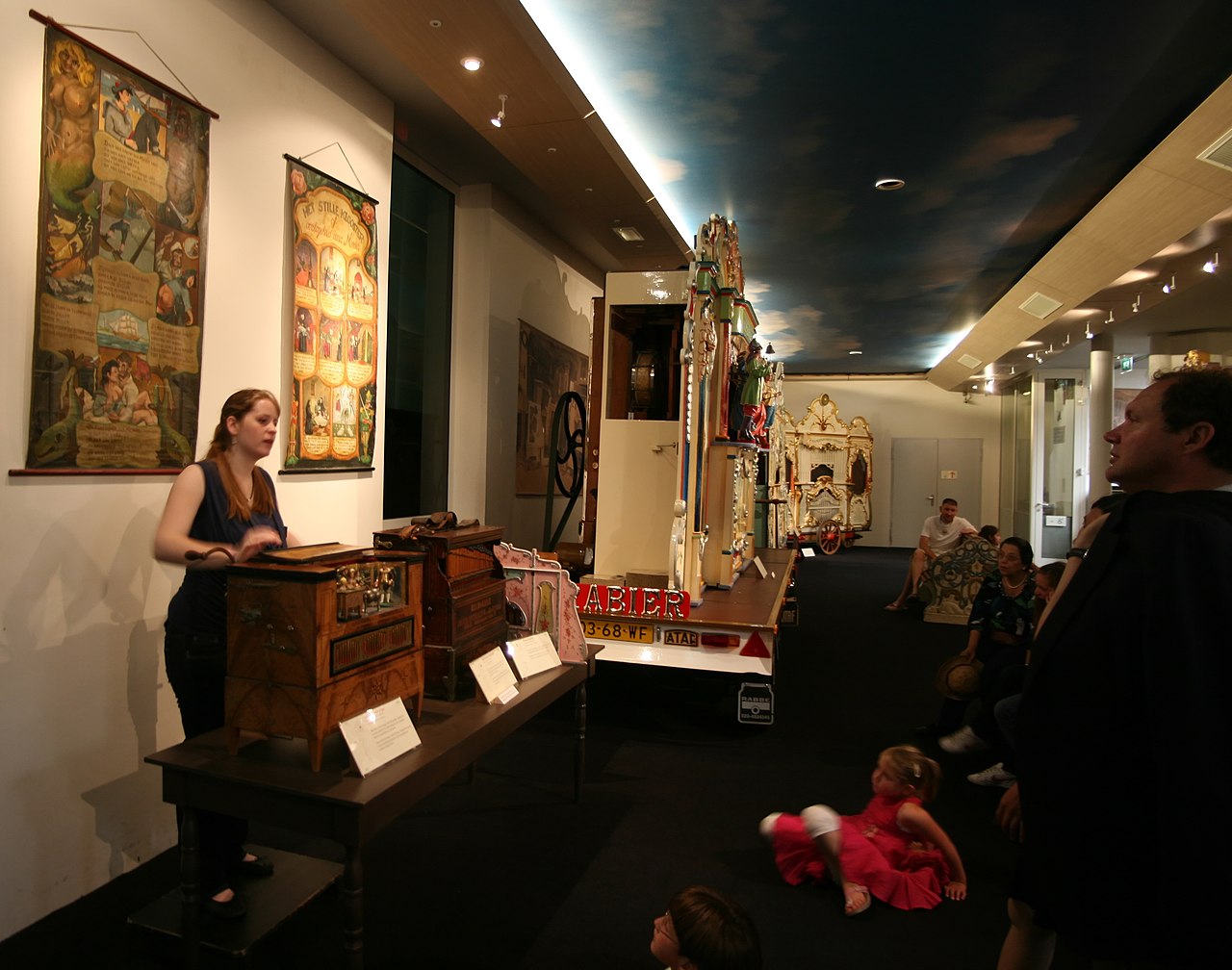
The street organ (19th c. into the 20th). The hand-cranked “monkey organ” took the barrel organ into the street with the itinerant organ grinder — often an Italian or German immigrant, traditionally with a monkey to collect coins. In the Netherlands the same street tradition grew large and civic: the Dutch street organ (draaiorgel), a book- or roll-playing organ on a cart, an Amsterdam institution to which the Waldkirch-trained arranger Carl Frei (later of Breda) was central. Vol 4.
The fairground and dance-organ golden age (≈ 1880s–1920s). The transformative event is Anselme Gavioli’s 1892 patent of cardboard book music — fan-folded punched card that freed tune length from a barrel’s circumference and let organs grow enormous (Wikipedia, Book music; Bowers). Gavioli himself (1828–1902) had already contributed the frein harmonique of 1878, the reed that let organ pipes imitate bowed strings; the 1892 book system was his decisive stroke, because a barrel could hold only what its circumference allowed while a folded book could be made almost any length. The great firms follow: Gavioli, Charles Marenghi and Limonaire Frères in Paris; Mortier and Decap in Antwerp building Belgian dance organs; Gebrüder Bruder / Wilhelm Bruder Söhne, A. Ruth & Sohn and Wellershaus in Waldkirch in the Black Forest; and Wurlitzer and Artizan at North Tonawanda, New York, building American carousel band organs. Their scales were large and mutually incompatible — the 89-key Gavioli, the various Mortier and Ruth keyings — so a book cut for one maker would not play on another, a fragmentation Vol 5 examines. This is Vol 5, and its orchestrion cousins — Welte of Freiburg, Hupfeld of Leipzig — are Vol 6.
The transition through those makers is treated era by era below; the table that follows the family tree sets each type against its medium and its principal firms in one view.
Decline (≈ 1920s–30s). Three technologies dismantled the market in a single generation: radio broadcasting, the gramophone, and sound film — the “talkies” — which made the photoplayer redundant overnight and hollowed out the fairground and orchestrion trades (Bowers). Vol 7 opens here.
Preservation and the DIY revival. Collectors then rescued what industry had abandoned. The Musical Box Society International (MBSI) was founded in 1949 (as the Musical Box Hobbyists; renamed 1953); the Fair Organ Preservation Society (FOPS) in Britain in 1957; the Carousel Organ Association of America (COAA) and the Dutch Kring van Draaiorgelvrienden followed, alongside museums such as Museum Speelklok in Utrecht. Modern makers kept the craft alive and small: Josef Raffin established his workshop in Überlingen in 1960, and the Raffin 20- and 31-note busker scales became de-facto standards. The thread reaches the present in the John Smith DIY busker-organ design of 1995 and its online community — the exact lineage the rest of this Mechanical Organs program sits in. Vol 7, and the sibling John Smith Universal dive.
1.3 The family tree of mechanical organs
The instruments fall into six recognisable types. They are not a strict lineage — several overlap in time and share media — but they descend from the two roots at the top of the tree, the wind-blown pipe organ (from the hydraulis) and the pinned-drum program (from the Banū Mūsā cylinder and the carillon drums), whose marriage produces the self-playing organ. The tree below shows how the six types branch from that union and which storage medium each characteristically uses.
<rect x="172" y="230" width="140" height="92" rx="6" fill="#e8cdb0" stroke="#222"/>
<text x="242" y="250" text-anchor="middle" font-weight="bold" font-size="11">Street / "monkey"</text>
<text x="242" y="268" text-anchor="middle">grinder & draaiorgel</text>
<text x="242" y="283" text-anchor="middle">19th–20th c.</text>
<text x="242" y="301" text-anchor="middle" fill="#7a4a1a">barrel · book · roll</text>
<text x="242" y="315" text-anchor="middle" font-size="9" fill="#666">Vol 4</text>
<rect x="324" y="230" width="140" height="92" rx="6" fill="#e8cdb0" stroke="#222"/>
<text x="394" y="250" text-anchor="middle" font-weight="bold" font-size="11">Fairground / dance</text>
<text x="394" y="268" text-anchor="middle">Gavioli, Mortier, Ruth</text>
<text x="394" y="283" text-anchor="middle">1880s–1920s</text>
<text x="394" y="301" text-anchor="middle" fill="#7a4a1a">cardboard book</text>
<text x="394" y="315" text-anchor="middle" font-size="9" fill="#666">Vol 5</text>
<rect x="476" y="230" width="140" height="92" rx="6" fill="#e8cdb0" stroke="#222"/>
<text x="546" y="250" text-anchor="middle" font-weight="bold" font-size="11">Orchestrion /</text>
<text x="546" y="264" text-anchor="middle" font-weight="bold" font-size="11">band organ</text>
<text x="546" y="281" text-anchor="middle">Welte, Wurlitzer</text>
<text x="546" y="301" text-anchor="middle" fill="#7a4a1a">roll (organ+ ranks)</text>
<text x="546" y="315" text-anchor="middle" font-size="9" fill="#666">Vol 6</text>
<rect x="628" y="230" width="140" height="92" rx="6" fill="#e8cdb0" stroke="#222"/>
<text x="698" y="250" text-anchor="middle" font-weight="bold" font-size="11">Busker / crank</text>
<text x="698" y="268" text-anchor="middle">Raffin, Hofbauer</text>
<text x="698" y="283" text-anchor="middle">20th c.–present</text>
<text x="698" y="301" text-anchor="middle" fill="#7a4a1a">paper roll (20/31)</text>
<text x="698" y="315" text-anchor="middle" font-size="9" fill="#666">Vol 7</text>
<rect x="780" y="230" width="140" height="92" rx="6" fill="#c6d4e2" stroke="#222"/>
<text x="850" y="250" text-anchor="middle" font-weight="bold" font-size="11">Modern DIY</text>
<text x="850" y="268" text-anchor="middle">John Smith 1995;</text>
<text x="850" y="283" text-anchor="middle">MIDI builds</text>
<text x="850" y="301" text-anchor="middle" fill="#2a4a7a">roll · MIDI</text>
<text x="850" y="315" text-anchor="middle" font-size="9" fill="#666">Vol 7 + siblings</text>1.4 The mechanical-organ families
The same six types, tabulated with the era, the venue and scale, the music medium and representative makers. Media and makers are developed in the volumes cited; the media themselves are the whole subject of the sibling Encoding the Music dive.
Table 1 — The mechanical-organ families
| Family / type | Era | Typical size & venue | Music medium | Representative makers |
|---|---|---|---|---|
| Barrel / chamber organ | 18th–19th c. | Small to medium; parish church gallery, drawing room | Pinned wooden barrel (8–10 tunes, shifted laterally) | Flight & Robson, Bishop, Bryceson (Vol 3) |
| Street / “monkey” organ | 19th–20th c. | Small, hand-carried or barrow; city streets | Small pinned barrel, later book/roll | Frati, Gasparini, Perlee; Carl Frei (arranger) (Vol 4) |
| Fairground / dance organ | ≈1880s–1920s | Large to enormous; carousels, fairs, Belgian dance halls | Cardboard book music (Gavioli 1892; large maker-specific scales) | Gavioli, Marenghi, Limonaire, Mortier, Decap, Bruder, Ruth (Vol 5) |
| Orchestrion / band organ | ≈1890s–1930s | Medium to large; cafés, arcades, carousels, cinemas | Perforated paper roll (organ + piano/percussion ranks) | Welte, Hupfeld, Wurlitzer, Artizan (Vol 6) |
| Busker / crank organ | 20th c.–present | Small, portable, hand-cranked; street performance | Perforated paper roll (Raffin 20/31-note) | Raffin, Hofbauer, Stüber (Vol 7) |
| Modern DIY | c.1980s–present | Small, portable; hobbyist-built | Paper roll or MIDI | John Smith design (1995); MIDI-organ builders (Vol 7 + siblings) |
Read across the medium column and the timeline of Encoding’s argument appears in miniature: barrel gives way to book, book to roll, roll to MIDI, each medium easier to author and change than the last — which is exactly why arranging has migrated from a guarded workshop craft to something a hobbyist manages on a laptop (Encoding the Music, Vol 6).
1.5 Why the lineage runs straight to the DIY busker organ
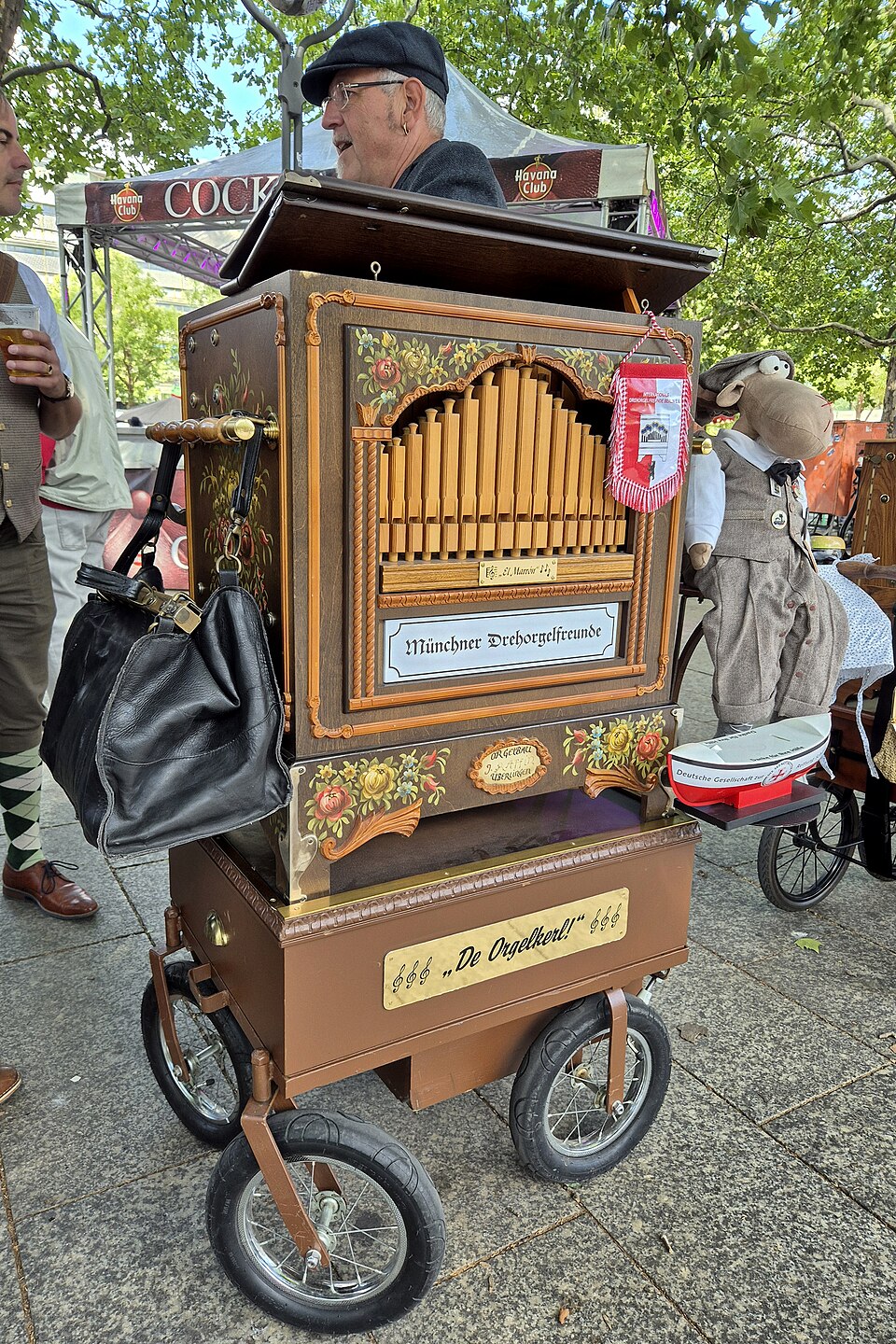
The point of assembling this history is not antiquarian. The modern DIY busker organ — a small, hand-cranked, paper-roll or MIDI pipe organ a hobbyist can build and play — is not a novelty grafted onto an old idea; it is the direct, unbroken descendant of everything above it. It is a wind-blown pipe organ (Root A, from the hydraulis). Its notes are chosen by a separable stored program (Root B, from the Banū Mūsā cylinder and the carillon drums). Its paper roll is the busker inheritance of the player-piano and fairground media, and its optional MIDI control is the same grid of pitch-against-time in electronic form (Encoding the Music, Vol 1). Its 20-note scale descends from the Raffin standard that a small modern maker fixed in the 1960s–70s; and the specific open-source design most home builders follow is John Smith’s 1995 busker organ, the subject of the sibling John Smith Universal dive.
That is why the history matters to the build: a person cutting a roll for a twenty-note organ today is doing, with card and a punch, what Gavioli’s arrangers did for the fairgrounds, what the barrel-pinner did in a Georgian workshop, and what the Banū Mūsā drum did in ninth-century Baghdad — placing a mark that says this pitch, from here to there, and letting the wind do the rest.
The continuity is technical as well as sentimental. The fixed, often gapped scale that constrains a busker arranger — a mechanical organ owns a specific and usually incomplete set of pitches, so music must be transposed and re-voiced to fit the lanes that exist — is the same constraint that shaped a barrel-pinner’s tune selection and a fairground arranger’s key choices; only the number of lanes and the ease of editing have changed. Likewise the hand crank that turns a modern busker organ is the direct descendant of the grinder’s crank and, before it, the falling-weight and water drives of the automata: a single, steady source of both wind and program motion. What the modern hobbyist gains over every predecessor is not a new principle but a cheaper, lighter, endlessly editable medium — paper, and then MIDI — for a machine whose logic was already complete in outline by the ninth century. The rest of this series follows that machine forward, one era at a time.
1.6 Roadmap — Volumes 2–8
The remaining volumes take each era in the depth this map only sketches. Keeping the deep detail there is deliberate; this volume is the orientation the others hang from.
- Vol 2 — Ancient Roots & Early Automata. The hydraulis; the Banū Mūsā programmable hydro-organ and its claim as the first programmable machine, with caveats; carillon drums; Renaissance water-garden automata and the Salzburg Hornwerk.
- Vol 3 — The Barrel Organ Era. Church and chamber barrel organs of the 18th– 19th centuries; the barrel organ in worship; domestic barrel organs; the pinned- barrel craft at its height.
- Vol 4 — Street & “Monkey” Organs. The hand-cranked street organ; organ grinders and the monkey; the busker tradition; the Dutch draaiorgel and Carl Frei.
- Vol 5 — The Fairground & Dance-Organ Golden Age. Book music and the great makers — Gavioli, Marenghi, Limonaire, Mortier, Decap, Bruder, Ruth, Wellershaus, and the Wurlitzer band organs; Waldkirch as the organ-building town.
- Vol 6 — Orchestrions & Automatic-Music Cousins. Orchestrions, nickelodeons, player pianos, photoplayers — the wider self-playing world (Welte, Hupfeld, Wurlitzer) and how it relates to the organ family.
- Vol 7 — Decline, Preservation & Revival. Radio, recording and sound film end the golden age; preservation (FOPS, MBSI, COAA, Museum Speelklok); modern makers (Raffin, Hofbauer, Stüber) and the John Smith DIY movement; MIDI organs.
- Vol 8 — Reference & Timeline. A full timeline table, a makers’ who’s-who, museums and societies, glossary, bibliography, and a cross-index to Vols 1–7 and the sibling Mechanical Organs dives.
Sources
- Q. David Bowers, Encyclopedia of Automatic Musical Instruments (1972) — the standard reference for barrel organs, book music, fairground and dance organs, orchestrions and the makers.
- Arthur W. J. G. Ord-Hume, Barrel Organ (1978), The Automatic Organ, Clockwork Music — barrel-and-pin programming, church barrel organs, and mechanical-music history.
- Fair Organ Preservation Society (FOPS) (established 1957); MBSI (Musical Box Society International, founded 1949; renamed 1953); COAA (Carousel Organ Association of America) — journals and histories.
- Museum Speelklok, Utrecht; St Albans Organ Museum; the Musical Museum, Brentford — collection histories.
- Wikipedia — Mechanical organ, Fairground organ, Barrel organ, Book music, Book of Ingenious Devices — for dates and cross-checks (Gavioli’s 1892 book-music patent; Banū Mūsā c. 850; Salzburg Hornwerk 1502).
- raffin.de (Orgelbau Raffin) — Josef Raffin’s Überlingen workshop, established 1960, and the Raffin busker scales.
- salzburg.info — the Salzburg Hornwerk / Salzburger Stier, commissioned 1502, barrel organ added c. 1640.
Cross-references: the note-vs-time grid and the four media (barrel, book, roll, MIDI) in the sibling Encoding the Music dive, Vol 1; the concrete modern 20/26-note busker organ in the John Smith Universal dive. Within this series: ancient roots in Vol 2, the barrel-organ era in Vol 3, street organs in Vol 4, the fairground golden age in Vol 5, orchestrion cousins in Vol 6, decline and revival in Vol 7, and the consolidated reference in Vol 8.
Comments (0)