History Of Mechanical Organs · Volume 5
The Fairground & Dance-Organ Golden Age
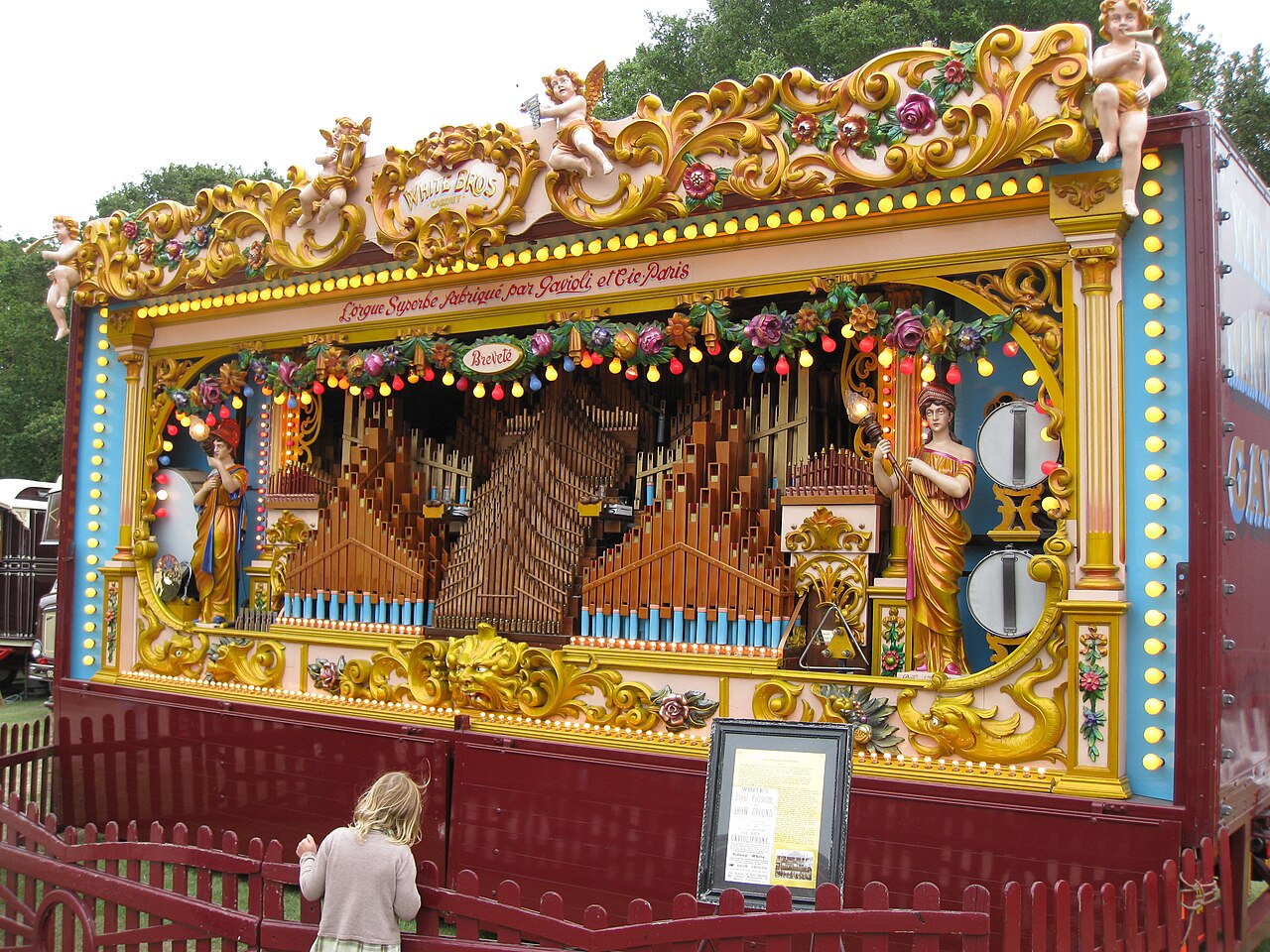
For roughly four decades either side of 1900, the self-playing organ grew from a parlour and street instrument into the loudest, largest and most extravagantly decorated machine most ordinary people would ever stand in front of. The fairground organ and its Belgian cousin the dance organ were the peak of the mechanical-organ art: cabinets the size of a cottage frontage, hundreds of pipes in a dozen ranks, drums and cymbals and glockenspiel, animated bandmaster and bell-ringing figures, and — behind the gilt — a folded cardboard book feeding the whole ensemble. This volume is the story of that golden age (≈ 1880s–1920s): the technical break that made it possible, the great firms that defined it centre by centre, the showmanship and economics that drove it, and the scale wars that kept every maker’s music locked to its own instruments.
The volume deliberately keeps the mechanism of book music — how a keyframe reads folded card and turns it into wind — to the sibling Encoding the Music dive (Vol 3), and it hands the orchestrion and band-organ cousins that mixed organ pipes with piano and percussion to Vol 6. The decline that radio and sound film brought is Vol 7. What belongs here is the human and industrial peak: the makers, the machines, the fairs, and the sound.
5.1 The break that made giants possible: book music, 1892
The barrel organ and the street organ of the earlier volumes were both prisoners of a cylinder. A pinned wooden barrel can only store as much music as its circumference allows — typically a handful of short tunes before the barrel must be shifted or changed — and a longer piece means a physically larger, heavier, more expensive drum. That ceiling is what Anselme Gavioli broke in 1892, when he patented the use of cardboard book music: fan-folded sheets of punched card, read by a keyframe whose sprung levers drop into the rectangular perforations and open the corresponding pallets (Wikipedia, Gavioli; Book music; Bowers, Encyclopedia of Automatic Musical Instruments, 1972). Because the book simply folds out to whatever length a tune needs, music was freed from the barrel’s circumference at a stroke — a march, a waltz, a full operatic selection could all be cut to the same width of card and simply run longer.
Two consequences followed directly, and both define the golden age. First, organs could grow enormous without any penalty in repertoire: a bigger instrument now meant more pipes and more registers, not a heavier program store. Second, the book was cheap to duplicate and to distribute, so a showman could carry a library of current tunes and refresh it as fashions changed. The barrel organ had been a fixed instrument playing a fixed set; the book organ was a platform playing an open, updatable catalogue.
Gavioli’s 1892 patent did not come from nowhere. The same firm had, in 1878, introduced the frein harmonique (“harmonic brake”) — a small metal tongue set at the mouth of a pipe that steadies its speech and lets it imitate the sustained, singing tone of a bowed cello or violin (Wikipedia, Gavioli). The violin and cello ranks that give a fairground organ its characteristic soaring countermelody are the frein’s direct descendants. Together the frein (expressive voicing) and book music (unlimited program length) turned the organ from a novelty into an orchestra.
The mechanism itself — keyframe, book, pallets, the note-versus-time grid the punched card encodes — is the whole subject of the Encoding the Music dive (Vol 3); this volume takes it as given and follows what makers built with it.
5.2 Waldkirch: the organ-building town
No account of the golden age can start anywhere but Waldkirch, a small town in the Black Forest (Baden, south-west Germany) that became, and still calls itself, the Orgelstadt — the organ city. Organ building was established there by Matthias Martin in 1799, but the decisive figure is Ignaz (Blasius) Bruder (1780–1845), who learned the barrel-organ craft — by tradition at Mirecourt in the Vosges — and built the town’s first street organ in 1806 (stadt-waldkirch.de; Wikipedia, Waldkirch). From that single workshop an entire local industry grew: by the late nineteenth century Waldkirch supported a cluster of firms that between them exported barrel organs, orchestrions and fairground organs across Europe and to the Americas. The town’s advantage was the same one that built the Black Forest clock trade — a dense local supply of skilled woodworkers, turners and mechanics who could be adapted to intricate pipework, keyframes and carved fronts.
Two Waldkirch dynasties dominate the fairground story, and both trace back to Ignaz Bruder’s shop.
5.2.1 The Bruder firms
The Bruder name is genuinely confusing because it belonged to several competing enterprises, and getting them straight matters. Ignaz Bruder’s sons and grandsons split into rival houses. In 1864 four of Ignaz’s sons — Andreas, Ignaz (II), Xaver and Wilhelm Bruder — formed Gebrüder Bruder (“Bruder Brothers”), which grew into the largest organ works in Waldkirch (COAA, Dahlinger, Learning From The Serial Numbers: Gebr. Bruder Organs; KDV, Bruder — Waldkirch). Separately, two sons of that Wilhelm — Wilhelm II (1841–1893) and Arnold (1842–1918) — founded their own factory under the name Wilhelm Bruder Söhne (“Wilhelm Bruder’s Sons”), which passed down through their children and grandchildren and became one of the most celebrated fairground-organ marques in Britain (waldkircher-orgelbau.de; LEO-BW). For the reader the practical point is simply that Gebr. Bruder and Wilhelm Bruder Söhne are two distinct firms with a common ancestor; a “Bruder” organ on a British fairground is usually a Wilhelm Bruder Söhne instrument, prized for a warm, full-bodied ensemble tone.
5.2.2 A. Ruth & Sohn
The other great Waldkirch house was founded by Andreas Ruth (1817–1888), who learned organ building directly from Ignaz Bruder — the two families were related by marriage — and settled in Waldkirch in 1841, first making musical clocks and crank pianos, then barrel organs (mechanical-music.fandom, Andreas Ruth & Sohn; COAA, Dahlinger). The firm A. Ruth & Sohn built organs in Waldkirch from 1841 until 1938. Under Andreas’s son Adolf I (1845–1907), who took over the management in 1875, the works turned to large book-playing fair organs, and under Adolf II (1887–1938) it reached its height. Ruth organs earned a reputation as the finest German fairground and concert organs — admired for well-judged instrumentation, high-grade pipework and a dependable pneumatic action — and surviving Ruth Model 33, 36 and 38 instruments are among the most sought fairground organs in existence.
5.2.3 Wellershaus — a German maker, but not a Waldkirch one
The firm of Wellershaus is routinely listed alongside the Waldkirch houses, and it belongs to the German fairground trade, but it was not a Waldkirch enterprise and the common grouping is a small error worth correcting. Wellershaus was founded in 1793 by Wilhelm Wellershaus (1764–1821) at Remscheid, in the Rhineland, initially as a clock- and church-organ maker; the later show-organ business (Gebr. Wellershaus, “Wellershaus Brothers”) operated from the Ruhr region — Mülheim-Saarn is recorded on surviving nameplates — not the Black Forest (Wikimedia Commons, Category:Wellershaus Organ; museum records). Wellershaus built and rebuilt mechanical organs of many types, including show organs and orchestrions, distributed chiefly in Germany, Belgium and Holland, and its instruments are recognisable by exceptionally ornate fronts. Placing it in the Ruhr rather than in Waldkirch keeps the geography honest: the German trade had two centres, Waldkirch (Bruder, Ruth) and the Rhine–Ruhr (Wellershaus), not one.
5.3 Paris: Gavioli, Limonaire, Marenghi
If Waldkirch was the German heart of the trade, Paris was its French capital, and for a generation the single most important firm anywhere was Gavioli & Cie. The house was, curiously, Italian in origin: it was founded in 1806 at Cavezzo, Italy, by Giacomo Gavioli (1786–1875), a maker of bird organs and flute clocks (tractors.fandom / trade histories; Bowers). His son Lodovico (Ludovic) Gavioli (1807–1875) — an inventor ambitious enough to have built a large orchestrion, the Panharmonico, for the Duke of Modena — moved the business to Paris in 1845, then the acknowledged capital of the organ trade. Ludovic’s three sons Anselme, Henry and Claude carried it on, and it was Anselme whose two innovations — the frein harmonique (1878) and book music (1892) — made Gavioli both the most influential and the most prolific fair-organ builder in the world. Anselme died in 1902; the firm passed to his son but did not long survive him, its senior craftsmen dispersing to found or strengthen rival houses.
The Gavioli scales became de-facto reference points for the whole industry: the 87-key scale and its later expansions to 89 and 98 keys, with a wide countermelody range, a separate piccolo section and a full bass, are still the basis on which many surviving fairground organs are keyed and arranged (mechanicalmusic.org, 87, 89, and 98 Key Gavioli Music).
Limonaire Frères was the other Parisian giant, and in the heyday of the Belle Époque only Gavioli was larger. The firm began in 1839 when the brothers Joseph and Antoine Limonaire set up as piano and organ builders; after they separated, Antoine carried the organ side forward, and after his death (aged 70) in 1886 his sons Eugène and Camille built a large modern factory on the Avenue Daumesnil — the same Paris quarter as Gavioli and Gasparini — installing a steam engine in 1890 and expanding fast (COAA, Stadler, Limonaire Frères Paris, 1839–1936; Wikipedia, Limonaire Frères). “Limonaire” became so familiar a name in France that it passed into the language as a common word for a fairground organ. The Daumesnil works closed and was demolished in 1936.
Charles Marenghi & Cie completes the Parisian trio, and it grew directly out of Gavioli’s troubles. Marenghi had risen through the Gavioli works to become chief of the workshops by 1900; when the firm faltered after Anselme’s death he left to found his own business in 1903, taking over part of the former Gavioli premises at the Avenue de Taillebourg near the Place de la Nation (Wikipedia, Charles Marenghi & Cie). His organs closely resemble Gavioli’s — unsurprising given the shared craftsmen and scales — but he added inventions of his own, notably the Grélotophone, a register of tuned sleigh-bells patented in 1914. Marenghi sold heavily into Britain, where several of his best instruments still play. The Parisian pattern is therefore one of a single dominant house (Gavioli) whose collapse seeded its rivals: Marenghi from its workshops, Mortier and others from its agency network.
5.4 Antwerp: Mortier, Decap and the Belgian dance organ
The Belgian trade took the book organ in a different direction, toward a distinct instrument: the dance organ (dansorgel), built not for the open-air fair but for the indoor dance hall and café. Where a fairground organ had to be weatherproof, portable and piercing enough to cut across a noisy midway, a dance organ lived permanently in one hall, so it could be larger, more richly voiced, and tuned to fill an enclosed room with music for dancing. The centre of this trade was Antwerp.
Théophile Mortier (1855–1944) built the greater of the two houses, and by an unusually commercial route. He began not as an organ builder but as a dance-hall manager who always kept a Gavioli organ playing, and who made a habit of selling the installed organ at a profit and replacing it — in effect a used-organ dealer. From 1898 he acted as the Belgian selling agent for Gavioli, and from 1906 he began building organs himself, at first as an annex of Gavioli and then, when the Paris firm could no longer meet orders, under his own name (thmortier.be; Wikipedia, Mortier; mus-col.com). After the First World War the firm employed some 80 workers and could turn out about 20 large dance organs a year — a cubic volume of instrument no other maker matched. Mortier fronts, all carved wood, coloured glass and, later, backlit Art-Deco panels, became the visual signature of the Belgian dance hall.
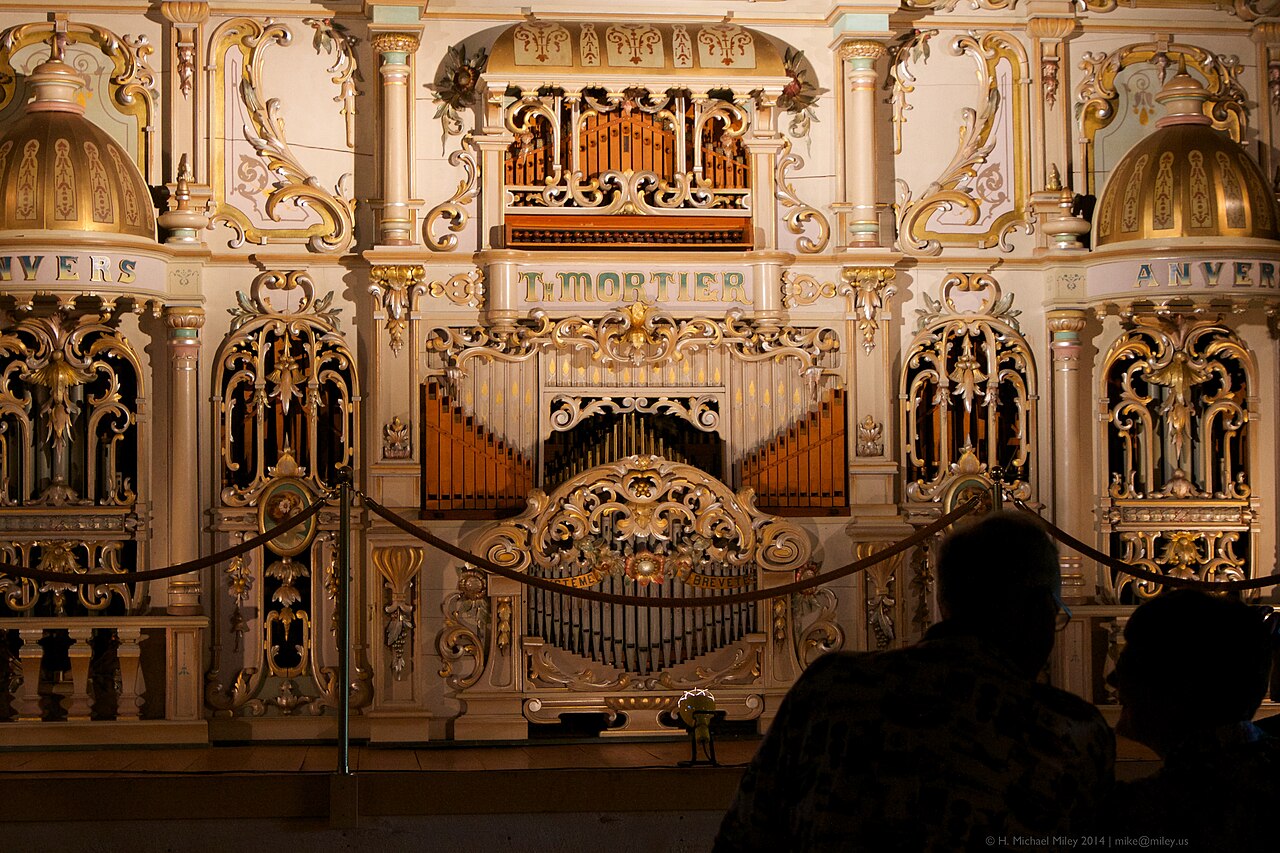
The rival house was Decap. Aloïs Decap began an organ business in Antwerp in the 1890s (a start about 1895 is usually given, with a factory of his own around 1902), and his son Frans established a separate works at Herentals in 1933; the firm is generally known as Gebroeders Decap Antwerpen — Decap Brothers of Antwerp (COAA, Mostmans, Gebroeders Decap; mechanical-music.fandom). Through the 1930s Decap matched Mortier’s dominance, and the two firms pushed the dance organ to its visual and musical zenith: enormous Art-Deco fronts lit by hundreds of coloured bulbs that changed with the registration, and articulated figures — a percussionist, a saxophone player, a stylised brass player — animated in time with the music. After the Second World War Decap led the dance organ into its final, jazz-age form: the “jazz organ” or dancing organ, in which electronic Hammond-type tone generators, accordion and saxophone ranks and amplification were built alongside (and partly in place of) traditional pipework, so the organ could keep up with contemporary popular music. That late electronic turn is the bridge from this volume’s pipe-and-book world toward the mid-century decline treated in Vol 7.
5.5 North Tonawanda, New York: the American band organ
The American branch of the golden age grew up around a single town — North Tonawanda, New York, near Buffalo — and served a distinctly American venue: the travelling carousel and carnival, whose machines are called band organs rather than fairground organs. The story begins in 1893, when the carousel maker Armitage-Herschell recruited Eugene de Kleist, a German organ builder then in London, to run the North Tonawanda Barrel Organ Factory — the first automatic-musical-instrument works in America, built to supply music for Herschell’s carousels (nthistory.com; Wikipedia, North Tonawanda Barrel Organ Factory).
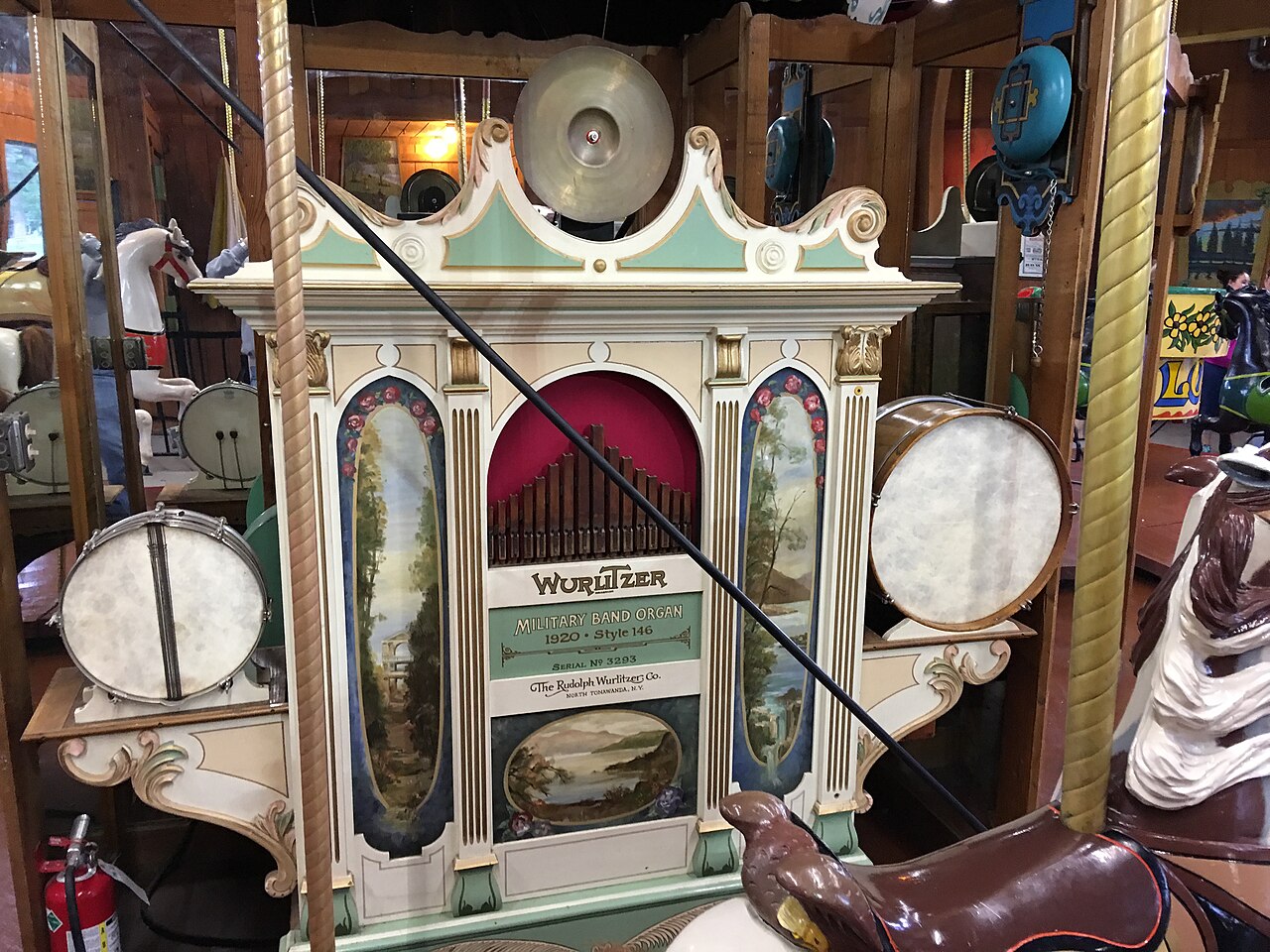
The pivotal partnership came in 1897, when de Kleist met the Rudolph Wurlitzer Company of Cincinnati, a long-established musical retailer. Wurlitzer asked whether de Kleist could build coin-operated pianos as well as band organs; the first Tonophone followed in 1898 and sold immediately. De Kleist was elected mayor of North Tonawanda in 1906, and in 1908 Wurlitzer bought him out, absorbing the works into what became one of the most famous names in American mechanical music. Wurlitzer band organs — the 125, 146, 153 and 165 styles above all — became the standard voice of the American carousel and remain the sound most Americans associate with a merry-go-round. A second local firm, Artizan Factories, was formed in 1922 by former North Tonawanda men (led by Stillman C. Woodruff) and built well-regarded band organs of its own into the 1920s (Wikipedia; Herschell Carrousel Factory Museum).
The American instruments differed from the European in emphasis: built for carousels rather than dance halls or fairground fronts, they often used paper rolls as well as book music and leaned toward a bright, brassy, trumpet-forward ensemble designed to carry across a fairground in the open air. (The roll-versus- book question, and the orchestrion pianos Wurlitzer also built, belong to Vol 6.)
5.6 A map of the great makers
The trade concentrated in four centres, each with its own venue, house style and characteristic scale. The map below places them.
5.7 The great makers, at a glance
Table 1 — The great makers, at a glance
| Maker | City / country | Founded / active | Specialty |
|---|---|---|---|
| Gavioli & Cie | Cavezzo (IT) → Paris (FR) | founded 1806; Paris from 1845; declines after 1902 | Fairground organ; book music (1892), frein harmonique (1878); 87/89/98-key scales |
| Limonaire Frères | Paris (FR) | 1839; Daumesnil works 1886–1936 | Fairground & street organ; the name became a French synonym for the instrument |
| Charles Marenghi & Cie | Paris (FR) | 1903 (ex-Gavioli chief) | Fairground organ; the Grélotophone sleigh-bell register (1914) |
| Wilhelm Bruder Söhne | Waldkirch (DE) | founded by Wilhelm II & Arnold Bruder | Fairground organ; warm full ensemble; famous in Britain |
| Gebrüder Bruder | Waldkirch (DE) | 1864 | Fairground organ & orchestrions; largest Waldkirch works |
| A. Ruth & Sohn | Waldkirch (DE) | 1841–1938 | Fairground / concert organ; premier German fair-organ maker |
| Gebr. Wellershaus | Remscheid → Ruhr (Mülheim-Saarn, DE) | firm from 1793 | Show organs & orchestrions; ornate fronts (not a Waldkirch firm) |
| Th. Mortier | Antwerp (BE) | agent 1898; builds from 1906 | Dance organ for halls; highest production volume of any maker |
| Gebr. Decap | Antwerp / Herentals (BE) | Antwerp ≈1895–1902; Herentals 1933 | Dance organ; Art-Deco fronts; post-war electronic jazz organs |
| Wurlitzer (ex-de Kleist) | North Tonawanda, NY (US) | factory 1893; Wurlitzer buys in 1908 | American carousel band organ (styles 125/146/153/165) |
| Artizan Factories | North Tonawanda, NY (US) | 1922 | American band organ for carousels & carnivals |
5.8 Showmanship: the front, the figures, the sound
A fairground organ is two machines fused into one object: an instrument, and an advertisement. The music drew a crowd to a ride, but the show front — the carved, gilded, mirrored, brightly painted façade, often several metres wide and tall — was what turned the head in the first place. On the great Gavioli, Marenghi and Bruder fronts, ranks of display pipes are framed by columns, scrollwork and allegorical carving; a central bandmaster figure beats time, side figures ring bells or strike a triangle, and (on the grandest) whole carved orchestras appear to play. On the Belgian dance organs the same instinct went Art-Deco: coloured and mirrored glass, hundreds of light bulbs that shift with the registration, and articulated saxophone- and drum-playing robots. None of this ornament is structural; all of it is salesmanship, because in a competitive fairground the organ’s job was to be seen and heard from the far side of the ground.
Behind the front sits the instrument proper, and its layout is consistent across makers. The annotated façade below shows where the parts live.
Musically, what set the golden-age organs apart from their barrel-organ ancestors was register variety: a large fair organ carried many distinct voices — bass and accompaniment pipes, a melody rank, a bright trumpet or trombone rank for the tune, singing violin and cello ranks (the frein’s legacy), flutes and piccolos, a glockenspiel or bells, plus bass drum, snare and cymbal — all under the control of the book, which could switch registers on and off within a piece exactly as a conducted band would. The arranger’s craft, cutting a book that exploited those voices, was as much a part of a maker’s reputation as its pipework.
5.9 The scale problem: a maker-locked catalogue
The one feature the golden age never solved — and arguably never wanted to — was incompatibility of scales. A “scale” is the fixed list of which pitches, ranks and functions each lane of holes across the book controls; it is the organ’s instruction set. Every major maker used its own, and they did not agree. Gavioli’s 87-, 89- and 98-key scales, the various Bruder and Ruth keyings, Mortier’s and Decap’s dance-organ scales, and the American band-organ scales were all mutually incompatible: a book cut for an 89-key Gavioli would not play on a Ruth or a Mortier, because the same lane meant a different note or a different rank on each (Bowers; dean/organ-scale references). Even nominally similar scales differed in lane assignment and note range.
This was partly a genuine engineering consequence — each maker optimised its scale around its own pipework, ranks and registers — and partly commercial strategy, for a proprietary scale locked a showman’s music library to that maker’s instruments and to that maker’s (or its licensed arrangers’) supply of new books. The result was a fragmented market in which the instrument and its music catalogue were sold together, and switching makers meant re-buying the library. Much of the twentieth-century preservation effort (Vol 7) has gone into documenting, copying and re-cutting these incompatible scales so that surviving organs can still be fed; and the contrast with the modern, deliberately standardised busker scales — the Raffin 20- and 31-note systems of the sibling dives — is exactly the point the Encoding the Music dive draws out: standardisation is what turned arranging from a maker-guarded trade secret into something an amateur can do.
5.10 The economics of the travelling fair
The golden age was driven by a specific commercial machine: the travelling fair and, in America, the carousel and carnival. For a showman, the organ was capital equipment with a clear return. It let a ride operate music continuously without paying a band, it played from opening to close without tiring, and — because its front was a spectacle — it pulled custom to the ride it fronted. A big, current, loud organ was a competitive advantage over the next showman’s ground, which is why operators invested in enormous instruments and kept their book libraries up to date with the latest popular tunes, marches and operatic selections.
That economic logic explains the whole shape of the industry: the drive toward ever larger and more spectacular fronts (advertising), the constant churn of new book music (fashion), the maker-locked scales (repeat sales of both instruments and music), and the geographic clustering in Waldkirch, Paris, Antwerp and North Tonawanda (skilled-labour pools and established supply chains). It also explains the industry’s fragility. The organ earned its keep only so long as the fair, the dance hall and the carousel were where people went for music and spectacle. When cheaper, more current entertainment arrived in the home — radio, the gramophone and, above all, sound film — the economic case for a four-metre gilded pipe organ on a fairground collapsed almost overnight. That collapse, and the preservation movement that rescued what survived it, is the subject of Vol 7.
Sources
- Q. David Bowers, Encyclopedia of Automatic Musical Instruments (1972) — the standard reference for book music, fairground and dance organs, the makers and their scales.
- Wikipedia — Gavioli; Limonaire Frères; Charles Marenghi & Cie; Mortier; Dance organ; Fairground organ; Waldkirch; North Tonawanda Barrel Organ Factory; Wurlitzer — for maker dates and cross-checks (book music 1892; frein harmonique 1878; Gavioli founded 1806, Paris 1845; Limonaire 1839; Marenghi 1903; Mortier from 1906; Ruth 1841–1938; NT factory 1893; Wurlitzer buys in 1908; Artizan 1922).
- Carousel Organ Association of America (COAA) journal — Fred Dahlinger, Learning From The Serial Numbers: Gebr. Bruder Organs and the North Tonawanda band-organ series; Andrea Stadler, Limonaire Frères Paris, 1839–1936; Roger Mostmans, Gebroeders Decap — Antwerpen, Belgie: A Short History.
- stadt-waldkirch.de and waldkircher-orgelbau.de — Waldkirch as the Orgelstadt; Matthias Martin 1799; Ignaz Bruder’s first street organ 1806; the Bruder firms.
- mechanicalmusic.org, 87, 89, and 98 Key Gavioli Music — the Gavioli scales.
- thmortier.be — the Mortier firm timeline (dance-hall origins; agency 1898; building from 1906).
- Wikimedia Commons, Category:Wellershaus Organ, and museum nameplates — the Wellershaus firm’s Rhineland/Ruhr (Remscheid → Mülheim-Saarn) origin, correcting its frequent mislabelling as a Waldkirch house.
Cross-references: the keyframe-and-book mechanism and the note-versus-time grid in the sibling Encoding the Music dive (Vol 3); the orchestrion and band-organ cousins that add piano and percussion ranks in Vol 6; the decline brought by radio, gramophone and sound film, and the preservation and DIY revival, in Vol 7. Within this series: the barrel-organ ancestors in Vol 3, the street organs and Dutch draaiorgel in Vol 4, and the master timeline and family tree in Vol 1.
Comments (0)