History Of Mechanical Organs · Volume 6
Orchestrions & Automatic-Music Cousins
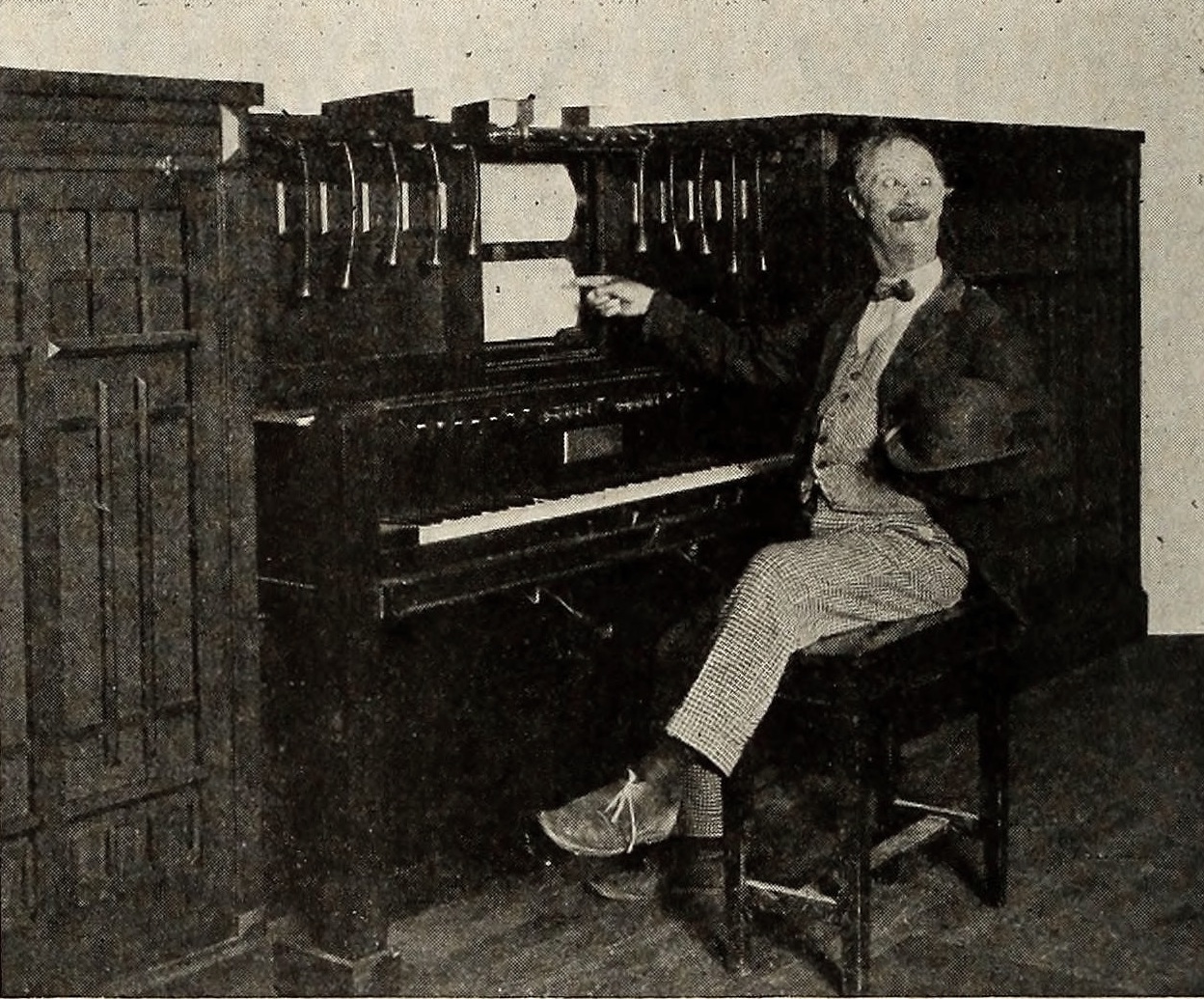
The mechanical organ did not evolve in isolation. Between roughly 1890 and 1930 the same idea that drives it — a stored, physical program scanned by a reading mechanism and turned into automatic performance — spread across an entire family of self-playing instruments, from cabinet machines that imitated a whole orchestra down to the household piano that played itself while its owner sat and read the newspaper. Pipes were only one branch of that explosion. This volume steps outside the organ family proper to place it in that wider world: the orchestrions and photoplayers that carried organ pipes into cafés, arcades and cinemas; the nickelodeons and coin pianos that fed on nickels in saloons; and the player piano and reproducing piano that shared the perforated paper roll but had no pipes at all.
The organizing question throughout is simple and diagnostic: does the instrument contain wind-blown pipes, or does it not? That single test sorts the cousins into the two camps this volume distinguishes. On one side sit the pipe-bearing relatives — orchestrion, band organ, photoplayer, the deluxe nickelodeon — which are true kin of the fairground and street organs of Vol 5 and Vol 4. On the other sit the string-and-hammer machines — the player piano and the reproducing piano — which borrowed the roll but strike strings, not pipes, and so belong to the piano’s history rather than the organ’s. The abstraction that unites all of them — a two-dimensional grid of pitch against time, stored on a physical medium and read back mechanically — is the whole subject of the sibling Encoding the Music dive; here the interest is in how many different instruments that one abstraction managed to colonize at once.
The great makers of this world are largely German and American: M. Welte & Söhne of Freiburg, Ludwig Hupfeld of Leipzig, J. D. Philipps of Frankfurt and Gebrüder Weber of Waldkirch in Europe; Wurlitzer, J. P. Seeburg and the American Photo Player Company in the United States. The fairground organs themselves belong to Vol 5, and the technologies that swept the whole trade away in the 1920s–30s belong to Vol 7; this volume holds to the cousins in their prime.
6.1 The dividing line: pipes or no pipes
The perforated paper roll is the great leveller of this period. A roll of the right width and hole-spacing could, in principle, drive a rank of organ pipes, a set of piano hammers, a xylophone, a bass drum, or a mechanical violin — and manufacturers built machines that combined several of these at once. Because the medium was shared, the instruments look, on paper, like a single family. Acoustically they are not, and the pipe test cuts cleanly through the confusion.
<rect x="242" y="205" width="182" height="66" rx="5" fill="#e8cdb0" stroke="#222"/>
<text x="333" y="223" text-anchor="middle" font-weight="bold">Band organ</text>
<text x="333" y="239" text-anchor="middle">all pipes/reeds, no piano</text>
<text x="333" y="254" text-anchor="middle" font-size="9">Wurlitzer, Artizan</text>
<text x="333" y="267" text-anchor="middle" font-size="9" fill="#666">carousel · fair (cross-ref Vol 5)</text>

<rect x="46" y="281" width="182" height="66" rx="5" fill="#e8cdb0" stroke="#222"/>
<text x="137" y="299" text-anchor="middle" font-weight="bold">Photoplayer</text>
<text x="137" y="315" text-anchor="middle">piano + pipe ranks + FX</text>
<text x="137" y="330" text-anchor="middle" font-size="9">American Photo Player, Seeburg</text>
<text x="137" y="343" text-anchor="middle" font-size="9" fill="#666">silent-movie theatre</text>

<rect x="242" y="281" width="182" height="66" rx="5" fill="#e8cdb0" stroke="#222"/>
<text x="333" y="299" text-anchor="middle" font-weight="bold">Nickelodeon (deluxe)</text>
<text x="333" y="315" text-anchor="middle">coin piano + pipes/perc.</text>
<text x="333" y="330" text-anchor="middle" font-size="9">Seeburg, Wurlitzer, Coinola</text>
<text x="333" y="343" text-anchor="middle" font-size="9" fill="#666">saloon · parlour (→ orchestrion)</text><rect x="712" y="205" width="182" height="66" rx="5" fill="#d9e2ee" stroke="#222"/>
<text x="803" y="223" text-anchor="middle" font-weight="bold">Reproducing piano</text>
<text x="803" y="239" text-anchor="middle">replays a performance</text>
<text x="803" y="254" text-anchor="middle" font-size="9">Welte-Mignon, Ampico, Duo-Art</text>
<text x="803" y="267" text-anchor="middle" font-size="9" fill="#666">wealthy home · concert</text>
<rect x="516" y="281" width="378" height="66" rx="5" fill="#eef1f5" stroke="#9aa" stroke-dasharray="3,2"/>
<text x="705" y="303" text-anchor="middle" font-size="10" fill="#444">Both share the roll but strike STRINGS. The reproducing piano adds</text>
<text x="705" y="319" text-anchor="middle" font-size="10" fill="#444">recorded dynamics + pedalling on top of the notes — still no pipes.</text>
<text x="705" y="337" text-anchor="middle" font-size="9" fill="#666">musical box (comb) and reed organ (free reeds) are further cousins, also outside the pipe camp</text>The boundary is not always tidy, and the makers themselves blurred it deliberately. A humble coin piano with only strings is a player piano in a coin-operated box; add a rank of violin pipes, a xylophone and a snare drum to the same cabinet and the trade catalogues would call it an orchestrion. A photoplayer is essentially an orchestrion re-tuned for the dark and the demands of the movie pit. And the largest single firm in the story, Welte of Freiburg, stood in both camps at once — it built the most opulent pipe orchestrions of the age and, from 1904, the Welte-Mignon reproducing piano, which has no pipes whatsoever. The pipe test sorts the instruments; it does not sort the companies.
6.2 Orchestrions: the pipe-bearing cousins
The orchestrion is the closest cousin of the fairground organ and the one that belongs most nearly inside the organ family. In its full form it is a self-playing cabinet that combines organ pipes with a piano and a battery of percussion — bass and snare drums, cymbal, triangle, xylophone, sometimes tuned bells or a mandolin rail — all driven pneumatically from a perforated paper roll, with the express aim of imitating a small orchestra from a single case. The name itself records that ambition. The word orchestrion is older than any of these firms — it was coined by the organist-theorist Georg Joseph Vogler for a large chamber organ of his own design around 1790, and was current in English by the 1830s — but it was Michael Welte’s early large automatic organs, exhibited from around 1849, that fixed it on the self-playing cabinet: they imitated a “many-voiced orchestra” so convincingly that the name stuck to the machine (Oxford English Dictionary, orchestrion; mechanicalmusicpress.com, Welte history; Bowers, Encyclopedia of Automatic Musical Instruments).
M. Welte & Söhne is the firm at the centre of the orchestrion story. Michael Welte founded the workshop in the Black Forest town of Vöhrenbach in 1832, building musical clocks and small automata, and in 1872 moved the business to Freiburg for its rail links and larger labour pool (mechanicalmusicpress.com). Welte’s decisive technical contribution came in 1887, when it became the first orchestrion maker to abandon the expensive pinned wooden cylinder for the inexpensive, mass-producible perforated paper roll — the innovation that made the whole roll-driven automatic-music industry economically possible. Its product range grew to span the domestic-scale Cottage and larger Concert orchestrions, and, from about 1910–1911, the grand Welte Philharmonic-Organ (and Philharmonic Orchestrion), full theatre- and residence-scale instruments installed in mansions, hotels and ships. Welte orchestrions of the pre-1914 “age of opulence” were among the most costly automatic instruments ever sold. The Freiburg works were destroyed by Allied bombing in November 1944, taking much of the firm’s guarded recording know-how with it.
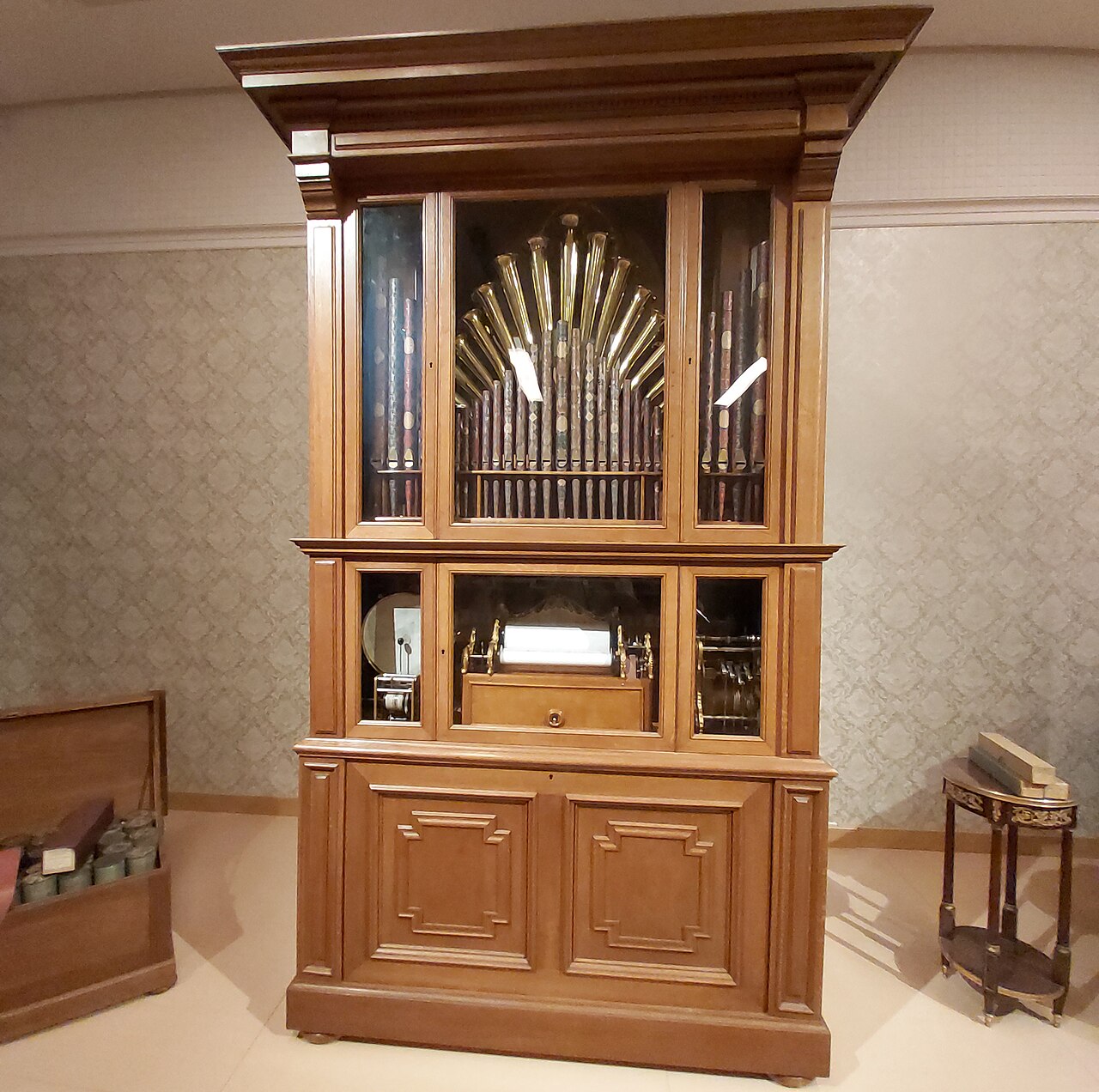
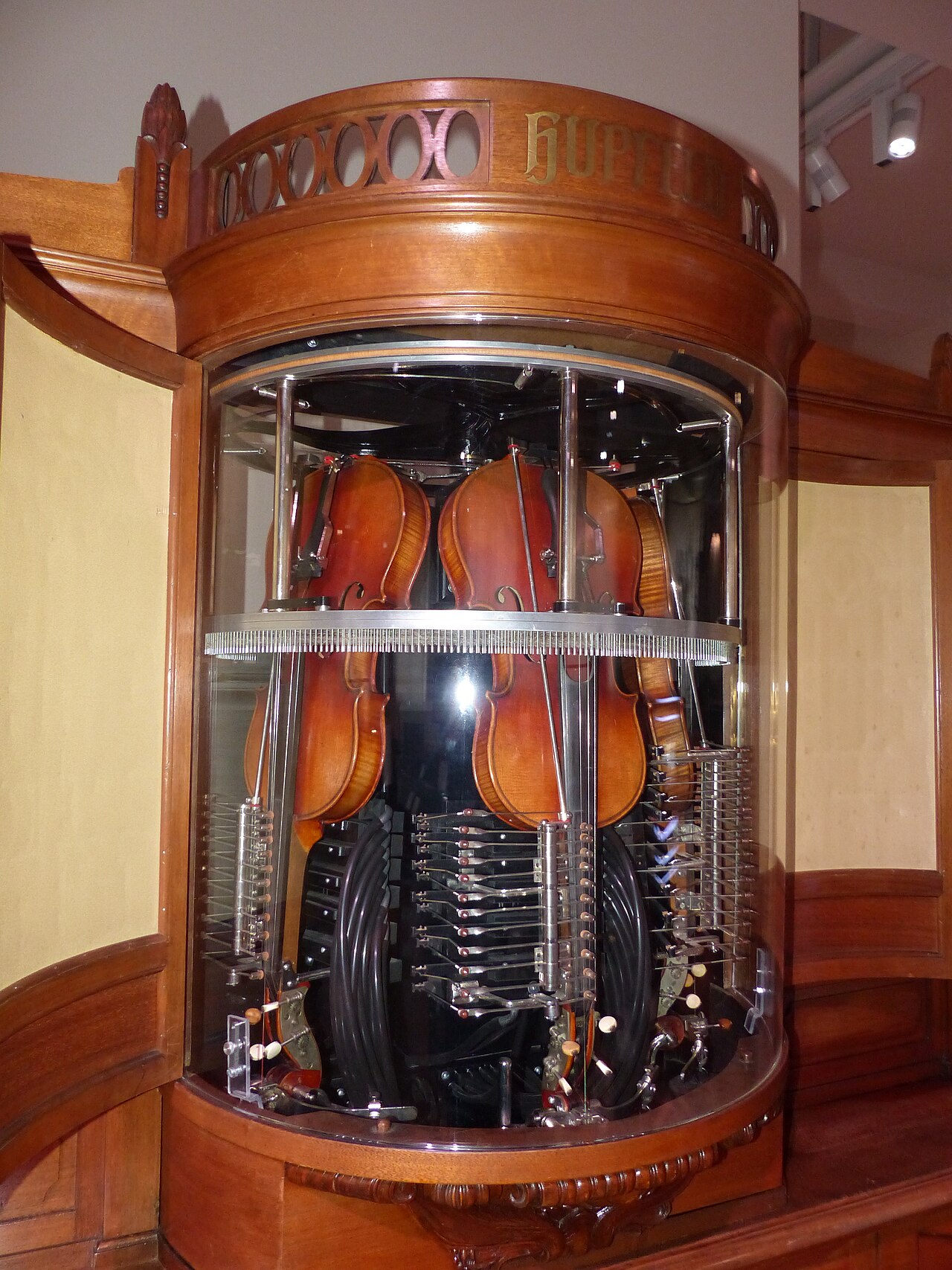
Ludwig Hupfeld of Leipzig was Welte’s great rival. The firm dates from 1892, when Ludwig Hupfeld acquired the instrument makers J. M. Grob & Co.; it became Ludwig Hupfeld AG in 1904 and in 1911 moved to a large purpose-built factory at Böhlitz-Ehrenberg outside Leipzig (Wikipedia, Ludwig Hupfeld; mechanicalmusicpress.com). Hupfeld’s signature instrument is the Phonoliszt-Violina, introduced in 1907 — a self-playing violin-and-piano orchestrion in which three real violins, each bowed on a single active string by a rotating circular bow of some 1,300 horsehair threads, were “fingered” by pneumatic pressure controlled from the roll. It was a sensation at the 1910 Brussels World’s Fair. Perhaps 10,000 Violinas were built between 1908 and 1928, of which only around 85 are thought to survive — a figure that captures how completely the trade later collapsed.
Two more German firms complete the European picture. J. D. Philipps & Söhne of Frankfurt, founded by Johann Daniel Philipps in 1886, introduced its roll-driven Pianella line in 1903 and pioneered automatic roll-changing: the Revolver-Magazine, patented by Philipps’s employee Leopold King in 1905, could hold up to a dozen rolls and cycle them without an attendant. Philipps supplied over a thousand instruments to Wurlitzer, which sold them in America under its own name as the “PianOrchestra” (de.wikipedia, J. D. Philipps). Gebrüder Weber of Waldkirch — the same Black Forest organ-building town that produced the great fairground firms of Vol 5 — built the finely engineered Maestro, Otero, Unika and Grandezza orchestrions in the 1910s. In the United States, orchestrions were mostly the deluxe end of the coin-piano trade (below), built by Seeburg and Wurlitzer for saloons, arcades and cafés rather than for mansions.
6.2.1 What is inside an orchestrion
The cutaway shows why the orchestrion sits on the organ side of the line. Wind from the bellows and reservoir is the same wind that feeds any pipe organ; the roll and tracker bar are the same reading principle as a fairground organ’s book (Vol 5) or a busker organ’s paper roll; and the percussion and piano are simply extra ranks hung on the same pneumatic system. Strip out the pipe ranks and the cabinet reduces to a piano with percussion — a coin piano. Keep them, and it is a member of the organ family that happens to travel in expensive company.
6.3 The photoplayer: the cinema’s one-man orchestra
The photoplayer is an orchestrion re-engineered for a specific and short-lived job: accompanying silent films. Between about 1910 and 1928, before recorded soundtracks, a moving picture needed live music and sound effects, and small theatres could not always afford an orchestra or even a skilled organist. The photoplayer answered that need with a single instrument, playable by one modestly trained operator, that combined a player piano, one or more ranks of organ pipes, and a bank of sound effects — drums, cymbals, a triangle, and imitative devices for a train whistle, a doorbell, a horse’s hooves, a gunshot, thunder — all triggered by cords and buttons the operator pulled and pushed while a roll played the music (Wikipedia, Photoplayer; Silent Cinema Society).
The best-known maker is the American Photo Player Company, founded by the brothers Harold and Burt Van Valkenburg, which set up its factory near the railroad in the Oakland–Berkeley area of California in 1912 and sold its instruments as the American Fotoplayer. Its characteristic form placed the piano in the centre with a side chest of pipes and effects on each flank, giving the machine its distinctive spread-out silhouette in the movie-house pit. Perhaps 8,000 to 10,000 photoplayers were built across the industry during the silent era; the American Photo Player Company ceased production around 1926 (Wikipedia, American Fotoplayer). Competitors included the Operators Piano Company of Chicago (the Reproduco), the Bartola Musical Instrument Company of Oshkosh, Wisconsin (the Bartola), and the larger houses Seeburg and Wurlitzer. When synchronized sound film — the “talkies” — arrived at the end of the 1920s, the photoplayer’s one reason to exist vanished almost overnight, a collapse Vol 7 examines.
6.4 Nickelodeons and coin pianos: automatic music for a nickel
The nickelodeon — in the mechanical-music sense, a coin-operated piano — was the American workhorse of the automatic-music trade and the direct ancestor of the jukebox. A patron dropped a nickel in the slot and the machine played a tune from a paper roll; the term covers a spectrum from the plain coin piano (piano action only) up through instruments with a mandolin attachment, then a pipe rank, then xylophone and percussion — at which point the trade simply called the deluxe end an orchestrion. The nickelodeon and the coin orchestrion are thus the same product family seen at different price points, which is why the pipe test lands a coin piano on either side of the line depending on how much its owner paid.
The two dominant American makers were Wurlitzer and the J. P. Seeburg Piano Company of Chicago, which built coin pianos and orchestrions from about 1909 through 1928, second to Wurlitzer in the 1910s and dominant in the 1920s (mechanicalmusicpress.com, Seeburg registry). Others included the Operators Piano Company (Coinola), Nelson-Wiggen, and Western Electric Piano. These instruments lived in saloons, ice-cream parlours, arcades, dance halls and restaurants — public places loud enough to need a machine that could “dazzle a crowd encouraged to put nickel after nickel into its coin slot.” That business model, entirely dependent on casual public play, made the coin-piano trade especially vulnerable: by 1928 there was little market left, and the 1929 crash finished it (Vol 7).
6.5 The non-pipe cousins: player piano and reproducing piano
Sharing the roll but firmly outside the organ family stand the two piano cousins. Both strike strings with hammers; neither has a pipe, and neither is a mechanical organ — but no account of the automatic-music world is complete without them, because they are what most households of the 1910s and 1920s actually owned.
The player piano, known everywhere by Aeolian’s trademark Pianola, plays the notes of a roll and nothing more; expression — tempo, loudness, pedalling — is left to the person operating the foot treadles and control levers. The instrument descends from Edwin Votey’s first Pianola, built in Detroit in 1895, which began as a “push-up” piano player — a separate cabinet of felt-covered wooden fingers wheeled up to any ordinary piano’s keyboard. The Aeolian Company commercialized the Pianola trademark from 1898, and the mechanism was soon built inside the piano case as the true player piano. Early rolls carried 65 notes; the industry standardized on the 88-note roll from around January 1909 (Pianola Institute). At its 1920s peak the player piano was a mass-market fixture of the middle-class parlour, sold by hundreds of piano makers under license.
The reproducing piano is the aristocrat of the non-pipe cousins: a player piano sophisticated enough to replay not just the notes but the dynamics, phrasing and pedalling of a specific recorded performance, so that a roll cut by a named pianist could recreate that pianist’s playing in the drawing room. Three systems dominated. Welte-Mignon, introduced by the same Freiburg firm in 1904, was the earliest and recorded its dynamics by a secret, largely automatic process the company never disclosed. The American Ampico (American Piano Company, from around 1913) and Aeolian’s Duo-Art (from 1913–1914) followed; the Duo-Art, unlike Welte, depended heavily on skilled human editors interpreting the performance at the recording session (Pianola Institute). Reproducing pianos captured the playing of Paderewski, Rachmaninoff, Grieg, Debussy, Mahler and many others, and constitute a genuine early sound archive — but they contain no pipes, and belong to the piano’s story, not the organ’s.
6.6 The cousins at a glance
Table 1 — The cousins at a glance
| Instrument | Has pipes? | Music medium | Typical venue | Representative makers |
|---|---|---|---|---|
| Orchestrion | Yes — pipes + piano + percussion | Perforated paper roll | Café, restaurant, arcade, wealthy home | Welte (Freiburg), Hupfeld (Leipzig), Philipps (Frankfurt), Weber (Waldkirch), Seeburg, Wurlitzer |
| Band organ | Yes — all pipes/reeds, no piano | Paper roll (also book/barrel) | Carousel, fairground, skating rink | Wurlitzer, Artizan (North Tonawanda) — cross-ref Vol 5 |
| Photoplayer | Yes — piano + pipe ranks + effects | Dual paper rolls (side chests) | Silent-movie theatre | American Photo Player Co. (Fotoplayer), Operators (Reproduco), Bartola, Seeburg, Wurlitzer |
| Nickelodeon / coin piano | Sometimes — piano only, or + pipes/percussion (then = orchestrion) | Paper roll (coin-triggered) | Saloon, arcade, ice-cream parlour, dance hall | Seeburg, Wurlitzer, Coinola/Operators, Nelson-Wiggen |
| Player piano (Pianola) | No — hammers strike strings | Paper roll (65- then 88-note) | The family home | Aeolian (Pianola); hundreds of licensees |
| Reproducing piano | No — strings, + recorded dynamics | Paper roll (system-specific) | Wealthy home, concert use | Welte-Mignon (1904), Ampico, Duo-Art |
6.7 Where the band organ sits
The band organ — the American carousel and fairground organ — is a full member of the pipe camp and is treated at length in Vol 5, but it earns a note here because it is easy to confuse with the orchestrion. The difference is the piano. An orchestrion is built around a piano with pipes and percussion added; a band organ has no piano at all — it is entirely pipes and reeds, loudly voiced to carry over the din of a midway, with a rank of drums and a cymbal for rhythm. The great American band-organ works was Wurlitzer’s plant at North Tonawanda, New York, which began in 1893 as Eugene de Kleist’s North Tonawanda Barrel Organ Factory, was bought by the Rudolph Wurlitzer Company in 1909, and built band organs until 1939. Under Wurlitzer the music source shifted from pinned barrels to perforated paper rolls, and the firm built a celebrated line including the “Military Band Organ” (one North Tonawanda example dates to 1917). The band organ is the fairground’s own instrument; it appears here only to be kept distinct from its café-dwelling orchestrion cousin.
6.8 The point: one idea, many instruments
The lesson of this volume is that the mechanical organ was a single branch of a far larger tree. The idea it embodies — a separable stored program scanned by a reading mechanism and converted into automatic performance — proved so powerful that between 1890 and 1930 it was grafted onto almost every instrument the era could build: onto pipes to make orchestrions, band organs and photoplayers; onto strings to make player and reproducing pianos; onto real violins to make the Phonoliszt-Violina. The perforated paper roll was a universal solvent, and for a generation it dissolved the boundary between a musician and a machine across the whole range of Western instruments.
Pipes were only one of the media that idea colonized — which is precisely why the mechanical organ can be understood only in this wider company. The busker organ at the far end of this program (the sibling John Smith Universal dive) and the fairground organ of Vol 5 are pipe-branch survivors of an explosion that once included the self-playing violin, the drawing-room Pianola and the cinema photoplayer. When radio, the gramophone and sound film arrived, they did not defeat the organ specifically; they made the entire “stored program → automatic performance” business obsolete at a stroke, taking orchestrion, photoplayer, nickelodeon and player piano down together. That common collapse — and the preservation and revival that followed — is the subject of Vol 7.
Sources
- Q. David Bowers, Encyclopedia of Automatic Musical Instruments (Vestal Press, 1972; reprints) — the definitive reference for orchestrions, coin pianos, photoplayers, band organs and the American and European makers.
- mechanicalmusicpress.com — M. Welte & Söhne history (Vöhrenbach 1832, Freiburg 1872, paper rolls from 1887, Cottage/Concert/Philharmonic lines); Ludwig Hupfeld history; J. P. Seeburg registry.
- Wikipedia — Orchestrion; Ludwig Hupfeld (firm 1892, AG 1904, Böhlitz-Ehrenberg 1911, Phonoliszt-Violina 1907); Photoplayer and American Fotoplayer (American Photo Player Co., factory 1912, production to c. 1926; ~8,000–10,000 photoplayers 1910–1928); List of Wurlitzer band organs / North Tonawanda Barrel Organ Factory (de Kleist 1893, Wurlitzer 1909–1939); Welte-Mignon (reproducing piano 1904).
- de.wikipedia — J. D. Philipps (Frankfurt firm 1886; Pianella 1903; King’s roll-changing Revolver-Magazine 1905; Wurlitzer distribution).
- The Pianola Institute (pianola.org) — the Pianola/player piano (Votey 1895, Aeolian trademark 1898, 65- to 88-note transition c. January 1909) and the reproducing systems (Welte-Mignon 1904, Ampico, Duo-Art 1913–14) and their differing dynamic-recording methods.
- Silent Cinema Society (silentcinemasociety.org) — the American Photo Player Company and the photoplayer in silent-film exhibition.
Cross-references: the shared medium (barrel → book → roll → MIDI) in the sibling Encoding the Music dive, Vol 1; the fairground and dance organs and the great book-music makers in Vol 5; the technologies that ended the trade, and the preservation and revival, in Vol 7; the master family tree in Vol 1.
Comments (0)