History Of Mechanical Organs · Volume 8
A History of Mechanical Organs — Reference & Timeline
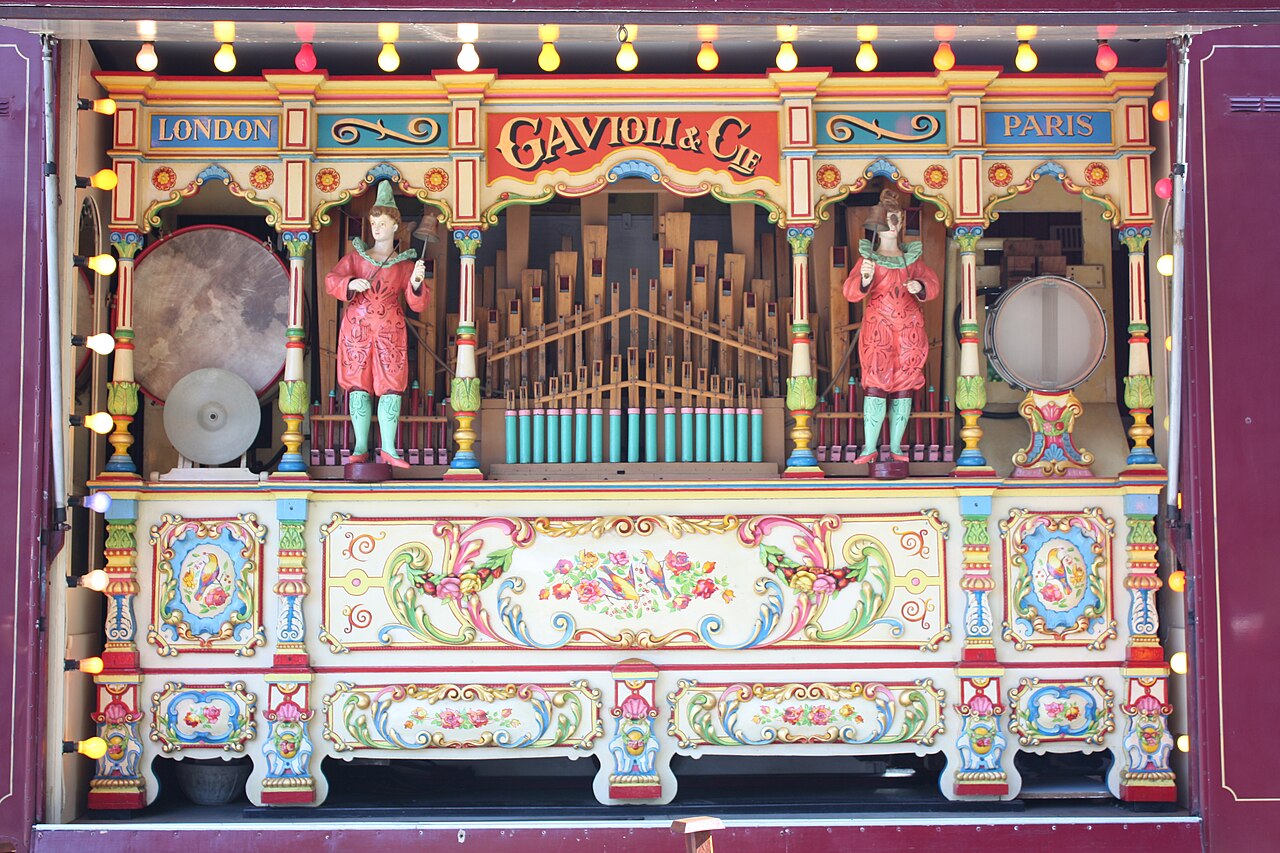
This final volume consolidates the whole series into a single working reference. It introduces no new argument and tells no new story; it gathers the dates, names, places and terms established across Vols 1–7 into tables that can be consulted directly — a master chronology from the hydraulis to the modern DIY revival, a makers’ who’s-who, a list of the museums and societies that preserve the tradition, a glossary of about thirty terms, a cross-index to the earlier volumes, and a consolidated bibliography. Every date and attribution here traces to the volume that first established it; where a value was flagged uncertain there it is repeated with the same hedge — “(est.)” — rather than hardened into fact. Where two earlier volumes stated a date slightly differently, the difference is reconciled inline with a note.
The reader who wants the reasoning behind any entry should follow the volume citation in the right-hand column back to its source chapter. The tables below are a map, not the territory.
8.1 The master chronology
The lineage is long but its firmly datable landmarks are few. The chart places the whole span on one axis; the table that follows it gives every event in detail. Both mark established history plainly and flag disputed or traditional points as such.
8.1.1 Full chronology table
Table 1 — Full chronology table
| Date | Event / instrument | Maker or figure | Vol |
|---|---|---|---|
| c. 246 BC (est.) | The hydraulis (water organ) — the earliest mechanical pipe organ; water stabilises the wind. Played, not self-acting. | Ctesibius of Alexandria | 2 |
| 1st c. AD | Pneumatica / Automata — the classical self-acting automaton established as an engineering category | Hero (Heron) of Alexandria | 2 |
| c. 850 | The Instrument That Plays by Itself — hydro-organ read by an interchangeable pinned cylinder; widely cited as the earliest programmable machine (with caveats) | Banū Mūsā brothers, Baghdad | 2 |
| 14th–16th c. | Carillon drums in the Low Countries — pinned barrels tripping bell hammers; the pinned barrel treated as a re-writable store | Civic belfries (Bruges, Ghent, Mechelen) | 2 |
| 1502 | Salzburg Hornwerk (Salzburger Stier) commissioned; a pinned barrel-organ mechanism added c. 1640; eleven monthly tunes later added by Eberlin and Leopold Mozart | Leonhard von Keutschach; built by Michael Rytzinger | 2 |
| 1566–1571 | Fountain of the Organ, Villa d’Este, Tivoli — first automatic organ in a Roman villa garden | Luc Leclerc & Claude Venard (design Pirro Ligorio) | 2 |
| 1615 | Les raisons des forces mouvantes — the pinned-barrel organ set down as a reproducible design method | Salomon de Caus | 2 |
| 1650 | Musurgia Universalis — the pinned-cylinder organ put into wide printed circulation | Athanasius Kircher | 2 |
| c. 1760–1840 | Peak of the English barrel-organ trade — parish-church and chamber/domestic organs | Pyke, Longman & Broderip, Astor, Bishop, Bryceson, Flight & Robson | 3 |
| 1796 | Bryceson firm founded (sliding-cradle barrel shift) | Henry Bryceson | 3 |
| c. 1815 | Shelland (Suffolk) church barrel organ acquired — still played in services | — | 3 |
| 1817 | The Apollonicon exhibited — a self-acting barrel-and-finger organ (~1,900 pipes) using spiral barrels; the barrel organ straining at its ceiling | Flight & Robson | 3 |
| 1830–1850 | West-gallery bands “ousted” by barrel organs across rural England | — | 3 |
| 1851 | Great Exhibition popularises the harmonium, which soon displaces the parish barrel organ | — | 3 |
| 1864 | Bass’s Act (Act for the Better Regulation of Street Music) — early noise legislation aimed at street organ grinders | M. T. Bass; agitation by Charles Babbage | 4 |
| 1875 | Amsterdam barrel-organ rental company founded — turns the draaiorgel into a civic institution; Perlee firm dates from the same year | Leon Warnies; Perlee | 4 |
| 1878 | The frein harmonique (“harmonic brake”) — lets pipes imitate bowed strings | Gavioli (Anselme) | 5 |
| 1892 | Cardboard book music patented — frees tune length from a barrel’s circumference; makes giant organs possible | Anselme Gavioli | 5 |
| 1893 | North Tonawanda Barrel Organ Factory — first automatic-music works in America | Eugene de Kleist | 5 · 6 |
| 1903 | Ch. Marenghi & Cie founded from the former Gavioli workshops; Grélotophone register 1914 | Charles Marenghi | 5 |
| 1904 | Welte-Mignon reproducing piano introduced (Welte had adopted the paper roll in 1887) | M. Welte & Söhne | 6 |
| 1906 | Mortier begins building dance organs under his own name (Gavioli agent from 1898) | Théophile Mortier | 5 |
| 1907 | Phonoliszt-Violina — self-playing violin-and-piano orchestrion; sensation at the 1910 Brussels World’s Fair | Ludwig Hupfeld, Leipzig | 6 |
| 1908–09 | Wurlitzer buys out de Kleist (band-organ production continues to 1939) | Rudolph Wurlitzer Co. | 5 · 6 |
| 1920s–1930s | Radio, the gramophone and sound film (“talkies”) dismantle the fairground, orchestrion and photoplayer trades | — | 6 · 7 |
| 1920 | Carl Frei settles in Breda — standardises the Dutch street-organ (“pierement”) sound | Carl Frei (1884–1967) | 4 |
| 1935 | New York ends the organ-grinder trade (licences not renewed 1936; ban repealed 1975) | Mayor F. La Guardia | 4 |
| 1936 / 1938 | Limonaire (Daumesnil) works closed 1936; A. Ruth & Sohn closes 1938 | — | 5 |
| 1949 | MBSI (Musical Box Society International) founded (as the Musical Box Hobbyists; renamed 1953) | — | 7 |
| 1954 | Kring van Draaiorgelvrienden (KDV) founded, Netherlands | — | 7 |
| 1956 / 1958 | Museum Speelklok — the 1956 From Musical Box to Barrel Organ exhibition (14,000 visitors) leads Utrecht to found a permanent museum, opened 1958 (moved to the Buurkerk 1984) | — | 7 |
| 1957 | FOPS (Fair Organ Preservation Society, UK) established — enthusiasts round Tom Alberts’ 98-key Marenghi, Bolton | — | 7 |
| 1960 | Raffin busker-organ workshop established, Überlingen; the Raffin 20-/31-note scales become de-facto standards | Josef Raffin | 7 |
| 1962 / 1963 | Musical Box Society of Great Britain (1962); Musical Museum, Brentford (1963) | — | 7 |
| 1995 | The open-source John Smith DIY busker-organ design — the thread this whole program sits in | John Smith | 7 |
| 1998 | COAA (Carousel Organ Association of America) founded | — | 7 |
8.2 Makers’ who’s-who
Consolidated from Vols 3–6. Cities and dates are as established in those volumes; where a firm spans two cities the move is noted. The one internal reconciliation: the de Kleist / Wurlitzer buy-out is given as 1908 in Vol 5’s makers’ account and 1909 in Vol 6’s band-organ account — both appear in the trade literature; this volume writes it 1908–09.
Table 2 — Makers' who's-who
| Maker / firm | City / region | Dates (founded–active) | Specialty |
|---|---|---|---|
| George Pyke | London | fl. c. 1760s | Luxury chamber barrel organs & organ clocks (Vol 3) |
| Longman & Broderip | London | from 1784 | Commercial chamber barrel organs (Vol 3) |
| George Astor | London | from 1799 | Chamber barrel organs (surviving tune-sheets) (Vol 3) |
| J. C. Bishop; Henry Bryceson | London | Bryceson from 1796 | Church & combination barrel organs; sliding barrel cradle (Vol 3) |
| Flight & Robson | London (St Martin’s Lane) | c. 1800 – bankrupt 1832 | Chamber & monumental organs; the Apollonicon (1817) (Vol 3) |
| Frati & Co. | Berlin | 1880s–1890s | Small hand-cranked street barrel organs (Vol 4) |
| Leon Warnies; Perlee | Amsterdam | from 1875 | Dutch street-organ rental & rebuilding (Vol 4) |
| Carl Frei | Waldkirch → Breda | 1884–1967; Breda 1920–45 | Dutch street-organ arranging; violin/celeste & bourdon céleste voicing (Vol 4) |
| Ignaz Bruder | Waldkirch | 1780–1845; first street organ 1806 | Founder of the Waldkirch trade (Vol 4 · 5) |
| Gebrüder Bruder | Waldkirch | from 1864 | Largest Waldkirch works; fairground organs & orchestrions (Vol 5) |
| Wilhelm Bruder Söhne | Waldkirch | founded by Wilhelm II & Arnold Bruder | Fairground organs prized in Britain; warm full ensemble (Vol 5) |
| A. Ruth & Sohn | Waldkirch | 1841–1938 | Premier German fairground/concert organs (Models 33/36/38) (Vol 5) |
| Gebr. Wellershaus | Remscheid → Ruhr (Mülheim-Saarn) | firm from 1793 | Show organs & orchestrions; ornate fronts. Not a Waldkirch firm (Vol 5) |
| Gavioli & Cie | Cavezzo (IT) → Paris | 1806; Paris 1845; declines after 1902 | The dominant fair-organ house; frein harmonique (1878), book music (1892); 87/89/98-key scales (Vol 5) |
| Limonaire Frères | Paris (Avenue Daumesnil) | 1839; works 1886–1936 | Fairground & street organs; name became a French synonym for the instrument (Vol 5) |
| Charles Marenghi & Cie | Paris | 1903 | Fairground organs (ex-Gavioli); the Grélotophone sleigh-bell register (1914) (Vol 5) |
| Th. Mortier | Antwerp | agent 1898; builds from 1906 | Belgian dance organs for halls; highest production of any maker (Vol 5) |
| Gebr. Decap | Antwerp / Herentals | Antwerp ≈1895; Herentals 1933 | Dance organs; Art-Deco fronts; post-war electronic jazz organs (Vol 5) |
| Wurlitzer (ex-de Kleist) | North Tonawanda, NY | factory 1893; Wurlitzer 1908–09; band organs to 1939 | American carousel band organs (styles 125/146/153/165) (Vol 5 · 6) |
| Artizan Factories | North Tonawanda, NY | 1922 | American band organs for carousels & carnivals (Vol 5) |
| M. Welte & Söhne | Vöhrenbach → Freiburg | 1832; Freiburg 1872; works destroyed 1944 | The grandest orchestrions; paper rolls from 1887; Welte-Mignon (1904) (Vol 6) |
| Ludwig Hupfeld | Leipzig | firm 1892; AG 1904 | Orchestrions; the Phonoliszt-Violina (1907) (Vol 6) |
| J. D. Philipps & Söhne | Frankfurt | 1886 | Roll-driven orchestrions (Pianella, 1903); automatic roll-changing (1905) (Vol 6) |
| Gebrüder Weber | Waldkirch | 1910s | Finely engineered orchestrions (Maestro, Unika, Grandezza) (Vol 6) |
| American Photo Player Co. | Berkeley/Oakland, CA | 1912 – c. 1926 | Photoplayers (the American Fotoplayer) for silent cinema (Vol 6) |
| J. P. Seeburg | Chicago | c. 1909–1928 | Coin pianos, nickelodeons & orchestrions (Vol 6) |
| Aeolian Company | US / UK | Pianola trademark from 1898 | Player pianos (Pianola) & the Duo-Art reproducing piano (non-pipe cousins) (Vol 6) |
| Raffin | Überlingen | from 1960 | Modern paper-roll busker organs; the 20-/31-note scale standards (Vol 7) |
| Hofbauer; Stüber | Germany | 20th c. | Modern busker/crank organs & kits (Vol 7) |
8.3 The makers by region — recap
The trade concentrated in a handful of centres. The compact map recaps who built what, and where; the full account is in Vol 5 (fairground/dance) and Vol 6 (orchestrions).
8.4 Museums & societies
The instruments survive because collectors and societies rescued them after the trade collapsed (Vol 7). Founding years below are as documented by each institution.
Table 3 — Museums & societies
| Institution | Location | Founded | Focus |
|---|---|---|---|
| MBSI — Musical Box Society International | United States | 1949 (renamed 1953) | Musical boxes & automatic instruments; the founding preservation society |
| Kring van Draaiorgelvrienden (KDV) | Netherlands | 1954 | Dutch street organs (draaiorgels); rescue & preservation |
| Museum Speelklok | Utrecht (Buurkerk since 1984) | 1958 (exhibition 1956) | Self-playing instruments — street, dance, fairground organs & orchestrions |
| Musical Box Society of Great Britain (MBSGB) | United Kingdom | 1962 | Musical boxes & mechanical music |
| Musical Museum (formerly British Piano Museum) | Brentford, London | 1963 (Frank Holland, MBE) | Player/reproducing pianos, orchestrions, organs; historic rolls |
| FOPS — Fair Organ Preservation Society | United Kingdom | 1957 | Fairground & dance organs; the standard UK fair-organ body |
| St Albans Organ Theatre (St Albans Musical Museum Society) | St Albans, UK | Trust formed 1978 (Charles Hart collection, from the 1960s) | Belgian dance organs, a Wurlitzer theatre organ, mechanical organs |
| COAA — Carousel Organ Association of America | United States | 1998 | Carousel/band & crank organs; publishes Carousel Organ |
Glossary
Terms as used across this series; the volume that develops each is noted.
Table 4 — Glossary
| Term | Meaning |
|---|---|
| Hydraulis | The ancient water organ (Ctesibius, c. 246 BC est.); water stabilises the wind to a pipe rank. Played by hand, not self-acting (Vol 2). |
| Automaton | A self-acting machine that mimics living action; the classical category (Hero of Alexandria) into which the self-playing organ falls (Vol 2). |
| Pinned barrel | A rotating wooden cylinder studded with pins (and bridge-staples) whose pattern encodes a tune; the oldest program medium (Vols 2–3). |
| Bridge / staple | A metal graduated over-pin on a barrel that holds a note open for a sustained duration, as opposed to a short single pin (Vol 3). |
| Carillon drum | A large pinned barrel that trips tuned-bell hammers in a tower; the pinned-barrel mechanism in a bell medium (Vol 2). |
| Hornwerk | A Renaissance bellows-and-pipe signalling organ (e.g. the Salzburg Stier, 1502), later fitted with a pinned barrel (Vol 2). |
| Barrel organ | In its primary sense, the chamber/church pinned-barrel pipe organ of the 18th–19th c.; loosely, any cranked barrel-driven organ (Vol 3). |
| Barrel-and-shift | Sliding a barrel laterally to bring a fresh set of pin-tracks (a new tune) under the key frame; typically ten tunes per barrel (Vol 3). |
| Barrel-and-finger | A combination organ with both an automatic barrel action and a conventional playable keyboard (Vol 3). |
| Dumb organist | A self-contained cranked barrel unit set over an ordinary finger organ, its wooden trackers depressing the manual keys (Vol 3). |
| West-gallery band | The pre-barrel-organ village church band (bassoon, serpent, fiddle, etc.) that barrel organs displaced c. 1830–1850 (Vol 3). |
| Monkey organ / hand organ | The small, portable, hand-cranked street barrel organ of the itinerant organ grinder (Vol 4). |
| Organ grinder | The itinerant street player of a hand organ, often an immigrant, traditionally accompanied by a coin-collecting monkey (Vol 4). |
| Orgue de Barbarie | French for the street barrel organ; the term of disputed origin (a maker “Barberi”, or Barbarie = “foreign”) (Vol 4). |
| Drehorgel / Leierkasten | German for the street organ (“turning organ” / “lyre-box”); the player is the Leierkastenmann (Vol 4). |
| Draaiorgel | The large Dutch street organ, book-driven, wheeled on a cart; a civic institution (Vol 4). |
| Pierement | Affectionate Dutch slang for the draaiorgel and its brassy, counter-melody-rich street sound (Vol 4). |
| Book music | Fan-folded punched cardboard read by a keyframe; Gavioli’s 1892 innovation that freed tune length from a barrel’s circumference (Vol 5). |
| Keyframe | The sprung-lever reader whose keys drop into a book’s perforations (or a roll’s holes) and open the corresponding pallets (Vol 5). |
| Frein harmonique | A “harmonic brake” tongue at a pipe mouth (Gavioli, 1878) that steadies speech so pipes imitate bowed strings (Vol 5). |
| Fairground organ | The large, weatherproof, piercing book-driven organ built to front a travelling-fair ride, with an ornate show front (Vol 5). |
| Dance organ (dansorgel) | The Belgian indoor hall/café organ (Mortier, Decap) — larger, richer, later Art-Deco and electronic (Vol 5). |
| Band organ | The American carousel/carnival organ — all pipes and reeds, no piano, brightly voiced; North Tonawanda (Vol 5 · 6). |
| Show front / façade | The carved, gilded, mirrored advertisement face of a fairground or dance organ; ornament, not structure (Vol 5). |
| Scale (organ scale) | The fixed list of which pitch/rank each lane of a book or roll controls — the organ’s “instruction set”; maker-specific and mutually incompatible (Vol 5). |
| Register / rank | A set of pipes of one voice (violin, cello, flute, trumpet, bass) switchable on and off by the program; register variety was a chief selling point (Vol 5). |
| Orchestrion | A self-playing cabinet combining organ pipes + piano + percussion to imitate an orchestra, roll-driven (Vol 6). |
| Photoplayer | An orchestrion re-engineered for silent cinema — piano, pipe ranks and effects worked by cords/buttons (c. 1910–1928) (Vol 6). |
| Nickelodeon / coin piano | A coin-operated roll-playing piano; with added pipes/percussion it becomes an orchestrion (Vol 6). |
| Player / reproducing piano | Roll-driven pianos that strike strings, not pipes — media cousins, not organs (Pianola; Welte-Mignon) (Vol 6). |
| Busker organ | The small, portable, hand-cranked paper-roll pipe organ of the modern era (Raffin; the John Smith DIY design) — the living end of the lineage (Vol 7). |
| Paper roll | A perforated-paper program medium (65-/88-note piano rolls; Raffin 20-/31-note busker rolls) — the busker inheritance of the fairground era (Vols 6–7). |
8.5 Cross-index to Vols 1–7
Table 5 — Cross-index to Vols 1–7
| Topic | Where treated |
|---|---|
| Definition of “mechanical organ”; the family tree; master timeline | Vol 1 §“What counts as a mechanical organ”, §“The family tree” |
| Hydraulis; Banū Mūsā pinned cylinder; carillon drums; Villa d’Este; Salzburg Hornwerk; Kircher | Vol 2 §§1–5 |
| The “first programmable machine” claim and its caveats | Vol 2 §2.1 |
| English barrel-organ trade; parish church use; “dumb organist”; barrel-and-shift | Vol 3 §§2–3 |
| Chamber/domestic barrel organs; Flight & Robson; the Apollonicon | Vol 3 §4 |
| Barrel organ’s decline (harmonium, 1851 onward) | Vol 3 §5 |
| Street/“monkey” organ; the grinder; nuisance laws (Bass’s Act, La Guardia) | Vol 4 §§“The small end”, “The nuisance campaigns” |
| Dutch draaiorgel; Warnies’ rental system; Carl Frei’s voicing | Vol 4 §§“The great contrast”, “Carl Frei” |
| Book music (1892); frein harmonique (1878); Waldkirch; Gavioli/Limonaire/Marenghi | Vol 5 §§“The break”, “Waldkirch”, “Paris” |
| Belgian dance organs (Mortier, Decap); American band organs (Wurlitzer, Artizan) | Vol 5 §§“Antwerp”, “North Tonawanda” |
| The scale-incompatibility problem | Vol 5 §“The scale problem” |
| Orchestrions, photoplayers, nickelodeons; the pipe test | Vol 6 §§“The dividing line”, “Orchestrions” |
| Player & reproducing pianos as non-pipe cousins | Vol 6 §“The non-pipe cousins” |
| Decline (radio, gramophone, sound film); preservation; Raffin & John Smith revival | Vol 7 (throughout) |
| Wellershaus = Remscheid/Rhine-Ruhr, not Waldkirch | Vol 5 §“Wellershaus”; corrected here |
| Raffin founded 1960 (not 1962); John Smith design 1995 | Vols 1, 7; consistent here |
8.6 Bibliography
Consolidated and de-duplicated from the sources sections of Vols 1–7.
8.6.1 Standard references
- Q. David Bowers, Encyclopedia of Automatic Musical Instruments (Vestal Press, 1972) — the definitive reference for barrel organs, book music, fairground and dance organs, orchestrions, photoplayers, coin pianos, band organs and their makers (Vols 1, 3–6).
- Arthur W. J. G. Ord-Hume, Barrel Organ: The Story of the Mechanical Organ and Its Repair (A. S. Barnes, 1978) — incl. the reprinted 1832 Flight & Robson auction catalogue; also The Automatic Organ, Player Piano, and Clockwork Music (Vols 1, 3–4).
- Nicholas Temperley, The Music of the English Parish Church (Cambridge University Press, 1979) — the west-gallery tradition and its displacement (Vol 3).
8.6.2 Society journals & institutions
- Fair Organ Preservation Society (FOPS), UK (established 1957) — fairground and dance-organ history and preservation.
- Musical Box Society International (MBSI) (founded 1949) and the Musical Box Society of Great Britain (1962) — journals and histories.
- Carousel Organ Association of America (COAA), Carousel Organ journal (from 1998) — F. Dahlinger, Learning From The Serial Numbers: Gebr. Bruder Organs and the North Tonawanda band-organ series; A. Stadler, Limonaire Frères Paris, 1839–1936; R. Mostmans, Gebroeders Decap; V. Morgan, Organ Grinders With Live Monkeys (Vols 4–6).
- Kring van Draaiorgelvrienden (KDV / draaiorgel.org) — Carl Frei — Waldkirch & Breda; Dutch street-organ history (Vol 4).
8.6.3 Museums
- Museum Speelklok, Utrecht (museumspeelklok.nl) — collection & institutional history (1956; Buurkerk from 1984).
- Musical Museum, Brentford (musicalmuseum.co.uk) — Frank Holland; player/ reproducing pianos, orchestrions, rolls (from 1963).
- St Albans Organ Theatre (stalbansorgantheatre.org.uk) — the Charles Hart dance-organ and theatre-organ collection (trust 1978).
- Victoria and Albert Museum, London — record O171546 (Flight & Robson chamber organ) (Vol 3).
8.6.4 Firm & maker histories
- stadt-waldkirch.de / waldkircher-orgelbau.de — Waldkirch as Orgelstadt; Matthias Martin 1799; Ignaz Bruder 1806; the Bruder firms (Vol 5).
- thmortier.be; mechanical-music.fandom (Andreas Ruth & Sohn; Gebr. Decap); mechanicalmusic.org (87, 89, and 98 Key Gavioli Music) (Vol 5).
- mechanicalmusicpress.com — M. Welte & Söhne, Ludwig Hupfeld, J. P. Seeburg histories (Vol 6); de.wikipedia, J. D. Philipps (Vol 6).
- The Pianola Institute (pianola.org) — player/reproducing pianos and their dynamic-recording methods (Vol 6).
- raffin.de (Orgelbau Raffin) — Josef Raffin’s Überlingen workshop (1960) and the Raffin busker scales (Vols 1, 7).
8.6.5 Cross-checks
- Wikipedia — Mechanical organ, Barrel organ, Book music, Fairground organ, Dance organ, Street organ, Orchestrion, Photoplayer, Carl Frei, Waldkirch, Book of Ingenious Devices, Musurgia Universalis, Museum Speelklok, Musical Museum, Brentford — for dates and cross-checks throughout.
8.7 Closing: where this program goes next
This history is one of two theory dives in the Mechanical Organs program, and it exists to give the modern builder the long view: the small, hand-cranked, paper-roll pipe organ on a hobbyist’s bench is the direct, unbroken descendant of the Baghdad water-organ, the Georgian barrel organ, the Gavioli fairground giant and the Raffin busker box (Vol 1 §“Why the lineage runs straight to the DIY busker organ”). Having placed the instrument in time, the reader is pointed to the sibling dives that treat it in the present:
- Encoding the Music — the four program media (barrel, book, roll, MIDI) as a single note-versus-time grid; the mechanism this history only names.
- How Organ Pipes Make Sound — flue and reed pipe acoustics: what the wind actually does inside the pipes catalogued here.
- Wind Systems — bellows, reservoirs and regulated pressure, the hydraulis’s problem solved for a modern build.
- The John Smith Universal build — the concrete open-source 1995 busker organ (and its 20-/26-note scales) that the whole revival thread runs to.
- Fairground & Dutch Street Organs (planned, dive 14) — a closer, instrument-by- instrument look at the golden-age and draaiorgel survivors surveyed in Vols 4–5.
The tables above are meant to be returned to. When a date, a maker or a term is needed at the bench, it should be findable here in one line — with a volume citation pointing back to the full story.
Comments (0)