History Of Mechanical Organs · Volume 2
Ancient Roots & Early Automata
Long before a barrel organ ever stood in an English parish gallery (the subject of Vol 3), two problems had to be solved separately and then married. The first was how to make a rank of pipes speak reliably on demand — a controlled, steady wind pushed through tuned pipes. The second was how to store a melody in physical matter so that a machine, rather than a player’s fingers, could recall it. The first problem was solved in Hellenistic Alexandria; the second matured, in its decisive form, in ninth-century Baghdad. Everything the crank organ later became — the pinned barrel, the interchangeable tune, the idea of a “program” frozen in brass and wood — descends from the moment those two ideas met.
This volume traces that prehistory: the hydraulis of Ctesibius, the self-playing organ of the Banū Mūsā brothers, the carillon drums of the medieval Low Countries, and the Renaissance water-garden automata that carried the pinned cylinder into the age of print. It deliberately stops short of the barrel organ proper. The concern here is the idea — a tune held as a pattern of pins, read by a rotating drum — and the long, discontinuous road by which that idea reached Europe. (For the encoding of tunes as pins, pegs, and holes as a general technology, cross-reference the sibling Encoding the Music dive.)
2.1 The hydraulis: the pipe-organ root
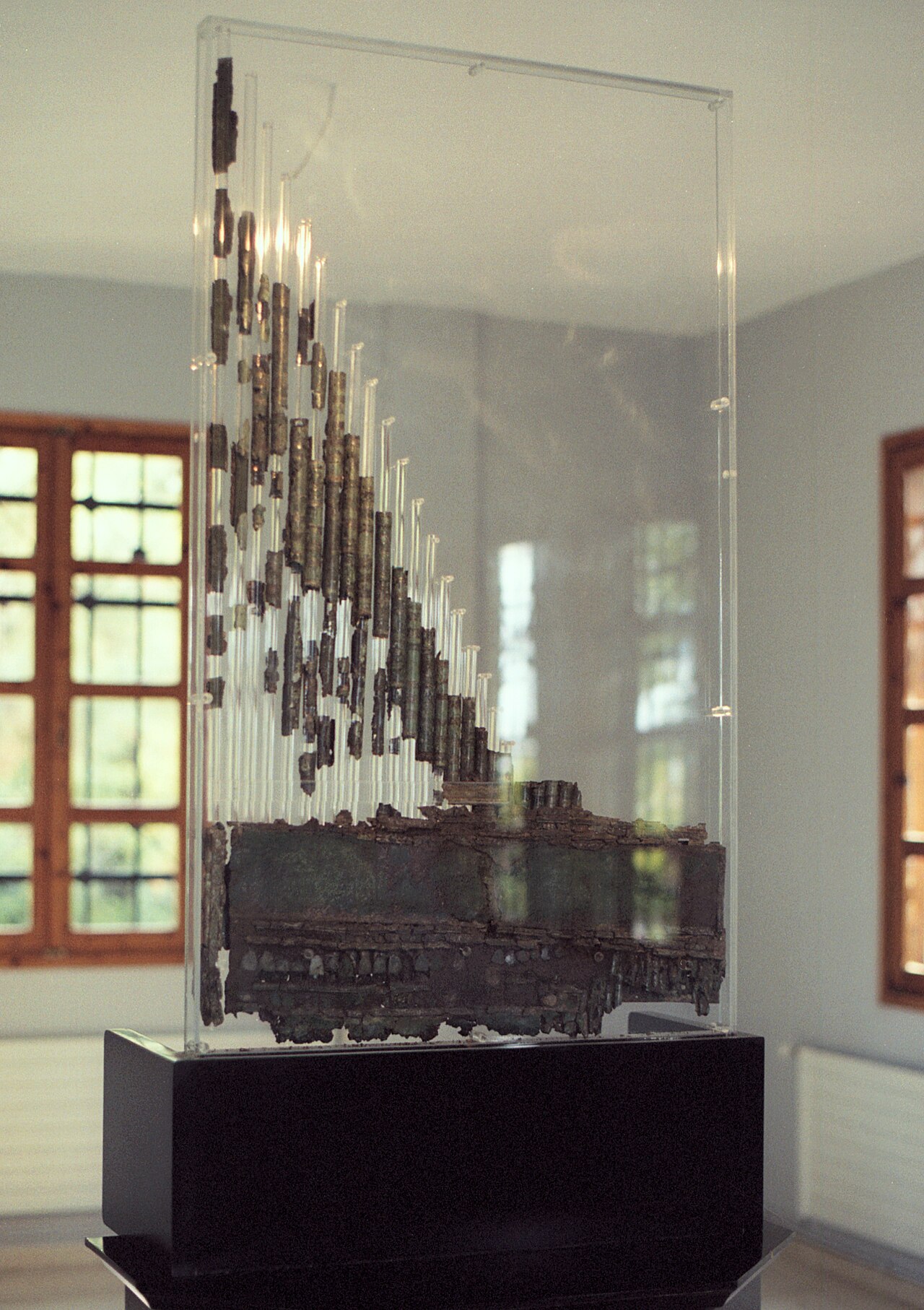
The organ begins as a plumbing problem. A single pipe blown by mouth is easy; a rank of large pipes demands a wind supply both copious and steady, because pipes go sharp and flat, or overblow, as wind pressure wanders. The solution is credited to Ctesibius of Alexandria (Greek: Ktesibios), a barber’s son who became the first great figure of the Alexandrian school of mechanics, active in the first half of the 3rd century BC — conventionally placed around c. 285–222 BC, though his exact dates are uncertain (Britannica, Ctesibius of Alexandria). None of his own writings survive; his inventions are known only at second hand, chiefly through the Roman architect Vitruvius (De architectura, Book X, c. 15 BC) and through Hero of Alexandria (1st century AD) (Britannica, Hydraulis).
His instrument, the hydraulis (ὕδραυλις, literally “water-pipe” or “water-aulos”), was the earliest known mechanical pipe organ. Its cleverness lay not in using water to make sound — the pipes were, as always, blown by air — but in using water to stabilize the air. One or two hand- or lever-worked piston pumps forced air into a bronze reservoir shaped like an inverted funnel or bell, whose open bottom stood immersed in a tank half-filled with water. When a pumper delivered a surge of air, the water rose in the surrounding tank and, by its weight, pressed back on the trapped air; when the pump paused between strokes, the water fell and the air cushion expanded to keep pressure up. The water thus acted as a pneumatic spring — a constant-pressure regulator — smoothing the pulsating output of the pumps into the even wind a rank of pipes needs (UNRV, Hydraulis; Wikipedia, Water organ).
It is worth naming the other Alexandrian who bears on this history: Hero (Heron) of Alexandria (1st century AD), whose Pneumatica and Automata describe temple-door openers, coin-operated vessels, and self-moving figures driven by air, water, and falling weights — including singing-bird and whistling automata in which a stream of air is made to voice a pipe without a human breath. Hero did not build a pinned-cylinder organ, and his musical automata are toys rather than sequencers; but his treatises establish the classical automaton — a self-acting machine that mimics living action — as a respectable object of engineering, and it is precisely these texts, recovered and reprinted, that Renaissance builders such as de Caus and compilers such as Kircher cite when they resume the automatic organ centuries later. The Hellenistic world, in short, bequeathed both the pipe-and-wind body (Ctesibius) and the intellectual category of the self-playing machine (Hero) — but not the stored program.
Notes were selected by hand: the player pushed in sliders (pnigeus/pallet mechanisms) beneath each pipe, admitting wind to one pipe at a time — the direct ancestor of the organ key. The essential point for this history is that the hydraulis was played, not automatic. It stored no tune. It was a live keyboard instrument, and a wildly popular one: the Romans adopted it for the arena, the theatre, and banquets, and by the 1st century AD a purely bellows-fed version (the organum, without the water regulator) had appeared alongside it. The hydraulis contributes the pipe-and-wind half of the crank organ’s ancestry — the sound-producing body — but none of the memory. It also supplies one of the deep-time figures of this dive.
2.2 The Banū Mūsā: a tune stored in pins
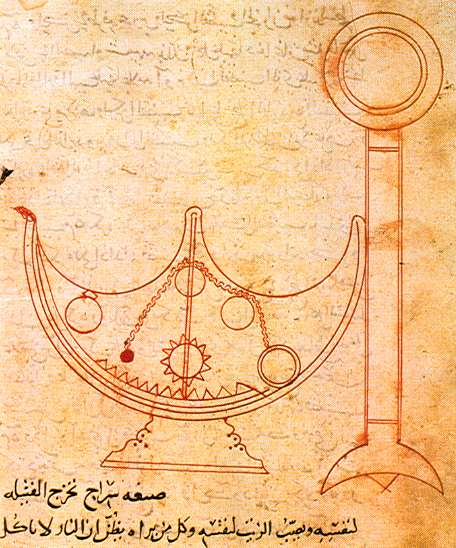
The decisive step — storing music in matter — is documented for the first time not in Greece but in Baghdad, around 850 AD, in the work of three brothers known collectively as the Banū Mūsā (“sons of Mūsā”): Muḥammad (before 803 – February 873), Aḥmad, and al-Ḥasan ibn Mūsā ibn Shākir. They were scholars of the ʿAbbāsid court, enrolled by the caliph al-Maʾmūn in the House of Wisdom (Bayt al-Ḥikma), where they worked in geometry, astronomy, mechanics, and music (Wikipedia, Banū Mūsā brothers). Their best-known engineering work, the Kitāb al-Ḥiyal (The Book of Ingenious Devices, c. 850), describes about a hundred mechanisms — fountains, self-trimming lamps, trick vessels — and in the process sets out one-way and two-way automatic valves, feedback controls, and what modern commentators call mechanical memory.
A separate, shorter treatise carries the crucial instrument: Kitāb al-āla allatī tuzammir bi-nafsihā — “The Book of the Instrument That Plays [or Sounds] by Itself.” It describes a hydro-powered organ that played automatically from a rotating cylinder studded with pins. Water drove a wheel; the wheel turned the cylinder; the pins, projecting from its surface at positions corresponding to a melody, caught levers as they came round; the levers opened valves that admitted air to the pipes. The instrument played on its own, continuously, as long as water flowed — no player, no keyboard (History of Information, The Musa Brothers Build the First Programmable Machine; Muslim Heritage, The Automatic Mechanical Hydraulic Organ of the Banū Mūsā ibn Shākir).
Two features make this instrument pivotal. First, the tune is encoded as the spatial arrangement of pins on the cylinder: melody has become geometry, readable by a machine. Second — and this is why the device is so often invoked in computing history — several accounts hold that the cylinder was interchangeable: a different pinned drum could be dropped in to play different music, so the same mechanism was not wedded to a single melody (Muslim Heritage). That combination — a general reading mechanism plus a swappable, physically encoded pattern — is exactly what later writers mean by a program, and it is on this basis that the Banū Mūsā organ is frequently described as the earliest known music sequencer and, more sweepingly, the first programmable machine (History of Information).
2.2.1 Handling the “first programmable machine” claim
The claim deserves care, because it travels farther than the evidence strictly supports. Several caveats belong in any responsible account:
- “Programmable” is a modern reading. The Banū Mūsā did not use, or possess, the concept of a stored program in the Turing sense. What they built is better described as a fixed-function automaton with an interchangeable data medium — powerful and genuinely novel, but not a general-purpose computer. The line from it to the digital computer is one of inspiration and analogy, drawn by later historians, not a direct technical lineage.
- The pinned-cylinder principle may be older. Whether the Banū Mūsā invented the pinned barrel or codified and refined an idea already circulating in Hellenistic and Byzantine mechanics is not settled. Their originality lies at least as much in the systematic, engineering-grade description — automatic valves, the interchangeable drum — as in raw priority.
- Transmission to Europe is unproven in detail. It is tempting to draw a clean line from Baghdad to the medieval European carillon drum to the barrel organ, but no documentary chain establishes that European makers knew the Banū Mūsā text when they pinned their first drums. Convergent invention is a live possibility; the safest statement is that the idea appears, fully formed and documented, in ninth-century Baghdad, and appears again, apparently independently, in later medieval Europe.
Stated with those hedges, the significance stands: the Banū Mūsā organ is the earliest instrument for which a physically stored, machine-read, and (by report) interchangeable musical program is documented. It supplies the memory half of the crank organ’s ancestry — the half the hydraulis lacked.
2.3 Carillon drums: the pinned barrel in medieval Europe
Whatever the route, the pinned barrel surfaces unmistakably in Europe in the late Middle Ages, and it does so first not in an organ but in a bell tower. The enabling technology was the weight-driven mechanical tower clock, which spread across European towns in the second half of the 14th century. Once a tower held a mechanism that turned steadily and could be tapped for power, it became natural to attach a pinned drum — a large rotating cylinder studded with pegs — that, as it turned, tripped a set of hammer-levers connected by wires to a series of tuned bells. The result was automatic music before the hour: the voorslag or warning-chime that told townspeople a strike was coming (Wikipedia, Carillon).
This flowered in the Low Countries — the territory of modern Belgium, the Netherlands, and the French-Flemish border — through the 15th and 16th centuries, where civic belfries such as those of Bruges, Ghent, and Mechelen combined timekeeping with musical signalling. The bell-drum was refined from crude early chime devices into precisely pinned barrels capable of proper airs, and by the 17th century the carillon proper — a large tuned set of bells playable both by a keyboard (stokkenklavier) and automatically by the drum — had become a defining Low-Countries art (Immaterieel Erfgoed, Carillon culture).
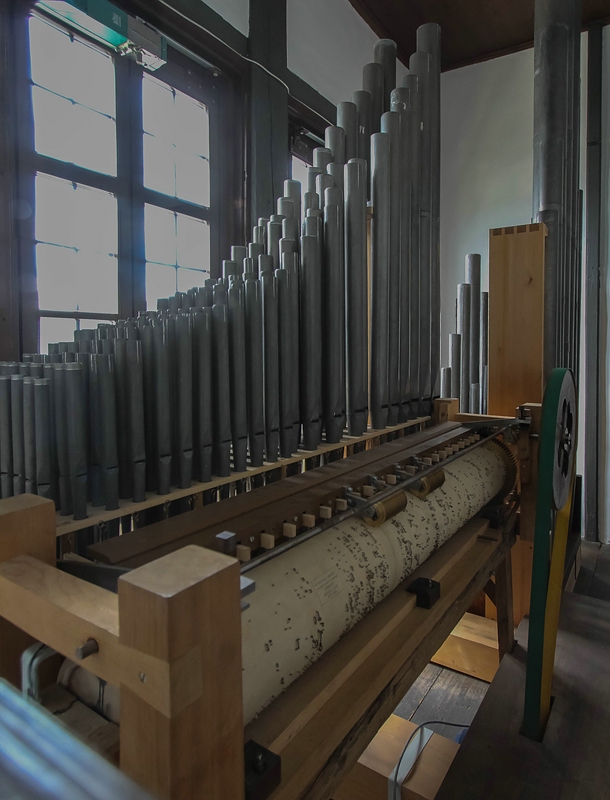
The carillon drum is worth dwelling on because it is the crank organ’s mechanism in a different medium. The barrel is pinned; the pins are set at longitudinal positions for pitch and angular positions for time; the drum is turned at a controlled rate; and each pin, as it comes round, releases a note. Replace the bells with pipes and the falling hammers with pallet valves, and the mechanism is, in principle, a barrel organ. Crucially, the carillon tradition also grappled early with re-pinning — periodically re-arranging the pegs to change the tunes, often on a seasonal or annual cycle — establishing the practice of treating the pinned barrel as a re-writable store, not a fixed one. That is the same practical insight as the Banū Mūsā’s interchangeable cylinder, expressed as maintenance rather than design.
2.4 Renaissance water gardens: the automaton organ returns
In the 16th century the pinned-barrel organ re-emerges in a courtly, spectacular setting: the water garden. Renaissance princes and cardinals, reading their recovered Hero of Alexandria and Vitruvius, built fontane sonore — “sounding fountains” — grottoes and terraces where hydraulic power drove not only jets and moving figures but self-playing organs. Here the hydraulis’s water-power and the pinned cylinder’s stored tune finally combined in Europe on a grand scale.
The showpiece is the Fountain of the Organ (Fontana dell’Organo) at the Villa d’Este in Tivoli, near Rome, commissioned by Cardinal Ippolito II d’Este to designs by Pirro Ligorio. The hydraulic organ within it was built between 1566 and 1571 by the Frenchman Luc Leclerc, with the pneumatic and organ-making work carried out by Claude Venard, a hydraulic-organ maker — the first automatic organ in a Roman villa garden. Falling water both compressed the wind (a hydraulis-style regulator) and turned the machinery; the organ was reputed to play a five-part madrigal automatically, without a musician present (The Organ of the Villa d’Este in Tivoli and the Standards of Pneumatic Engineering in the Renaissance; Wikipedia, Villa d’Este). Similar water-organ automata were installed at the papal Quirinal gardens and elsewhere around Rome and the Alban Hills; the fashion converted flowing water into a timed performance requiring no players on site — the very definition of the mechanical organ’s promise.
The engineer who did most to codify this practice in print was Salomon de Caus (c. 1576–1626), a Huguenot hydraulic engineer who worked for princely patrons in England and the Palatinate and laid out the celebrated Hortus Palatinus garden at Heidelberg. His treatise Les raisons des forces mouvantes (1615), avowedly building on Hero of Alexandria, gives explicit, buildable designs for garden automata — and, decisively for this history, describes an organ in which a pegged cylinder, turned by a water wheel, works levers that open pipe valves (Linda Hall Library, Salomon de Caus). De Caus’s cylinder, laid out in engravings, is the pinned-barrel organ set down as a reproducible design method: pitch across the barrel, time around it, the pattern of pegs the score.
2.5 Salzburg’s Hornwerk and Kircher’s synthesis
Two further landmarks close the pre-barrel-organ prehistory.
The Salzburg Hornwerk — the Salzburger Stier, the “Salzburg Bull” — stands at the Hohensalzburg Fortress above the city. It was commissioned in 1502 by Prince-Archbishop Leonhard von Keutschach and originally built by Michael Rytzinger; it survives as one of the last late-Gothic Hornwerke and, by common claim, the oldest mechanical wind instrument still regularly played (Salzburg Info, Salzburger Stier). A Hornwerk is a wind chest, bellows, and pipes whose voicing produced a great F-major triad — F–A–C, punningly fac!, the Latin imperative “do [it]” — whose bellowing gave the bull its name. Its original role was civic and siren-like: signalling the opening and closing of the town gates, morning and evening. What matters here is its later evolution. Around 1640 a pinned barrel-organ mechanism was added, at first playing only an “Old Chorale”; roughly a century on, the repertoire was expanded with eleven melodies by the court Kapellmeister Johann Ernst Eberlin and Leopold Mozart — the composer’s father — one tune per month of the year. The Hornwerk thus shows the transition in one instrument: a hand-and-bellows signalling organ, retrofitted with the pinned drum, keeping a rotating repertory of stored tunes.
The period’s great documentarian was the Jesuit polymath Athanasius Kircher, whose Musurgia Universalis (Rome, 1650) is the encyclopaedic summation of mid-17th-century thinking on sound and music. Among its engravings are detailed plans for water-powered automatic organs whose notes are set on a geared, pinned cylinder turned by a water wheel, alongside notations of birdsong and a combinatorial composing device, the Arca musarithmica (St Andrews University Collections, Kircher’s Musurgia Universalis; Wikipedia, Musurgia Universalis). Kircher did not invent these machines; he compiled, illustrated, and systematized them, and in doing so he put the pinned-cylinder organ into wide, printed circulation across learned Europe. Between de Caus (1615) and Kircher (1650), the mechanism passed decisively from courtly curiosity into published, transmissible engineering — the state in which the 18th-century barrel-organ makers of Vol 3 inherited it.
2.6 The thread
Read as one line, the story of this volume is the slow assembly of two halves:
Table 1 — Read as one line, the story of this volume is the slow assembly of two halves
| Element | Origin | What it contributed |
|---|---|---|
| Steady wind + tuned pipes | Ctesibius’ hydraulis, ~3rd c. BC, Alexandria | The sound-producing body; water as pressure regulator (played, not automatic) |
| Tune stored as pins on a cylinder | Banū Mūsā, c. 850, Baghdad | Machine-read, (reportedly) interchangeable musical program — the “memory” |
| Pinned barrel in Europe | Carillon drums, 14th–16th c., Low Countries | The pinned-barrel mechanism as a re-pinnable civic instrument |
| Water power + pinned organ combined | Villa d’Este (1566–71); de Caus (1615) | The automaton organ as a courtly and then a documented technology |
| Retrofit + codification | Salzburg Hornwerk (1502; barrel added c. 1640); Kircher (1650) | The rotating stored repertory, and the mechanism put into print |
The recurring, unifying idea is the one the whole Mechanical Organs program is built around: a melody can be stored as a physical pattern — pins on a barrel — and read back mechanically, and by changing the pattern one changes the music. The Banū Mūsā stated it, the carillon towers of Flanders practised it, the Renaissance water gardens spectacularly displayed it, and Kircher printed it. When the barrel organ proper arrives in the 18th century (Vol 3), it inherits a fully formed concept: the barrel is a data medium, the pins are the score, and re-pinning or swapping the barrel is editing the program — a lineage that runs, conceptually unbroken, all the way to the pinning, punching, and encoding methods examined in the sibling Encoding the Music dive.
Sources
- Britannica, Ctesibius of Alexandria and Hydraulis.
- UNRV Roman History, Hydraulis (Roman Water Organ); Wikipedia, Water organ.
- Wikipedia, Banū Mūsā brothers and Book of Ingenious Devices.
- History of Information, The Musa Brothers Build the First Programmable Machine; Muslim Heritage, The Automatic Mechanical Hydraulic Organ of the Banū Mūsā ibn Shākir.
- Wikipedia, Carillon; Immaterieel Erfgoed, Carillon culture.
- Academia.edu, The Organ of the Villa d’Este in Tivoli; Wikipedia, Villa d’Este.
- Linda Hall Library, Salomon de Caus.
- Salzburg Info, Salzburger Stier; Ord-Hume, About the Stier “Roar”.
- St Andrews University Collections blog, Kircher’s Musurgia Universalis (1650); Wikipedia, Musurgia Universalis.
Comments (0)