History Of Mechanical Organs · Volume 3
The Barrel Organ Era
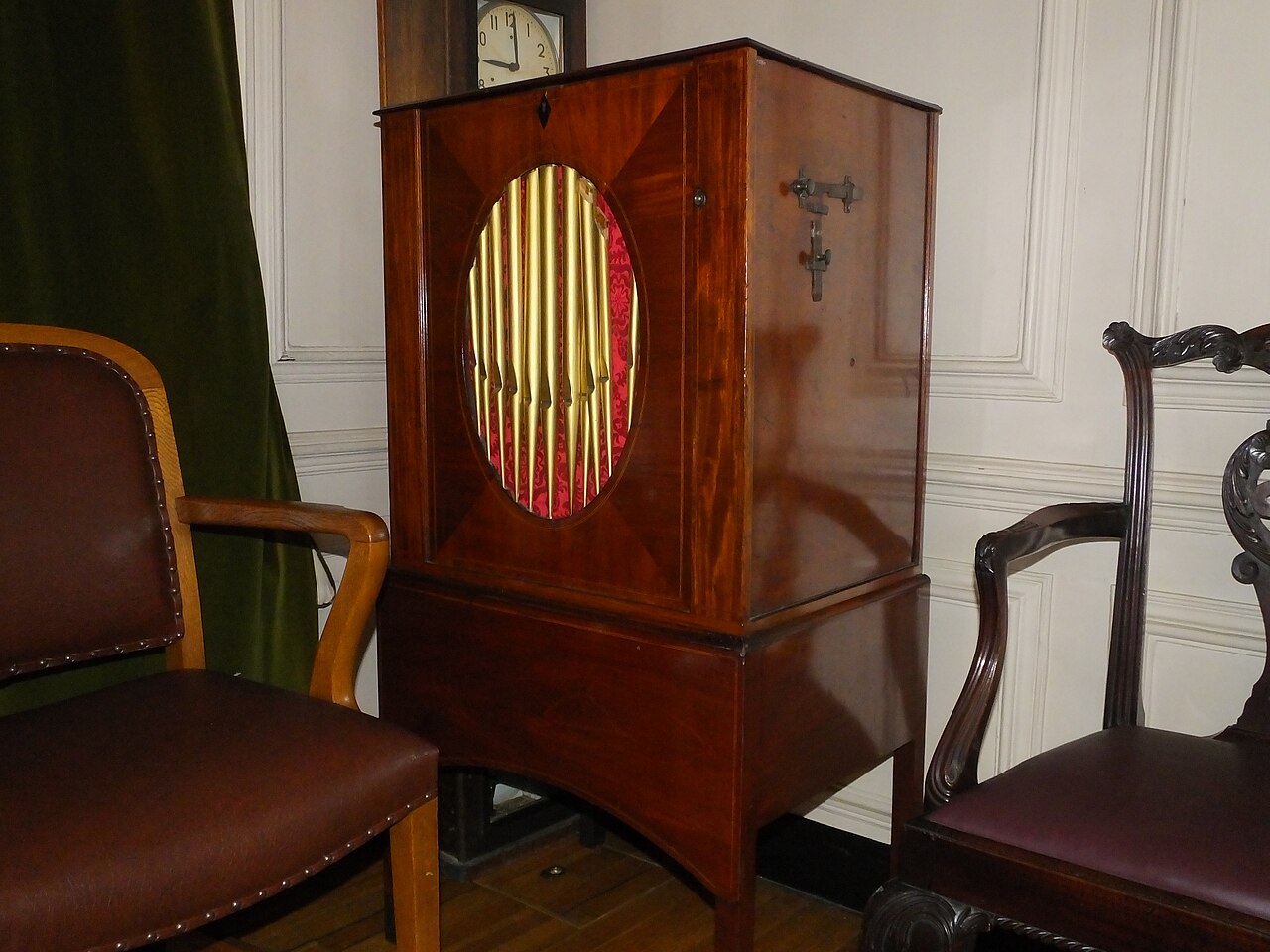
The barrel organ was the first self-playing keyboard instrument to become an ordinary object rather than a princely curiosity. Where the automata of Vol 2 — the Banu Musa hydro-organ, the Salzburg Hornwerk, the water-garden organs of the Villa d’Este — were one-off marvels commissioned by caliphs, archbishops and cardinals, the barrel organ of the eighteenth and nineteenth centuries was built in quantity, priced for a parish vestry or a merchant’s drawing room, and serviced by a recognisable trade of specialist makers. It carried the pinned barrel out of the palace and into the country church, the town chapel and the private house, and in doing so it established the commercial, social and technical ground on which every later crank organ — street, fairground, dance and busker — would stand.
This volume treats the barrel organ as a social and historical phenomenon: who built it, who bought it, what it played, and why it mattered. The pinned barrel as a coding medium — how a tune is laid out in pins and bridges (long “staples”), how the pinning is calculated, how a barrel is repaired and repinned — belongs to the sibling Encoding the Music dive (its Vol 2, on the pinned barrel as a mechanism); this volume cross-references that treatment rather than repeating it. The reader interested in the deep mechanism should read the two together.
3.1 What the barrel organ was
A barrel organ is a pipe organ whose keys are opened not by a player’s fingers but by pins and bridge-staples set into a rotating wooden cylinder — the barrel. An operator turns a crank; through a worm or crown gear the crank both rotates the barrel and, in most designs, works the feeder bellows that fill the wind reservoir. As the barrel turns, its projecting pins lift the tails of a row of pivoted keys; each key opens a pallet under a rank of pipes, and the organ speaks (Ord-Hume, Barrel Organ: The Story of the Mechanical Organ and Its Repair, A. S. Barnes, New York, 1978; Wikipedia, “Barrel organ”). Short pins give short notes; longer sustained notes are held open by bridges (staples) of graduated length. Because the whole scheme is fixed in wood and metal, the instrument needs no musician and never plays a wrong note — the two properties that made it valuable exactly where trained musicians were scarce.
The term “barrel organ” is used loosely in English, and Vol 4 untangles it: the hand-cranked instrument carried through the streets — the “monkey organ” or hand organ — is a small, portable member of the same family, but the word “barrel organ” in its primary eighteenth- and nineteenth-century sense means the chamber, church and domestic pipe instrument treated here, not the busker’s box (Wikipedia, “Barrel organ,” which distinguishes the categories). This volume uses “barrel organ” in that primary sense throughout.
3.2 The craft at its height
3.2.1 The English trade
England became the centre of gravity for the barrel organ. The trade’s peak runs roughly 1760–1840 (Immanuel’s Ground Quire, “Barrel organs”; Ord-Hume, Barrel Organ, 1978), and the roll of London makers is a who’s-who of Georgian keyboard manufacture. Among the earliest specialists was George Pyke (fl. c. 1760s), a London clockmaker and organ builder ranked with Charles Clay and James Cox as one of the three greatest makers of organ clocks of the century; his chamber barrel organs and organ clocks sit at the luxury end of the trade (Boalch instrument-maker records; West Dean Conservation, “Organ Clock signed George Pyke, circa 1765”). By the 1780s the pianoforte and music-publishing houses had taken up the instrument commercially: Pistor (active from c. 1767), Longman & Broderip (from 1784), George Astor (from 1799), and later Muzio Clementi & Co. all supplied barrel organs, as did Meyer, Joseph Davis, J. C. Bishop and Henry Bryceson, whose firm was founded in 1796 and who set the barrel in a sliding cradle so it could be shifted crisply from one tune-track to the next (search of Ord-Hume’s maker list and Bryceson firm records). British instruments of this period were generally reckoned finer than continental work until the French and German industries rose later in the nineteenth century.
3.2.2 Barrel-and-shift, barrel-and-finger, and the “dumb organist”
Three refinements defined the craft at its height, and each has a bearing on the social story.
Barrel-and-shift. A single barrel could hold several tunes side by side. By moving the barrel a fraction of an inch along its axis, a fresh set of pins and bridges is brought under the key frame, so one barrel plays a whole programme — in church instruments typically ten tunes to a barrel, with three barrels supplied, giving thirty tunes in all (Immanuel’s Ground Quire, “Barrel organs”; the mechanism of lateral shift is treated in the Encoding the Music dive, Vol 2). Fine domestic instruments used the same trick: a Flight & Robson chamber organ of c. 1815–1820 in the Victoria and Albert Museum carries three barrels of eight tunes each, twenty-four in all (V&A, item O171546).
Barrel-and-finger. Larger and better instruments were built as combination organs, with a conventional manual keyboard in addition to the automatic barrel action, so a competent player could perform by hand while the barrel served for hymns and for the unmusical (Wikipedia, “Barrel organ”). This hedged the parish’s bet: barrel for reliability, keyboard for the day a real organist appeared.
The “dumb organist.” A distinct and cheaper solution was the dumb organist — a self-contained, cranked barrel-and-key unit set on top of an ordinary finger organ, its wooden fingers (trackers) reaching down to depress the manual keys exactly as a human organist would. It let a church that already owned a keyboard organ, but no player, add mechanical performance without rebuilding the instrument (Immanuel’s Ground Quire, “Barrel organs”; Ord-Hume, Barrel Organ, 1978).
3.3 The parish church barrel organ
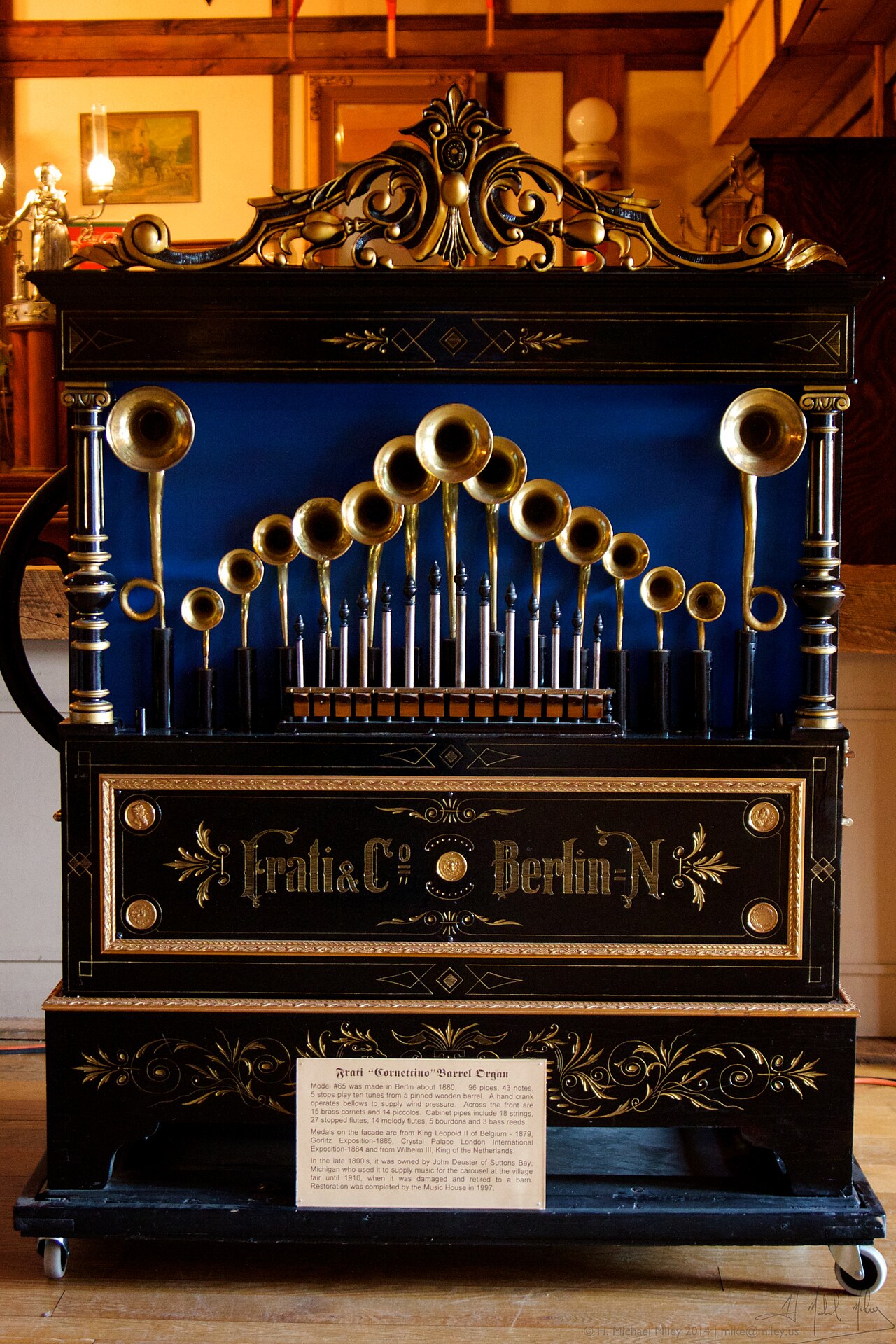
The barrel organ’s largest and most consequential role was in the English parish church. From the late eighteenth century into the mid-nineteenth, barrel organs supplied psalm tunes, hymns, chants and simple voluntaries in thousands of country churches and chapels that could afford neither a pipe organ with a keyboard nor, more to the point, a trained organist to play one (Immanuel’s Ground Quire, “Barrel organs”; N. Temperley, The Music of the English Parish Church, Cambridge University Press, 1979).
3.3.1 The problem it solved
Before the barrel organ, congregational music in the ordinary parish was led from the west gallery by a “quire” — a band of local instrumentalists and singers playing bassoon, clarinet, serpent, cello and fiddle, learning by ear and by cheaply printed tune-books. It is the world Thomas Hardy grew up in and later memorialised. The band was vivid but unreliable, sometimes unruly, and always dependent on the availability and sobriety of its players. The barrel organ offered the clergy an alternative that was cheap, needed no skill to operate, and would play the appointed tune correctly every Sunday. From roughly 1830 to 1850 the galleries were emptied and the bands “ousted” in favour of barrel organs across large parts of rural England, a change contemporaries framed as bringing “regularity and order” to congregational singing (West Gallery sources; Immanuel’s Ground Quire).
3.3.2 How it served the liturgy
The instrument’s repertoire was, by design, the metrical psalter and the hymn book: metrical psalm tunes and hymn tunes, with a scattering of chants and short voluntaries for the entrance and exit (Immanuel’s Ground Quire; the MIMO and museum catalogues of surviving instruments). A parish clerk or a boy turned the crank at the pace the minister wanted; the fixed thirty-tune library — three barrels of ten — was chosen to cover the common tunes of the church year. The limitation was real and often remarked: “few instruments had more than three barrels of ten tunes each,” so a parish’s musical vocabulary was literally bounded by its barrels (search summaries of the West Gallery and Ord-Hume material). When fashions in church music changed, some barrels were partially or wholly repinned with newer tunes in the mid-to-late nineteenth century — physical evidence, still readable on surviving barrels, of shifting taste in worship.
3.3.3 Survivals
A handful of parish instruments survive in working order and, remarkably, in use. The church of King Charles the Martyr at Shelland (Suffolk) retains a barrel organ acquired about 1815 and still played in services — probably the best known living example of the tradition (Immanuel’s Ground Quire, “Barrel organs”; county records place Shelland in Suffolk, though some accounts misattribute it to Norfolk — the reader should treat the county as the well-documented point and the exact provenance date as approximate). The organ at Bulwick carried a thirty-tune library before it was superseded by a keyboard organ built by George Maydwell Holdich in 1874; at Fingringhoe, Essex, a gallery band and choir active in 1801 gave way to a harmonium introduced in 1860 — a compressed local snapshot of the whole national arc (Immanuel’s Ground Quire).
3.4 Chamber and domestic barrel organs
Alongside the church trade ran a parallel and often more luxurious one: the chamber or domestic barrel organ, a drawing-room instrument for the Georgian and Regency household. Where the church barrel carried psalm tunes, the domestic barrel carried dances, marches, waltzes and operatic selections — light music for entertainment. The V&A’s Flight & Robson chamber organ of c. 1815–1820 is representative: three barrels of eight tunes, its printed tune-list naming pieces such as the “Bath Waltz,” the “Copenhagen Waltz” and “The Waterloo Dance” — the last dating the instrument neatly to just after 1815 (V&A, item O171546). Fine cabinet cases in the Sheraton manner, gilt dummy display pipes and inlaid mahogany placed these instruments squarely among the furniture of the fashionable house. George Astor chamber organs survive complete with their operating instructions, tune-sheets and labelled barrels — one with barrels arranged about 1806 by the pipe-organ builder William Redstone — giving an unusually full record of how such an instrument was owned and used (Ord-Hume maker records via search summaries).
3.4.1 Flight & Robson and the Apollonicon
The domestic and the monumental met in the firm of Flight & Robson. Benjamin Flight and Joseph Robson formed their partnership about 1800, worked at 101 St Martin’s Lane, Charing Cross, and styled themselves “Organ Builders to the Prince Regent”; the firm went bankrupt in 1832, and Ord-Hume reprints its illustrated 1832 auction catalogue as an appendix to Barrel Organ (1978) — a primary document for the whole trade (Ord-Hume, Barrel Organ; V&A). Their masterpiece, and the barrel organ’s high-water mark, was the Apollonicon, first exhibited in June 1817. It was a self-acting barrel-and-finger organ of about 1,900 pipes and 45 stops, with five keyboards (one serving as a pedal board), built over roughly five years at a cost of some £10,000, and inspired by Johann Nepomuk Maelzel’s Panharmonicon (Wikipedia, “Apollonicon”). To play pieces longer than an ordinary barrel allowed, Flight & Robson used spiral barrels, on which the pins run in a helix rather than in closed circles, so the barrel advances axially as it turns and never repeats. At its first exhibition the barrels performed the overtures to Mozart’s La clemenza di Tito and Cherubini’s Anacréon; the organist John Purkis then gave regular Saturday recitals on it for twenty-one years, an event the musicologist Rachel Cowgill has called “virtually synonymous with the establishment of the public organ recital in England” (Wikipedia, “Apollonicon,” citing Cowgill). The Apollonicon shows the barrel organ straining at its own ceiling: to make a self-acting machine perform symphonic music, the maker had to reinvent the barrel itself.
3.4.2 Uses and types at a glance
Table 1 — Uses and types at a glance
| Type / use | Period (peak) | Setting | Repertoire | Notable makers |
|---|---|---|---|---|
| Parish church barrel organ | c. 1790–1860 | Country churches, chapels; west gallery | Metrical psalm tunes, hymns, chants, short voluntaries | Bishop, Bryceson, Walker; local builders |
| ”Dumb organist” (barrel unit over a finger organ) | c. 1800–1850 | Churches that owned a keyboard organ but had no player | Same church tune library | Various English church-organ builders |
| Barrel-and-finger (combination) organ | c. 1800–1840 | Larger churches; wealthier chapels | Church tunes by barrel; free playing by hand | Flight & Robson, Bishop |
| Chamber / domestic barrel organ | c. 1760–1840 | Georgian/Regency drawing rooms | Dances, marches, waltzes, opera selections | George Pyke, Astor, Longman & Broderip, Clementi, Meyer, Flight & Robson |
| Monumental self-acting organ (e.g. Apollonicon) | 1817–c. 1840 | Public recital showroom | Overtures and symphonic transcriptions (spiral barrels) | Flight & Robson |
| Portable street “barrel organ” (precursor) | early–mid 19th c. onward | Streets, itinerant | Popular songs, dances | Continental makers → see Vol 4 |
3.5 Decline and replacement
The parish barrel organ was undone by a better mousetrap. From the 1840s, and markedly after the Great Exhibition of 1851 put reed instruments before a mass public, the harmonium (and the American reed organ) offered a keyboard that any moderately trained person — often the schoolmaster or a daughter of the vicarage — could play, at a price competitive with a barrel organ and with none of its fixed-repertoire limitation (Wikipedia, “Pump organ”; Immanuel’s Ground Quire). Where a congregation could now field even a modest keyboard player, the inflexible barrel — thirty tunes and no more, and those the tunes of a previous generation — looked exactly as limited as it was. Through the 1850s and 1860s the harmonium and the small finger organ displaced barrel organs across the parishes, just as, a little earlier, the barrel organ had displaced the west gallery band. The Fingringhoe harmonium of 1860 and the Holdich keyboard organ at Bulwick in 1874 are typical waypoints; by the end of the century redundant barrel organs were being sold off cheaply, and the survivors owe their preservation to neglect as much as to care (Immanuel’s Ground Quire).
The reform was not only economic but aesthetic and doctrinal. The Oxford Movement and the broader Victorian drive to make worship more “solemn” and choral told against both the boisterous west-gallery bands and the mechanical organ that had replaced them; galleries were pulled down, choirs moved into surpliced chancel stalls, and the whole west-gallery culture — bands, barrels and all — passed into memory within a generation.
3.6 Setting the stage for the street and the fairground
The barrel organ did not so much die as radiate. Its legacy runs in three directions that the following volumes take up in turn.
First, the portable street organ — the hand-cranked “monkey organ” of the organ grinder — is the barrel organ shrunk, ruggedised and taken outdoors. It inherits the pinned barrel, the crank and the barrel-and-shift tune library directly, and Vol 4 follows it into the streets and, in its grandest form, into the Dutch draaiorgel tradition.
Second, the fairground and dance organ inherits the barrel organ’s scale of ambition — the Apollonicon’s dream of a self-acting orchestra — while abandoning its coding medium. The fixed barrel could never carry enough music for a travelling show, and its thirty-tune ceiling was precisely the wall the Apollonicon had tried to climb with spiral barrels. The decisive break came in 1892, when Gavioli introduced folding cardboard book music, freeing the repertoire from the length of a cylinder; Vol 5 tells that story and names the great Waldkirch, Paris and Antwerp makers.
Third, and quietly, the barrel organ established the trade itself — the idea of a specialist maker who could pin a tune, voice a rank of pipes and sell a self-playing instrument to an ordinary customer. That commercial and craft infrastructure, more than any single machine, is what the street organ, the fairground organ, the orchestrion and eventually the modern busker organ all inherited. The pinned barrel would keep turning long after the parish clerk put down the crank — the mechanism itself, and how a tune becomes pins, is the subject of the Encoding the Music dive (Vol 2), to which the technically curious reader is referred.
Sources: A. W. J. G. Ord-Hume, Barrel Organ: The Story of the Mechanical Organ and Its Repair (A. S. Barnes, New York, 1978), incl. the reprinted 1832 Flight & Robson auction catalogue; Q. D. Bowers, Encyclopedia of Automatic Musical Instruments (1972); N. Temperley, The Music of the English Parish Church (Cambridge University Press, 1979); Victoria and Albert Museum collection record O171546 (Flight & Robson chamber organ); Wikipedia, “Barrel organ,” “Apollonicon,” and “Pump organ”; Immanuel’s Ground Quire, “Barrel organs”; West Dean Conservation and Boalch instrument-maker records (George Pyke). Dates for Shelland and for some maker floruit years are given as documented in these sources and hedged where accounts differ.
Comments (0)