History Of Mechanical Organs · Volume 4
A History of Mechanical Organs — Street & "Monkey" Organs
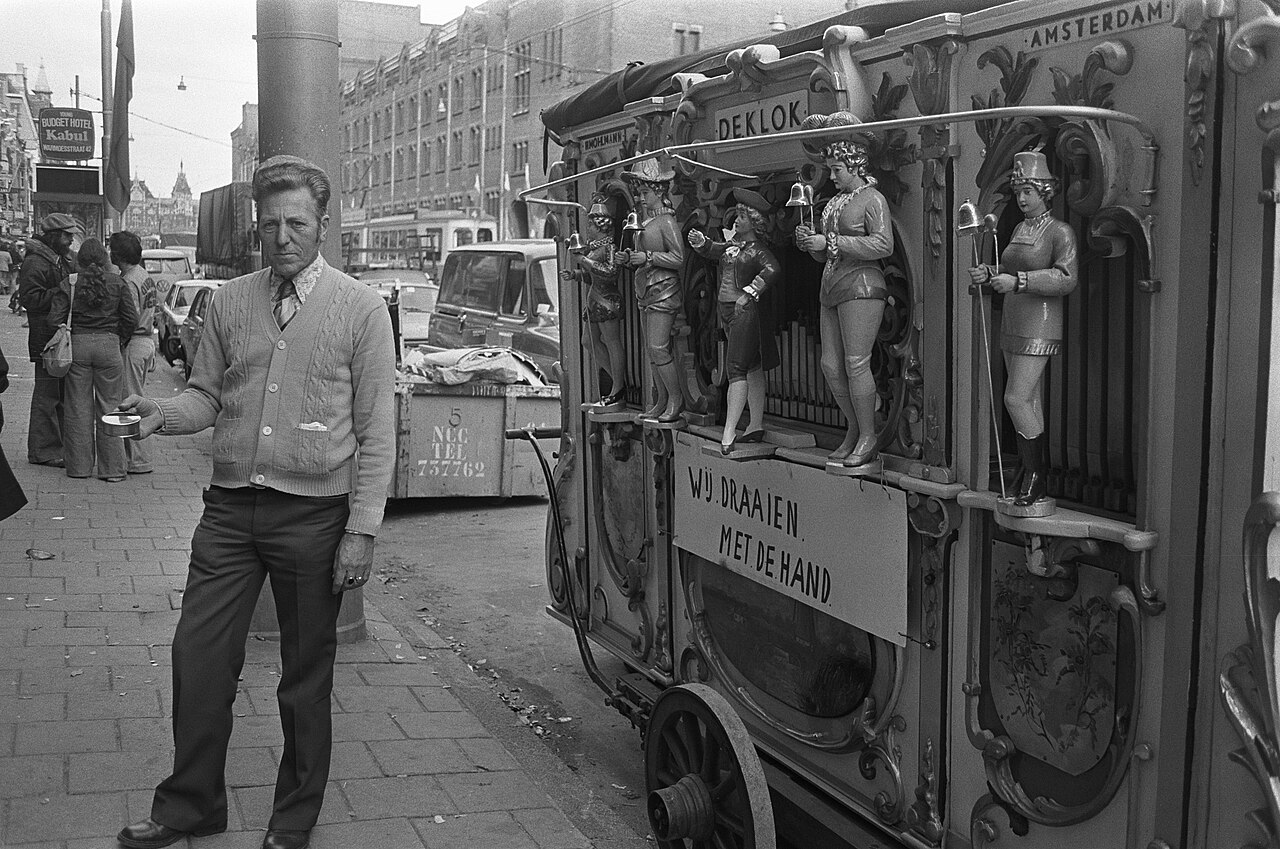
Of all the branches of the mechanical-organ family, the street organ is the one the public actually met. A church barrel organ (Vol 3) played to a seated congregation; a fairground organ (Vol 5) stood behind a carousel’s paybox. The street organ came to the listener, uninvited, and asked for a coin. It is also the branch that spans the widest range of size in the whole family: at one end the tiny hand-carried “monkey organ” of the itinerant grinder, a box of twenty or thirty pipes slung from a strap; at the other the great Dutch street organ, the draaiorgel, a book-playing instrument of hundreds of pipes wheeled through Amsterdam on a barrow, its carved and gilded façade taller than the men pushing it. Both are “street organs,” and the distance between them is the subject of this volume.
The street organ matters to this program for a second reason. Strip the small grinder’s organ down to essentials — a wind-blown pipe rank, a stored program, and a hand crank that supplies both wind and program motion in one turn — and one has, almost exactly, the modern DIY busker organ that the rest of the Mechanical Organs dives build. The lineage from the nineteenth-century grinder to the twenty-first century hobbyist is not metaphorical; it is a straight technical descent, taken up at the end of this volume and carried forward in Vol 7 and the sibling John Smith Universal dive.
4.1 Terms: what “street organ” names in five languages
The instrument acquired a name in every country it reached, and the names are not quite synonyms. The English trade called the small hand-cranked instrument a barrel organ when it read a pinned cylinder, and loosely a hand organ or, from the animal so often chained to it, a “monkey organ.” The French orgue de Barbarie — the term that has travelled furthest — is of disputed origin; tradition derives it from an Italian builder named Barberi (or Barbieri) of Modena, though the older reading from Barbarie (“Barbary,” i.e. foreign) is also cited, and neither is settled (Wikipedia, Street organ; the caution is warranted). German has both Drehorgel (“turning organ,” from the crank) and the affectionate Leierkasten (“lyre-box”), the Berlin street player being the Leierkastenmann; Vienna kept Werkel. The Italian street instrument was the organetto or organino; the Spanish, the organillo. The Dutch, whose tradition grew largest, called theirs the draaiorgel (“turning organ”) and, in affectionate slang, the pierement.
The distinctions matter because they track real differences in the machine. A barrel street organ is the oldest and smallest form, its tune pinned into a wooden cylinder that the crank both rotates and, gear-linked, pumps the bellows to feed. A book or roll street organ — the later and larger form, dominant in the Low Countries and France — reads folded cardboard book music (the Gavioli system of 1892; Vol 5) or a perforated paper roll, media that free tune length from a barrel’s fixed circumference and so permit the enormous Dutch instruments. One word, “street organ,” thus covers machines separated by a century of development and two orders of magnitude in size.
4.2 The small end: the hand organ and the grinder
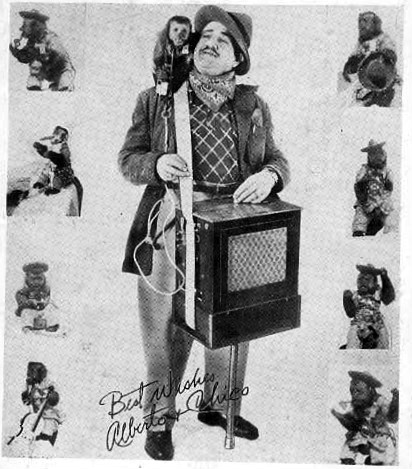
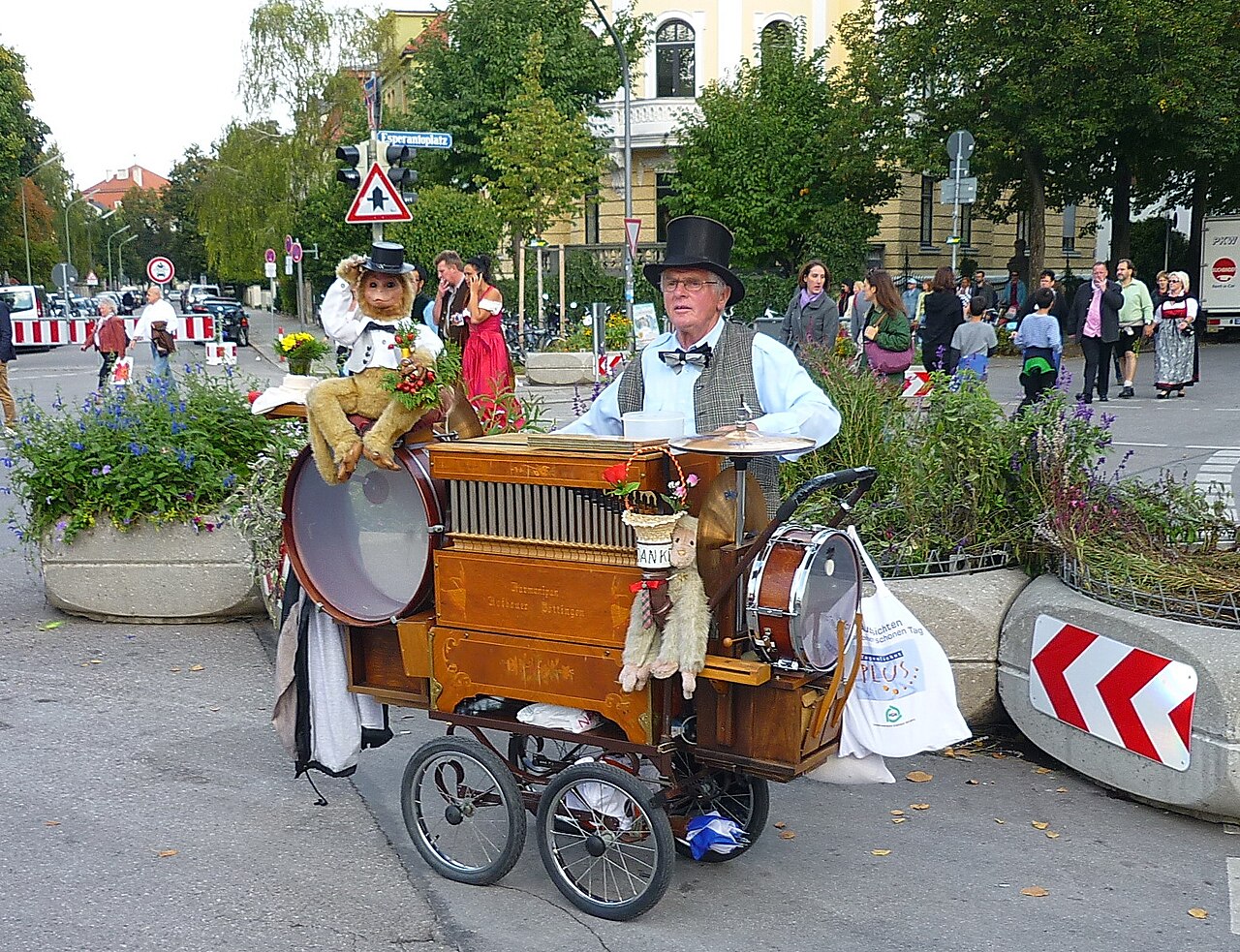
The itinerant hand organ was, in its classic nineteenth-century form, a small pinned-barrel organ of roughly 20 to 40 pipes, the case perhaps 50–75 cm long, carried on a shoulder strap and set down on a single wooden leg or prop-stick while played (Wikipedia, Street organ). The player turned a crank at the side; a worm-and-gear train rotated the pinned barrel while an eccentric on the same shaft worked a feeder bellows, so that a single steady cranking motion simultaneously supplied wind to the reservoir and advanced the program. Nothing about the performance required musicianship in the ordinary sense — the barrel held the tune, usually a set of eight or ten popular airs shifted by nudging the barrel laterally to bring a fresh set of pin-tracks under the keyframe — and this mechanical, skill-free quality was exactly what critics would later hold against it.
4.2.1 The organ grinder as a social figure
The player of this instrument — the organ grinder, organetto man, Leierkastenmann — became one of the most recognisable street figures of the nineteenth-century city, and one of the most disliked. In Britain and North America the trade was dominated by emigrants from southern Italy, and the demographic concentration was striking: by about 1880, with Italian immigration to Manhattan at its height, some contemporary accounts put nearly one in twenty Italian men in New York’s Five Points district at the trade — a striking figure best read as a period impression rather than a verified census (New York Almanack; Ephemeral New York). London had, by the 1850s–60s, over a thousand grinders working its streets, again heavily Italian, many of them padrone-controlled boys hired out with an instrument and expected to remit a fixed daily sum. In the German lands the Berlin Leierkastenmann was as often a disabled or elderly man to whom the authorities granted a grinding licence as a form of poor-relief — a recognised, if pitied, niche of the urban economy.
The monkey — usually a capuchin, tethered on a string and trained to doff a cap and take coins in a cup — was less universal than the stereotype suggests but real enough to fix the phrase “monkey organ” permanently in English (Wikipedia, Street organ; COAA, Organ Grinders With Live Monkeys, Carousel Organ no. 29, 2006). The animal did the begging the law would not let the man do openly: to ask outright for money was vagrancy, but to “entertain” and let a monkey collect gratuities stayed, just, on the right side of the ordinances. That legal fiction — payment for a service nobody had asked for — is the hinge of the whole “nuisance” quarrel that followed.
4.2.2 The nuisance campaigns and the licence
Almost from the beginning the hand organ was fought as a public nuisance, and the campaign against it produced some of the first modern noise legislation. In London the mathematician Charles Babbage waged a famous and futile personal war on street musicians through the 1850s and 1860s, and the agitation of Babbage and like-minded householders helped carry Michael Thomas Bass’s Act for the Better Regulation of Street Music in the Metropolis of 1864 — “Bass’s Act” — which gave a householder the right to require a street musician to move on and made refusal an offence (a measure aimed squarely at the Italian grinders). The word “organ nuisance” was a newspaper commonplace by mid-century.
The pattern repeated across the Atlantic and lasted into living memory. New York’s authorities long refused licences to Italian grinders; the trade was finally ended by fiat when Mayor Fiorello La Guardia moved against it in 1935, refusing to renew grinders’ licences the following year on the grounds that radio and free outdoor concerts had made them superfluous and that the city should discourage street begging. The ban stood until it was repealed in 1975 (Wikipedia; New York Almanack). Paris, characteristically, chose regulation over prohibition: a fixed and limited number of grinding permits, allocated by seniority and waiting list, turning the licence itself into a heritable asset. In every case the authorities were responding to the same double complaint — that the music was bad because mechanical, and that the “performance” was really mendicancy — and the street organ’s decline as a begging trade was, in the end, legislated as much as it was out-competed by the gramophone and radio (Vol 7).
4.3 The traditions, side by side
The word “street organ” thus resolves into several distinct regional traditions, differing in size, in the storage medium, and in whether the instrument was a beggar’s tool or a civic institution. The principal ones:
Table 1 — beggar's tool or a civic institution. The principal ones
| Tradition | Region & era | Typical size / medium | Social role | Notable names |
|---|---|---|---|---|
| Hand / “monkey” organ | Britain, US, France, Italy; 19th–early 20th c. | Small, ~20–40 pipes, hand-carried; pinned barrel | Itinerant busking, often immigrant grinders + monkey | Frati (Berlin), Gasparini, Fassano; padrone system |
| German street organ (Drehorgel / Leierkasten) | Waldkirch & Berlin, Germany; 19th–20th c. | Small–medium; barrel, later paper roll | Licensed street trade, often poor-relief | Bruder, A. Ruth & Sohn, Frati & Co. |
| French orgue de Barbarie | Paris; 19th–20th c. | Small–medium; barrel, later cardboard book | Permitted street trade (waiting-list licences) | Gavioli, Limonaire, Gasparini |
| Dutch street organ (draaiorgel / pierement) | Amsterdam, Rotterdam, The Hague; ~1875–present | Large to huge; cardboard book music, many ranks + percussion | Civic institution; rented, permitted, collected | Carl Frei, Gasparini, Perlee (renter/builder), Warnies |
The table’s real message is in the last two columns: as the instrument grew from the grinder’s shoulder to the barrow and then to the full civic draaiorgel, its social standing rose with it — from a nuisance the police moved on to a beloved municipal fixture with reserved pitches and a rental economy. That transformation is almost entirely a Dutch story, and it turns on one man’s business idea.
4.4 Waldkirch: where the street organs were built
Before the Dutch story, a word on manufacture, because most of the organs that ended up on Amsterdam’s streets were not Dutch at all. The overwhelming centre of street- and fairground-organ building was Waldkirch, a small town in the Black Forest that styled itself, with justice, the Stadt der Orgelbauer — the “town of organ builders.” Its industry was founded by Ignaz Bruder (1780–1845), who learned barrel-organ building (traditionally at Mirecourt, in the Vosges) and set up in Waldkirch, the family firm Gebrüder Bruder carrying on through his sons after his death; Andreas Ruth, founder of A. Ruth & Sohn, was among Bruder’s pupils (museum-digital, Deutsches Uhrenmuseum Furtwangen; Fairground Heritage Trust). From Waldkirch and its offshoots came a spectrum of instruments from small Drehorgeln up to the giant fairground organs of Vol 5. A separate German centre, Frati & Co. of Berlin, was a leading maker of the smaller hand-cranked street barrel organs through the 1880s and 1890s. The point to carry forward is that the “Dutch street organ” was a Dutch use of a German (and French, and Belgian) product: the Netherlands built almost none of its own organs and instead imported, rebuilt, re-voiced and, above all, arranged them.
4.5 The great contrast: the Dutch draaiorgel
The Dutch street organ is the opposite pole of the family from the monkey organ, and the contrast is worth stating plainly. Where the grinder’s organ was small, portable, barrel-driven, socially marginal and played for pennies, the mature draaiorgel was large, barrow- or cart-mounted, book-driven, civically respectable, and the object of genuine popular affection. A full Amsterdam street organ might carry several hundred pipes across melody, counter-melody, accompaniment and bass registers, plus a drum, cymbal and woodblock for rhythm, all behind an ornate carved and gilded façade with animated figures — an instrument physically closer to a fairground organ than to a grinder’s box, but worked through the streets on wheels rather than fixed at a fair.
4.5.1 Leon Warnies, the rental system, and the pierement
What made the Dutch street organ a civic institution rather than a beggar’s tool was not primarily the instrument but the business model around it, and its author was a Belgian. Leon Warnies moved to Amsterdam and, in 1875, established a barrel-organ rental company — the pivotal act in the Dutch tradition (DutchReview; Visiting the Dutch Countryside; COAA, Dutch Street Organs). Rather than a poor man owning a decrepit instrument, a player could now hire a well-maintained, well-tuned organ by the day from Warnies (and, soon, from competitors and successors such as the Perlee family, whose Amsterdam firm dates from the same year, 1875, and who both rented and rebuilt organs). The renter who treated an instrument well could hire a grander one the next season; the rental house took charge of maintenance, tuning and the constant re-arranging of the music to keep the repertoire current.
Two consequences followed. First, the quality of the instruments on the street rose dramatically, because a professional firm, not a penniless itinerant, now owned and serviced them — which is why the Dutch street organ could grow to book-driven giants while the grinder’s barrel organ stayed small. Second, the social standing of the player rose with it: organ-playing shifted from a trade people mocked to a licensed, municipally regulated occupation with reserved pitches in the city (DutchReview). The instruments earned an affectionate national nickname, the pierement, and their music — the loud, brassy, counter-melody-rich street arrangement — became a recognised genre in its own right. The tradition survives: historic organs are kept running by the Kring van Draaiorgelvrienden (the friends-of-the-street-organ society) and collected at museums including the Draaiorgelmuseum in Haarlem and Utrecht’s Museum Speelklok (Vol 7).
4.5.2 Carl Frei — the arranger who defined the Dutch sound
If Warnies built the economy, Carl Frei built the sound. Frei (born 4 April 1884 in Schiltach, Black Forest; died 10 May 1967 in Waldkirch) was, like the instruments themselves, a German import naturalised into Dutch culture. He was a Waldkirch product in the fullest sense: studying harmony and counterpoint at the Waldkirch music academy from the age of nine, and from fourteen working for the great firms — Bruder at Waldkirch and Gavioli, Mortier and DeVreese in Paris and Belgium — so that he had absorbed the whole craft, building and arranging alike, before he was grown (KDV, Carl Frei — Waldkirch & Breda; Wikipedia, Carl Frei). Displaced from Belgium by the First World War, he settled in Breda in the Netherlands in 1920, first repairing Dutch street organs and then building and arranging them, and remained there until 1945, when the aftermath of the Second World War forced him back to Waldkirch, where the firm continued with his son Carl Frei Jr (d. 1997).
Frei’s importance is that he standardised and refined the specific tonal recipe that “the Dutch street organ” now means. He is credited with introducing an amplified, undulating violin/celeste register — voicing whole ranks of pipes deliberately mistuned a few cents against one another to produce a rich, shimmering “floating” sound — and stops such as the bourdon céleste (replacing the fussy, maintenance- hungry clarinet and vox humana ranks with two rows of bright stopped pipes, one tuned slightly sharp) and the undamaris, along with the layered melody/counter- melody (“bifoon”) disposition of the larger organs (Wikipedia; KDV). His arrangements, and the arranging school he founded, gave the pierement its characteristic dense, march-and-waltz texture. And the Dutch street organ’s supply of organs, as distinct from its sound, came largely from the same European trade already named — Waldkirch’s Bruder and Ruth, Paris’s Gasparini and Limonaire, Antwerp’s Mortier — the Dutch firms and arrangers rebuilding and re-voicing imported carcases into the instrument the streets of Amsterdam made famous.
4.6 Why the street organ is the ancestor of the DIY busker organ
The through-line of this whole Mechanical Organs program surfaces most clearly here, at the small end of the street tradition. The modern hobbyist’s busker organ — the 20- or 26-note hand-cranked paper-roll pipe organ of the sibling John Smith Universal dive, and the Raffin instruments it descends from — is not a fresh invention but the direct heir of the grinder’s monkey organ, refined and made buildable. The essential machine is identical: a small rank of wind-blown flue pipes, a fixed and usually gapped scale, a separable stored program, and a single hand crank that supplies wind and program motion together in one motion. What has changed between the 1870s grinder and the 2020s builder is only the program medium — the awkward, workshop-pinned wooden barrel giving way to a cheap, editable paper roll (and, optionally, MIDI) — and the social frame: the modern busker organ is played for pleasure and craft rather than survival, and no one legislates it as a nuisance.
The continuity is even audible in the constraints. A modern busker arranger fitting a tune to twenty available lanes, transposing and re-voicing to dodge the notes the scale does not have, is doing precisely what the barrel-pinner did for a grinder’s organ and what Carl Frei did, at grander scale, arranging for a Dutch pierement: placing each note where the fixed pipework allows and letting the crank do the rest. The Raffin busker scales that anchor the modern hobby (Vol 7) are, in effect, the grinder’s small barrel organ re-standardised for paper. The street organ, in short, is where the mechanical organ came down to human scale and stayed there — which is exactly the scale the DIY builder works at today.
Sources
- Wikipedia, Street organ — definitions, the orgue de Barbarie etymology, the monkey, sizes (20-pipe to several-hundred-pipe instruments), the barrel→book/ roll evolution, Italian builders (Frati, Gavioli, Gasparini, Fassano), the New York La Guardia ban (1935) and its 1975 repeal.
- Wikipedia, Carl Frei, and Kring van Draaiorgelvrienden (KDV / draaiorgel.org), Carl Frei — Waldkirch & Breda — Frei’s dates (1884–1967), Waldkirch training, work for Bruder/Gavioli/Mortier/DeVreese, move to Breda (1920–1945), the violin/ celeste, bourdon céleste and undamaris stops, and his son Carl Frei Jr.
- DutchReview, Dutch Barrel Organ Culture; Visiting the Dutch Countryside, The History of the Dutch Street Organ Culture; COAA, Dutch Street Organs (A Brief History) (Carousel Organ) — Leon Warnies’s 1875 Amsterdam rental company, the rental economy, the Perlee family, the pierement, and the rise in the player’s social standing.
- COAA, Remembering Carl Frei (Rein Schenk) and Organ Grinders With Live Monkeys (Vincent Morgan, Carousel Organ no. 29, 2006) — Frei’s arranging legacy and the organ-grinder-and-monkey trade.
- New York Almanack, Organ Grinders and Street Music; Ephemeral New York, The sudden demise of New York’s organ grinders — the Italian-immigrant grinder trade, the Five Points concentration (c. 1880), and the La Guardia ban.
- Fairground Heritage Trust and Deutsches Uhrenmuseum Furtwangen (museum- digital) — Waldkirch as the “town of organ builders,” Ignaz Bruder (1780–1845), Gebrüder Bruder, A. Ruth & Sohn, and Frati & Co. of Berlin.
- Q. David Bowers, Encyclopedia of Automatic Musical Instruments (1972); A. W. J. G. Ord-Hume, Barrel Organ — general history of street and book organs and the makers.
Cross-references — within this series: the barrel-organ prehistory in Vol 3; the Gavioli 1892 book-music system and the great fairground/dance makers (Gavioli, Limonaire, Mortier, Bruder, Ruth) in Vol 5; decline, preservation (KDV, Museum Speelklok, COAA) and the modern Raffin/John Smith revival in Vol 7. Sibling dives: the four media (barrel, book, roll, MIDI) in Encoding the Music, Vol 1; the concrete modern 20/26-note busker organ in the John Smith Universal dive.
Comments (0)