How Organ Pipes Make Sound · Volume 1
Vol 01 — What an Organ Pipe Is: The Two Pipe Families
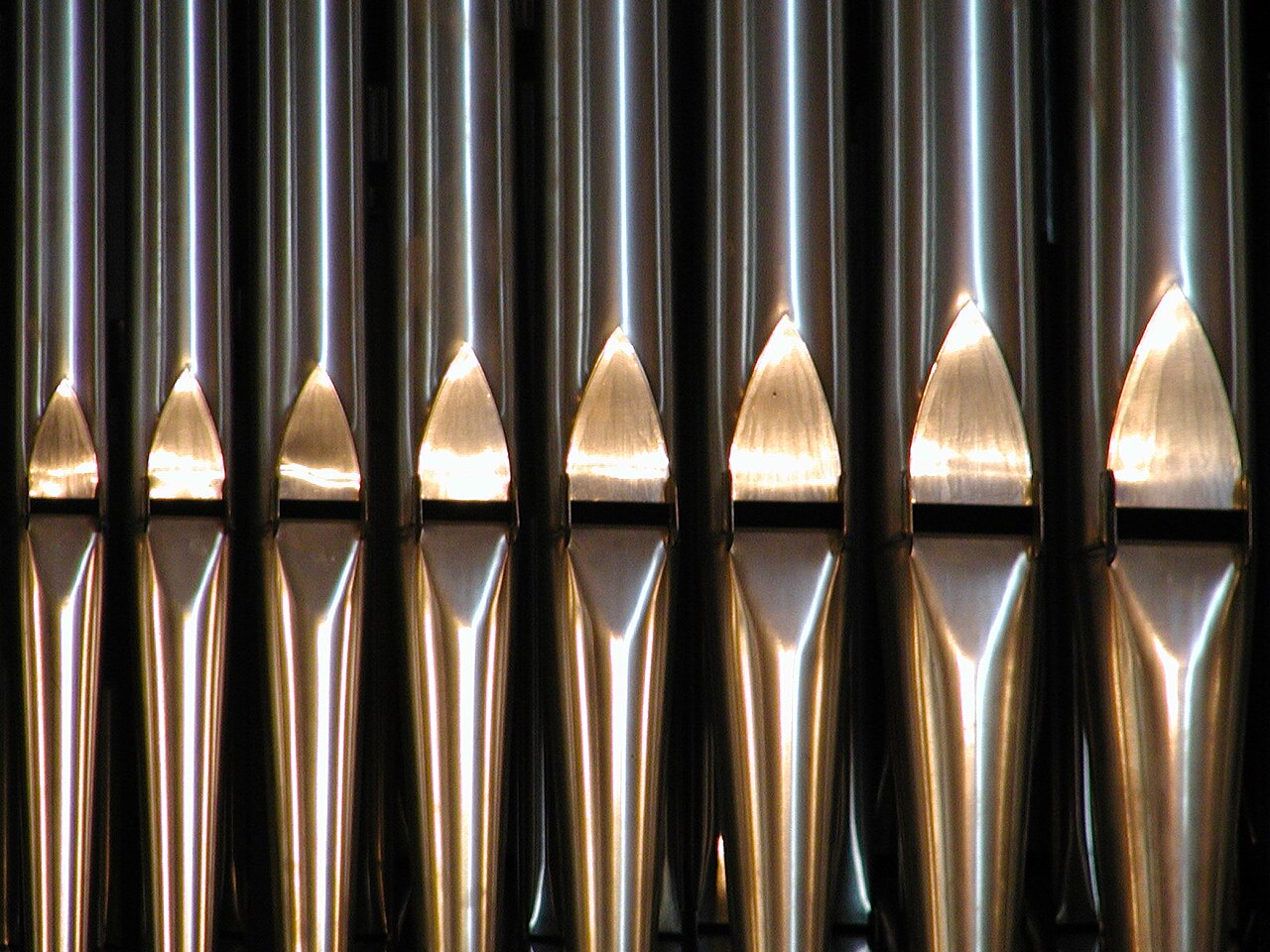
An organ pipe is a steady-wind sound source. Unlike a piano string that is struck, a guitar string that is plucked, or a violin string that is bowed once per stroke — all of which are set ringing and then decay — an organ pipe is fed a continuous supply of pressurised air and, in return, emits a continuous tone that holds for exactly as long as the wind flows. There is no decay envelope built into the physics: press the key, the pallet opens, wind reaches the pipe, and the note sounds indefinitely at constant amplitude until the pallet closes. This is the defining acoustical fact about the pipe organ, and it separates the whole instrument family (church organ, chamber organ, fairground and crank/busker organ, harmonium) from the struck-and-plucked instruments (Fletcher & Rossing, The Physics of Musical Instruments, Part V).
That single property — wind in, tone out, self-sustaining — means every pipe must contain a self-excited oscillator: a mechanism that converts the smooth, non-oscillating energy of a steady airstream into a periodic acoustic oscillation, and keeps it oscillating. There are exactly two ways the organ does this, and they define the two great families of organ pipe:
- Flue (labial) pipes, which work like a whistle, a recorder, or a bottle blown across the top: a thin sheet of air is thrown across a mouth and strikes a lip, and that unstable air jet drives the air column. The great majority of pipes in any organ are flue pipes.
- Reed (lingual) pipes, in which a springy brass tongue beats against a shallot and chops the airflow into puffs, driving a resonator above it — mechanically a valve, acoustically a buzzing exciter, exactly analogous to the lips on a trumpet or the cane reed of a clarinet (Fletcher & Rossing; Audsley, The Art of Organ Building).
Both families share the same three-part architecture, and understanding that shared chain is the goal of this volume. What differs is only the exciter at the front. This volume defines the two families, names every part, and previews the four things a builder or voicer actually controls. The detailed jet aerodynamics are developed in Vol 2, the standing-wave physics of open and stopped pipes in Vol 3, diameter scaling in Vol 4, and reed physics in Vol 5.
1.1 The common chain: exciter → resonator → radiated sound
Every organ pipe, flue or reed, is the same three-stage machine:
- An energy source / exciter. A steady flow of pressurised air (the “wind”) arrives at the pipe. Something turns that steady flow into an oscillation: in a flue pipe an air jet that flip-flops across the mouth; in a reed pipe a vibrating tongue that opens and closes over the shallot. The exciter is broadband and by itself has no strong pitch — an edge tone or a naked buzzing reed is a rough, unmusical sound.
- A resonator — the pipe body — that selects the pitch. The column of air enclosed by the pipe has natural resonant frequencies fixed almost entirely by its length (with smaller corrections from diameter and end conditions). The resonator does two jobs at once: it filters the broadband exciter, strongly favouring frequencies at and near its own resonances, and it feeds energy back to the exciter so that the exciter locks to the resonator’s frequency. The result is a stable, pitched, periodic tone. The resonator, not the exciter, sets what note is heard.
- Radiated sound. The oscillating air column couples to the room through the pipe’s open end (and, in a flue pipe, through the mouth). Only a small fraction of the acoustic power in the standing wave escapes as radiated sound; most is stored in the resonating column and recirculated. This is why a rank of pipes can be loud yet run on only a few watts of pneumatic power.
The load-bearing idea is the feedback loop. Neither family is a simple “blow and it whistles” system; both are coupled oscillators in which the exciter and the resonator continuously drive and correct one another. In the flue pipe the resonator’s standing wave steers the air jet; in the reed pipe the resonator’s pressure wave helps time the tongue’s beating. Cut the resonator off — sound the exciter alone — and the tone collapses to a rough hiss or rasp (Fletcher & Rossing; Pykett, pykett.org.uk, on the flue-pipe feedback mechanism).
1.2 Family 1 — the flue (labial) pipe
A flue pipe is a whistle scaled up to musical size. Wind entering the pipe passes through a narrow slot — the windway or flue — formed between the languid (an internal horizontal plate) and the lower lip. That slot compresses the airflow into a thin, flat, fast sheet (jet), typically a fraction of a millimetre thick, which is thrown across the open mouth of the pipe toward the sharp upper lip. The jet is aerodynamically unstable: small disturbances grow as it travels, so it does not fly straight but waves from side to side, alternately spilling air outside the upper lip (into the room) and inside it (into the pipe body). This oscillating jet crossing an edge is the classic edge tone (Fletcher & Rossing; Fletcher, Sound production in organ pipes, JASA).
On its own the edge tone is weak and hunts in pitch. But because the upper lip sits at the foot of a resonating air column, the standing wave in the pipe body imposes a periodic transverse air motion across the mouth, and that motion sweeps the jet in step with the pipe’s own resonance. The jet stops hunting and locks to the resonator; each cycle of the standing wave the jet delivers a pulse of air into the pipe at exactly the right phase to sustain the oscillation. The pipe body — the resonator — has captured the exciter and dictates the pitch. The nonlinear, one-sided way the jet feeds the pipe (it can only add air when it is on the inside of the lip) is what generates the higher harmonics that give the pipe its timbre (Fletcher & Rossing; Pykett). This whole coupled process — jet transit time, edge tone, lock-in, harmonic generation, and the brief pre-lock transient heard as chiff or speech — is the subject of Vol 2.
The anatomy of a flue pipe, foot to top:
- Foot — the conical or cylindrical base the pipe stands on; wind enters through the foot-hole at the very bottom, whose size (the “toe”) meters how much wind reaches the mouth.
- Languid — the thick internal plate that, with the lower lip, forms the windway and aims the jet. Its position and the small notches cut in it (nicking) strongly affect speech.
- Windway / flue — the thin slot that forms the air sheet.
- Mouth — the rectangular opening in the pipe wall; its lower edge is the lower lip, its upper edge the upper lip (the cutting edge). The vertical height of the mouth is the cut-up.
- Ears — optional side flaps beside the mouth (common on the basses) that steady the jet, aid prompt speech, and slightly lower pitch.
- Body — the resonating tube (the actual resonator). It may be open at the
top, stopped by a cap or a stopper, or half-stopped (a chimney/
Rohr). - Cap / stopper — on stopped pipes, the closure at the top; sliding it tunes the pipe. On open metal pipes the top is instead trimmed or fitted with a tuning slide or scroll.
Flue pipes are made in wood (open or stopped, square section, easy to build — the dominant material in small and home-built organs) or in metal, typically a tin/lead alloy (higher tin = brighter and “spotted”; more lead = softer). Both sound by the identical jet mechanism; material differences are secondary to geometry (Vol 8).
1.3 Family 2 — the reed (lingual) pipe
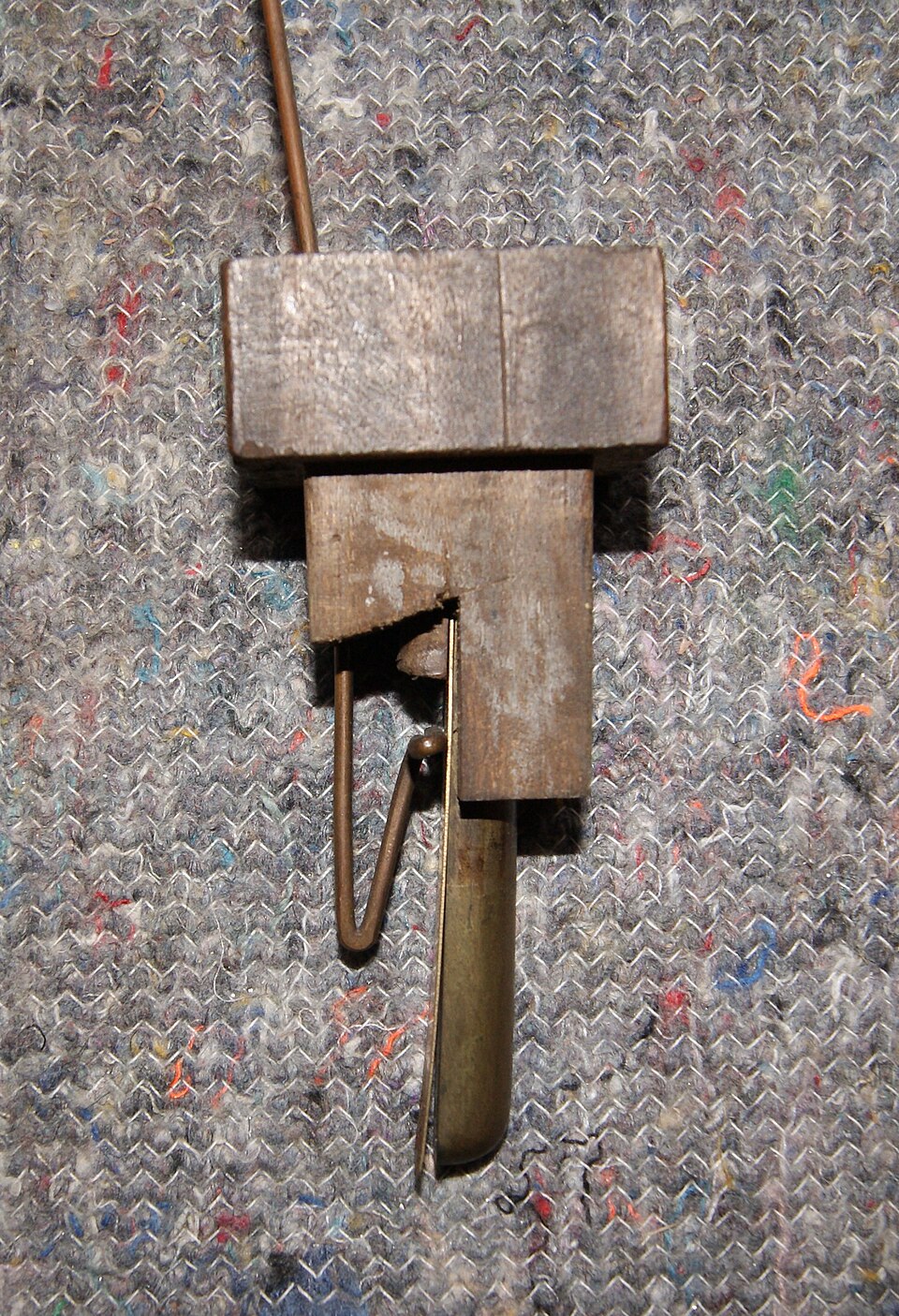
A reed pipe replaces the air jet with a mechanical vibrator. At its heart is a thin, curved strip of brass — the tongue (reed) — clamped at one end and free at the other, lying over a lengthwise opening in a tube called the shallot. The shallot, block, and tongue hang down inside the boot, the enclosed foot-chamber that receives the wind. Pressurised air in the boot pushes the free end of the tongue down against the face of the shallot; as the tongue closes over the opening it cuts off the flow, the pressure differential collapses, the tongue’s own springiness snaps it back open, air rushes through again, and the cycle repeats. The tongue is thus a valve chopping the airflow into a train of puffs — a buzzing, broadband exciter, rich in harmonics but harsh and only weakly pitched by itself (Fletcher & Rossing; Organ Historical Society, Reed Pipe Construction).
Sitting above the shallot is the resonator — a tube (conical for a Trumpet, cylindrical for a Clarinet-type, short and flaring for many others) tuned so its own resonance reinforces one of the reed’s harmonics. As with the flue pipe, the resonator both selects which components are radiated (shaping the timbre) and feeds pressure back to help time the tongue, so reed pitch is set by the combination of tongue and resonator, not the tongue alone. A full-length resonator (e.g. an 8′ Trumpet) reinforces the fundamental and gives a broad, powerful tone; a fractional-length resonator (Regal, and to a degree Oboe or Vox Humana) reinforces an upper partial and yields a thin, nasal, buzzy voice (Fletcher & Rossing; Audsley).
Anatomy of a reed pipe, boot to top:
- Boot — the closed conical foot that holds the wind and encloses the reed assembly; wind enters through its toe.
- Block — the plug across the top of the boot that carries the reed assembly and the base of the resonator.
- Shallot — the small tube with a flat, open face; the tongue beats against this face. Its opening’s shape and size heavily colour the tone.
- Tongue (reed) — the curved brass strip that vibrates; a wedge holds its clamped end firmly into the block against the shallot.
- Tuning wire (tuning spring) — a stiff wire bearing on the tongue; sliding it down shortens the free vibrating length and raises pitch, sliding it up lengthens it and lowers pitch. This is the reed pipe’s tuning control.
- Resonator — the tube above the block that sets timbre and reinforces the reed.
Most organ reeds are striking (beating) reeds: the tongue is slightly wider than the shallot opening, so it strikes the face and seals it each cycle. Free reeds — the tongue narrower than the slot, so it swings through — appear in harmoniums, reed organs, and some regals, and behave differently (they need no resonator to speak). Reed physics, striking-vs-free behaviour, and reed-resonator tuning are the whole of Vol 5.
1.4 How each family excites its resonator — one glance
The two exciters are physically unalike — a wobbling sheet of air versus a snapping strip of brass — yet they play the identical role in the chain: convert steady wind to an oscillation, hand it to the resonator, and let the resonator lock them to pitch. The schematic below places them side by side.
1.5 The four things a builder or voicer controls
Everything a pipe maker or voicer does to a pipe adjusts one of four perceptual outputs. This is the organising map for the rest of the series; each is stated here and developed later.
1.5.1 Pitch — set by resonator length
Pitch is governed almost entirely by the length of the resonating air column,
through the speed of sound c (about 343 m/s at 20 °C). For a flue pipe open
at both ends the fundamental is approximately f₁ ≈ c / 2L; for a stopped
pipe (one end closed) it is approximately f₁ ≈ c / 4L, an octave lower for the
same physical length — equivalently, a stopped pipe reaches a given pitch at about
half the length of an open one (Fletcher & Rossing; standing-wave detail in
Vol 3). The reed pipe’s pitch is set primarily by the free vibrating length of
the tongue (via the tuning wire), with the resonator tuned to match (Vol 5).
Because c rises with temperature (about 0.6 m/s per °C) while pipe length is
nearly fixed, organ pitch rises as the room warms — the dominant tuning-drift
mechanism, treated in Vol 7. Pitch differences are quantified in cents
(1200·log₂(f₂/f₁); 100 cents = one equal-tempered semitone).
1.5.2 Loudness — set by wind pressure, scale, and mouth
Loudness rises with wind pressure (which sets the jet velocity in a flue pipe or the driving force on a reed tongue), with pipe scale (a wider pipe moves more air and radiates more power), and with mouth geometry (mouth width and cut-up). Chamber and house organs run at only a few inches of water column — roughly 2–6 in H₂O; the John Smith busker organ, the worked example that this program’s build dives reference, runs about 5 in H₂O ≈ 127 mm ≈ 1.24 kPa. Pushed too hard, a flue pipe overblows to the octave. Loudness cannot be set independently of timbre — raising pressure also brightens tone — which is why regulation across a rank is a craft, covered in Vol 6.
1.5.3 Timbre — set by family, scale, cut-up, and resonator form
Timbre is where the families and their geometry diverge most:
- Family. Flue pipes give rounder, more “vocal” tone with a harmonic spectrum shaped by the jet; reed pipes give bright, buzzy, harmonically rich tone (Trumpet, Oboe, Clarinet) driven by the chopped airflow.
- Open vs stopped. An open flue pipe supports the full harmonic series (all integer multiples) and sounds bright and complete; a stopped pipe supports odd harmonics only (1, 3, 5, …) and sounds hollow, rounder, and quieter — the Gedackt/Bourdon/stopped-diapason character (Vol 3).
- Scale (diameter-to-length). Wide scale suppresses upper harmonics → fluty; narrow scale enriches them → stringy (Gamba, Salicional); medium scale gives the Principal/Diapason, the organ’s signature voice. Töpfer’s Normalmensur formalises how diameter should shrink up a rank to keep timbre even (Vol 4).
- Cut-up. In a flue pipe the mouth height sets the harmonic balance: high cut-up → fewer harmonics, fluty; low cut-up → brighter/stringier but harder to speak (Vol 2, Vol 6).
- Resonator form on reeds — full-length vs fractional, conical vs cylindrical — selects which partials are reinforced (Vol 5).
1.5.4 Speech and attack — the transient before lock-in
Because the pipe is an oscillator that must start, there is a brief transient between wind-on and stable tone while the exciter and resonator pull into lock. In flue pipes this is the chiff or speech — a short, breathy, often higher-pitched spit heard at the very onset — and voicers deliberately shape it with nicking (notches in the languid that steady the jet and soften the attack), ears, and windway geometry (Fletcher & Rossing; Pykett). Reeds have their own onset behaviour as the tongue settles into beating. The attack carries much of a pipe’s identity to the ear even though it lasts only tens of milliseconds; the physics is developed in Vol 2 (flue) and Vol 5 (reed), and the voicer’s controls in Vol 6.
1.6 Flue vs reed at a glance
Table 1 — Flue vs reed at a glance
| Parameter | Flue (labial) pipe | Reed (lingual) pipe |
|---|---|---|
| Exciter | Air jet/sheet flip-flopping across the mouth (edge tone) | Brass tongue beating on a shallot (a flow-chopping valve) |
| Analogy | Whistle, recorder, blown bottle | Trumpet lips, clarinet reed |
| Where pitch is set | Resonator (pipe body) length: open f≈c/2L, stopped f≈c/4L | Free length of the tongue (tuning wire), resonator tuned to match |
| Tuning control | Slide the stopper/cap; trim or tuning-slide on open metal | Slide the tuning wire (down = sharper, up = flatter) |
| Key anatomy | Foot, foot-hole, languid, windway, lower/upper lip, mouth, ears, body, cap/stopper | Boot, block, shallot, tongue, wedge, tuning wire, resonator |
| Timbre drivers | Scale (diameter), cut-up, open vs stopped, wind pressure | Shallot shape/opening, tongue, resonator length & form (full/fractional) |
| Harmonic content | Open: full series; stopped: odd harmonics only | Rich, bright, buzzy; resonator selects the reinforced partials |
| Share of a typical organ | The large majority of ranks | A minority — the “chorus reeds” and colour/solo reeds |
| Tuning stability | Good; drifts with temperature (c changes) | Poorer; tongues also drift with temperature and need frequent touch-up |
| Developed in | Vols 2–4, 6 | Vol 5 (+ voicing in Vol 6) |
Rules of thumb (scale-to-timbre, cut-up-to-brightness, typical wind pressures) are
builder’s craft knowledge, corroborated by Audsley and Pykett; the open/stopped
frequency relations, the harmonic-content distinction, and the temperature
dependence of c are established acoustics (Fletcher & Rossing). Specific numeric
pressures for a given organ are examples, not universal constants, and are marked
as such where they appear.
1.7 Roadmap to the series
This volume has defined the pipe as a steady-wind, self-excited oscillator, named the two families and their anatomy, and laid out the four controllable outputs. The remaining volumes go deep on each mechanism:
- Vol 2 — The Flue Pipe: Jet, Edge Tone & Resonator. The aerodynamics of the air sheet, the edge tone, jet transit time, lock-in, harmonic generation, and the chiff/speech transient.
- Vol 3 — Open vs Stopped Pipes. Standing waves and boundary conditions; the
c/2Lvsc/4Lrelations; end correction; half-stopped/chimney pipes; quint and mutation ranks. - Vol 4 — Pipe Scaling & Timbre. Diameter-to-length scaling, Töpfer’s Normalmensur and the halving ratio, and how scale sets the principal/flute/string families.
- Vol 5 — Reed Pipes. The beating tongue on the shallot, boot, tuning wire; the resonator’s role and reed-vs-resonator tuning; striking vs free reeds; regals.
- Vol 6 — Voicing: Shaping the Tone. Cut-up, windway geometry, nicking, ears, languid position, and wind pressure — the physics behind each voicer’s move, and rank regulation.
- Vol 7 — Pitch, Temperament & Tuning. Frequency vs length; the temperature
dependence of
cand why organs drift; cents; equal, meantone, and well temperaments; tuning flue and reed pipes. - Vol 8 — Materials, Timbre & Reference. Wood vs metal (tin/lead/spotted metal, zinc), the wall-material timbre debate, a full glossary, a formula cheat-sheet, and the bibliography.
Sources
- Fletcher, N. H. & Rossing, T. D., The Physics of Musical Instruments (2nd ed., Springer), Part V — steady-wind excitation, flue-pipe jet drive and edge tone, reed-pipe mechanics, open/stopped pipe modes and harmonic content, the exciter–resonator feedback loop, speed of sound and its temperature dependence.
- Fletcher, N. H., Sound production in organ pipes and related air-jet/edge-tone papers (JASA) — the coupled jet–resonator oscillator and harmonic generation.
- Colin Pykett — pykett.org.uk — the flue-pipe feedback excitation mechanism, voicing and cut-up, and the material/timbre discussion (corroborating).
- Audsley, G. A., The Art of Organ Building (1905) — pipe anatomy, scaling, reed construction, voicing (builder’s-craft rules of thumb).
- Organ Historical Society, Reed Pipe Construction / Pipes and Timbres (organhistoricalsociety.org) — reed-pipe parts (shallot, tongue, boot, wedge, tuning wire) and their function.
- Program cross-reference: the John Smith busker-organ build dive (dive 5, published) — the ~5 in H₂O worked pressure example; kept general here.
Cross-references: jet aerodynamics and speech in Vol 2; standing waves and open/stopped modes in Vol 3; scaling in Vol 4; reed physics in Vol 5; voicing controls in Vol 6; pitch/temperature/temperament in Vol 7; materials and the glossary in Vol 8.
Comments (0)