How Organ Pipes Make Sound · Volume 3
Vol 03 — Open vs Stopped Pipes: Standing Waves & the Resonator
Vol 2 established the drive: a thin air jet crossing the mouth, thrown at the upper lip, generating a harmonically rich, clipped stream of volume flow. But the jet on its own only makes an edge tone — a hydrodynamic squeal with no fixed pitch. The pitch, the harmonic series, and the very stability of the note come from the resonator: the air column enclosed by the pipe body above the mouth. This volume develops the resonator as an acoustic boundary-value problem, and shows why the single choice of leaving the far end open or stopped (capped) splits every flue rank into two families that differ by an octave, by their harmonic content, and by their physical length.
The two central results are simple to state and worth memorising before the
derivation: an open pipe of length L sounds a fundamental near f₁ ≈ c/2L
and radiates the full harmonic series (1, 2, 3, 4 …); a stopped pipe of
the same length sounds near f₁ ≈ c/4L — an octave lower — and radiates
odd harmonics only (1, 3, 5 …). Equivalently, a stopped pipe reaches a given
pitch at roughly half the length of the open pipe that sounds it. That single
factor of two, and the disappearance of the even partials, is the entire subject
of this volume. Established acoustics is cited; builders’ conventions and
schematic figures are marked as such.
3.1 The resonator as a boundary-value problem
Inside the pipe the acoustic pressure p(x,t) and the longitudinal particle
displacement ξ(x,t) obey the one-dimensional wave equation, propagating at the
speed of sound c ≈ 343 m/s (at 20 °C; c ≈ 331.3·√(1 + T/273.15) m/s, rising
about 0.6 m/s per °C — the temperature term that makes organs go sharp as the room
warms, developed in Vol 7). A standing wave is a solution that satisfies the
boundary condition imposed at each end of the pipe. There are exactly two kinds of
end, and each fixes one quantity:
-
An open end communicates with the free atmosphere, which cannot support an acoustic overpressure — the pressure at an open end is clamped near ambient. An open end is therefore a pressure node and, because pressure and displacement are a quarter-wave out of phase, a displacement (velocity) antinode: the air is free to slosh in and out with maximum amplitude but cannot build pressure. (Strictly the pressure is not clamped at the geometric plane of the opening but a little beyond it — the end correction, treated below — because the radiating air just outside the pipe has mass and moves with the column.)
-
A closed (stopped) end is a rigid cap. The air cannot move through it, so the particle displacement is zero — a displacement node — and, correspondingly, the pressure is free to swing to its maximum — a pressure antinode. The cap reflects the wave in phase (pressure-wise), the same way a wall reflects.
The mouth end of a flue pipe is, acoustically, an open end regardless of the family: the mouth is a large aperture to the room, so it too is a pressure node / displacement antinode. What distinguishes the two families is only the treatment of the far (top) end — open, or capped. This is the whole taxonomy. Everything else follows from fitting sinusoidal standing waves between one fixed open end (the mouth) and either a second open end or a closed end.
3.2 The open pipe: full harmonic series
An open pipe has a displacement antinode (pressure node) at both ends. The
allowed standing waves are those with an antinode at x = 0 and at x = L; the
displacement envelope is ξ_n(x) ∝ cos(nπx/L), n = 1, 2, 3 …, which places
n half-wavelengths’ worth of pattern such that L = n·λ_n/2. With λ = c/f:
f_n = n · c / (2L) n = 1, 2, 3, 4, … (open pipe)The resonant frequencies are all integer multiples of the fundamental
f₁ = c/2L — a complete harmonic series. Because Vol 2’s jet–lip nonlinearity
generates candidate energy at every harmonic, and the open resonator has a mode
waiting at every one of them, the pipe radiates the full series: f₁, 2f₁, 3f₁, 4f₁ …. This is the acoustic basis of the bright, “complete,” singing tone of the
open Principal (Diapason) and open flute ranks — the reference sound of the organ.
3.3 The stopped pipe: odd harmonics, an octave down
Cap the top and the far end becomes a displacement node. Now the standing wave
must have a displacement antinode at the mouth (x = 0, open) and a
displacement node at the top (x = L, closed). The envelope is
ξ_m(x) ∝ sin((2m−1)πx/2L), which fits an odd number of quarter-wavelengths
into the tube: L = (2m−1)·λ/4. Hence
f_m = (2m − 1) · c / (4L)   m = 1, 2, 3, …  →  f₁ = c/4L, 3f₁, 5f₁, 7f₁, …
                                                (stopped pipe)
Two consequences fall straight out of the arithmetic:
-
The fundamental is
c/4L, an octave below the open pipe of the same length. The quarter-wave fundamental has twice the wavelength (λ = 4L) of the open pipe’s half-wave fundamental (λ = 2L), so half the frequency — a factor of two, exactly one octave (1200 cents). Stopping a pipe drops its pitch an octave without changing a millimetre of its length. -
Only odd harmonics are supported. The mode set is
1, 3, 5, 7 …; the even multiples (2f₁, 4f₁ …) would require a displacement antinode at the closed top, which the rigid cap forbids. The resonator has no mode to reinforce them, so they are largely absent from the radiated tone. The result is the hollow, round, “covered,” quieter voice of the stopped ranks — Gedackt, Bourdon, Stopped Diapason, Lieblich Gedeckt — acoustically a near-cousin of the cylindrical clarinet, which is likewise a stopped-at-one-end column sounding odd harmonics (Fletcher & Rossing, The Physics of Musical Instruments, 2nd ed., ch. 8, 15, 17).
The diagram below draws both families to the same physical length so the two results are visible at once: read across a row and the stopped pipe (right) is doing the same job with a lower, more widely spaced standing wave; read down and the open pipe steps through 1f–2f–3f while the stopped pipe skips the even mode and steps 1f–3f–5f.
3.4 Open vs stopped, side by side
The two families differ in exactly four coupled ways — pitch law, harmonic content, length for a given pitch, and timbre — as summarised below.
Table 1 — Open vs stopped, side by side
| Property | Open pipe | Stopped (capped) pipe |
|---|---|---|
| Boundary conditions | Displacement antinode at both ends | Antinode at mouth, node at closed top |
| Fundamental | f₁ = c/2L (+ end corr.) | f₁ = c/4L (+ end corr.) |
| Resonant series | n·c/2L, n = 1,2,3,4… — all harmonics | (2m−1)·c/4L — odd harmonics 1,3,5,7… |
| Pitch of same length | Reference | One octave lower (÷2, 1200 cents) |
| Length for same pitch | Reference L | ≈ ½·L (half the material and height) |
| Timbre | Bright, full, “complete,” singing | Hollow, round, “covered,” clarinet-like |
| Relative power | Louder for equal scale/wind | Quieter (fewer radiating partials, capped top) |
| Overblows to | The octave (2nd mode = 2f₁) | The twelfth (next mode = 3f₁) |
| Example ranks | Open Diapason/Principal, Open Flute, Octave, Fifteenth | Gedackt, Bourdon, Stopped Diapason, Lieblich Gedeckt, Quintadena |
| Tuning access | Cut/cone the open top, or a slide/tuning roll | Move the stopper in/out (a large, easy adjustment) |
The overblowing rows connect back to Vol 2’s regimes: an over-pressured open pipe
jumps to its second mode (2f₁, the octave), which is why the harmonic flute is
built at double length and driven there deliberately; an over-pressured stopped
pipe has no second-mode octave to jump to and instead leaps to the twelfth
(3f₁), the characteristic “quinting” or squealing failure of an over-blown
Gedackt. The stopper’s mobility also gives the stopped family a practical
advantage the diagram does not show: tuning is done by sliding the cap, a coarse
and forgiving motion, whereas an open metal pipe is tuned by cutting, coning, or a
tuning slide at the top — one reason stopped wooden ranks are common in small and
home-built organs.
3.5 End correction: why real pipes are cut short
The formulas above are idealisations. An open end is not a perfect pressure node exactly at the geometric plane of the opening, because the slug of air just outside the pipe participates in the oscillation — it has inertia and radiates. The pipe therefore behaves as if it were slightly longer than its physical length. The correction added to the acoustic length at a plain open end is
Δ ≈ 0.6·a   (a = pipe internal radius)   — more precisely 0.61·a for an
                                            unflanged circular open end
(Rayleigh; Levine & Schwinger’s exact result gives 0.6133·a for an unflanged pipe;
Fletcher & Rossing, ch. 8; corroborated widely, e.g. Hedberg, “Physics of End
Correction in Organ Pipes,” ATOS). At the mouth end there is a second, larger
and less tractable correction — a mouth (labial) correction Δ_m — because the
mouth aperture, its cut-up, ears, and the local jet flow all load the column with
extra effective mass. The full effective length is
L_eff = L_phys + Δ_top + Δ_mouth      f = c / (2·L_eff)   [open]
                                       f = c / (4·L_eff)   [stopped]
so the pipe must be cut physically shorter than the naive c/2f or c/4f to
land on pitch. For a moderately scaled pipe the two corrections together can shave
on the order of a diameter or more off the physical length; the mouth correction
in particular is large enough that voicers and scalers treat it empirically rather
than from first principles (Nederveen, Acoustical Aspects of Woodwind
Instruments; Pykett, pykett.org.uk, “Scaling and the physics of organ pipes”).
Because the correction scales with radius, wide-scale (fluty) pipes are cut
proportionally shorter than narrow-scale (stringy) pipes of the same pitch — a
detail that belongs to scaling (Vol 4). A stopped pipe carries an end correction
only at its single open (mouth) end, not at the capped top, which is part of why
its half-length rule is not exactly one-half in practice.
This end correction is also why the organ’s “foot-length” names are nominal.
An 8′ open rank is so called because its lowest pipe is about eight feet of
speaking length, but the modern equal-tempered bottom C (C₂, 65.41 Hz at A₄ =
440 Hz) actually wants an open speaking length near 343/(2·65.41) = 2.62 m ≈ 8.6 ft before end correction — trimmed back toward the nominal eight feet once the
corrections are applied. The name is a pitch label, not a tape-measure reading.
3.6 Worked lengths at c = 343 m/s
The table gives ideal speaking lengths (before end correction) for the common
pitches, computing both families from L_open = c/2f and L_stopped = c/4f. The
sounding note is referenced to the equal-tempered scale at A₄ = 440 Hz; “8′” pitch
places C₂ (65.41 Hz) at the bottom of a 61-note manual.
Table 2 — Worked lengths at c = 343 m/s
| Pitch name | Sounding note | Frequency | Open L = c/2f | Stopped L = c/4f |
|---|---|---|---|---|
| 8′ (unison) | C₂ | 65.41 Hz | 2.62 m (8.60 ft) | 1.31 m (4.30 ft) |
| 4′ (octave) | C₃ | 130.81 Hz | 1.31 m (4.30 ft) | 0.655 m (2.15 ft) |
| 2′ (fifteenth) | C₄ | 261.63 Hz | 0.655 m (2.15 ft) | 0.328 m (1.08 ft) |
| 2⅔′ (nasard, quint) | G₃ | 196.00 Hz | 0.875 m (2.87 ft) | 0.438 m (1.44 ft) |
| 1⅗′ (tierce) | E₄ | 329.63 Hz | 0.520 m (1.71 ft) | 0.260 m (0.85 ft) |
| 16′ (sub-unison) | C₁ | 32.70 Hz | 5.25 m (17.2 ft) | 2.62 m (8.60 ft) |
Read the 8′ and 16′ rows together and the economy of the stopped pipe is obvious: a stopped rank reaches 16′ pitch in the physical length of an open 8′ pipe (≈ 2.62 m). This is precisely why the ubiquitous pedal and manual Bourdon is a stopped 16′ rank — full-length open 16′ pipes (over 5 m) are costly, heavy, and space-hungry, whereas a stopped Bourdon delivers the same fundamental pitch in half the height, at the price of the rounder, odd-harmonic timbre. The same logic makes the stopped Gedackt 8′ the standard soft foundation of small organs: an 8′ voice barely 1.3 m tall.
3.7 Harmonic content: full series vs odd only
The pitch law is only half the story; the timbre difference is carried by which partials the resonator lets through. Vol 2 showed that the jet–lip nonlinearity offers energy at many harmonics; the resonator then reinforces those partials it has a mode for and starves the rest. An open pipe, with a mode at every integer harmonic, therefore radiates a full, gently decaying series; a stopped pipe, with modes only at the odd harmonics, radiates a spectrum with the even partials deeply suppressed — the “hollow” quality the ear reads as a covered, clarinet-adjacent tone. The schematic spectra below (relative amplitudes, illustrative) make the gap visible.
Perceptually, a spectrum of odd harmonics with a strong fundamental and weak,
widely spaced upper partials sounds hollow, dark, and flute-like at low volume;
the missing octave partial (2f₁) removes the “brightening” the ear associates
with a full series, and the fundamental dominates. This is the tonal signature of
the Gedackt and Bourdon. An open Principal’s full series, by contrast, gives the
firm, present, “vocal” tone that carries the organ’s chorus. The degree of upper
development in either family is then trimmed by cut-up, scale, and wind pressure —
the voicing variables of Vol 6 and the scaling of Vol 4 — but the presence or
absence of the even harmonics is fixed here, by the boundary condition alone.
3.8 Half-stopped and chimney pipes (Rohrflöte)
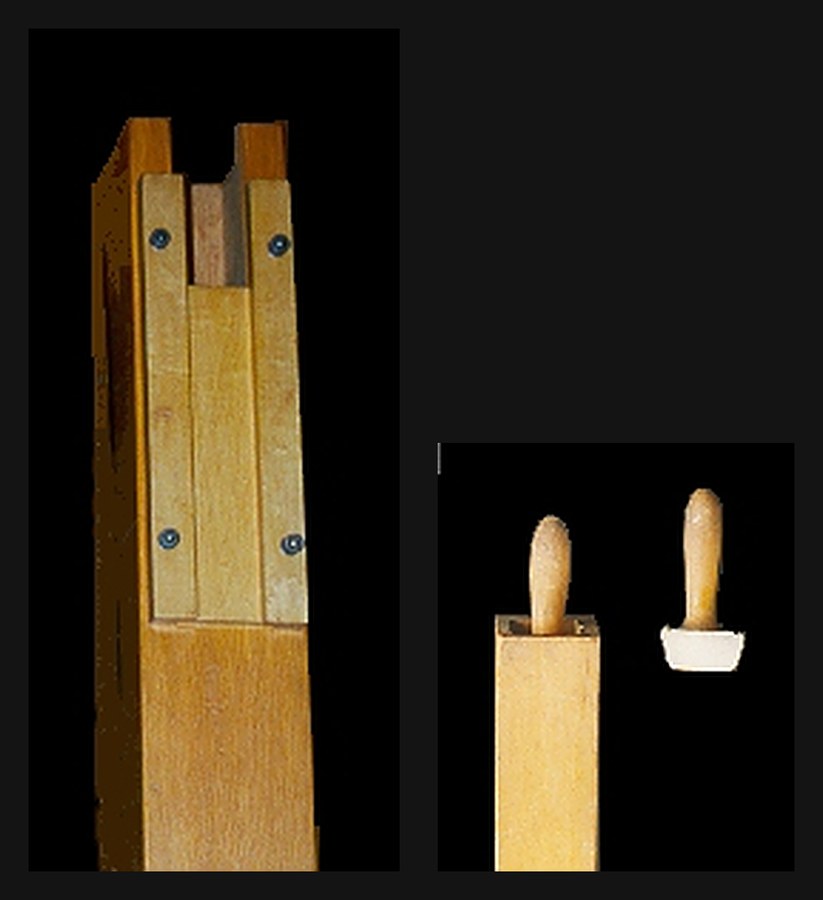
Between the two families sits a hybrid: the half-stopped or chimney pipe, of which the Rohrflöte (“reed-” or “tube-flute,” also Chimney Flute, Koppelflöte) is the archetype. The cap of an otherwise stopped pipe is pierced and a short open tube (chimney) — in a wooden pipe, a hole bored through the stopper — is fitted at the top. Acoustically the chimney is a small open resonator in series with the closed body: it is roughly a quarter-wave tuned to a higher partial, and it selectively re-admits some of the harmonics the plain stopper forbade, most audibly reinforcing certain upper partials and adding a measure of even-harmonic content back into the spectrum.
The effect is a stopped-pipe fundamental (so the octave-down, half-length economy is largely kept) carrying a brighter, more “transparent” upper structure than a pure Gedackt — a bell-like or slightly reedy sparkle prized in solo flute stops. The chimney’s proportions set how much and which partials return: Audsley (The Art of Organ Building, 1905) recommends a chimney diameter of about 1/6 to 1/3 of the body diameter and a length of 1/4 to 1/2 of the body length; wider or longer chimneys admit more even harmonics and a brighter tone (organstops.org, “Chimney Flute”; Fletcher & Rossing, ch. 17). The related Quintadena is a stopped pipe deliberately voiced (narrow scale, low cut-up) to let its third harmonic — the twelfth, a quint — sound audibly against the fundamental, a different route to the same idea of coaxing an odd upper partial out of a stopped body.
3.9 The pitch-length convention and mutation ranks
Organ registration labels every rank by the pitch an open pipe of that length would sound, in feet, referenced to the lowest note of the manual. The unison — the rank that sounds the played pitch — is 8′; an octave above is 4′; two octaves, 2′; three, 1′. Sub-unisons run 16′ (an octave below) and 32′. Because the label tracks pitch, not physical size, it applies uniformly across open and stopped ranks — and this is exactly where the stopped pipe’s factor of two becomes a registration fact rather than a curiosity:
A stopped “8-foot” rank is physically about four feet tall, because a 4-ft stopped column sounds the same pitch (
c/4L) as an 8-ft open column (c/2L). The nameplate reads 8′ — the pitch — while the pipe is half that length. Likewise a Bourdon 16′ is built from stopped pipes about 8 ft long.
Ranks pitched to a non-octave harmonic of the unison are mutations, and they exist to synthesise timbre additively — each reinforces a specific harmonic of the 8′ series so that drawing several together builds a composite tone (the organ’s version of additive synthesis, and the principle behind the Cornet and Sesquialtera solo combinations):
Table 3 — Sesquialtera solo combinations)
| Rank | Length name | Harmonic of 8′ | Interval sounded | Note over C₂ |
|---|---|---|---|---|
| Twelfth / Nasard | 2⅔′ | 3rd | octave + fifth (a twelfth) | G₃ |
| Tierce | 1⅗′ | 5th | two octaves + major third | E₄ |
| Larigot | 1⅓′ | 6th | two octaves + fifth | G₄ |
| Septième | 1 1/7′ | 7th | two octaves + minor seventh | ≈ B♭₄ |
The fractional feet are literal harmonic ratios: 2⅔ = 8/3 (the 3rd harmonic),
1⅗ = 8/5 (the 5th), 1⅓ = 8/6 (the 6th). A quint rank at 2⅔′ can be open or
stopped; a stopped Nasard is only about 0.44 m long (half of the open 0.875 m
from the worked table), which is why quiet chorus mutations are frequently stopped
or chimneyed — small, economical, and mild. A stopped mutation naturally
suppresses its own even harmonics, so a stopped Nasard voiced to reinforce the
3rd harmonic contributes a purer fifth-flavoured colour than an open one that also
drags in its 2nd and 4th. The boundary condition of this volume thus reaches all
the way up into how a registration is designed.
3.10 A note on pitch stability
Every length formula above holds L fixed and lets c vary with temperature, so
the sounding pitch of all these pipes, open and stopped alike, rises about
+3 cents per °C (from c’s ≈ 0.6 m/s per °C, i.e. ≈ 0.18 %/°C ≈ 3 cents/°C).
Because the shift is common to every flue pipe, a flue chorus stays internally in
tune as the room warms; it is the mismatch between flue pipes (which track c) and
reed pipes (whose tongue frequency is nearly temperature-independent) that detunes
an organ against itself. That interaction is the subject of Vol 7; it is flagged
here only to stress that the resonator length set by this volume’s boundary
conditions is what the temperature term acts upon.
3.11 Summary
A flue pipe’s resonator is a one-dimensional acoustic cavity whose allowed
standing waves are fixed by its two ends. The mouth is always an open end
(displacement antinode / pressure node). If the far end is also open, the pipe
supports f_n = n·c/2L — the full harmonic series — and sounds the bright,
complete Principal/flute tone. If the far end is stopped, the pipe supports
f_m = (2m−1)·c/4L — odd harmonics only — sounds an octave lower than the
open pipe of equal length (equivalently reaching a given pitch at half the
length), and produces the hollow, round, quieter Gedackt/Bourdon tone. Real
pipes carry an end correction (≈ 0.61·a per open end plus a larger, empirical
mouth correction), so they are cut physically short and their foot-length names are
nominal pitch labels. Half-stopped/chimney pipes (Rohrflöte) re-admit selected
upper and even partials for a brighter covered tone; the Quintadena coaxes out
its own twelfth. The pitch-length convention labels ranks by the pitch of an
equivalent open pipe, which is why a stopped 8′ is physically ~4 ft and a Bourdon
16′ ~8 ft; mutation ranks (2⅔′, 1⅗′, 1⅓′ …) pitch to non-octave harmonics to
build timbre additively, and stopped mutations naturally deliver purer odd-harmonic
colour. The drive that excites all of this is Vol 2; how diameter (scale) sets the
degree of harmonic development within each family is Vol 4; the voicer’s control
of cut-up, wind, and ears is Vol 6.
Sources
- Fletcher, N. H. & Rossing, T. D., The Physics of Musical Instruments, 2nd ed. (Springer) — ch. 8 (standing waves in air columns, boundary conditions, end correction ≈ 0.6a), ch. 15 (cylindrical stopped columns / clarinet analogy, odd harmonics), ch. 17 (flue-pipe resonators, open vs stopped, chimney/half-stopped pipes, overblowing to octave vs twelfth).
- Levine, H. & Schwinger, J., “On the radiation of sound from an unflanged circular pipe,” Phys. Rev. 73 (1948) — exact open-end correction 0.6133·a; Rayleigh, J. W. S., The Theory of Sound — classical 0.6·a result.
- Nederveen, C. J., Acoustical Aspects of Woodwind Instruments — end and mouth/hole corrections, effective length, half-stopped columns.
- Colin Pykett — pykett.org.uk, “Scaling and the physics of organ pipes,” “The physics of voicing organ flue pipes” — end/mouth correction as empirical quantities, open vs stopped spectra, chimney pipes. Rigorous, freely readable.
- Audsley, G. A., The Art of Organ Building (1905) — stopped, half-stopped, and chimney (Rohrflöte) construction; chimney proportions (⅙–⅓ body diameter, ¼–½ body length); mutation-rank practice. Public domain.
- Hedberg, D., “Physics of End Correction in Organ Pipes” (ATOS) — measured end-correction behaviour in real organ pipes.
- organstops.org and Organ Historical Society, “Pipes and Timbres” — Gedackt/Bourdon/Rohrflöte/Quintadena rank definitions and timbres; mutation and foot-length conventions.
Cross-references: the jet-drive that excites these resonances, harmonic generation at the mouth, and overblowing regimes — Vol 2; pipe anatomy and the flue/reed families — Vol 1; how diameter (scale) sets the degree of harmonic development and loudness within each family — Vol 4; reed resonators (a different tuning relationship) — Vol 5; the voicer’s cut-up, ears, and wind-pressure control of the tone — Vol 6; the temperature dependence of
cand the resulting pitch drift and flue-vs-reed detuning — Vol 7.
Comments (0)