How Organ Pipes Make Sound · Volume 7
Vol 07 — Pitch, Temperament & Tuning
Vol 3 fixed the resonator’s job: an open pipe of length L sounds f₁ ≈ c/2L, a
stopped pipe f₁ ≈ c/4L, and every length formula in that volume was written with
L held constant and c free to vary. This volume takes the second variable
seriously. Two facts drive everything that follows. First, the speed of sound c
is a function of air temperature, not a constant, so a pipe of fixed length is a
thermometer as much as an oscillator — its pitch rises as the room warms. Second,
a reed pipe’s pitch is set by a vibrating brass tongue, not by an air column, and
the tongue barely notices temperature; so flue and reed pipes drift apart as
the building heats, which is the single most common tuning complaint an organ
technician hears. From there the volume develops the arithmetic of pitch
differences — cents — and uses it to lay out the temperaments (equal,
Pythagorean, meantone, well) that decide how the twelve semitones are spaced, and
finally the mechanical tuning methods by which each pipe family is brought to
pitch. Established physics is derived and cited; builders’ rules of thumb are
marked as such.
7.1 Frequency and length: the starting point
For a flue pipe the sounding frequency is set by the resonator (Vol 3):
open:    f = c / (2·L_eff)          stopped:  f = c / (4·L_eff)
L_eff = L_phys + end corrections    c = speed of sound in the pipe's air
L_eff is a mechanical length — sheet metal or wood plus a fixed end correction —
that changes only with slow thermal expansion of the pipe body (a few parts in
10⁵ per °C for metal, negligible against the air term). To a very good
approximation the pipe’s length is a constant, and the sounding pitch is
directly proportional to c. Everything about organ pitch drift is contained
in that proportionality: f ∝ c, so Δf/f = Δc/c. The pipe does not go sharp
because it shrinks; it goes sharp because the air inside it carries sound faster.
7.2 Why organ pitch rises with temperature
The speed of sound in an ideal gas depends on absolute temperature T (in kelvin)
as c = √(γ·R·T/M), which for dry air reduces to the working form used throughout
this dive (Fletcher & Rossing, The Physics of Musical Instruments, ch. 6):
c ≈ 331.3 · √(1 + T_C / 273.15)  m/s      (T_C in °C)
  →  c ≈ 331.3 m/s at 0 °C,  343.2 m/s at 20 °C
Differentiating, the fractional sensitivity near room temperature is
dc/dT = 331.3 · (1/2) / (273.15 · √(1 + T_C/273.15))
      ≈ 0.585 m/s per °C   at 20 °C
(1/c)·dc/dT ≈ 0.585 / 343.2 ≈ 0.00170 per °C  ≈ 0.170 % per °C
Because f ∝ c, the pitch changes by the same fraction, 0.170 % per °C. Converting
that fraction to cents (the cents formula is derived in the next section):
Δ(cents)/°C = 1200 · log₂(1 + 0.00170) = 1200 · 0.00170 / ln 2 ≈ 2.95 cents/°CSo a flue pipe sharpens by roughly +3 cents per °C (est. for the derivation above; the exact figure drifts slightly with the reference temperature and with humidity). Organ technicians more often quote the equivalent Fahrenheit rule of thumb, about +2 cents per °F, which is the same slope (2 cents/°F × 1.8 °F/°C = 3.6 cents/°C — of the same order, the discrepancy coming from the practical inclusion of chest and building effects; Muller Pipe Organ Co.; D.C. Schroth Organ Builders; Wikipedia, “Pipe organ tuning”). The direction is the part never to forget: warm room, sharp pipe. A chorus tuned on a cold winter morning at 12 °C and played to a packed, warm room at 24 °C has risen about 12 × 3 ≈ 36 cents — better than a third of a semitone — sharp, entirely from the air.
Two practical corollaries follow. First, because the shift is common to every
flue pipe in the instrument (they all share the same c), a pure flue chorus
stays internally in tune as the room warms; the whole organ simply floats up and
down together and, played alone, sounds fine — the problem only appears when it
must play with fixed-pitch instruments (Vol 3 flagged this). Second, the drift is
why a builder tunes at, and specifies, a working temperature (commonly stated
near 20 °C / 68–70 °F) and asks that the room be brought to within a degree or two
of it before use; the pitch standard A₄ = 440 Hz is meaningless without a stated
temperature (Colin Pykett, pykett.org.uk, “Organ pitch and temperature”).
7.3 Flue and reed pipes drift apart: the tuning headache
A reed pipe (Vol 5) makes its pitch a different way. A brass tongue clamped at
the top of the shallot beats against the shallot opening; the length of tongue left
free to vibrate — set by the tuning wire — fixes the frequency, exactly as the
free length of a clamped steel spring or reed fixes its resonant frequency. That
frequency is governed by the mechanical stiffness and mass of the brass, not by
the speed of sound in air. Brass stiffness (Young’s modulus) falls only very
slightly with temperature, so a reed tongue’s natural pitch is nearly
temperature-independent — it rises perhaps a few tenths of a cent per °C, an order
of magnitude less than a flue pipe (Fletcher & Rossing, ch. 13; Pykett, “Why organ
reeds go out of tune”). The reed’s resonator (the trumpet or oboe body above it)
does track c like a flue pipe, but in most organ reeds the beating tongue is
the dominant pitch-determining element and the resonator only reinforces and
colours it, so the composite pitch moves far less than a flue’s.
The consequence is the plot above. Warm the room and the flues sail sharp while the reeds stay nearly put; relative to the risen flue chorus, the reeds now sound flat. It is a common illusion, worth stating plainly for the technician: when the Trumpet sounds flat against the Principals on a hot afternoon, the Trumpet has not moved — the flues have moved up under it (Muller Pipe Organ Co.; Wikipedia, “Pipe organ tuning”). Because the two families cannot be made to track each other, a warm-room performance often demands a reed touch-up: the tuner runs the reeds up to match the temperature-floated flues, knowing the correction will have to be undone when the room cools. This is why a reed chorus is the part of an organ most frequently retuned, why reeds are given the most accessible tuning mechanism (a wire tapped from above, below), and why hall temperature stability is treated as a tuning parameter in its own right (D.C. Schroth Organ Builders, “Temperature and the Pipe Organ”).
7.4 Cents: the currency of pitch differences
Pitch ratios are multiplicative (an octave is ×2, a fifth ×3/2), but the ear hears them additively, so tuning arithmetic is done in the logarithmic unit of the cent: one cent is 1/1200 of an octave, i.e. 1/100 of an equal-tempered semitone. For any two frequencies,
interval (cents) = 1200 · log₂(f₂/f₁) = 1200 · ln(f₂/f₁) / ln 2An octave is 1200·log₂2 = 1200 cents; an equal-tempered semitone is exactly 100
cents. The value of cents is that small ratios turn into small, addable numbers:
for a ratio close to 1, 1200·log₂(1+x) ≈ 1731·x, so a 0.17 %/°C pitch change is
1731 × 0.0017 ≈ 3 cents/°C, recovering the temperature result above without a
logarithm. The just intervals — the small whole-number frequency ratios the ear
accepts as consonant — have irrational cent values that do not line up with the
equal-tempered grid, and the gap between them is what temperament must manage:
Table 1 — equal-tempered grid, and the gap between them is what temperament must manage
| Interval | Just ratio | Just (cents) | Equal temp. (cents) | Just − ET |
|---|---|---|---|---|
| Unison | 1/1 | 0.0 | 0 | 0.0 |
| Minor third | 6/5 | 315.6 | 300 | +15.6 |
| Major third | 5/4 | 386.3 | 400 | −13.7 |
| Perfect fourth | 4/3 | 498.0 | 500 | −2.0 |
| Perfect fifth | 3/2 | 702.0 | 700 | +2.0 |
| Minor sixth | 8/5 | 813.7 | 800 | +13.7 |
| Major sixth | 5/3 | 884.4 | 900 | −15.6 |
| Minor seventh | 16/9 | 996.1 | 1000 | −3.9 |
| Major seventh | 15/8 | 1088.3 | 1100 | −11.7 |
| Octave | 2/1 | 1200.0 | 1200 | 0.0 |
Two rows carry the whole story of Western temperament. The just fifth (3/2) is +2.0 cents wider than the equal-tempered fifth, and the just major third (5/4) is −13.7 cents narrower than the equal-tempered third. Equal temperament’s thirds are noticeably sharp — 13.7 cents is easily audible as a fast beating — while its fifths are almost pure. Every historic temperament is a different answer to the question of how to distribute those errors.
7.5 The comma problem, and the temperaments that answer it
If one tunes twelve pure fifths upward (C–G–D–A–…–B♯) the endpoint overshoots seven pure octaves by the Pythagorean comma:
(3/2)¹² / 2⁷ = 531441 / 524288 = 1.013643 → 1200·log₂(1.013643) = 23.46 centsTwelve pure fifths cannot close the circle; roughly a quarter-semitone of excess
must be absorbed somewhere. Independently, four pure fifths stacked to reach a major
third overshoot the pure third (5/4) by the syntonic comma, 81/80 = 21.51
cents — which is why pure fifths force impure (Pythagorean) thirds and vice versa.
A temperament is a scheme for parcelling out these commas across the twelve fifths.
Four historic strategies frame the choices:
-
Pythagorean. Keep every fifth pure (702 cents) and dump the entire Pythagorean comma into one unusable “wolf” fifth. Fifths are perfect, but the major thirds become the sharp
81/64 = 407.8-cent ditone (+21.5 cents over just) — strident in harmony. Suited melodic and early organum practice, not triadic music. -
Quarter-comma meantone (dominant on organs c. 1500–1700). Narrow each of eleven fifths by a quarter of the syntonic comma, to 696.6 cents, so that four of them stack to a pure 5/4 major third (386.3 cents). The reward is gorgeous, beatless major thirds in the common keys; the price is that the eleven narrowed fifths leave a savage wolf fifth of about 737.6 cents (≈ +35.7 cents, unusable) between G♯ and E♭, and the remote keys with sharps/flats beyond the ~E♭–G♯ span are unplayable. Meantone organs simply avoid those keys, and many had split sharp keys (separate G♯/A♭ pipes) to extend the usable range.
-
Well temperaments (Werckmeister, Kirnberger, Vallotti, c. 1680 onward). Spread the comma unevenly so that every key is playable (no wolf) but keys keep distinct “colour”: near keys (few accidentals) get near-pure thirds, remote keys get wider, brighter thirds. Werckmeister III (1691) narrows four fifths (C–G, G–D, D–A, B–F♯) by a quarter of the Pythagorean comma and leaves the other eight pure, giving a C–E third of ≈ 390.2 cents (nearly pure) grading to ≈ 407.8 cents (Pythagorean) in the far keys. Kirnberger III narrows the four fifths C–G–D–A–E each by a quarter of the syntonic comma (with the schisma on F♯–C♯) and gives a pure C–E third. These temperaments are the reason a Bach chorale sounds subtly different transposed key to key, and why historically-informed organ builders still voice for them.
-
Equal temperament. Make every fifth identical at exactly 700 cents (each −1.955 cents from pure, absorbing 1/12 of the Pythagorean comma), so every semitone is exactly 100 cents and all keys are interchangeable. The cost is that every major third is a uniformly sharp 400 cents (+13.7 over just) — perpetually, mildly beating in all keys. It won the keyboard for its modulatory freedom, not its consonance; many organs, especially those for early repertoire, are deliberately tuned to an unequal temperament instead.
The comb diagram makes the trade explicit. It plots the size of the major third built on each of the twelve chromatic roots (arranged in circle-of-fifths order, home keys at left) for three temperaments, against the reference lines of the pure 5/4 third (386.3 cents) and the equal third (400 cents).
7.6 Tuning the pipes: one method per family
Temperament decides the target frequencies; tuning is the mechanical act of
bringing each pipe onto its target. The method is dictated by how the pipe sets its
pitch, and differs sharply between the three pipe types of this dive. In all cases
the tuner alters an effective length — of an air column for flues, of a
vibrating tongue for reeds — since f ∝ 1/L: shortening raises pitch, lengthening
lowers it.
Table 2 — Tuning the pipes: one method per family
| Pipe type | What is adjusted | Mechanism | Direction |
|---|---|---|---|
| Open flue (fixed length) | Speaking length L | Cut the pipe to length at voicing (permanent); fine work by cone — a coning tool flares (raises) or crimps (lowers) the open top | Shorten → sharp |
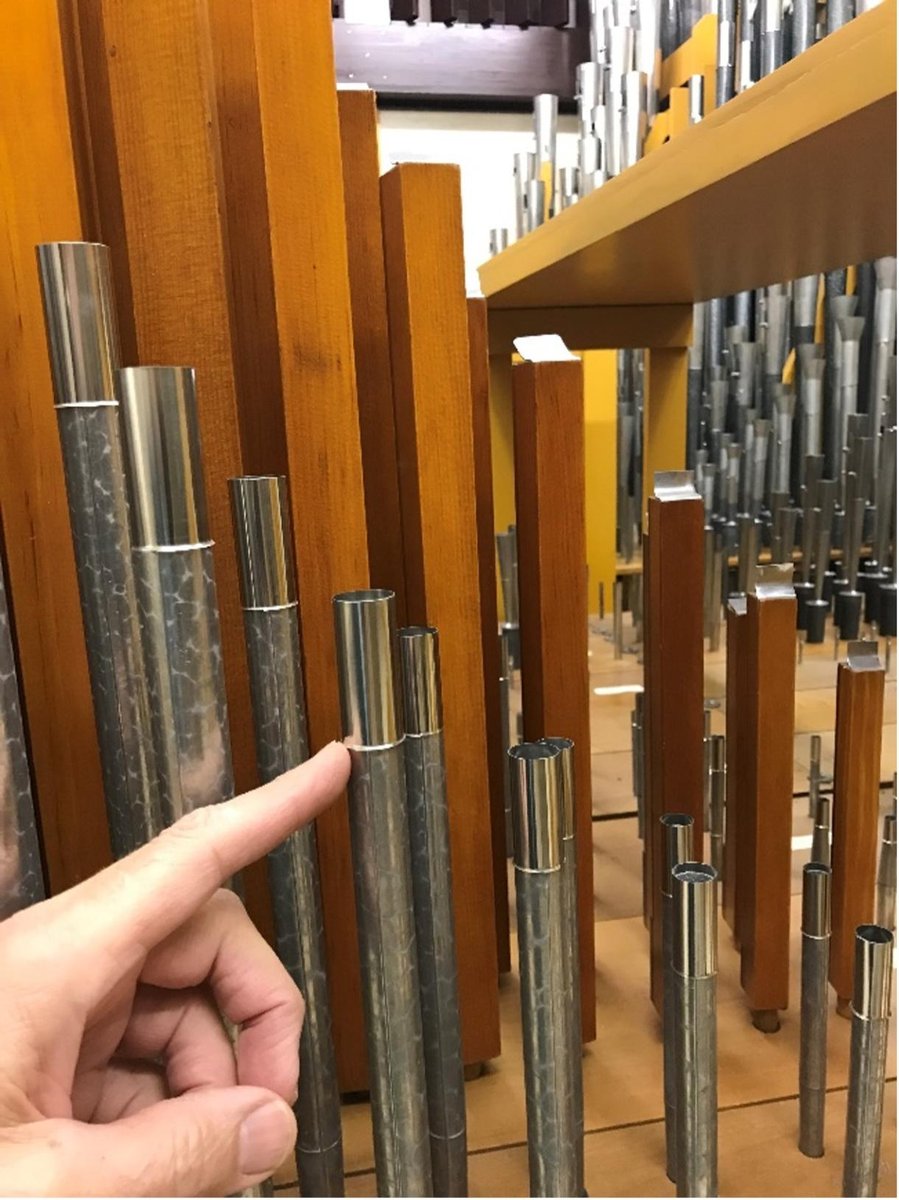
| Open flue (adjustable) | Effective open length | Tuning slide (sleeve) or tuning roll/scroll: a metal collar or a rolled tab of pipe metal at the top slides down (shorter → sharp) or up (longer → flat) | Slide down → sharp |
| Open flue (small/soft) | Mouth loading | Ears and tuning flaps/beards at the mouth; small pitch trims, mainly on strings and basses | Close/adjust → lower |
| Stopped flue | Effective length | Move the stopper in (shorter column → sharp) or out (longer → flat); a large, coarse, forgiving motion | Push in → sharp |
| Reed | Free tongue length | Move the tuning wire down (shorter vibrating tongue → sharp) or up (longer → flat); tap with a tuning knife | Wire down → sharp |
Open flue pipes present the hardest case, because their length is fixed sheet metal. The oldest method is simply to cut the pipe to pitch when it is made and, thereafter, to cone the top: a hollow or solid tuning cone is tapped onto the open end to flare it slightly (raising the pitch by effectively shortening or opening the end) or to squeeze it inward (lowering it). Coning is permanent metal deformation and is reserved for smaller pipes and for pipes not meant to be retuned often. Larger and more accessible ranks are built with a tuning slide — a close-fitting sleeve of thin metal around the top of the pipe that slides down to shorten the speaking length (sharpen) or up to lengthen it (flatten) — or with a tuning roll / scroll, where a tongue of the pipe metal at the top is cut and rolled; unrolling it lengthens the pipe (flattens), rolling it tighter shortens it (sharpens). Some open pipes also carry a cut-out tuning slot with a moveable sleeve. Wooden open pipes are tuned by a moveable wooden shade or flap over a slot near the top. Small strings and basses may additionally be trimmed by adjusting the ears or a tuning beard at the mouth, though those are primarily voicing (speech) devices (Vol 6) rather than tuning devices.
Stopped flue pipes are the easiest to tune and, not coincidentally, are common
in small and home-built organs (Vol 3). Because the pitch is c/4L and the top is
a moveable stopper, tuning is done by pushing the stopper in (shortening the
column, sharpening) or pulling it out (lengthening, flattening) — a large,
low-sensitivity motion that a millimetre of stopper travel spreads over a
comfortable range of cents, forgiving of a shaky hand. The handle atop a wooden
Gedackt stopper is a tuning handle. The trade is that a stopper that is not airtight
leaks and detunes, so the leathering of the stopper is a maintenance item.
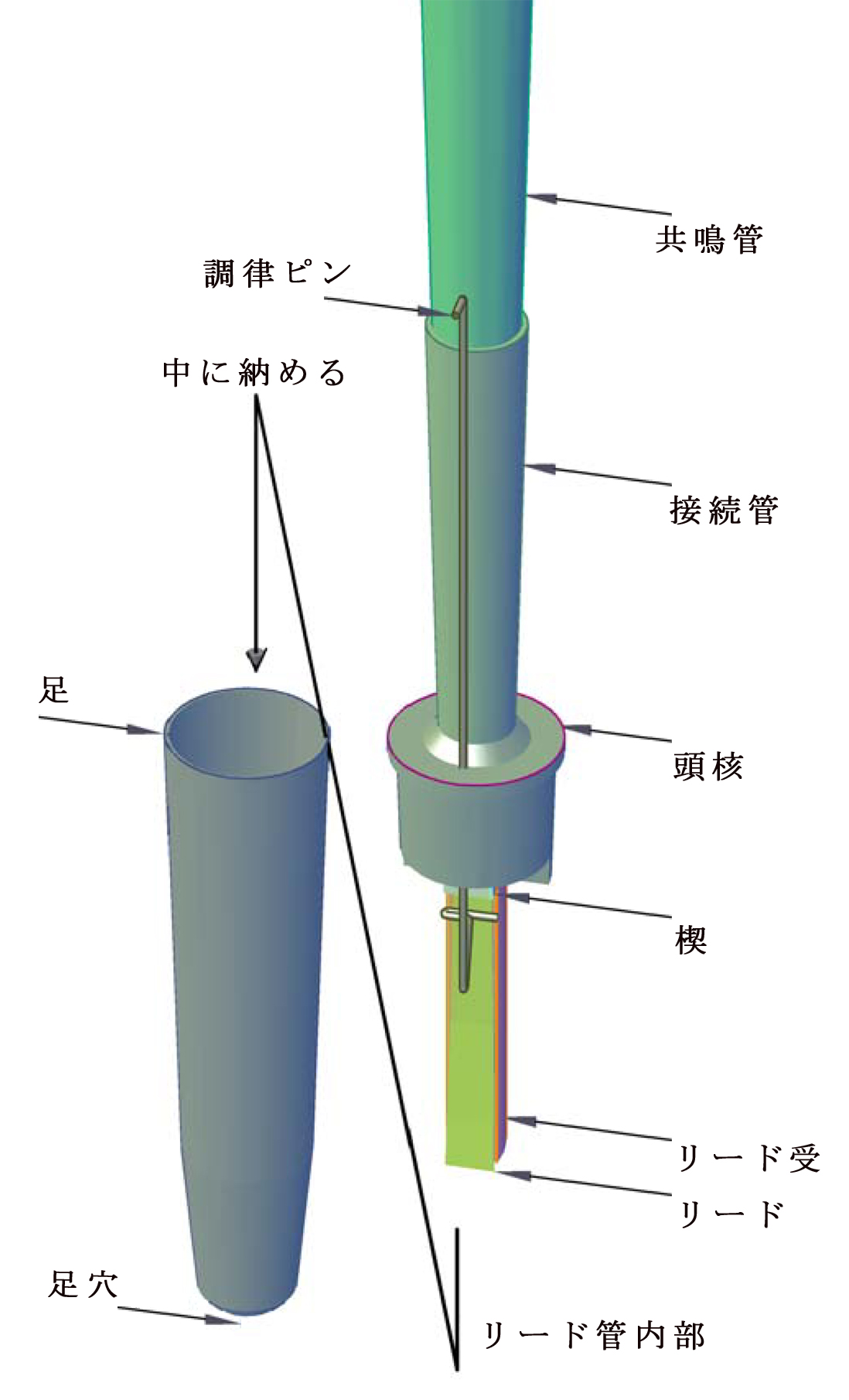
Reed pipes are tuned entirely at the tuning wire (the “tuning spring”): a
stiff wire that presses the tongue against the shallot and defines the point below
which the tongue is free to vibrate. Tapping the wire down shortens the free
length of the tongue and raises the pitch; tapping it up lengthens the free
tongue and lowers it — the same f ∝ 1/L law applied to a beating spring
rather than an air column (Vol 5). Because the wire is reached from the top of the
boot with a light tuning knife, and because — as this volume’s temperature argument
shows — reeds are the pipes most often dragged back into tune against a
temperature-floated flue chorus, the tuning wire is deliberately the most
accessible adjustment on the instrument. The reed resonator is tuned once, at
voicing, to reinforce the tongue’s frequency; it is not a routine tuning control.
7.7 The busker-organ practical case
For a small mechanical organ playing outdoors — the John Smith “Universal” busker organ is the worked example in the companion build dive (dive 5) — every principle above lands as a practical instruction. The instrument is almost entirely stopped flue pipes, so routine tuning is stopper travel: coarse, forgiving, and done by ear against a reference. Crucially, the pipes must be tuned on the organ’s own wind, at the organ’s working pressure (about 5 in H₂O / 127 mm / ≈ 1.24 kPa for the John Smith), because wind pressure shifts pitch and timbre (Vol 6): a pipe trimmed on a tuning jig at a different pressure will not agree with the rest of the rank once mounted on the chest. And because the whole flue chorus floats together with temperature, an outdoor organ that is internally in tune on a cool morning stays internally consonant as the day warms — it simply rises in absolute pitch, which matters little for solo street performance where there is no fixed-pitch ensemble to clash with. The temperature problem only bites when reeds are added to the stoplist, at which point the reed wires become the part the busker retunes most (cross-reference the John Smith build dive for the concrete voicing and stopper procedure).
7.8 Summary
Organ pitch is governed by f ∝ c with the pipe length essentially fixed, and the
speed of sound rises about 0.6 m/s per °C (c ≈ 331.3·√(1+T/273.15) m/s), so a
flue pipe sharpens ≈ +3 cents/°C (≈ +2 cents/°F, builders’ rule) — warm room,
sharp pipe. A reed pipe’s pitch comes from a brass tongue whose stiffness is nearly
temperature-independent, so reeds barely move while flues float up; a warm room
therefore leaves the reeds sounding flat relative to the flues, the commonest
retuning job on an organ. Pitch differences are measured in cents
(1200·log₂(f₂/f₁)): a just fifth is 702 cents (+2 over equal), a just major third
386.3 cents (−13.7 under equal). Twelve pure fifths overshoot seven octaves by the
23.5-cent Pythagorean comma, and four pure fifths overshoot a pure third by the
21.5-cent syntonic comma; a temperament distributes those commas.
Pythagorean keeps fifths pure at the cost of sharp ditone thirds and a wolf;
quarter-comma meantone buys eight pure thirds at the cost of a savage wolf fifth
and dead keys; well temperaments (Werckmeister III, Kirnberger III) make every
key playable with graded key-colour; equal makes every key identical with every
third uniformly 13.7 cents sharp — which is why historic and early-music organs
favour the unequal systems. Tuning is a length adjustment appropriate to each
family: open flues by cutting / coning / tuning slide / scroll / ears, stopped
flues by moving the stopper, reeds by moving the tuning wire — and small
busker organs are tuned on their own wind at working pressure. Drive is Vol 2;
resonator length is Vol 3; scaling is Vol 4; the reed mechanism is Vol 5; the
voicing that sets speech and the pressure that must be held constant during tuning
are Vol 6.
Sources
- Fletcher, N. H. & Rossing, T. D., The Physics of Musical Instruments, 2nd ed. (Springer) — ch. 6 (speed of sound in air, temperature dependence), ch. 13 (reed vibration, tongue stiffness), ch. 17 (flue-pipe resonators, tuning). The standard reference for the physics used here.
- Colin Pykett — pykett.org.uk, “Organ pitch and temperature,” “Why organ reeds go out of tune,” and articles on temperament — rigorous, freely readable corroboration of the +3 cents/°C flue drift and the flue-vs-reed divergence.
- Muller Pipe Organ Company, “Temperature and Tuning”; D.C. Schroth Organ Builders, “Temperature and the Pipe Organ: A Practical Guide”; Wikipedia, “Pipe organ tuning” — the ~2 cents/°F builders’ rule, reeds drifting slower than flues, and stated tuning-temperature practice.
- Standard temperament theory — Pythagorean and syntonic commas (23.46 / 21.51 cents); quarter-comma meantone fifth (696.6 cents), pure 5/4 third, and wolf fifth (≈ 737.6 cents); Werckmeister III and Kirnberger III constructions and their major-third series. Corroborated across Barbour, Tuning and Temperament, and standard references; cent values computed directly from the ratios.
- Audsley, G. A., The Art of Organ Building (1905) — tuning slides, cones, stoppers, and reed tuning-wire practice by pipe type. Public domain.
Cross-references: the jet drive and the wind pressure that must be held constant while tuning — Vol 2 and Vol 6; the resonator length
f=c/2L/c/4Lthat the temperature term acts on, and the note on pitch stability — Vol 3; pipe scaling — Vol 4; the reed tongue, shallot, boot, and tuning wire whose temperature-independence sets up the flue-vs-reed drift — Vol 5; materials and reference tables — Vol 8; the busker-organ worked case — the John Smith Universal build dive (dive 5).
Comments (0)