How Organ Pipes Make Sound · Volume 8
Vol 08 — Materials, Timbre & Reference
Every preceding volume has treated the pipe as geometry plus wind: a resonator of a certain length and diameter (Vols 3–4), excited by a jet or a tongue (Vols 2, 5), shaped at the mouth by the voicer (Vol 6), and tuned against the room (Vol 7). Almost nothing so far has depended on what the pipe is made of. That omission is deliberate and, as this volume argues, largely correct: the physics of tone is dominated by shape and air, not by wall material. Yet material is not irrelevant — it decides durability, tuning stability, cost, workability, and the character of the attack, and it is the first practical choice a builder of a small or busker organ actually makes. This closing volume does two jobs. First it surveys the materials — wood, the tin/lead alloys, zinc, copper and brass — and lays out, even-handedly, the long-running argument over whether wall material changes the steady tone. Then it consolidates the whole series into a reference apparatus: a materials table, a formula/quick-reference card, a glossary of the terms used across all eight volumes, a cross-index, and a de-duplicated bibliography. Established acoustics is cited; builders’ craft and unconfirmed figures are marked (est.).
8.1 Wood
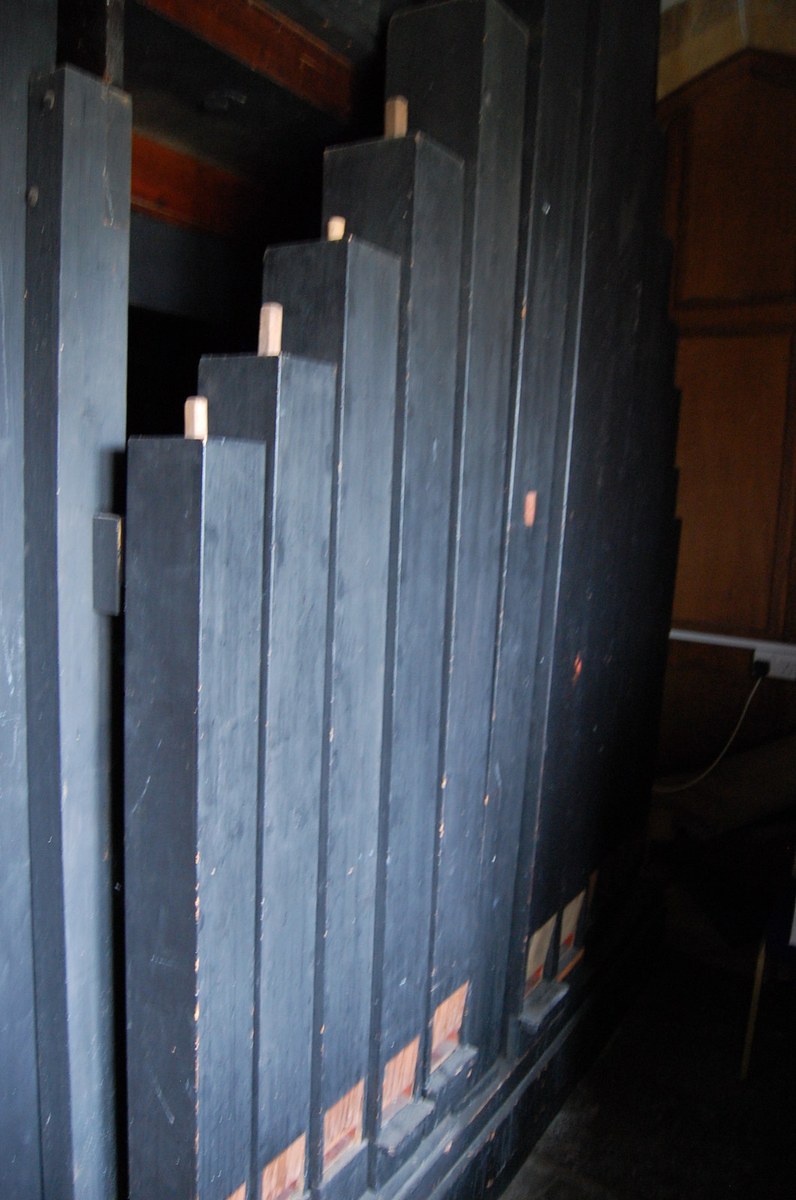
Wood is the oldest pipe material and still the default for small, chamber, fairground, and home-built organs, including the John Smith designs that this program’s build dives use as a worked example. Its advantages are practical rather than acoustic: a square or rectangular wooden pipe is far easier to make by hand than a rolled and soldered metal cylinder, timber is cheap and available, and a wooden stopper slides to tune the pipe with a large, forgiving motion (Vol 3). Most wooden ranks are stopped flutes — Gedackt, Bourdon, Stopped Diapason — which suits wood well: the odd-harmonic, fundamental-heavy, “round” tone of a stopped pipe (Vol 3) matches the wide, flute-leaning scales that are natural to cut from stock board (Vol 4), and a stopped 8′ voice stands only ~1.3 m tall.
Common species are sugar pine and other pines, spruce, oak, mahogany, and maple (Organ Historical Society, Pipe Materials; Audsley, The Art of Organ Building, 1905). Straight, even grain and dimensional stability matter more than species-specific “tone”: a warped or split wall leaks wind and buzzes. Wall thickness is chosen for rigidity and for holding a true mouth, not primarily for sound — a heavier wall is simply less prone to vibrate, warp, or leak. Wood is reputed for a warm, mild, “woody” voice, and while some of that is genuinely the wide stopped-flute geometry wooden pipes usually carry, the timbre is inseparable from that geometry (see The wall-material debate, below). Wood’s real liabilities are hygroscopic: it swells and shrinks with humidity, so joints, stoppers, and mouths must be sealed, and a wooden rank needs a stable environment more than a metal one does.
8.2 Organ metal: the tin/lead alloy
“Organ metal,” “pipe metal,” or “common metal” is not bronze or brass but a simple binary alloy of tin and lead. The two do not form a true intermetallic compound in the proportions used; on cooling they partly segregate into tin-rich and lead-rich regions, and the tin/lead ratio sets both the look and the reputation of the metal:
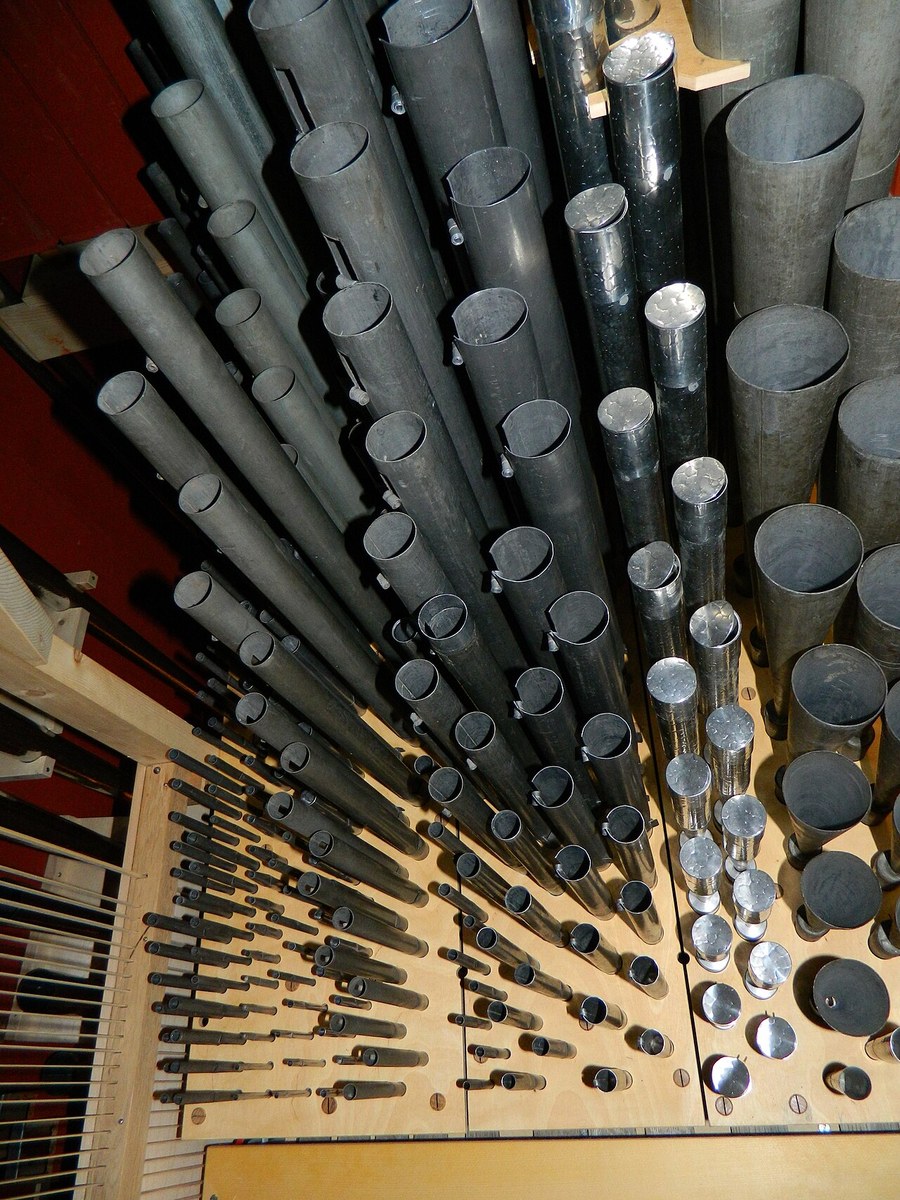
- Common metal / plain metal — roughly 20–40 % tin, balance lead (the Organ Historical Society cites a representative 30 % tin / 70 % lead). Soft, dark grey, inexpensive, easily worked; the workhorse for interior ranks. Higher lead content gives a soft, rounder, “darker” reputed tone and a metal that is easy to cut but prone over decades to creep (slow sagging under its own weight), so tall common-metal pipes need support.
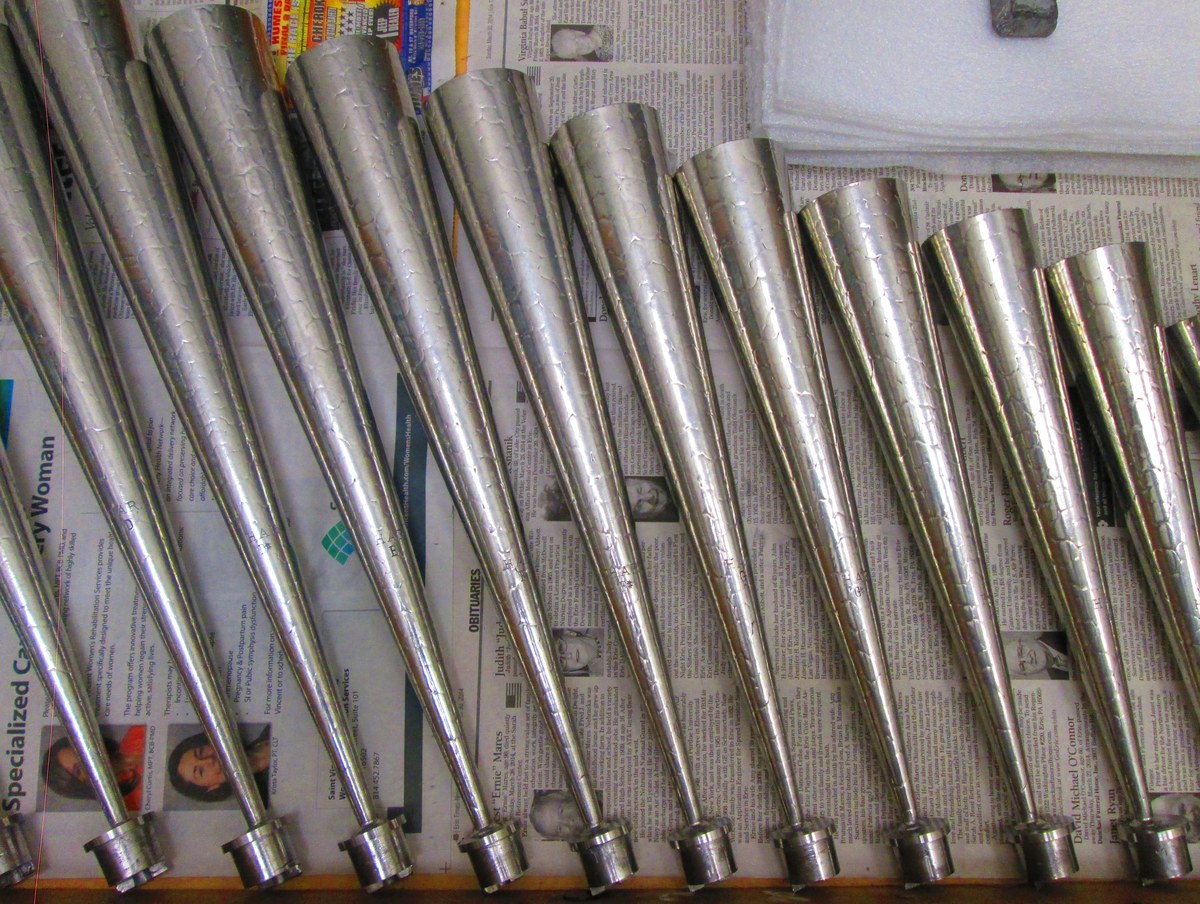
- Spotted metal — the prized middle, most often about 50 % tin / 50 % lead (builders’ ratios run ~45–60 % tin). Because the off-eutectic melt (the tin/lead eutectic is 63 % Sn / 37 % Pb at 183 °C) solidifies over a temperature range, it freezes into a mottled pattern of tin-rich crystals in a lead-rich matrix — the characteristic “spots” or leopard-mottle from which the metal takes its name. It is harder, brighter-surfaced, and more durable than common metal, and it is the traditional choice for good Principals and chorus work.
- Plain (high) tin — ~75 % up to 95–100 % tin (Organ Historical Society cites 95–100 % for the highest grades). Bright, hard, silvery, expensive, and strong enough to be self-supporting and to take a sharp, durable mouth edge — the choice for brilliant façade Principals and keen strings.
- Antimonial / hardened lead — lead stiffened with a few percent antimony (~6 %, est.) as an economical, more rigid substitute for tin in some ranks.
The builders’ rule is old and universal: more tin → brighter, harder, more harmonic-rich in reputation; more lead → softer, rounder, more fundamental-heavy (Organ Historical Society; C. B. Fisk, Some Thoughts on Pipe Metal; Greifenberger Institut, Pipe material). How much of that difference is the metal and how much is the geometry and voicing that different metals invite is exactly the debate below — but the correlation between tin content, surface hardness, and the reputed brightness of a rank is real and consistent across the trade.
8.3 Zinc for the large basses
The tall bass pipes — an open 16′ approaches 5.25 m of speaking length (Vol 3) — are heavy and costly in tin/lead, and a high-lead pipe that size would creep and buckle. The standard economical answer is zinc: cheap, rigid, strong, and light enough to stand tall without sagging. Zinc is customary for pipes longer than about 4′ C, i.e. the bass octaves and pedal basses, and for large façade pipes (Organ Historical Society; organsupply.com). It is often given a tin/lead mouth and languid so the crucial mouth geometry is still cut in the more workable alloy, with the zinc serving only as the resonator wall. Zinc has a duller reputation than spotted metal, but its role is structural economy rather than tonal ambition, and in the bass — where the ear is least sensitive to upper-partial colour — the trade-off is easily accepted.
8.4 Copper and brass
Copper is used less often than tin/lead and appears chiefly where pipes are visible (façade display pipes) or for certain reed resonators, where its colour and stiffness are wanted. Brass is essential in one place: the tongue and (often) the shallot of a reed pipe (Vol 5), where the alloy’s springiness and fatigue resistance are what let the tongue beat for years without cracking. Flared display reeds (en chamade trumpets) are frequently brass or copper for appearance as much as sound.
8.5 The wall-material debate
Does the substance of the pipe wall change the sound a listener hears? This is one of the oldest arguments in organ building, and the honest answer distinguishes the steady tone from everything else.
The physics case: geometry and wind dominate the steady tone. The scientific consensus, developed across a century of measurement, is that the sustained timbre of a flue pipe is set overwhelmingly by the air-column geometry — scale, mouth width, cut-up, open-vs-stopped boundary condition — and the wind, with the wall material a minor contributor at most. The reasoning is direct: the resonator is the air inside the pipe; the standing wave’s boundary conditions are set by the pipe’s shape, not its chemistry (Vols 2–4). For the wall to colour the tone it would have to vibrate appreciably and either radiate sound itself or react back on the air column. Measurements find those wall vibrations to be small and heavily damped: in a well-made pipe the wall is deliberately heavy and rigid precisely so it does not move under the modest acoustic pressure of the internal standing wave. Coltman’s flute experiments found no effect of wall material on steady tone quality; Backus and Hundley, and later workers, measured wall-vibration sound levels as a negligible fraction of the radiated tone (J. W. Coltman, JASA; Backus & Hundley, “Wall Vibrations in Organ Pipes and Their Effect on Tone,” JASA 1966; Fletcher & Rossing, The Physics of Musical Instruments, 2nd ed.). Colin Pykett (pykett.org.uk) reaches the same conclusion from theory and measurement: the steady-state influence of wall material is at or below the threshold of what most tonal differences between “wood” and “metal” or “tin” and “lead” pipes are usually attributed to — those differences are far better explained by the different geometries and voicing that different materials invite and permit. The greifenberger-institut summary puts it plainly: “the influence of the material is usually overestimated,” because scale, cut-up, mouth treatment, wind, and pipe position all contribute more.
Where material does act. The case is not that material is inert, only that its steady-state effect on timbre is small relative to geometry. Material demonstrably matters in four places:
- The attack transient. Wall vibrations, though negligible in the steady tone, are measurably larger during the first tens of milliseconds while the standing wave builds — the same ~20–50-cycle window that carries the chiff (Vol 2). Several studies find the wall’s mechanical resonances leave a faint, material-dependent fingerprint on the onset (Angster, Rucz, Miklós and colleagues, “Influence of wall vibrations on the transient sound of a flue organ pipe”; Kob). Because the attack is a strong perceptual cue for pipe identity, this is where a listener is most likely to hear “something.”
- Wall damping and small pitch/level shifts. A vibrating back wall can pull the fundamental very slightly and shift level near a wall resonance (Nederveen; Fletcher & Rossing), a second-order effect that a voicer perceives as the pipe feeling “live” or “dead” under the hand.
- Workability — which sets what geometry is achievable. Hard high-tin metal takes and holds a sharper, more precise mouth and languid edge than soft high-lead metal or wood; this changes the jet–lip interaction (Vol 2) and hence the tone through geometry. Much of what the trade hears as “the tin sounds brighter” is really “tin lets me cut a keener mouth.”
- Durability and tuning stability. Tin and zinc resist creep and hold their shape and mouth over decades; high-lead common metal sags; wood swells and shrinks with humidity and needs a stable room (Vol 7). Over the life of the instrument this is the most consequential material effect of all.
The voicers’ counter-position. Many experienced builders and voicers insist, against the laboratory result, that they can hear the metal — that a spotted-metal Principal has a “sheen” a common-metal one lacks even at matched geometry. The even-handed reading is that they are usually right about the outcome and often wrong about the cause: the audible difference is real, but it is dominated by the geometry, mouth-edge precision, and voicing that the harder or softer metal made possible, plus the transient fingerprint above, rather than by the wall chemistry acting on the steady standing wave. For the builder the practical guidance is the same either way: choose material for durability, workability, cost, and the geometry it lets you cut — then get the tone from scale, cut-up, and voicing (Vols 4, 6). The wall-material question is genuinely open only at the margin of the attack transient; the steady tone is a geometry problem.
8.6 Reference: materials at a glance
Table 1 — Reference: materials at a glance
| Material | Typical composition | Reputed tonal tendency | Typical use |
|---|---|---|---|
| Wood (pine, spruce, oak, mahogany, maple) | Solid timber, sealed joints | Warm, mild, “woody” (largely the wide stopped-flute geometry it carries) | Stopped flutes (Gedackt, Bourdon, Stopped Diapason); small/DIY/busker organs; wooden basses |
| Common metal | ~20–40 % tin / balance lead (≈30/70 typical) | Soft, round, “darker,” fundamental-heavy | Interior flutes and mild ranks; economical chorus; creeps if tall |
| Spotted metal | ~45–60 % tin / lead (≈50/50 classic) — mottled “spots” | Firm, bright-surfaced, harmonic-rich; the standard chorus metal | Principal/Diapason, Octave, good chorus and string work |
| Plain (high) tin | ~75–100 % tin | Brightest, keen, brilliant | Façade Principals, keen strings (Gamba, Viole), display work |
| Antimonial / hardened lead | Lead + ~6 % antimony (est.) | Between common metal and tin; stiffer than plain lead | Economical, more rigid substitute in some ranks |
| Zinc | Rolled zinc sheet, often tin/lead mouth | Duller reputation; chosen for economy, not colour | Large basses (> ~4′ C), 16′/pedal, big façade pipes |
| Copper | Copper sheet | Colour and stiffness; visual | Façade display pipes; some reed resonators |
| Brass | Spring brass | Essential to reed excitation | Reed tongues and (often) shallots; en chamade reeds |
Sources: Organ Historical Society, Pipe Materials; C. B. Fisk, Some Thoughts on Pipe Metal; Greifenberger Institut, Pipe material; organsupply.com; Audsley (1905). Tonal tendencies are trade reputation; see The wall-material debate for how much is material vs geometry.
8.7 Reference: formula & quick-reference card
The load-bearing relations from across the series, in one place. Symbols: c =
speed of sound in air, L = speaking length, a = internal radius, f =
frequency, p = wind pressure, ρ = air density, U_j = jet velocity, h =
cut-up (mouth height), T = temperature.
Worked speaking lengths at c = 343 m/s (before end correction), A₄ = 440 Hz:
Table 2 — Worked speaking lengths at c = 343 m/s (before end correction), A₄ = 440 Hz:
| Pitch | Note | Frequency | Open c/2f | Stopped c/4f |
|---|---|---|---|---|
| 16′ | C₁ | 32.70 Hz | 5.25 m | 2.62 m |
| 8′ | C₂ | 65.41 Hz | 2.62 m | 1.31 m |
| 4′ | C₃ | 130.81 Hz | 1.31 m | 0.655 m |
| 2′ | C₄ | 261.63 Hz | 0.655 m | 0.328 m |
(Consistent with Vol 3; foot-length names are nominal pitch labels, not tape measurements, because of end correction.)
Glossary
Terms as used across Vols 1–8.
Table 3 — Glossary
| Term | Definition |
|---|---|
| Beard (harmonic bridge / roller) | A bar or roller across a string pipe’s mouth that lets its keen fundamental speak without overblowing (Vol 6). |
| Boot | The enclosed conical foot of a reed pipe that holds the wind and encloses the reed assembly (Vol 5). |
| Bourdon | A stopped (usually wooden) flute rank, commonly 16′; odd-harmonic, round tone (Vols 3–4). |
| Chiff / speech | The brief noisy attack transient before a flue pipe locks to its resonator; the ~20–50-cycle edge-tone-to-resonance hand-off (Vol 2). |
| Common metal | Tin/lead alloy of ~20–40 % tin; soft, dark, economical interior-pipe metal (Vol 8). |
Cut-up (h) | Mouth height, flue exit to upper lip; the master flue tone control — low = bright/stringy, high = round/fluty (Vols 2, 6). |
| Edge tone | The self-sustaining oscillation of a jet flip-flopping across a lip, absent a resonator; governed by St = fh/U_j (Vol 2). |
| Ears | Side flaps at the mouth that stabilise speech and lower pitch slightly (Vol 6). |
End correction (Δ) | The added effective length at an open end (~0.61·a) plus a larger empirical mouth correction (Vol 3). |
| Flue (windway) | The narrow slot between languid and lower lip that forms the air sheet; also the labial-pipe family name (Vols 1–2). |
| Foot-hole (toe) | The wind inlet at the base of a pipe; opened/closed to regulate loudness (Vol 6). |
| Free reed | A tongue narrower than its slot, swinging through it; self-pitched, needs no resonator (harmonium, accordion) (Vol 5). |
| Gedackt | A stopped flute rank; hollow, round, quiet; the standard soft foundation of small organs (Vol 3). |
Halving number (h) | Scaling parameter in dₙ = d₁/2^((n−1)/(h−1)); for Normalmensur Principals h = 17, so a rank’s diameter halves every 16 semitones (Vol 4). |
| Languid | The internal plate that, with the lower lip, forms the flue and aims the jet (Vols 1–2, 6). |
| Labium (upper lip) | The bevelled cutting edge across the mouth that the jet strikes (Vols 1–2). |
| Mensur (scale) | Diameter relative to length; the primary timbre/power control — wide = fluty, narrow = stringy (Vol 4). |
| Mouth | The rectangular opening in a flue pipe’s wall where the jet crosses; always an acoustic open end (Vols 1–3). |
| Mutation | A rank pitched to a non-octave harmonic (2⅔′, 1⅗′…) to build timbre additively (Vol 3). |
| Nicking | Small notches filed in the languid edge that steady the jet and soften the chiff (Vols 2, 6). |
| Normalmensur | Töpfer’s reference scale: 155.5 mm at 8′ C, mouth ¼ circumference, a common yardstick (Vol 4). |
| Open pipe | A pipe open at both ends; f = c/2L, full harmonic series (Vol 3). |
| Overblowing | Jumping to a higher resonator mode (octave in open, twelfth in stopped) under excess wind (Vols 2–3). |
| Rank | One pipe per note across the compass for a single stop; regulated for evenness (Vol 6). |
| Reed (lingual) pipe | A pipe excited by a beating brass tongue on a shallot; Trumpet, Oboe, Clarinet, Regal (Vol 5). |
| Regal | A reed stop with a very short resonator; snarling, buzzy, raw tone (Vol 5). |
| Regulation | Evening loudness, speech, and colour across a whole rank (Vol 6). |
| Rohrflöte (chimney flute) | A half-stopped pipe with a pierced cap and short tube that re-admits some upper/even partials (Vol 3). |
| Scale | See Mensur. |
| Shallot | The slotted tube with a flat facing that a reed tongue beats against (Vol 5). |
| Spotted metal | Tin/lead alloy ~50/50 with a mottled “spotted” surface; durable chorus metal (Vol 8). |
| Stopped pipe | A pipe capped at the far end; f = c/4L, odd harmonics, octave below open, ~half length (Vol 3). |
| Stopper | The movable cap that closes and tunes a stopped pipe (Vols 3, 7). |
Strouhal number (St) | Dimensionless edge-tone group f·h/U_j (Vol 2). |
| Temperament | The scheme for distributing tuning compromises — equal, meantone, well (Vol 7). |
| Tongue | The springy brass strip that beats on the shallot to excite a reed pipe (Vol 5). |
| Töpfer | J. G. Töpfer (1791–1870), originator of Normalmensur and the halving-number scaling system (Vol 4). |
| Tuning wire (Stimmkrücke) | The wire that sets a reed tongue’s free vibrating length; down = sharper (Vol 5). |
| Voicing | Bench adjustment of mouth, jet, and wind to make a pipe speak correctly (Vol 6). |
| Zinc | Rigid, economical wall metal for large bass pipes (Vol 8). |
8.8 Cross-index to the series
Table 4 — Cross-index to the series
| Volume | Title | Owns |
|---|---|---|
| Vol 1 | What an Organ Pipe Is | Steady-wind self-excited oscillator; flue vs reed families; pipe anatomy; the four controllables (pitch, loudness, timbre, speech). |
| Vol 2 | The Flue Pipe: Jet, Edge Tone & Resonator | Jet formation (U_j ≈ C_d√(2p/ρ)), edge tone (St), lock-in, transit time τ, harmonic generation, chiff/speech, regimes. |
| Vol 3 | Open vs Stopped Pipes | Standing-wave boundary conditions; c/2L vs c/4L; odd vs full harmonics; end correction; chimney/half-stopped; mutations; footage convention. |
| Vol 4 | Pipe Scaling & Timbre | Mensur; wide/medium/narrow families; Normalmensur; halving number h; mouth width & cut-up as scale’s partners; wooden pipes. |
| Vol 5 | Reed Pipes | Tongue/shallot/boot/tuning wire; tongue-sets-pitch inversion; reed–resonator frequency jump; striking vs free; resonator families. |
| Vol 6 | Voicing: Shaping the Tone | Cut-up, flue/windway, languid & lip, nicking, ears, beard; regulation; wind pressure; reed voicing (tongue curvature). |
| Vol 7 | Pitch, Temperament & Tuning | Frequency vs length; c(T) and pitch drift (~+3 ¢/°C); cents; equal/meantone/well temperaments; flue vs reed tuning workflow. |
| Vol 8 | Materials, Timbre & Reference | Wood, tin/lead alloys, zinc, copper/brass; the wall-material debate; glossary; formula card; cross-index; bibliography. |
8.9 Where this connects in the Mechanical Organs program
This dive is foundational theory; the program’s sibling dives apply it. The John
Smith Universal Organ build dive is the concrete worked example referenced
throughout — stopped wooden flute ranks on ~5 in H₂O (127 mm ≈ 1.24 kPa), the
cereal-box windway spacer standing in for the trade voicer’s adjustable flue, and
bass ears for prompt speech — and it demonstrates in wood everything Vols 2–6
develop in general. The planned program dives on the wind supply (bellows,
reservoirs, regulators — the pressure p that sets U_j), note encoding
(book/roll/MIDI), pipe-making (cutting and voicing wooden and metal pipes by
hand), tuning and voicing in practice, and materials and restoration each
build directly on this foundation. A reader who has this series can pick up any of
them knowing what a pipe is doing and why.
Sources
- Organ Historical Society, Pipe Materials and Pipes and Timbres (organhistoricalsociety.org) — tin/lead/spotted-metal/zinc/copper/brass compositions and uses; wood species; material-to-stop assignments.
- Colin Pykett — pykett.org.uk — the physics of voicing and the material/tone question; steady-state wall-material effect small relative to geometry and wind.
- Fletcher, N. H. & Rossing, T. D., The Physics of Musical Instruments, 2nd ed. (Springer) — wall vibrations, pipe-tone determinants, the standing-wave and reed physics summarised in the reference card.
- N. H. Fletcher, “Sound production in organ pipes” and related air-jet papers (JASA) — jet-drive and edge-tone relations in the formula card.
- Coltman, J. W., flute wall-material experiments (JASA); Backus, J. & Hundley, T. C., “Wall Vibrations in Organ Pipes and Their Effect on Tone” (JASA 1966) — negligible steady-state wall-vibration contribution.
- Angster, J., Rucz, P., Miklós, A. et al. — “Influence of wall vibrations on the transient sound of a flue organ pipe”; wall effects concentrated in the attack transient.
- Audsley, G. A., The Art of Organ Building (1905, Dover reprint) — pipe metals, wood, scaling, voicing (public domain).
- Hopkins, E. J. & Rimbault, E. F., The Organ, Its History and Construction — historical pipe construction and materials.
- C. B. Fisk, Some Thoughts on Pipe Metal (cbfisk.com); Greifenberger Institut, Pipe material — builder’s perspective on tin/lead and the material debate.
- Töpfer, J. G., Lehrbuch der Orgelbaukunst (via Vol 4 sources) — Normalmensur and the halving-number system.
- Program cross-reference: the John Smith Universal Organ build dive — the applied wooden-pipe worked example.
Cross-references: this reference volume consolidates all seven preceding volumes — pipe families and anatomy Vol 1; jet drive and speech Vol 2; open/stopped resonators and end correction Vol 3; scaling and Normalmensur Vol 4; reed pipes Vol 5; voicing and regulation Vol 6; pitch, temperature and temperament Vol 7. The John Smith Universal Organ build dive is the applied example across the Mechanical Organs program.
Comments (0)