How Organ Pipes Make Sound · Volume 4
Pipe Scaling & Timbre
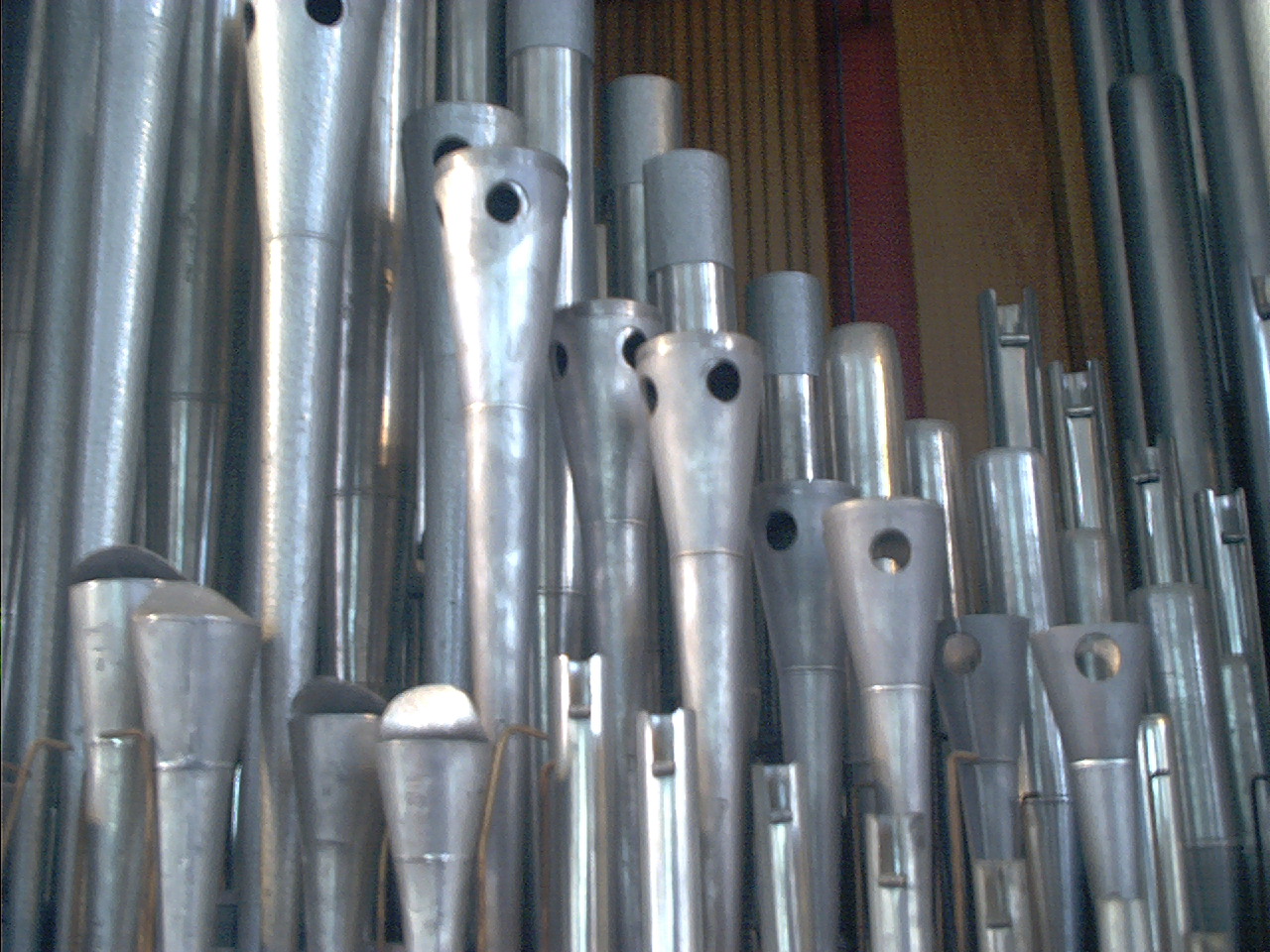
Two flue pipes can be cut to the same speaking length, blown from the same wind, and voiced by the same hand, yet one sings a round, hollow flute while the other cuts a keen, singing string. Pitch is set by length (Vol 3); what separates a Flute from a Gamba from a Diapason at that pitch is scale — loosely, the pipe’s diameter relative to its length, the single most consequential timbral decision a builder makes before a knife ever touches the mouth. Scale governs which harmonics the resonator will support and how loudly, and therefore whether a rank reads to the ear as fluty, principal, or stringy. This volume develops the physics of scale, then the numerical convention that tames it across an entire rank — Töpfer’s Normalmensur and the halving number — and closes on how scale, mouth width, and cut-up form one interlocking system, including the square wooden pipes of small and home-built organs.
Scale is a property of the resonator’s geometry, distinct from voicing (the adjustment of the mouth, jet, and wind at the bench, developed in Vol 6). The two interact intimately, but they are separable: scale is chosen when the pipe is drawn on paper; voicing is what coaxes the intended tone out of that geometry afterward.
4.1 What “scale” means
The scale (German Mensur) of a flue pipe is the ratio of its internal diameter to its speaking length — or, stated across a rank, the rule by which diameter is chosen at every pitch. A pipe voiced to a given pitch has its length fixed by the physics of the standing wave (open pipe f ≈ c/2L, stopped pipe f ≈ c/4L; see Vol 3). Diameter is the free variable, and it is chosen independently of pitch to set the tone.
Three intertwined mechanisms make diameter the dominant timbral lever (Fletcher & Rossing, The Physics of Musical Instruments, 2nd ed., Part V; Pykett, The physics of voicing organ flue pipes, colinpykett.org.uk):
- End correction scales with radius. The acoustic length of an open pipe exceeds its physical length by roughly 0.6·r per open end plus a mouth correction, so a wide pipe carries a proportionally larger end correction. That correction is not the same fraction of a wavelength at every harmonic; it detunes the upper resonant modes of a wide pipe away from exact integer multiples of the fundamental, so those modes reinforce the jet’s upper partials less effectively. A narrow pipe’s modes sit closer to a true harmonic series and lock the upper partials in strongly.
- Mouth and jet geometry track diameter. Mouth width is conventionally a fixed fraction of the circumference (about one-quarter for Normalmensur — see below), so a wide pipe has a wide mouth and a broad, slow air sheet. A broad jet arrives at the upper lip “considerably wider and more diffuse,” generating fewer harmonics; a narrow jet delivers steeper pressure pulses with faster rise times, and steep pulses are harmonically rich (Pykett, physics of voicing).
- Radiation and internal damping. Wider bores radiate the fundamental efficiently and damp the higher modes more heavily relative to it; narrow bores are comparatively lossy at the fundamental and let the upper partials stand out.
The upshot is the builder’s oldest rule, and it is sound physics: “wide pipes are poor in harmonics, and narrow pipes are rich in harmonics” (Wikipedia, Organ flue pipe scaling, summarizing Töpfer; corroborated by Fletcher & Rossing and Pykett). Wide scale suppresses the upper partials and throws weight onto the fundamental — round, covered, flute-like. Narrow scale starves the fundamental and lets a long train of upper partials through — thin, bright, string-like. Medium scale balances the two into the Principal or Diapason, the tone the ear reads as “organ.”
4.2 The scale families
Organ tone is organized into three broad tonal families, and each corresponds to a band of scale. The diameters below are for the same pitch (Normalmensur 2′ C ≈ 55 mm as the reference), quoted in the German halftone offset notation used by builders: a stop marked −7 ht has, at any given pitch, the diameter that Normalmensur reaches 7 semitones lower (i.e. it is narrower); +4 ht is 4 semitones wider (Wikipedia, Organ flue pipe scaling, after Töpfer/Mahrenholz).
Table 1 — The scale families
| Family | Relative scale | Example diameter at 2′ C | Harmonic character | Example stops |
|---|---|---|---|---|
| Flute (wide) | widest; +4 to +9 ht | Gedackt ≈ 65 mm (+4 ht); Flûte ouverte ≈ 81 mm (+9 ht) | fundamental dominant, few/weak upper partials; round, covered | Gedackt, Bourdon, Rohrflöte, Flûte harmonique, Hohlflöte |
| Principal (medium) | reference band; −2 to ±0 ht | Principal ≈ 50 mm (−2 ht); Normalmensur ≈ 55 mm (±0 ht) | balanced series; firm fundamental with a controlled harmonic “cap”; the defining chorus tone | Principal / Diapason, Octave, Fifteenth, Mixture |
| String (narrow) | narrowest; −7 to −10 ht | Salicional ≈ 41 mm (−7 ht); Viole d’orchestre ≈ 36 mm (−10 ht) | rich, long harmonic train; thin, keen, “singing” | Gamba, Salicional, Viole d’orchestre, Aeoline, Dulciana |
Source: diameters and ht offsets from Wikipedia, Organ flue pipe scaling (2′ C figures: Viole d’orchestre 35.6 mm, Salicional 40.6 mm, Principal 50.4 mm, Normalmensur 54.9 mm, Gedeckt 65.4 mm, Flûte ouverte 81.1 mm); family/timbre attributions after Audsley, The Art of Organ Building (1905) and the Organ Historical Society, Pipes and Timbres.
The families are not rigid boxes but a continuum: a Dulciana is a mild, narrow-ish Principal; a Rohrflöte is a stopped/half-stopped Flute with a chimney; the string family shades from the gentle Dulciana through the incisive Viole d’orchestre with its harmonic-inducing beard (frein). What the table fixes is the ordering — wider always means rounder, narrower always means keener, at every pitch.
4.3 Töpfer’s Normalmensur
Left to itself, “diameter relative to length” is a slippery thing to specify across 61 pipes, because length changes at every pitch. The German organist and theorist Johann Gottlob Töpfer (1791–1870) gave the trade its enduring reference frame, the Normalmensur (“normal scale”), published in his Lehrbuch der Orgelbaukunst (mid-19th century). Normalmensur fixes:
- an internal diameter of 155.5 mm (6.12 in) at 8′ C, the lowest note of the modern manual compass;
- a mouth width of one-quarter of the circumference of that pipe (Wikipedia, Organ flue pipe scaling; Pykett).
From that anchor, diameter is reduced up the rank by a geometric rule (below) so that the whole rank is a single smooth progression. Every other scale is then expressed as an offset from Normalmensur in halftones — the −10…+9 ht figures above. This is Normalmensur’s real service: it is not a tone to be copied but a common yardstick. Two builders on different continents can compare a “Salicional at −7 ht” and know they mean the same geometry, regardless of pitch.
Crucially, Normalmensur is stated to keep volume and timbre adequately constant across the whole compass of the rank — a single stop that sounds like “the same instrument” from its lowest pipe to its highest (Wikipedia, Organ flue pipe scaling, summarizing Töpfer). Achieving that constancy is exactly what the halving number is for.
4.4 The halving number: why diameter halves every ~16 semitones, not 12
Here is the subtlety at the heart of scaling, and the one most often gotten wrong. If a builder scaled diameter in proportion to length — halving the diameter every time the pitch rose an octave, since length halves every octave — the ratio of diameter to length would stay constant up the rank. That sounds tidy, and it is wrong: it makes the treble sound thin and weak. The reason is that the physics of the mouth, the jet, and radiation do not scale geometrically with the pipe. A small treble pipe with the same slender proportions as its bass octave has too little mouth area and radiating surface to hold its own; its fundamental collapses and the rank grows reedy and feeble toward the top.
Töpfer’s solution is to shrink the diameter more slowly than the length. In Normalmensur the diameter halves not every octave (12 semitones) but every 16 semitones — i.e. on the 17th pipe. The governing constant is the halving number h; for Normalmensur/Principals, h = 17. The diameter of the n-th pipe of a rank is
d_n = d_1 / 2^((n − 1)/(h − 1))with d₁ the starting (largest) diameter and n counting semitone steps up from it (Wikipedia, Organ flue pipe scaling). With h = 17, the exponent’s denominator is 16, so d is multiplied by 2^(−1/16) ≈ 0.9576 per semitone, and after 16 semitones the accumulated factor is exactly ½. Equivalently, per octave (12 semitones) the diameter falls to
2^(−12/16) = 2^(−0.75) ≈ 0.5946 (to about 59.5 % per octave)and the cross-sectional area — which goes as diameter squared — falls per octave to (0.5946)² = 2^(−1.5) = 1 : √8 ≈ 0.354 (Wikipedia, Organ flue pipe scaling). Because length halves every octave (a factor 0.5) while diameter falls only to 0.595, the diameter-to-length ratio grows steadily toward the treble: the little pipes are proportionally fatter than the big ones. That rising d/L is precisely what keeps the fundamental strong and the timbre even up the rank. Verify the direction against intuition: the narrower the pipe the brighter; if the treble were scaled to constant proportion it would be effectively too narrow and would over-brighten and thin out, so Normalmensur deliberately widens it back.
The table makes the contrast concrete for a Normalmensur Principal (h = 17) versus the naïve constant-proportion rule (halve diameter every octave, an effective h = 13). Nominal footage lengths are used for the ratio column and are approximate — the true speaking length carries end and mouth corrections that depend on scale (Vol 3).
Table 2 — The halving number: why diameter halves every ~16 semitones, not 12
| Pitch (open) | Nominal length | Ø, Normalmensur h = 17 | d : L (h = 17) | Ø, naïve halve-per-octave | d : L (naïve) |
|---|---|---|---|---|---|
| 8′ C | ≈ 2438 mm | 155.5 mm | ≈ 1 : 15.7 | 155.5 mm | ≈ 1 : 15.7 |
| 4′ C (+12 st) | ≈ 1219 mm | 92.5 mm | ≈ 1 : 13.2 | 77.8 mm | ≈ 1 : 15.7 |
| 2′ C (+24 st) | ≈ 610 mm | 55.0 mm | ≈ 1 : 11.1 | 38.9 mm | ≈ 1 : 15.7 |
| 1′ C (+36 st) | ≈ 305 mm | 32.7 mm | ≈ 1 : 9.3 | 19.4 mm | ≈ 1 : 15.7 |
Under Normalmensur the top pipe is 32.7 mm across; under the naïve rule it is a spindly 19.4 mm — narrow enough to lose its fundamental and sound thin and shrill. The Normalmensur figures are internally consistent with the 8′ anchor: 155.5 mm scaled up 24 semitones gives 155.5 × 2^(−24/16) = 155.5 × 2^(−1.5) ≈ 55.0 mm at 2′ C, exactly the reference diameter quoted above.
Halving numbers other than 17. Normalmensur’s h = 17 is the Principal norm, but it is not universal. Conventional practice spans roughly h = 16 to 24 semitones per halving (pipeorganservices.com scale calculator; The Organ Forum, pipe scaling formulae). Two strategies coexist and are often combined:
- Constant halving number, whole-rank offset. Keep h = 17 and shift the entire rank narrower or wider by a fixed number of halftones — the −10…+9 ht system tabulated above. This is the cleanest way to name a stop’s family while preserving Normalmensur’s even progression.
- Variable (family-specific) halving number. Use a different h for a family, or even within a rank, so the character deliberately evolves up the compass. Flutes and strings “may use other ratios” than the Principal’s 17 (The Organ Forum). A rank can also be given variable scaling — a changing h that keeps strings incisive in the treble or lets a flute broaden in the bass. Audsley’s The Art of Organ Building tabulates pipe dimensions for many families at various halving ratios for exactly this purpose (Audsley 1905).
Either way the halving number is the lever that keeps a single stop coherent, while the ht offset (or a distinct base diameter) is the lever that sets which family the stop belongs to.
4.5 Mouth width and cut-up: scale’s partners
Scale sets the bore, but a pipe’s tone is finished at the mouth, and mouth geometry is scaled with the diameter, not independently. Two parameters complete the system:
- Mouth width is conventionally quoted as a fraction of the pipe’s circumference — about 1/4 for Normalmensur, and commonly 1/4 to 1/5 across the families (Wikipedia; Pykett). Because circumference tracks diameter, a wide flute automatically gets a wide mouth and a broad, slow air sheet, and a narrow string gets a narrow mouth and a fast, thin jet — reinforcing the tonal tendency the bore already set. Narrower mouths (1/5, or expressed in “mouths” as a smaller arc) push toward string tone; wider mouths (1/4 and beyond) push toward flute tone.
- Cut-up is the height of the mouth (lower lip to upper lip), specified as a fraction of the mouth width. Principals are typically cut up to about 1 : 4 (height one-quarter of width) (Pykett, physics of voicing). High cut-up attenuates the higher harmonics — the jet arrives wide and diffuse at a distant upper lip — giving fluty tone; low cut-up keeps the jet tight and sharply defined against a near lip, favouring the upper partials for string tone. Cut-up is not fixed on the drawing board; it is set at the bench during voicing (Vol 6), which is why the same drawn scale can be pushed some distance toward flute or string by the voicer.
Scale, mouth width, and cut-up thus pull in the same direction for a given family: wide bore + wide mouth + high cut-up = flute; narrow bore + narrow mouth + low cut-up = string; the middle ground = Principal. A voicer can trade a little of one against another, but fighting the bore — trying to voice a keen string out of a wide flute scale — yields an unconvincing, effortful tone. This is why scale is chosen first: it decides what the voicer can plausibly ask for. Strings in particular need help the bore alone cannot give: a low cut-up plus a beard or frein harmonique (a roller or bar across the mouth) to stabilise the fast jet and let the harmonic-rich tone speak promptly (Audsley 1905; Pykett).
4.6 Choosing a scale for a stop
A builder specifying a rank works from the desired tone backward to geometry:
- Pick the family and its offset. Decide flute / principal / string, then a base diameter or an ht offset from Normalmensur (e.g. a full-toned open flute at +6 ht; a stringy Salicional at −7 ht; a Diapason at −2 to ±0 ht). Softer ranks (Dulciana, Aeoline) sit narrow; bold chorus and solo flutes sit wide.
- Pick the halving number. h ≈ 17 for a Principal that must blend in the chorus; a larger or variable h if the tone should broaden or brighten across the compass.
- Set mouth width and provisional cut-up consistent with the family (1/4 circumference and ~1:4 cut-up for a Principal; narrower mouth and lower cut-up for a string; wider mouth and higher cut-up for a flute).
- Match to wind and the room. Wider scales and higher cut-ups want more wind to speak fully; a rank must be scaled with its wind pressure and the building’s acoustic in mind — the same drawn scale is voiced louder or gentler on different winds (Vol 6; Audsley 1905).
The result is a rank that is coherent within itself and sits correctly against its neighbours in the chorus — the Principal firm, the flutes round beneath and around it, the strings singing at the edges.
4.7 Wooden pipes and small/DIY organs
Everything above is stated for round metal pipes, but the scaling logic is identical for the square wooden pipes that dominate small chamber, busker, and home-built organs, including the John Smith designs (see the John Smith Universal Organ dive for a worked build). For a square or rectangular wooden pipe, “scale” is the cross-sectional dimensions relative to length, and the family rules carry straight over: a wide, near-square section gives fluty tone (most home-organ ranks are stopped wooden flutes — Gedackt-like, round and economical of height); a narrow, deep rectangular section gives stringier tone. Because most small-organ ranks are stopped (a cap or stopper closing the top; Vol 3), they sound an octave below an open pipe of the same length and speak with odd-harmonic-leaning, hollow, mellow tone — which pairs naturally with the wide, flute-leaning scales practical to cut from stock timber.
Builders of such organs still face the halving problem: hold the wooden section too closely proportional to length up the rank and the treble goes thin. The practical fix mirrors Normalmensur — keep the treble pipes proportionally wider than a constant-ratio rule would give — and small-organ plans encode this as tabulated per-note width/depth dimensions rather than as an explicit halving number. The mouth of a wooden pipe follows the same family grammar: mouth width a fraction of the pipe’s front-face width, and cut-up a fraction of mouth width, set (and re-set) as the pipe is voiced on the finished organ. The John Smith Universal, running about 5 in H₂O (127 mm, ≈ 1.24 kPa), is a concrete example of stopped wooden flute ranks scaled and voiced on modest wind; this volume stays general — see that dive for the exact dimensions and the cereal-box windway detail, and Vol 6 for the voicing moves.
4.8 Summary
- Scale (mensur) is diameter relative to length, chosen independently of pitch, and it is the primary control of timbre and power: wide → fluty (fundamental-dominant, few harmonics), narrow → stringy (harmonic-rich), medium → Principal/Diapason (the organ’s defining tone).
- The three tonal families — Flute, Principal, String — occupy a continuum of scale, quoted as halftone offsets from Normalmensur (roughly +9…−10 ht).
- Töpfer’s Normalmensur anchors the trade: 155.5 mm at 8′ C, mouth 1/4 circumference, a common yardstick rather than an ideal tone.
- The halving number h governs how diameter falls up a rank: d_n = d₁ / 2^((n−1)/(h−1)), with h = 17 for Principals — diameter halves every 16 semitones (on the 17th pipe), or to ≈ 59.5 % per octave, area to 1 : √8 per octave. Because that is slower than the octave-wise halving of length, treble pipes are kept proportionally wider, holding timbre even; a naïve constant-proportion rule (halving diameter every octave) thins the treble.
- Mouth width (≈ 1/4 circumference) and cut-up (≈ 1:4 for Principals) complete the system, pulling with the bore toward the intended family; the builder chooses scale first, then voices within it (Vol 6).
- The same logic governs the square wooden pipes of small and home-built organs (John Smith and kin), where stopped, flute-leaning scales dominate.
Open vs stopped resonators and end correction are developed in Vol 3; the bench adjustment of mouth, jet, nicking, ears, beard, and wind that finishes the tone scale prescribes is Vol 6.
Sources
- Wikipedia, Organ flue pipe scaling — Normalmensur (155.5 mm at 8′ C, mouth 1/4 circumference); halving number h = 17; formula d_n = d₁/2^((n−1)/(h−1)); diameter halves every 16 semitones / on the 17th pipe; area varies as 1 : √8 per octave; the family diameter/ht table (Viole d’orchestre 35.6 mm/−10 ht … Flûte ouverte 81.1 mm/+9 ht at 2′ C); “wide pipes are poor in harmonics, and narrow pipes are rich in harmonics.”
- Colin Pykett — The physics of voicing organ flue pipes (colinpykett.org.uk) — jet width vs harmonic generation; high cut-up attenuates upper harmonics; Principals cut up ≈ 1:4; mouth width as fraction of circumference; the empirical residue beyond present theory.
- G. A. Audsley, The Art of Organ Building (1905; Dover reprint) — scale families, per-family dimension charts at various halving ratios, mouth/cut-up and beard/frein for strings.
- N. H. Fletcher & T. D. Rossing, The Physics of Musical Instruments (2nd ed., Springer, Part V) — end correction ∝ radius, mode detuning with bore, radiation and damping vs scale; the physical basis of the harmonic/scale relationship. See also Fletcher, Scaling rules for organ flue pipe ranks (UNSW).
- Organ Historical Society, Pipes and Timbres — tonal-family taxonomy and representative stops.
- The Organ Forum, pipe scaling formulae; pipeorganservices.com scale calculator — conventional halving-number range (h ≈ 16–24); Principals ≈ 17, flutes/strings may use other ratios.
- Töpfer, Lehrbuch der Orgelbaukunst (via the above) — the Normalmensur system and the constancy-of-timbre rationale for the 17th-pipe halving.
- Cross-references: Vol 3 (open/stopped pipes, end correction, footage↔pitch); Vol 6 (voicing: cut-up, mouth, nicking, ears, beard, wind); the John Smith Universal Organ dive (a worked wooden-pipe build) for concrete stopped-flute scale/voicing figures.
Comments (0)