How Organ Pipes Make Sound · Volume 2
Vol 02 — The Flue Pipe: Jet, Edge Tone & Resonator
A flue pipe is, physically, a wind-driven feedback oscillator. A steady, silent supply of pressurised air enters the foot; a thin sheet of that air is shaped at the flue and flung across the mouth toward a sharp lip; and the pipe body — the resonator — turns that crossing sheet into a self-sustaining, pitched tone. The sound is not “blown into” the pipe in any direct sense. The wind carries only energy and no pitch information; the pitch, the harmonic content, and the very existence of a steady note all emerge from the coupling between an unstable air jet and a resonant air column. This volume develops that coupling: how the jet forms, why the jet alone makes an edge tone, how the resonator captures and paces the jet into a locked oscillation, where the harmonics come from, and what happens in the fraction of a second before lock-in — the attack, chiff, or “speech.”
The standing-wave behaviour of the resonator (open vs stopped, end correction, the harmonic series it will support) is developed in Vol 3; the voicer’s adjustments that exploit the physics below — cut-up, nicking, ears, languid position, wind pressure — are the subject of Vol 6. This volume owns the drive: what physically makes a flue pipe speak. Established acoustics is stated as such and cited; builders’ rules of thumb and unconfirmed figures are marked (est.).
2.1 From foot pressure to a jet
The pipe foot is a small plenum. Wind at the chest pressure p (a few hundred
pascals to about 1.5 kPa in organ practice — small house and chamber organs run
roughly 2–4 in H₂O ≈ 0.5–1.0 kPa, larger instruments 3–6 in H₂O; the John Smith
busker organ referenced in the sibling build dive runs ~5 in H₂O = 127 mm ≈
1.24 kPa) fills the foot and escapes upward through the flue — the narrow
slot, typically a fraction of a millimetre to a couple of millimetres wide,
formed between the languid (the horizontal plate closing off the foot) and
the lower lip. Because the slot is small relative to the foot, the pressure
inside the foot is very nearly the full chest pressure, and the air leaves the
flue as a fast, thin, ribbon-like sheet or jet.
The jet speed follows, to first order, from Bernoulli’s principle applied between the still air in the foot and the free jet at the flue exit:
U_j ≈ C_d · √(2p / ρ)with ρ ≈ 1.20 kg/m³ for air at 20 °C and a discharge coefficient C_d < 1
(est. ~0.6–0.95, depending on flue geometry) accounting for viscous and
vena-contracta losses. For p = 1.24 kPa the ideal (loss-free) value is
√(2·1240/1.20) ≈ 45 m/s; for a gentler p = 0.75 kPa (~3 in H₂O) it is
≈ 35 m/s. Measured jet velocities in laboratory flue pipes fall in the range
7–33 m/s across normal speaking pressures and Reynolds numbers of about
1000–5000, with sounding frequencies of ~130–580 Hz in one representative study
(Fabre & Hirschberg, in Fletcher & Rossing, The Physics of Musical
Instruments, 2nd ed., ch. 16–17; Verge et al., JASA). The key operational
fact is that jet velocity is set by wind pressure (as √p), and jet
velocity is the single most important control on whether — and in which regime —
the pipe speaks. This is why regulating wind pressure is a voicing act, not a
loudness knob alone (developed in Vol 6).
The jet is not a rigid ribbon. It is a free shear layer, hydrodynamically unstable: any small transverse disturbance at its root grows as it travels. That instability is the entire mechanism of sound production, so the geometry it crosses matters enormously.
2.2 Anatomy of the mouth
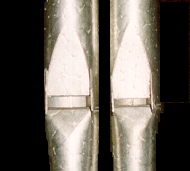
The mouth is the rectangular opening cut in the front of the pipe just above
the foot. Its lower edge is the lower lip (with the languid and flue just
behind and below it); its upper edge is the upper lip (also called the
labium), bevelled to a fairly sharp edge. The vertical distance from the flue
exit to the upper lip is the cut-up h — the length of free jet, and the
parameter that, with jet velocity, sets the pipe’s operating regime. The full
anatomy and the naming of every part are laid out in Vol 1; the drive-relevant
geometry is shown below.
2.3 The edge tone: the jet on its own
Detach the jet-and-lip geometry from the resonator — imagine the same flue and upper lip with no pipe body above — and it still makes sound. A thin jet directed at a wedge or sharp edge produces an edge tone (also called a mouth tone or jet tone): a self-sustaining, roughly tonal oscillation. The mechanism is a short hydrodynamic feedback loop entirely local to the mouth. A tiny sideways deflection of the jet at its root grows into a travelling wave as it crosses the gap; when the wave reaches the lip, the jet is thrown alternately to one side of the edge and then the other; each flip creates a pressure disturbance near the lip that propagates back (essentially instantaneously, at the speed of sound over the short gap) to the sensitive jet root and re-triggers the next deflection. The loop closes, and the jet flaps at a rate set by how long the disturbance takes to travel the gap.
The controlling dimensionless group is a Strouhal number built from the
edge-tone frequency f, the jet velocity U_j, and the flue-to-edge distance —
here the cut-up h:
St = f · h / U_jEdge tones lock onto discrete stages (hydrodynamic modes) in which roughly an
integer-plus-a-fraction number of jet wavelengths fit the gap, so for fixed
geometry the edge-tone frequency rises nearly linearly with jet velocity, and
then jumps abruptly to a higher stage as velocity increases past a threshold
(Brown; Curle, Proc. Roy. Soc. 1953; Fletcher & Rossing, ch. 16). A useful
classical scaling for the lowest stage is f ≈ 0.4·U_j/h · (1 − const) form
(Brown’s relations; the exact constants are geometry-dependent and are treated as
empirical). Two facts carry forward: edge-tone frequency scales as U_j/h,
and it prefers discrete stages rather than a continuum.
In a real speaking pipe the pure edge tone is largely suppressed — the resonator hijacks the feedback, as the next section shows — but the edge tone does not vanish. It governs the attack transient, and its stage structure is exactly what a pipe overblows into.
2.4 The coupled oscillator: jet locked to the resonator
Mount the same jet-and-lip over a resonant air column and the physics changes character. The resonator has its own natural frequencies (Vol 3). At the mouth, the resonator’s standing wave produces an oscillating acoustic particle velocity transverse to the jet — the air at the mouth sloshes in and out of the pipe once per acoustic cycle. That transverse velocity is a far more potent, coherent disturbance of the jet root than the jet’s own edge-tone instability. The jet is therefore deflected in step with the resonator, not in step with its own edge tone: the jet entrains to, and locks onto, a resonator natural frequency (Cremer & Ising; Coltman; Fletcher, “Sound production in organ pipes,” JASA; Fletcher & Rossing, ch. 17).
The result is a jet-drive feedback oscillator with a clean division of labour: the jet is the energy source (a valve-like, nonlinear amplifier that converts steady wind power into oscillating power) and the resonator is the frequency-determining element (the pitch-setting, phase-setting feedback network). The system oscillates at whichever resonator mode satisfies the loop’s gain and phase conditions.
2.4.1 The phase condition and jet transit time
Why does the loop settle on a resonator mode rather than the free edge-tone
frequency? Because of timing. The transverse deflection imposed on the jet at
its root does not act on the lip instantly — it must travel up the jet as a
growing hydrodynamic wave. That wave convects at a speed well below the mean jet
velocity; measurement and theory put the convection (phase) speed at roughly
u_w ≈ 0.4–0.5·U_j (Fletcher & Rossing, ch. 17; jet-wave amplification studies,
JASA 103). The jet therefore takes a transit time
τ ≈ h / u_w ≈ h / (0.4–0.5 · U_j)to carry the disturbance from flue to lip. For sustained oscillation the total
phase around the loop must come back in step (2πn), which requires the jet
transit phase ωτ to sit in a specific window — established analysis and
experiment place the useful range between about π/2 and 3π/2, i.e. the jet
delay is on the order of a half to somewhat over one acoustic period (Fletcher;
Verge; Fabre & Hirschberg). The resonator supplies the rest of the phase and,
crucially, a sharp resonance that makes the gain condition easy to satisfy at
its own natural frequency and hard to satisfy anywhere else. The pipe therefore
sounds at the resonator’s pitch, with the jet delay automatically adjusting
(within its window) to keep the loop in phase.
This single relation ties the drive physics to geometry: because τ depends on
h/U_j, the cut-up and the wind pressure jointly determine whether the phase
condition can be met at the resonator’s fundamental — which is precisely why an
under-cut or over-blown pipe fails to speak cleanly (see Regimes, below) and
why cut-up is a primary voicing dimension (Vol 6).
2.4.2 Where the energy comes from
The jet acts as a flow-controlled valve. When the acoustic field draws air out of the mouth, the jet is deflected so that more of its mass flux enters the pipe; a half-cycle later the field reverses and the jet feeds the front. Because the jet delivers its momentum in phase with the acoustic velocity in the pipe, net work is done on the air column every cycle, replacing the energy lost to radiation from the mouth and open end and to viscothermal damping at the walls. The steady wind supplies that work; the oscillation grows until the jet’s nonlinear saturation (it can only be deflected so far — eventually it is thrown entirely to one side of the lip) limits the amplitude, and the pipe reaches steady state. This is the textbook signature of a self-sustained oscillator: linear instability (growth) bounded by nonlinear saturation (Fletcher & Rossing, ch. 8, 17).
2.5 Harmonic generation
A flue pipe’s tone is rich in harmonics even though the resonator, to first order, is a nearly linear filter. The harmonics are generated at the mouth, by the nonlinearity of the jet–lip interaction (Fletcher, JASA; Fletcher & Rossing, ch. 17; Pykett, “The physics of voicing organ flue pipes”). Two nonlinear effects dominate:
- Jet saturation / clipping. The sideways displacement of the jet is a smoothly growing wave, but its effect on the lip is not smooth: once the jet is thrown far enough, it lies wholly inside or wholly outside the lip and can move no further in that direction. The volume flow injected past the lip is therefore a clipped, pulse-like function of time, not a sinusoid — and a pulse train is rich in harmonics. Lower cut-up produces a thinner jet and sharper, narrower flow pulses, hence a brighter, more harmonic-rich spectrum; higher cut-up produces broader, more rounded pulses and a mellower, flute-like spectrum (Pykett). This is the physics the voicer exploits when setting cut-up (Vol 6).
- Nonlinear jet profile. The transverse velocity profile the jet presents to the lip is itself nonlinear in displacement, adding further harmonic content and shaping the amplitude and phase of individual partials as the jet position relative to the lip is trimmed.
The resonator then filters and reinforces this harmonically rich drive: the partials that coincide with the air column’s resonances are strengthened and radiate efficiently, while off-resonance components are comparatively weak. An open pipe, whose resonances form a complete harmonic series, therefore radiates a full set of harmonics; a stopped pipe, whose resonances are the odd harmonics only, preferentially radiates the odd partials and sounds hollower (the resonator side of this is Vol 3). The drive generates candidate harmonics; the resonator selects among them.
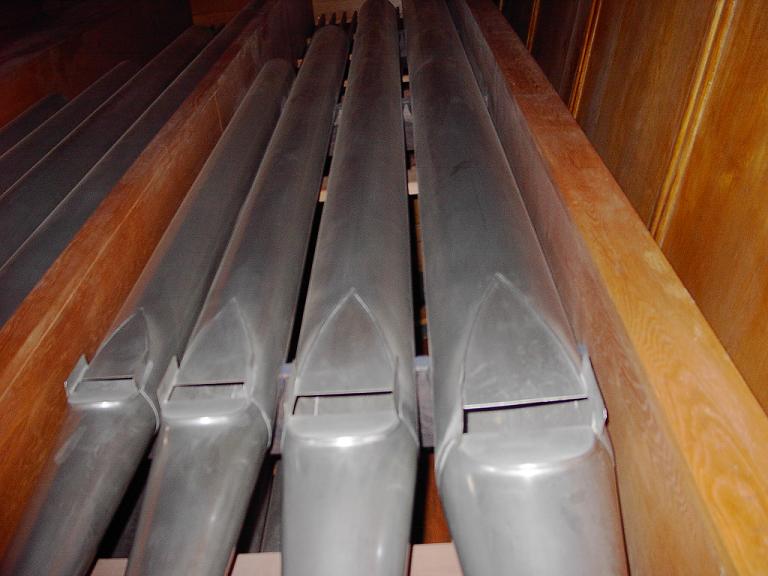
2.6 The attack transient: speech and chiff
Before the locked steady state exists, the pipe must start. In the first
milliseconds after the pallet opens, wind rushes into the foot, the jet forms and
is often flung well outside the mouth before the acoustic field has built up, and
there is as yet no strong resonator oscillation to entrain it. During this window
the jet behaves more like a free edge tone, whose frequency (∝ U_j/h) is
generally not the pipe’s eventual pitch and is often higher. As the resonator’s
standing wave builds from noise and from the edge-tone drive, the feedback loop
captures the jet and pulls it down onto the resonator mode. The audible result of
this hand-off is the attack transient — the chiff or speech — a brief,
noisy, often higher-pitched spit at note onset that resolves into the steady tone
(Fletcher & Rossing, ch. 17; Pykett; Fraunhofer / Angster et al., “Properties of
the sound of flue organ pipes”).
The transient is not instantaneous. Establishing steady lock-in commonly takes on the order of tens of acoustic cycles — roughly 20–50 periods (est., varying with pipe, pressure, and voicing) — during which pitch and spectrum evolve toward their final values (Pykett notes “fifty cycles or more” for some pipes). The transient is musically important: it is much of what distinguishes a “prompt,” “slow,” “chiffy,” or “smooth” pipe, and it is a strong perceptual cue for pipe identity. The voicer manages it deliberately — nicking (small serrations on the languid edge) breaks up the initiating jet turbulence to soften and steady the attack; ears and a beard/roller at the mouth stabilise the transverse field to promote prompt, repeatable speech (the mechanisms of these adjustments are Vol 6). The physics to carry forward is that the attack is the edge-tone-to- resonator transition, and its character is governed by how quickly and cleanly the resonator captures the jet.
2.7 Regimes: underblowing, speech, and overblowing
Because the operating point is set by the jet transit phase ωτ ≈ ωh/(0.4–0.5·U_j)
against the resonator’s modes, sweeping wind pressure (hence U_j) walks the pipe
through distinct regimes (Fletcher & Rossing, ch. 17; Cremer & Ising; Pykett):
- Underblowing (too little pressure). With
U_jtoo low, the jet transit time is long, the phase overshoots the useful window for the fundamental, and the jet wave is weak and slow to amplify. The loop gain at the fundamental cannot be sustained; the pipe is breathy, unstable, slow to speak, or silent. A pipe that “won’t speak” on low wind is underblown. - Correct speech (normal regime). In the design range of
U_jthe transit phase sits in the working window at the resonator’s fundamental, loop gain exceeds unity, and the pipe locks promptly onto its intended pitch with the intended harmonic development. The whole craft of voicing is keeping a rank in this regime, evenly, note to note (Vol 6). - Overblowing (too much pressure). As
U_jrises, the transit phase for the fundamental eventually falls below the working window while the phase for the second mode enters it. The jet then satisfies the loop condition at a higher resonator mode and the pipe jumps up — typically to the octave in an open pipe (second mode = 2f₁), or to the twelfth in a stopped pipe whose next mode is 3f₁ (Vol 3). This is the same stage-jumping the free edge tone shows, now organised by the resonator. Overblowing is a fault in normal ranks but is used deliberately in harmonic flutes, which are built at double length and intentionally overblown to sound their second mode with a bright, stable tone.
The existence of these regimes is why wind pressure, flue geometry, and cut-up must be mutually matched: they jointly place the transit phase, and a pipe voiced for one pressure will mis-speak or overblow at another.
2.8 Summary
A flue pipe converts steady wind into a pitched tone through a jet-drive feedback
oscillation. Wind pressure sets the jet velocity (U_j ≈ C_d√(2p/ρ), ~7–33 m/s
in practice). The thin jet crossing the mouth is hydrodynamically unstable; on
its own it makes a stage-locked edge tone (St = fh/U_j). Coupled to a
resonator, the jet instead locks to a resonator natural frequency, because
the acoustic velocity at the mouth is a stronger, coherent disturbance and
because the jet’s finite transit time (τ ≈ h/(0.4–0.5·U_j)) satisfies the loop
phase condition (roughly π/2–3π/2) at the resonator’s pitch. The jet supplies the
energy; the resonator sets the pitch. Harmonics come from the nonlinear,
clipped jet–lip interaction and are then selected by the resonator. The attack
transient (chiff/speech) is the ~20–50-cycle hand-off from free edge tone to
locked resonance. Sweeping pressure moves the pipe through underblowing → clean
speech → overblowing to a higher mode. The resonator physics (which modes
exist) is Vol 3; the voicing adjustments that set cut-up, nicking, ears, and
pressure to place all of the above are Vol 6.
Sources
- Fletcher, N. H. & Rossing, T. D., The Physics of Musical Instruments, 2nd
ed. (Springer) — ch. 8 (self-sustained oscillators), ch. 16 (air-jet & edge-tone
generation, Strouhal scaling, stages), ch. 17 (flue-pipe jet drive, jet-wave
convection speed
~0.4–0.5·U_j, phase condition, harmonic generation, attack). - N. H. Fletcher, “Sound production by organ flue pipes,” and related air-jet excitation papers, Journal of the Acoustical Society of America — jet-drive feedback model, phase/lock-in, nonlinear harmonic generation.
- Verge, Fabre, Hirschberg et al., jet-oscillation and jet-wave amplification
studies, JASA 103 (1998), “Jet-wave amplification in organ pipes” — measured
jet velocities 7–33 m/s, Re 1000–5000, exponential wave growth
exp(μx). - Cremer, L. & Ising, E.; Coltman, J. W. — foundational jet-drive and phase-condition analyses for flue/flute-type oscillators.
- Brown, G. B.; Curle, N., Proc. Roy. Soc. A 216 (1953), “The mechanics
of edge-tones” — edge-tone stages and the
f ∝ U_j/hscaling. - Colin Pykett — pykett.org.uk, “The physics of voicing organ flue pipes” and “How the flue pipe speaks” — laminar jet sheet, cut-up vs harmonic content, nonlinear pulse formation, attack transient (“fifty cycles or more”), nicking/ ears in speech. Rigorous, freely readable corroboration.
- Angster, Rucz & Miklós / Fraunhofer, “Properties of the sound of flue organ pipes” (Springer, 2017) — steady spectrum vs attack transient assigned to the acoustic resonator, the jet as hydrodynamic oscillator, and the wall as a mechanical resonator; primacy of the edge tone in the attack.
- Audsley, G. A., The Art of Organ Building (1905) — flue, languid, lip, and mouth terminology (builder’s treatise; cross-referenced for anatomy in Vol 1).
Cross-references: pipe anatomy and the two families — Vol 1; standing waves, open vs stopped resonators, end correction, and which harmonics each supports — Vol 3; pipe scaling and how diameter sets timbre — Vol 4; the voicer’s adjustments (cut-up, nicking, ears, languid position, wind pressure) that place the drive physics of this volume — Vol 6.
Comments (0)