How Organ Pipes Make Sound · Volume 6
Vol 06 — Voicing: Shaping the Tone
A pipe that is geometrically correct is not yet a musical pipe. Cut a resonator to the right length (Vol 3), give it the right diameter for its family (Vol 4), and put wind under it, and it will make a sound — but that sound may be breathy, slow, uneven against its neighbours, harsh in the attack, or simply the wrong colour for the stop it belongs to. Voicing is the craft of adjusting the mouth and the wind so that a pipe speaks promptly, holds its intended pitch, carries the tone the stop is named for, and matches the pipes on either side of it. It is where the deterministic physics of the preceding volumes meets a hand-work tradition that predates the physics by centuries.
This volume owns those adjustments. Vol 2 established the drive: the jet issues
from the flue, crosses the mouth over the cut-up height h, and locks to the
resonator through a feedback loop whose phase depends on the jet transit time
τ ≈ h/(0.4–0.5·U_j), with jet velocity U_j ≈ C_d√(2p/ρ) set by wind pressure
p. Everything a voicer does is a way of placing that loop — moving the
operating point into clean speech and holding it there, then shaping the
nonlinear jet–lip interaction that generates the harmonics. The established
acoustics is cited; the voicer’s rules of thumb, which are empirical and often
shop-specific, are marked as craft and flagged (est.) where a number is not
from a measured source.
6.1 The voicing variables at the mouth
Almost every voicing act happens in a region a few millimetres tall at the mouth of the pipe. The variables are few, but they interact strongly, and part of the skill is knowing which one to move when a pipe misbehaves. The diagram below collects them; the sections after it take each in turn.
6.2 Cut-up: the master tone control
The cut-up — the mouth height h from the flue exit to the upper lip — is
the single most powerful timbre control a voicer has, and it is the one that most
directly ties back to the drive physics of Vol 2. It is usually quoted as a
fraction of the mouth width: a common starting point for a diapason is a cut-up
of about one-quarter of the mouth width, strings run lower (nearer one-fifth or
less), and wide flutes run higher (one-third or more) (Audsley; craft ranges,
est.). In absolute terms a small treble pipe may have a cut-up of a millimetre or
two, a large bass pipe several centimetres.
The physics is the jet transit time. A taller cut-up lengthens the free jet, so
the disturbance takes longer to convect from flue to lip: τ ≈ h/u_w with
u_w ≈ 0.4–0.5·U_j (Vol 2; Fletcher & Rossing, The Physics of Musical
Instruments, 2nd ed., ch. 17). Two consequences follow.
First, spectral content. With a low cut-up the jet is thin and its throw across the lip clips sharply, injecting narrow, pulse-like flow into the mouth; a pulse train is harmonically rich, so a low cut-up gives a bright, keen, string-like tone with strong upper partials. Raising the cut-up broadens and rounds the flow pulses, thinning the upper harmonics toward a round, fluty, fundamental-dominated tone (Pykett, “The physics of voicing organ flue pipes”; Fletcher & Rossing, ch. 17). This is the voicer’s coarsest colour knob: to make a rank keener, cut it up less; to make it rounder, cut it up more.
Second, speech and stability. A low cut-up is harder to make speak cleanly. The short jet must satisfy the loop phase at the fundamental on a thin, easily disturbed sheet; too little cut-up and the pipe is slow, unstable, or overblows to the octave. A high cut-up speaks readily and resists overblowing, but past a point goes dull and loses its edge, and can become windy. Cut-up therefore also sets how loud a pipe can be driven before speech breaks down or it overblows: the taller the mouth, the more wind it will take without jumping to the next mode (organforum voicers’ consensus; consistent with the regime analysis of Vol 2).
Cut-up cannot be set in isolation, because it trades directly against wind pressure. The two together fix the transit phase; the map below shows the trade.
6.3 Flue, windway, and jet thickness
The flue (also windway) is the slot between the languid and the lower lip
through which the jet issues. Its width — typically a fraction of a
millimetre to about 2 mm (Vol 2) — sets the thickness of the jet sheet, and
its geometry, together with wind pressure, sets the jet velocity U_j. A wider
flue passes more air and makes a thicker, more powerful jet; a narrower flue
makes a thinner, faster-clipping jet that favours upper harmonics but passes less
power. Voicers open or close the flue to trim loudness and brightness together,
and to match a pipe’s air demand to what the chest can supply. Because
U_j ≈ C_d√(2p/ρ) depends on pressure through the square root, doubling the
pressure raises jet velocity only about 40 % — one reason pressure is a coarse
control and mouth geometry the fine one.
The windway also has a direction. The languid’s top bevel and the relative advance of the lower lip aim the sheet: pointed straight at the upper lip’s edge for a clean, prompt diapason; aimed slightly outward (the jet skimming the front of the lip) for a softer, breathier flute; aimed slightly inward for a keener, more aggressive string. This aim is set by the languid position and the lower-lip advance, discussed next. The John Smith Universal busker-organ dive gives a concrete amateur analogue: the windway there is set by a cereal-box card spacer clamped between languid and cap, a fixed-geometry substitute for the trade voicer’s adjustable flue; cross-reference that dive for the practical DIY construction rather than reproducing it here.
6.4 Languid position and lip alignment
The languid is the plate that closes the foot and forms the lower boundary of the flue. Its height and its fore-and-aft position relative to the upper lip decide where the jet is aimed and how the transit distance relates to the cut-up. Raising the languid narrows the flue and can raise the jet’s line of attack; advancing it (moving it toward the mouth opening) shortens the effective jet path and shifts the sheet outward. Trade voicing distinguishes flue voicing — the languid roughly flush and the jet aimed near the lip edge, giving prompt, harmonically full principal tone — from languid voicing techniques where the languid is deliberately set high or low to bias the jet.
The lower lip (the front edge just below the flue) and the upper lip (labium) must be aligned so the jet crosses the mouth and meets the labium at the intended offset. If the lower lip is advanced ahead of the upper lip the jet is thrown outward (a retarded or breathy voicing); if the upper lip overhangs, the jet is caught more sharply (a keener, promptER voicing). This offset, set in tenths of a millimetre, is one of the finest adjustments in voicing and is what an experienced voicer trims last when chasing even speech across a rank. The established physics is simply that these moves reposition the jet relative to the lip and change the phase and the clipping asymmetry of the jet–lip interaction (Vol 2; Steenbrugge & De Baets, “Aerodynamics of flue organ pipe voicing”); the exact settings are craft.
6.5 Nicking: steadying the jet and taming the chiff
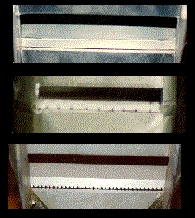
Nicking is a set of small notches filed across the edge of the languid (and sometimes the lower lip), perpendicular to the flue. Instead of leaving the jet to issue as a single unbroken sheet, the nicks break it into a row of small streams that shed fine turbulence at the flue exit. The effect is to damp the attack transient and suppress random mode-switching: the pipe speaks with less of the initial edge-tone spit (the chiff), fewer spurious higher-mode transients, and less mouth wind-noise (Pykett; Wikipedia, “Flue pipe”; Chalmers, “Undoing nicking in old flue organ pipes”).
Physically, the chiff is the ~20–50-cycle hand-off from free edge tone to locked resonance developed in Vol 2. Heavy nicking pre-seeds the jet with fine-scale turbulence, which spoils the coherent edge tone so the resonator captures the jet with little audible transient — a smooth, seamless onset. Light or no nicking leaves a crisp, articulate chiff that many builders now prize as an expressive, “speaking” quality. Nicking is therefore a deliberate stylistic choice as much as a corrective one: nineteenth- and early-twentieth-century romantic voicing nicked heavily for a seamless legato ensemble; the twentieth-century Organ Reform movement swung back to little or no nicking for articulate, transparent speech. The trade-off is real — heavy nicking that removes the chiff also slightly slows and blurs the onset, so the choice couples attack character to ensemble style.
6.6 Ears, beards, and rollers
Ears are vertical flaps soldered or fixed to the two short sides of the mouth, projecting forward past the labium. They contain the transverse acoustic field at the mouth, stabilising speech — especially in the bass and on higher wind, where the jet is long and easily disturbed by neighbouring pipes or room air currents — and they lower the pitch slightly by adding an end-correction mass at the mouth, so a pipe fitted with ears is a touch flatter and often mildly richer in fundamental (Sakamoto, Yoshikawa & Angster, “Acoustical investigations on the ears of flue organ pipes”; organ-builder consensus). The pitch shift is small but real and must be accounted for in tuning (Vol 7).
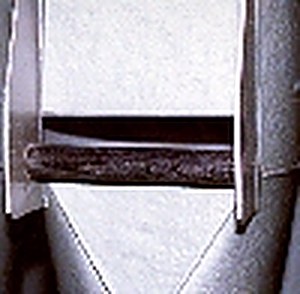
For string pipes, whose narrow scale and low cut-up make prompt fundamental speech difficult (the pipe would rather overblow to the octave), voicers add a beard or harmonic bridge / roller between the ears: a horizontal bar, often a wooden dowel or a metal roller, set across the mouth a short distance in front of the flue. The bar perturbs the jet’s aerodynamic field so that the fundamental establishes itself before the octave can take over, letting a keen string speak its fundamental promptly without overblowing (Audsley; PJM Organs, “Strings”; organstops.org). It is the classic fix for the hardest-speaking pipes in the organ, and it is the reason a Gamba or Salicional can hold a thin, harmonically rich tone (Vol 4 scaling) that would otherwise be unstable. In the John Smith Universal DIY organ, the same principle appears as simple ears fitted to the bass pipes to steady their speech; cross-reference that build for the amateur execution.
6.7 The voicing variables at a glance
Table 1 — The voicing variables at a glance
| Variable | What the voicer changes | Effect on tone / speech / loudness |
|---|---|---|
Cut-up h (mouth height) | Raise the upper lip (taller) or keep it low | Low → bright, keen, stringy, strong upper partials, but harder to speak and overblows sooner. High → round, fluty, fundamental-heavy, speaks easily, resists overblowing but can go dull. Master tone control; sets max drivable loudness before break-up. |
| Flue / windway width | Open or close the slot between languid and lower lip | Wider → thicker jet, more air, louder and fuller but heavier on the chest. Narrower → thinner, faster-clipping jet, keener but quieter. Trims brightness and loudness together. |
Wind pressure p | Set at the chest/regulator (a rank-wide choice) | Raises U_j ≈ √p: louder and brighter, but past the design point overblows to octave (open) or twelfth (stopped). Coarse control; must be matched to cut-up. |
| Languid position / height | Raise, lower, advance or retract the languid | Aims the jet at the lip and sets the effective jet path; biases toward prompt principal, breathy flute, or keen string. Fine speech control. |
| Lower/upper lip offset | Advance lower lip or overhang upper lip (tenths of a mm) | Sets whether the jet is thrown out (breathy, retarded) or caught sharply (keen, prompt); the finest even-speech adjustment. |
| Nicking | File notches across the languid edge | More/heavier nicks → softer, seamless attack, less chiff, no random mode-switching, but slightly slower onset. Little/no nicking → crisp, articulate chiff. Stylistic and corrective. |
| Ears | Fix side flaps at the mouth | Stabilise speech (esp. bass/high wind); lower pitch slightly; can enrich fundamental. |
| Beard / harmonic bridge / roller | Add a bar or roller across the mouth of a narrow-scale pipe | Lets keen strings speak the fundamental promptly without overblowing to the octave. |
6.8 Regulation: making a rank into an instrument
Voicing a single pipe well is only half the task. A rank — one pipe per note across the compass, often 61 pipes for a manual stop — must be regulated so that every note is even in loudness, matched in speech (all prompt, none chiffy against the rest), and consistent in tone colour from bass to treble. Regulation is the systematic side of voicing: the voicer plays up and down the rank, listens for the note that jumps out or lags, and trims its flue, cut-up, languid, or foot-hole to bring it into line with its neighbours (Audsley; tonal- finishing practice, GSTOS).
Two adjustments are specific to regulation. The foot-hole (the hole in the toe through which wind enters the foot) is opened or closed to meter the wind to each pipe, setting loudness without disturbing the carefully voiced mouth: coning the toe smaller quiets a pipe, opening it lets it speak fuller. And the cut-up is trimmed pipe-by-pipe against the scaling progression (Vol 4): because Töpfer’s Normalmensur halves the diameter every ~16–17 semitones rather than every octave, the mouth proportions and hence the cut-up fraction must be progressively adjusted up the rank to keep timbre even — the physics of scaling and the craft of regulation are two views of the same requirement. A final tonal finishing pass is done with the rank installed in the actual room, on the actual wind, because room acoustics and chest behaviour shift the target (GSTOS, “Tonal Finishing”).
The interaction with the resonator family (Vol 3) shows up here too. A stopped rank (Gedackt, Bourdon) radiates only odd harmonics and is quieter, so it is generally voiced with a higher relative cut-up for its round, hollow tone and needs less wind; an open rank of the same pitch is louder and carries the full harmonic series, so its cut-up and flue are set for the brighter principal or flute colour intended. The voicer chooses cut-up, flue and nicking knowing which harmonics the resonator will even permit.
6.9 Wind pressure as a rank-wide lever
Wind pressure is not usually a per-pipe control — it is set once for a whole rank or division at the regulator — but it is a voicing decision, because it trades against cut-up across the entire rank. Raising the pressure makes the rank louder and brighter and lets narrow-scale strings speak more assertively, but it demands proportionally higher cut-ups everywhere to stay in the clean-speech band of the chart above, and it raises the wind-noise floor at every mouth. Lower pressure gives a gentler, more intimate voice that speaks on modest cut-ups but cannot be pushed for power. House and chamber organs therefore commonly run ~2–4 in H₂O (0.5–1.0 kPa), larger instruments ~3–6 in H₂O, and the John Smith busker organ referenced throughout this series runs ~5 in H₂O (127 mm ≈ 1.24 kPa) (Vol 2; source anchors). Choosing the pressure is choosing the whole family of cut-ups the rank will need — which is why pressure and voicing are decided together, not one after the other.
6.10 Reed regulation, in brief
Reed pipes (Vol 5) are voiced and regulated too, but the controls are different because there is no jet and no mouth. The colour and evenness of a reed rank are set chiefly by curving the tongue — the voicer burnishes a precise curvature into the brass tongue so it closes against the shallot progressively rather than slapping flat, which controls loudness, promptness, and the harmonic development of the tone — and by the tuning wire, which sets the sounding length of tongue and hence pitch, and by matching the resonator length to reinforce the reed. Regulating a reed rank means evening tongue curvature and wire position note to note so the stop speaks uniformly. The mechanics of the tongue, shallot, boot and resonator are Vol 5; the pitch side of tuning the wire, and how reeds drift against flues with temperature, are Vol 7. The point for this volume is only that “voicing” spans both families, with the flue voicer’s cut-up-and-mouth toolkit and the reed voicer’s tongue-and-wire toolkit as parallel crafts over the same resonator physics.
6.11 Summary
Voicing places and shapes the jet-drive oscillation of Vol 2 by hand. The
cut-up is the master control: a low mouth gives a thin, sharply clipping jet
and a bright, stringy, harmonic-rich tone that is hard to speak and overblows
early, while a high mouth gives rounded flow pulses and a fluty, fundamental-heavy
tone that speaks easily — because cut-up sets the jet transit time
τ ≈ h/(0.4–0.5·U_j) against the resonator. Wind pressure sets jet velocity
(U_j ∝ √p) and trades directly against cut-up; the two must be matched to keep
every pipe in the clean-speech band between underblowing and overblowing. The
flue/windway sets jet thickness and power; the languid position and
lip offset aim the jet and are the fine speech controls; nicking seeds
turbulence to damp the chiff and prevent mode-switching (a stylistic as well as a
corrective choice); ears stabilise speech and lower pitch slightly; and a
beard or harmonic bridge lets narrow-scale strings speak their fundamental.
Regulation evens loudness (via foot-holes), speech, and colour across a whole
rank, working with the scaling progression of Vol 4 and the resonator family of
Vol 3, and finishing in the room. Reed ranks are voiced by tongue curvature
and tuning wire instead (Vol 5, Vol 7). The John Smith Universal busker organ is
the concrete DIY analogue throughout — sliding cover for cut-up, cereal-box
windway spacer, bass ears — and is cross-referenced rather than reproduced.
Sources
- Colin Pykett — pykett.org.uk, “The physics of voicing organ flue pipes” — cut-up vs harmonic content, nonlinear pulse formation, nicking and the attack transient, ears and speech; rigorous, freely readable.
- Fletcher, N. H. & Rossing, T. D., The Physics of Musical Instruments, 2nd
ed. (Springer), ch. 16–17 — jet-drive feedback, jet transit/convection speed
~0.4–0.5·U_j, cut-up and harmonic generation, overblowing regimes. - Audsley, G. A., The Art of Organ Building (1905) — voicing, regulation, cut-up proportions, ears, beards/harmonic bridges, the practical craft.
- Sakamoto, Yoshikawa & Angster, “Acoustical investigations on the ears of flue organ pipes” — measured effect of ears on speech and pitch.
- Steenbrugge, D. & De Baets, P., “Aerodynamics of flue organ pipe voicing” — languid/lip geometry and the jet.
- Chalmers University, “Undoing nicking in old flue organ pipes” — nicking’s effect on speech and its reversal; Organ Reform context.
- PJM Organs / organstops.org / Garden State Theatre Organ Society — string voicing, beards/rollers, tonal finishing and regulation in practice.
Cross-references: the jet-drive oscillator, edge tone, transit time and attack transient this volume adjusts — Vol 2; open vs stopped resonators and which harmonics each permits — Vol 3; scaling / Normalmensur and how cut-up must track the diameter progression — Vol 4; reed tongue, shallot, boot and resonator that reed regulation works on — Vol 5; pitch, the ear/wire pitch shifts and temperature drift — Vol 7. The John Smith Universal busker-organ dive is the concrete DIY voicing example (sliding cover, cereal-box windway, bass ears).
Comments (0)