How Organ Pipes Make Sound · Volume 5
Vol 05 — Reed Pipes: The Beating Tongue, the Shallot & the Resonator
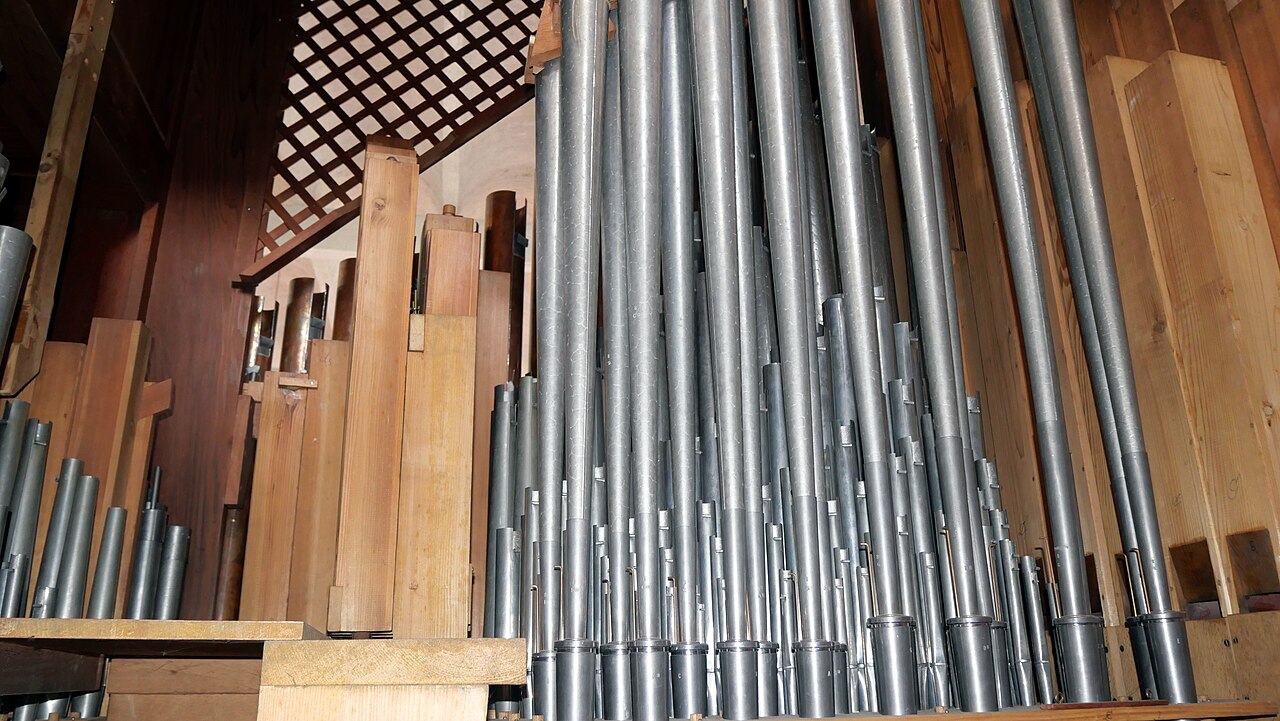
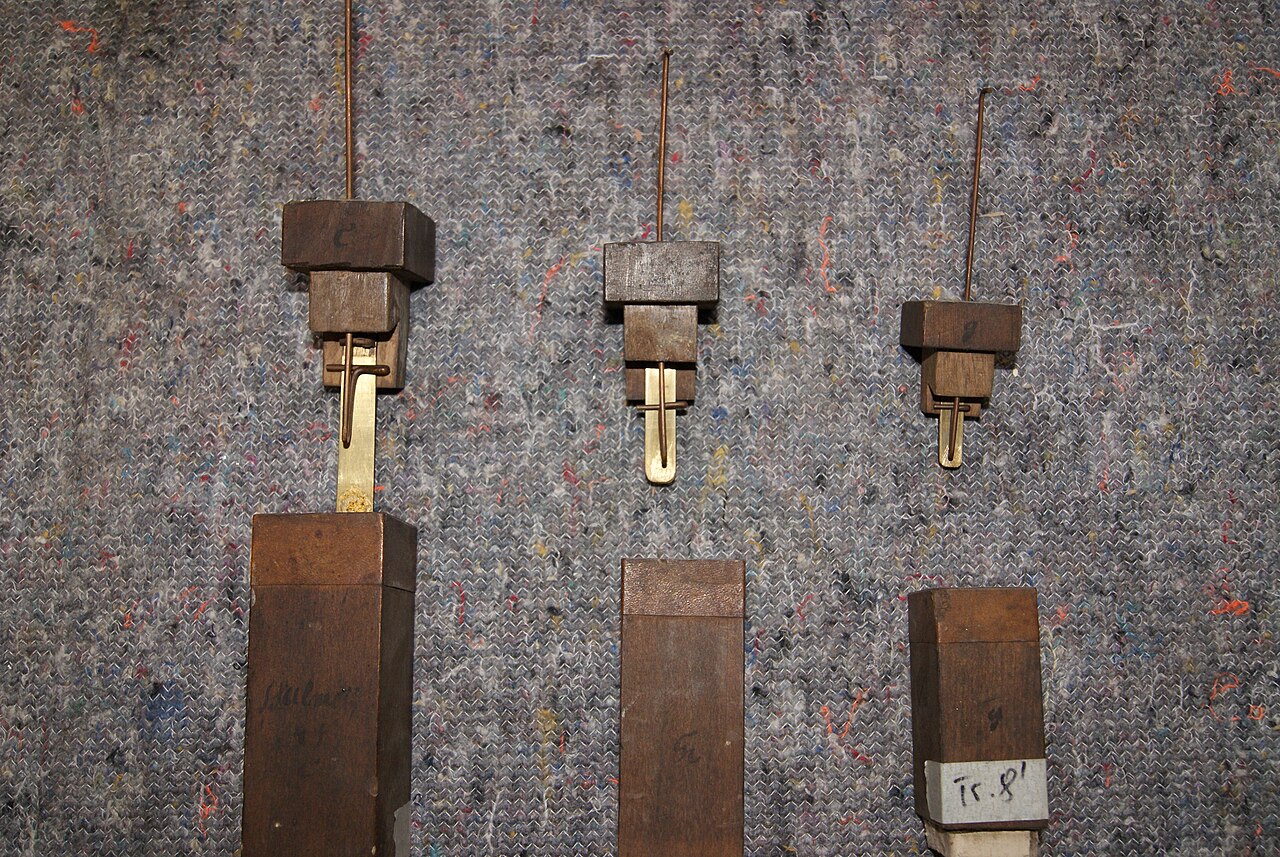
A reed (lingual) pipe makes its tone by a route entirely different from the flue pipe of Vol 2. Where the flue pipe throws an unstable sheet of air across a mouth and lets an aerodynamic instability — the edge tone — do the oscillating, the reed pipe hangs a strip of springy brass over a slotted tube inside a wind-tight chamber and lets a mechanical vibrator chop the airflow. The brass strip is the tongue; the slotted tube is the shallot; the chamber is the boot; and above them all rises the resonator that colours and radiates the sound. The tongue is, in the most useful one-sentence description, a pressure-controlled valve — a self-oscillating flow interrupter that converts a steady head of wind into a train of air puffs at its own beating frequency (Fletcher & Rossing, The Physics of Musical Instruments, 2nd ed., Part V; Organ Historical Society, Reed Pipe Construction).
That mechanical-oscillator character is what makes reed pipes behave so differently from flues. In a flue pipe the resonator sets the pitch and the jet obediently locks to it (Vol 2, Vol 3). In a reed pipe the tongue sets the pitch, primarily through the length of brass left free to vibrate, and the resonator is tuned to reinforce that pitch rather than to dictate it (Plitnik, G. R., Vibration characteristics of pipe organ reed tongues and the effect of the shallot, resonator, and reed curvature, JASA 107(6):3460, 2000). This one inversion — exciter-dominant instead of resonator-dominant — cascades into every practical difference between the families: how they are tuned, why reeds drift out of tune with temperature by a different mechanism than flues, and why a rank of chorus reeds needs far more frequent attention than a rank of Principals (tuning drift is developed in Vol 7).
5.1 The valve cycle: how a tongue chops the wind
Trace one cycle. Wind at the organ’s chest pressure — a few inches of water column, typically 2–6 in H₂O for chamber and house organs, about 5 in H₂O ≈ 127 mm ≈ 1.24 kPa for the John Smith busker organ used as this program’s worked example — enters the boot through its toe and fills the enclosed foot-chamber. The tongue is a curved brass strip clamped rigidly at its upper end against the block, its lower end free and resting over the lengthwise opening in the shallot. Because the tongue is curved away from the shallot face near its free tip, there is a gap through which wind escapes into the shallot bore and up into the resonator.
- Open phase. Wind flows through the gap between tongue and shallot into the shallot bore. The moving air, by the Bernoulli effect, and the static pressure difference across the tongue both act to push the free end toward the shallot face.
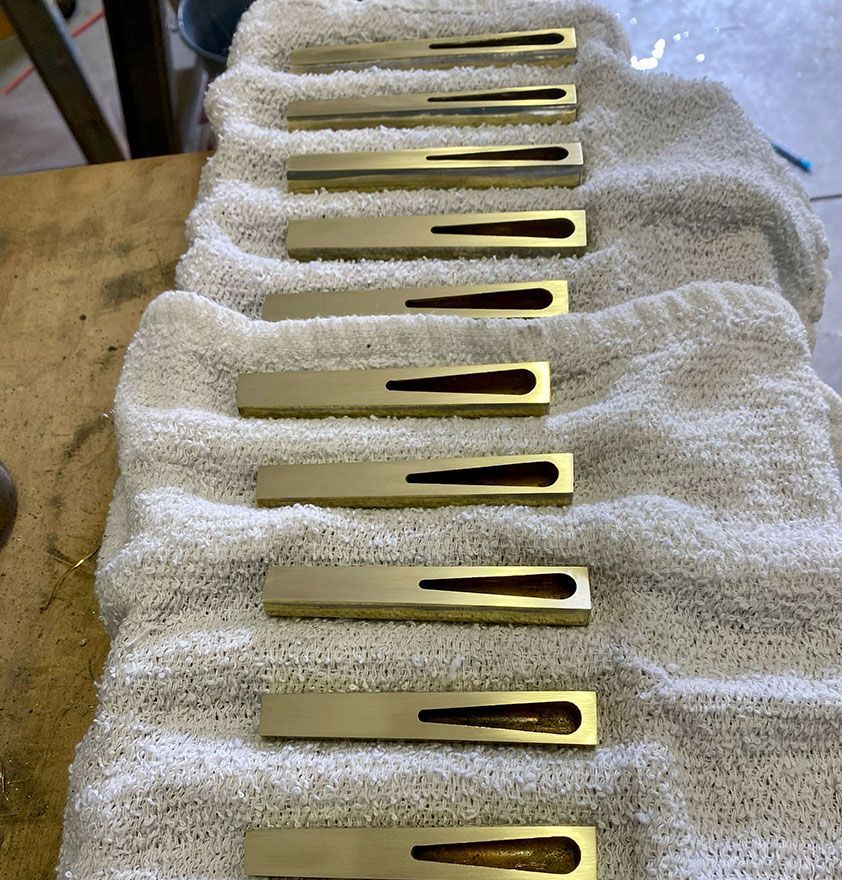
- Closing. The tongue accelerates onto the bevelled facing of the shallot, progressively narrowing the gap and throttling the flow. In a striking (beating) reed — the organ norm — the tongue is slightly wider than the shallot opening, so it seats against the flat facing and very nearly seals it.
- Closed / flow interrupted. With the gap shut, the through-flow collapses. The pressure that was holding the tongue down disappears, and the tongue’s own elastic restoring force dominates.
- Reopening. The spring of the brass drives the tongue back off the facing; it overshoots outward, the gap reopens, wind rushes through again, and the cycle repeats.
The result at the shallot mouth is not a smooth flow but a periodic series of puffs at the tongue’s beating frequency. That chopped flow is acoustically rich — a buzzing, harmonically dense excitation, but by itself rasping and only weakly pitched, exactly like a trumpeter’s lips buzzed without the instrument, or a clarinet reed sounded on the mouthpiece alone (Fletcher & Rossing, Part V). The musical tone appears only once the resonator above is allowed to filter and reinforce it.
Because the airflow is what closes the tongue — higher pressure tends to push the tongue shut — the organ reed belongs to the class of inward-striking (blown-closed) reed generators in Fletcher & Rossing’s taxonomy, the same class as the clarinet’s cane reed. This is the opposite of the brass player’s lips, which are outward-striking (blown-open) and behave differently near resonance. The distinction matters for the pitch physics below: an inward-striking reed sounds at a frequency at or a little below the tongue’s own mechanical resonance, and the resonator, when present, pulls that frequency around (Fletcher & Rossing, §13 on reed generators).
5.2 Where the pitch comes from: the tuning wire and the vibrating length
The frequency of a clamped-free vibrating bar (which is what the tongue approximates) scales as
f ∝ (t / L²) · √(E/ρ),
where t is the tongue thickness, L its free vibrating length, E the Young’s
modulus of brass and ρ its density. The controlling variable in service is L.
Pressing a stiff tuning wire (the Stimmkrücke, also called the tuning spring)
down against the tongue shortens the length of brass that is free to vibrate;
because f goes as 1/L², shortening the vibrating length raises the pitch,
and drawing the wire up lengthens the tongue and lowers it (Organ Historical
Society; Fletcher & Rossing). A tuner taps the wire down a hair with a tuning
knife to sharpen a reed, up to flatten it — a mechanical adjustment with no direct
equivalent in the flue rank, where one instead moves a stopper, a slide, or trims
the pipe (Vol 7).
This is the load-bearing distinction of the whole volume: in a reed pipe the tongue is the primary pitch reference, not the resonator. The tongue will beat and sound a definite pitch — set by its length, thickness, curvature, and the wind pressure — even if the resonator above it is the wrong length or removed entirely (Plitnik measured exactly this: with no resonator the reed frequency is a smooth, continuous function of vibrating length). The resonator’s job is to be tuned so that one of its air-column resonances lands on the reed’s pitch (or a chosen partial of it) and reinforces it.
5.2.1 The reed–resonator interaction is not gentle
Although the tongue leads, the coupling between tongue and resonator is strong and distinctly nonlinear. The definitive measurement is that as the resonator is brought into tune, the sounding frequency does not vary smoothly — it jumps. As the reed’s vibrating length is changed, its frequency climbs steadily until it approaches a resonance of the air column, then snaps abruptly from just below to just above that resonance, skipping the frequencies right at resonance (Plitnik, JASA 107(6):3460, 2000). Around each such crossing the resonator either pulls the tongue slightly flat or slightly sharp and stabilises it there. The practical consequence is that a reed sounds cleanest and steadiest, and speaks most promptly, when the resonator is tuned so its resonance sits close to but not exactly on the reed’s frequency — which is why reed voicing is a two-handed craft: set the tongue with the wire, then trim or adjust the resonator to sit it in the sweet spot.
A further subtlety the same work quantified: the shallot itself is a tone control, not mere plumbing. Plitnik measured that the style of shallot — the shape of its opening and how far its interior is filled or tapered — shifts both the reed’s frequency and, more strongly, its spectrum: progressively filling the shallot interior lowers the sounding frequency, while different facings redistribute the upper harmonics that give a chorus reed its bright, brassy “formant” (Plitnik, JASA 107(6):3460, 2000). The shape and depth of the shallot opening are therefore genuine voicing variables, not mere plumbing.
5.3 The resonator: length and form make the voice
If the tongue sets pitch, the resonator sets timbre and radiated power. Two independent choices define a reed stop’s character: the resonator’s effective length relative to the reed pitch, and its cross-sectional form (conical, cylindrical, flaring, capped).
- Full-length resonators are tuned so their fundamental air-column resonance matches the reed’s fundamental. They reinforce the fundamental and lower harmonics strongly, giving a broad, powerful, “complete” tone. An 8′ Trumpet has resonators roughly the length of an 8′ open flue pipe — about 8 ft (≈2.4 m) for the lowest C — of inverted-conical (widening) form.
- Fractional-length resonators are deliberately made a half, a third, or some small fraction of full length. They cannot reinforce the reed’s fundamental; instead they reinforce an upper partial, thinning and brightening the tone into something nasal or buzzy. Carried to the extreme — a resonator only a few centimetres long, or a mere cap — the result is the snarling Regal.
- Conical vs cylindrical form changes which partials the column favours, much as it does for woodwind bores: a full cone supports a near-complete harmonic series (Trumpet, Oboe are conical/flaring), while a cylinder stopped-pipe-like favours odd harmonics and gives the hollow, “woody” Clarinet voice (compare the open/stopped harmonic-content physics of Vol 3).
5.3.1 Reed-pipe families by resonator
Table 1 — Reed-pipe families by resonator
| Stop (typical) | Resonator form & length | Reed type | Timbre |
|---|---|---|---|
| Trumpet / Tromba | Full-length inverted cone (widening); ~8′ at 8′ pitch | Striking | Broad, bright, powerful; strong fundamental + rich harmonics — the chorus reed |
| Oboe / Hautbois | Near-full conical, often with a small bell or pavillon | Striking | Reedy, keen, “orchestral”; slightly thinner than Trumpet |
| Clarinet / Cromorne | Cylindrical, roughly half length (stopped-like) | Striking | Hollow, woody, odd-harmonic-weighted; imitative clarinet colour |
| Vox Humana | Short, small-scaled, capped or partly stopped (often < 1/4 length) | Striking | Thin, nasal, “vocal”; deliberately imperfect, used with tremulant |
| Regal | Very short — a few cm, or just a cap/tube fraction | Striking | Snarling, buzzy, harmonically raw; the reed’s naked voice barely filtered |
| Harmonium / free-reed rank | Often none, or a very short cavity | Free | Smooth, sustained, accordion-like; pitch set by the tongue alone |
The pattern is consistent: the shorter and less complete the resonator, the more of the tongue’s raw buzz survives into the radiated tone, and the more the pitch rests entirely on the tongue. A Trumpet’s full resonator disciplines the buzz into a singing brass tone; a Regal barely disciplines it at all (Audsley, The Art of Organ Building, 1905; Organ Historical Society).
5.4 Striking (beating) reeds vs free reeds
Every organ reed is one of two kinds, distinguished by whether the tongue strikes the shallot or passes through it.
- Striking (beating) reed — the organ standard. The tongue is slightly wider than the shallot opening, so on each cycle it comes down onto the flat facing and seals (or nearly seals) it, then springs back. The flow is interrupted hard, once per cycle, producing a sharp, harmonically rich puff train. Because the tongue slaps a fixed stop, its motion is strongly nonlinear and the tone is bright. All the classic organ reeds above — Trumpet, Oboe, Clarinet, Vox Humana, Regal — are striking reeds.
- Free reed — the tongue is slightly narrower than the slot in its frame, so it swings through the opening rather than striking a face. The flow is modulated more gently and never fully slammed shut, giving a smoother, rounder, less harmonically raw tone. A free reed also vibrates essentially at its own natural frequency and needs no resonator to speak — which is exactly why the harmonium, reed organ, and accordion work with banks of bare free reeds and no pipes at all. Some regals historically used free reeds; most organ regals are striking (Fletcher & Rossing, Part V; Audsley).
The acoustical differences follow directly. The striking reed’s hard closure generates strong high harmonics and couples avidly to a resonator, so it is loud, bright, and resonator-shaped. The free reed’s gentler modulation is quieter and mellower, self-sufficient in pitch, and comparatively insensitive to what (if anything) sits above it. Free reeds are also easier to tune permanently — filing the tip raises pitch, filing near the clamped root lowers it — and are markedly more stable with temperature than striking reeds in resonated pipes, one reason harmoniums hold their tuning far longer than a chorus of chamber-organ Trumpets (Vol 7).
5.5 Why reeds drift out of tune differently from flues
Flue and reed pipes both go sharp when a room warms, but by different physics, and the two do not move together — which is why an organ that has cooled overnight sounds most obviously “out” between its reeds and its flues (Vol 7 treats the tuning workflow; the mechanism is stated here).
- Flue pipes are pitched by their air column,
f ≈ c/2L(open) orc/4L(stopped). The pipe lengthLis nearly fixed; the speed of soundcrises about 0.6 m/s per °C (fromc ≈ 331·√(1 + T/273.15)m/s), so flue pitch rises with temperature in near-lockstep across the whole flue chorus — by roughly +3 cents per °C (est., fromΔf/f ≈ ½·ΔT/(273+T)). Because every flue pipe shares this one mechanism, the flues stay in tune with each other even as the whole chorus drifts. - Reed pipes are pitched mainly by the brass tongue, whose frequency
depends on the metal’s stiffness
Eand dimensions, not on the speed of sound. A warming tongue changes pitch only slightly (brass stiffness and length change little over a room’s temperature swing), so the reed’s own pitch barely moves — meanwhile the reed’s resonator (an air column, like a flue) does followcand drifts sharp. The tongue and its resonator therefore pull apart: the resonator’s reinforcing resonance slides off the tongue’s slow-moving frequency, the reed–resonator coupling weakens, and the reed’s speech and tuning both degrade. The net effect is that reeds drift less and more erratically than flues and end up sounding flat relative to the sharpening flue chorus.
Because the two families track temperature by unrelated mechanisms, they must be
tuned at the temperature the instrument will be played at, and the reeds are
almost always touched up after the flues — often as the last act before a
performance, since a chorus of striking reeds will not hold its tuning against the
flues through a large temperature change (Pykett, pykett.org.uk, on reed vs flue
tuning stability; Fletcher & Rossing on the temperature dependence of c). This
is the acoustical root of the old tuner’s rule that “the reeds always need doing
last.”
5.6 Reed vs flue — the contrast, summarised
Table 2 — Reed vs flue — the contrast, summarised
| Property | Flue (labial) pipe — Vol 2 | Reed (lingual) pipe — this volume |
|---|---|---|
| Exciter | Air jet/sheet flip-flopping across the mouth (edge tone) | Brass tongue beating on a shallot (a flow-chopping valve) |
| Nature of exciter | Aerodynamic instability (no moving part) | Mechanical oscillator (moving brass tongue) |
| Sets the pitch | The resonator (air-column length): f≈c/2L or c/4L | The tongue (free vibrating length via the tuning wire); resonator tuned to match |
| Role of resonator | Defines pitch; jet locks to it | Reinforces & colours; pitch already set by the tongue |
| Coupling behaviour | Jet locks smoothly to the standing wave | Frequency jumps across each resonator resonance (nonlinear) |
| Tuning control | Move stopper/cap; trim or tuning-slide | Slide the tuning wire (down = sharper, up = flatter) |
| Key anatomy | Foot, languid, windway, lips, mouth, body | Boot, block, shallot, tongue, wedge, tuning wire, resonator |
| Temperature drift | Rises with c, ~+3 cents/°C (est.), whole chorus together | Tongue barely moves; resonator drifts — the two pull apart |
| Tuning stability | Good; drifts uniformly | Poorer; needs frequent touch-up, tuned last |
| Typical stops | Principal, Flute, Gedackt, Gamba, Bourdon | Trumpet, Oboe, Clarinet, Vox Humana, Regal |
5.7 What the reed pipe teaches
The reed pipe inverts the flue pipe’s division of labour. In the flue family the resonator is sovereign and the exciter serves it (Vol 2–Vol 4); in the reed family the tongue is sovereign and the resonator serves it — colouring, reinforcing, and radiating a pitch the tongue has already chosen. Everything practical follows from that inversion: the tuning wire rather than a stopper, the two-stage voicing of tongue-then-resonator, the family palette that runs from full-length Trumpet to capped Regal as the resonator is starved, the striking-vs-free split that separates organ reeds from the self-sufficient free reeds of the harmonium, and the awkward tuning behaviour that sends the tuner back to the reeds last of all. The next volume, Vol 6, turns from the physics of tone production to the physics of tone shaping — voicing and regulation — where the reed’s tongue curvature and shallot opening take their place beside the flue’s cut-up and nicking as the levers a voicer actually pulls.
Sources
- Fletcher, N. H. & Rossing, T. D., The Physics of Musical Instruments (2nd ed., Springer), Part V and §13 (reed generators) — striking vs free reeds, inward- vs outward-striking classification, the reed as a pressure-controlled valve, reed–resonator coupling, and the temperature dependence of the speed of sound.
- Plitnik, G. R., Vibration characteristics of pipe organ reed tongues and the effect of the shallot, resonator, and reed curvature (JASA 107(6):3460–3473, 2000) — reed frequency as a function of vibrating length, the abrupt frequency jump from below to above each resonator resonance once the resonator is added, and the effect of shallot style and reed curvature on frequency and spectrum.
- Colin Pykett — pykett.org.uk — reed vs flue tuning stability and why reeds are tuned last (corroborating).
- Audsley, G. A., The Art of Organ Building (1905) — reed-pipe construction (shallot, tongue, wedge, tuning wire, boot) and the resonator-form basis of the Trumpet/Oboe/Clarinet/Vox Humana/Regal families (builder’s-craft detail).
- Organ Historical Society, Reed Pipe Construction (organhistoricalsociety.org) — the parts of a reed pipe and the tuning-wire mechanism.
- Program cross-reference: the John Smith busker-organ build dive — the ~5 in H₂O ≈ 127 mm ≈ 1.24 kPa worked wind-pressure example; kept general here.
Cross-references: flue-pipe jet drive and speech in Vol 2; open vs stopped standing waves (odd-harmonic cylindrical resonators) in Vol 3; scaling in Vol 4; voicing and regulation in Vol 6; pitch, temperature drift, and the reeds-tuned-last workflow in Vol 7; materials and glossary in Vol 8.
Comments (0)