John Smith Universal Organ · Volume 1
John Smith "Universal" Organ — Vol 01: Overview & History
This volume defines what the John Smith “Universal” (20/26-note) crank organ is, who designed it and why, where it sits inside John Smith’s family of amateur-buildable plans, and how it belongs to the wider tradition of barrel, street, and busker organs. The end-to-end air path, the two note scales in detail, the wind system, the pipework, and the build sequence are developed in later volumes; see the cross-references inline. The full history of the mechanical organ as a genre is deferred to the Mechanical Organs program’s opening dive — this volume sketches only enough lineage to place the Universal.
Note: The subject of record for this deep dive is the John Smith “Universal” (20/26-note) organ — a hand-cranked, paper-roll, valved busker organ built from John Smith’s plans. It plays both the standard Raffin 20-note scale and the Alderman 26-note scale on a nominal 110 mm roll. Its valveless siblings — the Busker (Basic 20-Note) and the Senior 20 — are treated throughout as contrast, not as the subject. The theory of operation is developed in Vol 02; the two scales in Vol 03; the wind system in Vol 04.
1.1 What the John Smith Universal is
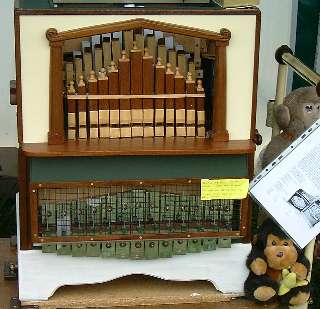
The John Smith Universal is a hand-cranked, pneumatic, paper-roll pipe organ small enough to carry — the modern descendant of the Victorian street busker’s “monkey organ.” Turning a single crank does three jobs at once: it pumps the feeder bellows that supply wind, it drives the paper roll past a tracker bar, and it therefore sets the tempo of the music. Where a perforation in the roll passes over a tracker-bar hole, air is admitted to a small pneumatic pouch; the pouch swells and lifts a valve; the valve uncovers a wooden flue pipe, and the pipe speaks. Release the perforation and the note stops. The roll is the program; the organ is a small, wind-driven, read-only player mechanism (Beckman, COAA #31; Senger, COAA #24).
Two words in that description carry the weight of this whole deep dive:
- Valved. The Universal is a valved organ. A tracker-bar hole does not feed a pipe directly; it feeds a pillow-pouch board, and the pouch operates a separate valve in a valve box over a pressurized chest. This pneumatic amplification is what lets one small crank drive dozens of pipes, several ranks, and a percussion voice without the cranking effort becoming unmanageable. Its simplest sibling, the Busker (Basic 20-Note), is valveless — the tracker bar and roll are the valves, the perforation admitting wind straight to the pipe (Senger, COAA #24). The valve action is treated in Vol 06 §6.3; the valved-vs-valveless trade is set out in Vol 02 §2.4.
- Universal. The organ is called “Universal” because it is deliberately built to read two different music scales from one tracker bar — the standard Raffin 20-note scale and the extended Alderman 26-note scale — so that a builder is not locked into one library of rolls (Beckman, COAA #31). This is the design’s headline feature and the reason it earns its name; it is unpacked in “What ‘Universal’ means” below and in full in Vol 03.
Defining traits, as built to the plan (Beckman, COAA #31; and see the model table below):
- Four melody ranks, selectable as four stops: a rank of open flutes, a rank of stopped (closed) flutes, a rank of open flutes one octave higher, and a front rank of stopped flutes tuned slightly sharp so it beats against another rank to produce a tremolo/celeste shimmer. The four stops are the subject of Vol 05 §5.4.
- Five bass pipes, mitred to fit under the skirt of the case, plus five bass “helpers” tuned an octave higher and mounted on top of the bellows to reinforce the bass without the bulk of full-length pipes (Beckman, COAA #31).
- An optional glockenspiel or xylophone in the base of the case — the percussion voice that, in Beckman’s words, “generates the most comments at rallies” (Beckman, COAA #31). Covered in Vol 05 §5.6.
- A three-feeder bellows wind supply driven by a three-lobed crankshaft (lobes 120° apart), feeding a sprung reservoir that regulates delivery pressure to roughly 5 in H₂O (127 mm H₂O, ≈ 1.24 kPa) — the same working pressure quoted for the Basic organ (Senger, COAA #24). The wind system is Vol 04.
- A nominal 110 mm paper roll on a friction/idler/take-up drive, with a disengage lever for rewind and loading (Beckman, COAA #31). The drivetrain and roll transport are Vol 07.
The whole instrument is meant to be built by an amateur, on a bench, from ordinary materials — which is the point of the next section.
1.2 John Smith and the “readily-available materials” philosophy
The design originates not with a manufacturer but with one retired engineer and one grandson’s request. In 1995, John Smith’s grandson Daniel asked him to make an organ; Smith settled on the small Victorian “busker” street organ as the right target, and worked out his own 20-pipe design driven by a punched paper roll, built “from bits and pieces” in his workshop but using techniques carried over from his experience with larger organs (johnsmithbusker.co.uk, History; Mel Wright). John Smith worked in Paignton, Devon, England (wife Julia), and after others saw the first instrument he built a second one, videoed the process, and released the video together with measured drawings and instructions — turning a one-off into a plan set anyone could follow (Senger, COAA #24; johnsmithbusker.co.uk).
That plan-set model is the whole reason the John Smith organs matter to a home builder. The stated design brief was a light, full-sounding organ that could be built from everyday materials without special woodworking or engineering skills — explicitly so that “not only woodworking hobbyists but others with little experience” could build one, a group Smith cheerfully described as including “housewives working on kitchen tables, people in retirement homes, and school projects” (johnsmithbusker.co.uk, History). The target budget was famously modest: on the order of £75 in materials (roughly $150 at the time), a figure Smith set as a design constraint, not an afterthought (Senger, COAA #25). Real builds run higher once a builder upgrades to nicer stock — Senger recorded spending about $439 on his Basic organ after choosing basswood, better leather, and Baltic birch ply over the cheapest options (Senger, COAA #25) — but the £75 figure fixes the philosophy: no castings, no machine shop, no unobtainable parts.
The clearest expression of that philosophy is Smith’s own substitution list, which reads like a scavenger hunt (Senger, COAA #25): bamboo skewers for stopper handles; adhesive weather-stripping for gaskets; a school ruler as the tracker-bar blank; a vacuum-cleaner drive belt as the idler tire; an English penny as a crankshaft-case bearing; a rainwater downspout or mailing tube as the take-up spool; a binder clip for the reservoir spring; coat-hanger wire for the lid’s paper tensioner; flexible electrical conduit as air hose; and blackout cloth to cover the bellows and reservoir. Only a handful of items are genuinely specialist — leather from an organ-leather supplier, and precision hole spacing in the tracker bar — and even those are sourced as ready-made parts. Smith also wrote and gave away a free “Guide to Improvements,” and continued publishing refinements over the years (Senger, COAA #24; Mel Wright).
Note: John Smith’s plans are still supplied, and ready-made parts — the tracker bar, crankshaft, turned wheels, leather, tubing, and springs — are available so a builder need not fabricate the few critical components. In the United States these were sold through Roll Cutter (rollcutter.com), John Smith’s US agent; in the UK direct from johnsmithbusker.co.uk (Senger, COAA #24). Suppliers are consolidated in Vol 11 §11.6.

1.3 The John Smith plan range
Smith did not design a single organ; he designed a graded family, each plan a rung up in capability and difficulty from the last. Understanding the range is the fastest way to understand what the Universal is for — it is the top of the paper-roll ladder, just below the MIDI-driven Topsy. The table below places the Universal among its siblings.
Table 1 — The John Smith plan range
| Model | Notes | Roll / drive | Valves? | Pipes | Percussion | Rewind | Role in the range |
|---|---|---|---|---|---|---|---|
| Busker (Basic 20-Note) | 20 | 140 mm paper roll (John Smith’s own format) | No (valveless) | 20 | No | No (hand-load) | The entry design; the roll and tracker are the valves. The 1995 original (Senger, COAA #24) |
| Senior 20 | 20 | 140 mm paper roll, large holes | Yes | 20+ | Optional | Yes, built-in | A larger, louder 20-note organ with automated rewind and an “automated conductor”; its 140 mm roll is not interchangeable with the Universal’s 110 mm roll (johnsmithbusker.co.uk; forum consensus) |
| 26-Note | 26 | ~110 mm paper roll | Yes | 69 | Glockenspiel | Yes | The dedicated 26-note valved organ — richer scale, more pipes (Senger, COAA #24) |
| Universal (20/26) | 20 and 26 | ~110 mm paper roll | Yes | four melody ranks + 5 bass + 5 helpers | Optional glockenspiel/xylophone | Yes, with disengage lever | Plays both the Raffin 20-note and the Alderman 26-note scale from one tracker bar — the “universal” reader (Beckman, COAA #31) |
| Topsy | (electronic) | MIDI, no paper roll | Yes | — | Optional | n/a | A MIDI-driven organ that replaces the paper roll with an electronic file; outside the scope of a paper-roll deep dive (johnsmithbusker.co.uk, Topsy) |
Two boundaries in that table are worth fixing now, because they trip up newcomers:
- The Senior 20 is not a bigger Universal. It is a separate 20-note design on a 140 mm roll with larger holes; those rolls will not play on the Universal, whose roll is 110 mm (forum consensus, buskerorgan). The two organs share a builder and a philosophy, not a music library.
- The 26-Note and the Universal are close cousins, and the Universal is the more capable of the two. Both are valved 110 mm organs, but the Universal is laid out so its single tracker bar reads the 20-note scale and the 26-note scale, where the plain 26-Note is optimized for 26 alone. That flexibility is the whole reason the Universal exists.
1.3.1 The John Smith range, at a glance
1.4 What “Universal” means: two scales, one tracker bar
The Universal earns its name from a piece of quiet cleverness in how mechanical-organ scales were standardized. The standard 20-note scale — as built by Raffin of Überlingen and the other German makers (Hofbauer, Stüber, and so on) — puts 20 note holes on the roll, of which only three are true bass notes (C, F, G) and only one is a sharp (A♯). It is a serviceable but musically thin layout (MMD Digest, Aug 1997; and see Vol 03 §3.1).
In England, organ builder Ian Alderman (of Poole, Dorset — the surname is rendered “Aldeman” in Beckman’s COAA article) noticed that a standard 20-note roll wastes its margins: there was room for six more note channels in the blank edges — five at one end and one at the other — without widening the roll. He added exactly those six: a bass D, an accompaniment F♯, and four melody notes (F♯, C♯, D♯, A♯), producing the 26-note scale (MMD Digest, Aug 1997). Melvyn (Mel) Wright collaborated with Alderman on the choice of which notes to add (MMD Digest, Aug 1997), and Alderman built organs on the scale together with Roy Davis of Poole; it is commonly known simply as the Alderman 26-note scale (BOGA, boga.co.uk; Mel Wright). Because the six extra channels sit in previously empty margin space, the crucial property holds: a 26-note organ still plays standard 20-note rolls, and a 26-note roll is simply a 20-note roll with the margins filled in. Wright reports the six additions are so well chosen that a 26-note organ “can play any music that the larger 31-note organs can play” (Mel Wright; MMD Digest, Aug 1997).
The Universal exploits exactly this backward compatibility. Its tracker bar carries 26 holes: 20 of them in the identical positions used by the standard Raffin/Hofbauer/ Stüber valved 20-note organs, plus the 6 Alderman margin holes (buskerorgan forum; Beckman, COAA #31). Feed it a 20-note roll and the six margin holes simply see no perforations; feed it a 26-note roll and all 26 speak. One tracker bar, one 110 mm roll format, two entire libraries of music. That is what “Universal” means — and note the essential distinction it does not cross: the Senior 20’s 140 mm roll is a different format entirely and remains off-limits (buskerorgan forum). The full hole map, spacing, and note assignments are the subject of Vol 03 §3.2.
1.5 The tradition it sits in
The Universal is a late, democratized entry in a very old line. Its ancestor is the barrel organ — a pinned wooden barrel plucking or opening pipes — which by the eighteenth and nineteenth centuries had shrunk into the portable street organ carried by itinerant musicians. The small shoulder- or cart-mounted version became the “monkey organ,” so named for the capuchin monkey that street performers (“organ grinders”) kept to collect coins; “busker organ” is the same instrument named for the busking street performer rather than the animal (general busker-organ history; Mel Wright). The Universal is functionally a monkey organ with two modernizations: a paper roll in place of the pinned barrel, giving effectively unlimited music, and pneumatic pouch-and-valve action in place of direct mechanical linkage, giving more pipes per turn of the crank.
The genre’s serious engineering happened on the Continent. German and Dutch builders scaled the principle up into the fairground and street organs — the Dutch draaiorgel and pierement, the German Drehorgel, the French orgue de Barbarie — and, critically for the Universal, standardized the music scales that home builders now inherit. The 20-note and 31-note scales of Raffin (Überlingen, established 1960) are the de facto reference the John Smith organs are cut to (Mel Wright, Raffin; MMD Digest 1997). A proper treatment of that lineage — barrel to book to roll to MIDI, and the German/Dutch/ French fairground tradition — belongs to the Mechanical Organs program’s opening dive and is not repeated here; the point for this volume is only that the Universal reads a standard scale, which is exactly what makes its music interchangeable with the wider hobby.


1.6 The modern DIY / COAA community
What keeps the John Smith designs alive is a small but genuinely active community of builders, arrangers, and roll-cutters, largely organized around two poles: the Carousel Organ Association of America (COAA), whose rallies and The Carousel Organ quarterly are the main gathering point in the US, and the MBSI (Musical Box Society International) grinds and the UK/European street-organ scene. The two COAA build articles that anchor this deep dive — Beckman’s “John Smith Universal (20/26) Organ” (#31) and Senger’s “Building the John Smith Organ” (#24–25) — are first-person accounts of first builds, exactly the audience the plans target (Beckman, COAA #31; Senger, COAA #24).
A handful of names recur across the hobby and throughout this deep dive:
- Melvyn (Mel) Wright — maintains the definitive John Smith reference pages (melright.com/busker), supplies music masters and rolls in both the Alderman and Deleika 26-note scales, and collaborated with Ian Alderman on the choice of the 26-note scale’s six added notes (MMD Digest, Aug 1997).
- Ed Gaida — publishes build photos and punched rolls (edgaida.com), a standard visual reference for what a finished John Smith organ and its rolls should look like.
- Roll Cutter (rollcutter.com) — John Smith’s US agent; supplies the plans and the ready-made critical parts (tracker bar, crankshaft, turned wheels, leather, tubing, springs) so a US builder need not fabricate them (Senger, COAA #24).
- Detlef Volkmer — author of the TUNE!IT tuning software used to voice and tune the pipes (Senger, COAA #25), which returns in Vol 10 §10.4.
- Pete Osborne, Burl Updyke, Bob Stanoszek — active builders/arrangers; Stanoszek’s Wurlitzer 105 band-organ pipe plans are a common cross-reference for pipe scaling (source anchors; Beckman, COAA #31).
- The Busker Organ Forum (tapatalk.com/groups/buskerorgan) is the day-to-day troubleshooting hub, and the source of much of the practical lore in later volumes.
1.7 Why the Universal is an excellent serious first build
For a builder who wants to make one crank organ and have it be a keeper, the Universal is the sweet spot in the John Smith range, for reasons that are as much about strategy as about sound:
- It is genuinely a first-build design. Both anchor articles document first attempts at organ building succeeding on these plans (Beckman, COAA #31; Senger, COAA #24). The “readily-available materials” ethos, the video, the measured drawings, and the ready-made critical parts remove the traps that sink most scratch organ projects.
- It is not a toy. With four melody stops (open, stopped, octave, and a tremolo rank), a real bass section with helpers, and an optional glockenspiel, the Universal is a musically complete instrument — the article-writers’ rallies bear that out (Beckman, COAA #31). A builder is not going to outgrow it in a season.
- It future-proofs the music library. Choosing the Universal over the plain Busker or the plain 26-Note means never being locked out of either the vast 20-note catalogue or the richer 26-note arrangements — one organ, both scales (Beckman, COAA #31). The small extra effort of laying out 26 holes instead of 20 buys a permanent doubling of the available music.
- The skills transfer. The valved pouch-and-chest action, pipe voicing, bellows and reservoir construction, and roll handling learned on a Universal are the same skills used on far larger organs — this is a scale model of serious mechanical-organ practice, not a dead-end craft.
- The budget is real and the tooling is modest. The £75 material target is a floor, not a fiction; the build needs a bench, ordinary hand and small power tools, patience with hole spacing, and care with airtightness (Senger, COAA #25). No lathe, mill, or foundry.
The honest counterweight: it is a valved organ, so it is more work than the valveless Busker — more pouches, more valves, a laminated chest, more places to chase an air leak. For a builder who is sure they want a lifelong instrument rather than a weekend proof of concept, that extra work is the point, and it is exactly what the rest of this deep dive is here to de-risk.
1.8 Where this deep dive goes
This volume establishes the instrument and its context. The remaining ten volumes develop
the Universal end to end, across four parts (see the area CLAUDE.md for the full plan):
Part I — Foundation (Vols 1–3). This overview; the theory of operation as a single air path from crank to pipe, with the valved-vs-valveless distinction (Vol 02); and the 20-note and 26-note scales in full — the hole map, 110 mm roll spacing, note assignments, what music suits the organ, and roll-vs-MIDI options (Vol 03).
Part II — The Subsystems (Vols 4–7). The wind system — feeder bellows, the three-lobed 120° crankshaft, reservoir, spring, and relief valve, with pressure measurement (Vol 04); the pipework and the four stops — stopped vs open flutes, languid/windway/ cut-up, the pipe scale with its +5–10 % length margin, and the bass pipes, helpers, and glockenspiel (Vol 05); the pressure box, tracker bar, and pouch-and-valve action — the mechanical backbone, the 4 mm/6 mm tracker holes, and the pillow-pouch valve chest (Vol 06); and the drivetrain and roll transport — crank, drive and idler wheels, take-up spool, and the rewind/disengage lever (Vol 07).
Part III — Building It (Vols 8–10). Materials, tools, and cutting — woods (balsa vs basswood vs Baltic ply), leather, glues, the substitution ethos, and cut planning for the roughly 800 parts (Vol 08); a realistic assembly sequence with airtightness and trial-fit strategy (Vol 09); and setup, voicing, and tuning — first wind, leak chasing, flue-pipe voicing, and tuning to temperament with the TUNE!IT/manometer rig, including the slightly-sharp tremolo rank (Vol 10).
Part IV — Music & Reference (Vol 11). Getting and punching rolls, arranging, busking and COAA rallies, and the consolidated reference — specs table, scale/hole map, cut-list summary, cheat sheet, suppliers, bibliography, and cross-links to the other Mechanical Organs dives (Vol 11).
Sources
- Beckman, H. C., “John Smith Universal (20/26) Organ,” The Carousel Organ (COAA) #31 — the Universal build article: 110 mm roll, Raffin-20 + Alderman (“Aldeman”)-26 scales, four melody stops, bass pipes and helpers, optional glockenspiel/xylophone, valved pouch-and-chest action, three-feeder bellows, and the author’s first-build success.
- Senger, Paul, “Building the John Smith Organ,” The Carousel Organ (COAA) #24–25 — the Basic 20-Note build: valveless action, ~5 in H₂O working pressure, pressure box as backbone, the “readily-available materials” substitution list, the ~£75 target vs the author’s ~$439 actual, ~800–901 part count, and Roll Cutter as US agent.
- John Smith Organs (johnsmithbusker.co.uk) — History (the 1995 grandson-Daniel origin; design brief and philosophy), Universal, Senior 20 (140 mm roll), and Topsy (MIDI) model pages; UK plan and parts supply.
- Melvyn Wright (melright.com/busker) — John Smith reference pages; the Alderman 26-note scale (Wright collaborated with Alderman on the note choice) and music/roll supply; Raffin (the German 20-/31-note standard).
- MMD Digest, “20-Note and 26-Note Organ Roll Scales” (mmdigest.com, Aug 1997) — the 20-note scale content (3 bass, 1 sharp), Ian Alderman’s six margin additions (5 + 1) and the resulting 26-note note list, and 20-note backward compatibility.
- Busker Organ Forum (tapatalk.com/groups/buskerorgan) — Universal tracker-bar layout (26 holes, 20 in the standard Raffin pattern + 6), and the Senior 20’s incompatible 140 mm roll format.
- Ed Gaida (edgaida.com); Roll Cutter (rollcutter.com); Detlef Volkmer (TUNE!IT tuning software) — community build references, US plan/parts agent, and tuning tooling.
Cross-references: the end-to-end air path and valved-vs-valveless distinction in Vol 02 §2.4; the 20-/26-note scales and hole map in Vol 03 §3.1–3.2; the wind system in Vol 04; the four stops and percussion in Vol 05 §5.4–5.6; the pressure box and pouch-and-valve action in Vol 06 §6.3; the drivetrain in Vol 07; materials and cut planning in Vol 08; tuning with TUNE!IT in Vol 10 §10.4; suppliers and the consolidated reference in Vol 11 §11.6.
Comments (0)