John Smith Universal Organ · Volume 3
The John Smith Universal — Vol 03: The Scales & Musical Design
This volume defines what “20-note” and “26-note” actually mean musically on the John Smith Universal: which pitches the instrument can and cannot sound, how those pitches are laid out across the paper roll and the tracker bar, and what that fixed palette demands of an arranger. The air path that turns a punched hole into a speaking pipe (crank → bellows → reservoir → pressure box → tracker → pouch → valve → pipe) is developed in Vol 02; the pipe ranks and stops that colour the notes are in Vol 05; the physical tracker bar, pouch board and valves are in Vol 06; and the roll transport / drivetrain in Vol 07. This volume is about the notes — the score the machine reads.
Note: The Universal is called “Universal” precisely because of its scale flexibility. As built to the Roll Cutter / johnsmithbusker.co.uk plans it plays the de-facto-standard Raffin 20-note scale on commercial 110 mm rolls, and it can be built (or extended) to the 26-note Alderman scale, which adds six pitches without disturbing the original twenty (Beckman, Carousel Organ #31; johnsmithbusker.co.uk/universal.html).
3.1 What “20-note” and “26-note” mean
A hand-cranked organ has no keyboard and no player choosing pitches in real time. Every note it can ever sound corresponds to one channel — one hole in the tracker bar, feeding one valve, feeding one (or one stop-group of) pipe(s). “20- note” is therefore a literal hardware count: twenty tracker holes, twenty valves, twenty melody/accompaniment channels (plus the bass pipes and any percussion drawn from those same channels). The paper roll is the program; a perforation over a given channel, at a given instant, sounds that channel’s pitch for as long as the perforation is open under the tracker bar (Wright, melright.com/busker; see Vol 02 §2 for the pneumatic action).
The number is small by pipe-organ standards, and that is the whole design tension of a busker organ: twenty fixed pitches must cover bass line, harmony, and melody simultaneously. The “26-note” scale is a direct response — six more pitches, chosen to remove the sharpest musical limitations of the twenty, while staying backward-compatible so that existing 20-note rolls still play (Alderman scale; MMD Digest, 1997.08.29; Beckman #31).
3.2 The Raffin 20-note scale (the de-facto standard)
The Universal’s baseline is the Raffin 20-note scale, the commercial standard shared across the German 20-note (20er) instruments — Raffin, Hofbauer, Stüber, Schlemmer, Hendrickx — so that rolls are interchangeable between makers (thomas-sterk.nl; Wright, melright.com/busker/raffin.htm). Its authoritative definition, as encoded for arranging software, runs across two octaves plus a few notes, from F3 up to D6 (Venable, 20-Raffin gamma file, wallace-venable.name; A4 = 440 Hz reference for the frequencies below):
Table 1 — wallace-venable.name; A4 = 440 Hz reference for the frequencies below)
| Hole | Note (SPN) | MIDI | Freq (Hz, ET) | Role (by convention) | Tracker hole |
|---|---|---|---|---|---|
| 1 | F3 | 53 | 174.61 | Bass | 6 mm |
| 2 | B♭3 | 58 | 233.08 | Bass | 6 mm |
| 3 | C4 (middle C) | 60 | 261.63 | Bass | 6 mm |
| 4 | D4 | 62 | 293.66 | Accompaniment | 4 mm |
| 5 | E♭4 | 63 | 311.13 | Accompaniment | 4 mm |
| 6 | E4 | 64 | 329.63 | Accompaniment | 4 mm |
| 7 | F4 | 65 | 349.23 | Accompaniment | 4 mm |
| 8 | G4 | 67 | 392.00 | Accompaniment | 4 mm |
| 9 | A4 | 69 | 440.00 | Accompaniment | 4 mm |
| 10 | B♭4 | 70 | 466.16 | Accompaniment | 4 mm |
| 11 | C5 | 72 | 523.25 | Melody | 4 mm |
| 12 | D5 | 74 | 587.33 | Melody | 4 mm |
| 13 | E♭5 | 75 | 622.25 | Melody | 4 mm |
| 14 | E5 | 76 | 659.26 | Melody | 4 mm |
| 15 | F5 | 77 | 698.46 | Melody | 4 mm |
| 16 | G5 | 79 | 783.99 | Melody | 4 mm |
| 17 | A5 | 81 | 880.00 | Melody | 4 mm |
| 18 | B♭5 | 82 | 932.33 | Melody | 4 mm |
| 19 | C6 | 84 | 1046.50 | Melody | 4 mm |
| 20 | D6 | 86 | 1174.66 | Melody | 4 mm |
The distinct pitch classes are therefore just eight: C, D, E♭, E, F, G, A, B♭. That set is exactly an F-major scale (F G A B♭ C D E) plus an added E♭ — the E♭ being the flattened seventh of F, which is what lets the organ modulate down to B♭ major and voice a dominant-seventh colour. The instrument’s true home key is F major; B♭ major is comfortably reachable; C major is only partly available, because there is no B natural anywhere in the scale — the leading tone of C is simply missing. This single absence, more than any other, shapes how music is arranged for a 20-note organ (see §Arranging).
Note: Sources disagree on the exact spelling of the lowest register. The Venable/Raffin gamma places the three bass pitches at F3, B♭3, C4; some John-Smith-specific descriptions label the bass as C, F, G and count a separate accompaniment A♯ (MMD Digest, 1997.08.29). This volume follows the commercial Raffin gamma, since that is the roll standard the Universal is built to read; the discrepancy is one of labelling and octave, not of playability. The forum shorthand “Bass C = middle C” is consistent with C4 sitting in the bass group (Busker Organ Forum, Question about Raffin Scale).
3.2.1 Tracker-bar hole map
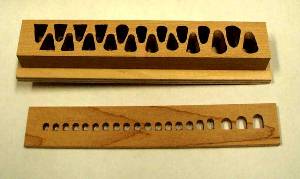
The diagram below shows the twenty channels in pitch order, with the three larger 6 mm bass holes and the seventeen 4 mm melody/accompaniment holes. It is schematic (pitch-ordered for legibility); the lateral order in which the holes actually sit across the paper is set by the Raffin roll standard and is not simply low-to-high (see §Roll geometry).
3.3 Melody, accompaniment and bass — one palette, three jobs
The role labels in the table are conventions of arranging, not hardware partitions. Every one of the twenty channels feeds the same melody pipe ranks (open flute, stopped flute, octave rank, and the slightly-sharp tremolo rank — Vol 05 §5.3), and the three lowest channels also drive the dedicated bass pipes and bass “helpers” under the skirt and on the bellows (Vol 05 §5.4). What makes a note “bass,” “accompaniment,” or “melody” is where the arranger uses it:
- Bass (F3, B♭3, C4). The three lowest channels carry the walking or oom-pah bass line. They are given the larger 6 mm tracker holes so the big, slow-speaking bass pipes get ample air and reliable triggering (Senger, Carousel Organ #24–25).
- Accompaniment (≈ D4–B♭4). The middle octave supplies chord tones — the “pah” chords of an oom-pah, or sustained harmony pads. With only C, D, E♭, E, F, G, A and B♭ available, the usable chords are essentially those of F and B♭ major (F, B♭, C, Dm, Gm, and a C7 via the E♭ … see §Arranging).
- Melody (≈ C5–D6). The top ten channels carry the tune. Ten pitches over an octave-and-a-bit is enough for most popular and folk melodies once they are arranged into range.
Because the middle octave (roughly C4–B♭4) is the only place where all of bass, harmony and melody can overlap, a good 20-note arrangement is a constant exercise in register economy — keeping the tune high, the bass low, and the harmony sandwiched between, so that no single channel is asked to do two jobs at once.
3.4 Tracker-bar hole sizing and John Smith’s revision
The paper perforations on a commercial Raffin roll are about 3 mm in diameter (Venable gamma file, “3 mm holes”). The tracker-bar reading holes are drilled larger than the paper holes so that small tracking errors still uncover the perforation reliably. John Smith’s original tracker specified 4 mm holes for the seventeen melody/accompaniment channels and 6 mm for the three bass channels — the bass pipes are large and slow to speak, and want more airflow and a longer “open” window (Senger #24–25).
That mixed sizing complicates drilling and layout, so John Smith later published a revision: the bass channels can also be drilled at 4 mm provided the tracker hole is lengthened into a short slot along the direction of paper travel, giving the same effective open-time as a 6 mm round hole without the wider bore (Senger #24–25; Wright, melright.com/busker/jsart20.htm). The physical construction of the bar — the honeycomb of internal channels, the drilling jig, the cumulative-dimension spacing spreadsheet — belongs to Vol 06 §6.2; here the point is only that hole size tracks note role: bigger holes for the bass.
3.5 Roll geometry: 110 mm width, spacing, and paper speed vs tempo
The Universal reads the 110 mm-wide commercial Raffin roll — the same rolls sold for Raffin, Hofbauer and Stüber 20-note organs (thomas-sterk.nl; Beckman #31). This is a deliberate and important choice: it makes the Universal compatible with a large, commercially available music library rather than a proprietary format.
It is worth being precise about which John Smith roll standard applies, because the plan range uses two:
- John Smith Busker / Senior 20 — John Smith’s own 20-note standard on 140 mm rolls, with tracker spacing of sixteen 6 mm gaps and three 9 mm gaps (the wider gaps at the bass), and correspondingly large paper holes (Busker Organ Forum, John Smith 20er tracker bar; thomas-sterk.nl lists the 140 mm rolls as “John Smith / Castlewood”).
- Universal — built to the 110 mm commercial Raffin geometry, whose tracker holes sit at roughly 3.8 mm centre-to-centre (“a little more than ⅛ inch”), giving twenty channels across the narrow roll (Müller, haraldmmueller.de; Busker Organ Forum). This is the geometry the Universal’s tracker bar is drilled to.
The narrow 3.8 mm spacing on 110 mm stock is why the Universal’s tracker is a precision part: a fraction of a millimetre of accumulated drilling error walks the whole row off the paper (Vol 06 §6.2 covers the jig that prevents this).
3.5.1 Paper speed, tempo and the crank
On a roll organ, tempo is encoded as distance: a note twice as long is punched as a slot twice as long, and the music plays at the rate the paper is drawn under the tracker bar. That rate is fixed by the drivetrain — the take-up spool diameter and the crank-to-spool gearing (Vol 07 §7.3) — not by an independent speed control. The Raffin gamma encodes a nominal roll speed and a standard internote spacing for arranging software (Venable gamma: roll-speed and 385-unit internote parameters), which the arranger works in so that a punched roll plays at the intended musical tempo.
A consequence peculiar to mechanical organs: cranking faster speeds up the music but does not raise its pitch. Pitch is set entirely by the pipes (Vol 05), so unlike a phonograph the tune does not go “chipmunk” when the operator hurries. Cranking faster does two things at once — it draws the paper faster (quicker tempo) and pumps the feeders faster (more wind, louder and firmer speech) — so crank speed is a combined tempo-and-dynamics control with a fairly narrow musical sweet spot (Vol 04 §4.1 covers the reservoir that buffers this).
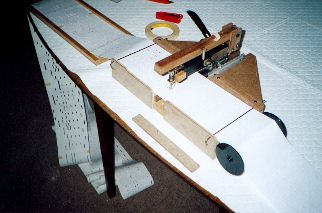
The diagram below shows how punched holes become notes over time — the “piano- roll” view an arranger actually edits.
3.6 The 26-note (Alderman) scale
The 26-note scale grew out of the 20-note world in England: Ian Alderman and Roy Davis of Poole, Dorset built organs on a 26-note scale that “beefed up” the 20-note to overcome its musical limitations, while remaining able to play existing 20-note music (Wright, melright.com/busker; MMD Digest, 1997.08.29). The Universal is “universal” because a single instrument can be built to this larger scale — hence the “20/26” in its name (Beckman #31). (The name is variously spelled Alderman and Aldeman across sources; both refer to the same scale.)
The design principle is elegant: the 26-note scale keeps all twenty original channels in exactly their original positions and squeezes six extra channels into the blank margins of the standard 110 mm roll — five holes at one end and one at the other — so the roll width does not change and old 20-note rolls still play unaltered on a 26-note organ (Beckman #31; MMD Digest, 1997.08.29).
The six added pitches, per the Beckman/MMD description, are:
Table 2 — The six added pitches, per the Beckman/MMD description, are
| Added channel | Note | Musical purpose |
|---|---|---|
| Bass | D | completes a bass of C, D, F, G (a proper IV–V–I bass in F/C) |
| Accompaniment | F♯ | the accidental that unlocks D-major/G chords in harmony |
| Melody | F♯ | leading tone / chromatic passing tone in the tune |
| Melody | C♯ | chromatic passing tone; dominant of D |
| Melody | D♯ / E♭ | chromatic passing tone |
| Melody | A♯ / B♭ (top) | extends the top of the melodic range |
The gain is almost entirely accidentals. The 20-note scale is diatonic-plus (F major with one added E♭) and cannot voice an F♯ or C♯ at all; the 26-note scale adds those chromatic tones, so arrangements can use passing notes, secondary dominants, and a wider set of keys, and the bass gains the D it needs for a convincing IV–V–I. It does not make the organ fully chromatic — there is still no complete 12-note octave — but it removes the harshest compromises of the twenty (MMD Digest, 1997.08.29; Beckman #31). For the best musical result on a 26-note Universal, arrangers use rolls punched specifically for 26 notes (e.g. from Melvyn Wright), which exploit the six extra channels, rather than plain 20-note rolls (Wright, melright.com/busker/jsmith26.htm).
3.7 Arranging for a 20-note diatonic-plus organ
Writing for the Universal is an exercise in living inside eight pitch classes. The practical rules that fall out of the scale above:
- Transpose into the organ’s keys. With C, D, E♭, E, F, G, A, B♭ available and no B natural, the natural home is F major, with B♭ major and G minor / D minor close by. A tune written in G or D major (which need F♯/C♯) must be transposed down into F or B♭, or re-voiced to dodge the missing accidentals (Wright, melright.com/busker; general busker-arranging practice).
- Mind the missing leading tones. True C major is compromised by the absent B; a C-major cadence has to substitute or omit the leading tone. Melodies that lean on B natural or on F♯/C♯/G♯ either get re-harmonised or have those notes bent to the nearest available pitch — an audible compromise the arranger chooses deliberately.
- Keep the texture in three registers. Bass in the bottom three channels, chords in the middle octave, melody up top (the piano-roll figure above). When a melody dips into the accompaniment octave, the arranger must decide which voice wins that channel at that instant — two notes cannot share one channel.
- Fold wide melodies into range. Ten melody channels span roughly C5–D6. Notes above or below get folded back an octave (the busker equivalent of the Hammond foldback), which is usually musically invisible on a bright flute rank.
- Exploit repetition and octaves. With limited harmony, arrangers lean on octave doubling, rhythmic drive (the oom-pah), and grace notes to add interest the harmony cannot.
A 26-note arrangement relaxes the first two rules considerably: the added F♯/C♯/ D♯ let a tune keep more of its original accidentals and reach into sharp keys, and the bass D firms up the cadences.
3.8 Where the music comes from
Three note-sources feed a Universal, and they converge on the same 110 mm roll geometry:
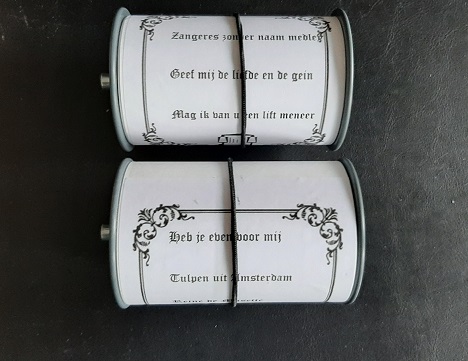
- Ready-punched rolls. The simplest path: buy commercial or hobbyist-punched 20-note (or 26-note) rolls. Ed Gaida (edgaida.com) and Melvyn Wright (melright.com/busker) are the community’s principal sources, and any standard 110 mm Raffin 20-note roll — including second-hand rolls — will play (Beckman #31; thomas-sterk.nl).
- Paper masters, punched at home. Mel Wright and others publish paper masters / arrangements that a builder marks out and punches (by hand jig or perforator) onto blank 110 mm stock, which is how many builders grow a library cheaply (Wright, melright.com/busker). The arranging is done in the software scale defined by the Raffin gamma (Venable, wallace-venable.name).
- MIDI as a note source. An arrangement authored as a MIDI file can be mapped to the twenty (or twenty-six) channels and either punched to paper or played directly by a MIDI-driven valve system that replaces the tracker bar with solenoids (Müller, haraldmmueller.de; the 20-Raffin gamma exists precisely to translate MIDI to the scale). The Universal as built is a paper instrument, but the same scale underlies an electronic front-end. The dedicated MIDI-organ treatment — solenoid valves, note-mapping, the electronics — is the subject of the program’s Dive 7, “The MIDI-Driven 20-Note Crank Organ”, and the broader survey of encoding methods (barrel, book, roll, MIDI) is Dive 4, “Encoding the Music.”
Whichever source supplies the notes, the constraint is the same and it is the subject of this volume: twenty fixed pitches — an F-major scale with an added E♭ — asked to carry bass, harmony and melody at once, with a six-note Alderman extension available to soften the sharpest of the compromises.
Sources
- H. C. Beckman, “John Smith Universal (20-26) Organ,” Carousel Organ #31 (COAA) — the Universal name and 20/26 scale rationale, 110 mm rolls, six added notes fitted in the roll margins, backward compatibility.
- Paul Senger, “Building the John Smith Organ,” Carousel Organ #24–25 (COAA) — 4 mm melody / 6 mm bass tracker holes and the 4 mm-plus-slot revision; operating detail.
- Melvyn Wright, melright.com/busker (jsmith.htm, jsart20.htm, raffin.htm, jsmith26.htm) — the Raffin 20-note standard, tracker-bar notes, the Alderman 26-note scale and Ian Alderman / Roy Davis of Poole, music sources.
- Wallace Venable, 20-Raffin gamma file and mechanical-music resources, wallace-venable.name — the authoritative Raffin 20-note pitch list (MIDI 53–86), 3 mm holes, 110 mm width, roll-speed and internote spacing parameters.
- Thomas Sterk Arrangementen, thomas-sterk.nl — 110 mm Raffin vs 140 mm John Smith / Castlewood roll standards; interchangeable-maker note.
- Harald M. Müller, haraldmmueller.de/midi_en.htm — 20er tracker hole spacing (≈ 3.8 mm), MIDI-to-channel mapping for a 20-note organ.
- Busker Organ Forum, tapatalk.com/groups/buskerorgan — John Smith 20er tracker bar (6 mm / 9 mm spacing on the 140 mm design), Question about Raffin Scale (“Bass C = middle C”).
- Mechanical Music Digest, mmdigest.com, 1997.08.29 — 20-note vs 26-note scale, the specific six added notes (bass D; accompaniment F♯; melody F♯, C♯, D♯, A♯).
Cross-references: the pneumatic action that reads each hole in Vol 02 §2; the pipe ranks, stops and bass pipes those channels drive in Vol 05 §5.3–5.4; the physical tracker bar, spacing jig and pouch/valve action in Vol 06 §6.2; the roll transport and drive ratio that set tempo in Vol 07 §7.3; the reservoir that buffers crank-speed changes in Vol 04 §4.1. Program-level: Dive 4 (Encoding the Music) and Dive 7 (The MIDI-Driven 20-Note Crank Organ) for the MIDI note-source path.
Comments (0)