John Smith Universal Organ · Volume 8
Materials, Tools & Cutting
This volume is the procurement-and-preparation bench sheet for the John Smith “Universal” (20/26-note) organ: the full materials survey, the tool and jig inventory, the glue kit, and the cut-planning method that turns a stack of sheet stock into roughly 800–900 discrete parts. It sits between Vol 05 (pipework — where the pipe scale and rank layout are derived) and Vol 09 (assembly sequence — where these prepared parts are glued up in order). The step-by-step build order belongs to Vol 09; the deep classic-versus-modern materials-science and restoration comparison belongs to program Dive 15 — this volume stays build-practical for one Universal.
The governing idea is John Smith’s own: an organ an amateur can build from readily-available materials, at a target cost of about £75 (roughly $150 at the time of the plans) (Beckman, COAA #31). That number is a materials floor, not a realistic total. Paul Senger’s build — with basswood, Baltic-birch, and bought Columbia leather substituted for the cheapest options — came to about $439 (Senger, COAA #24/#25). The gap between those two figures is precisely the subject of this volume: which readily-available substitution to accept, and which upgrade to pay for.
8.1 The “readily-available materials” ethos
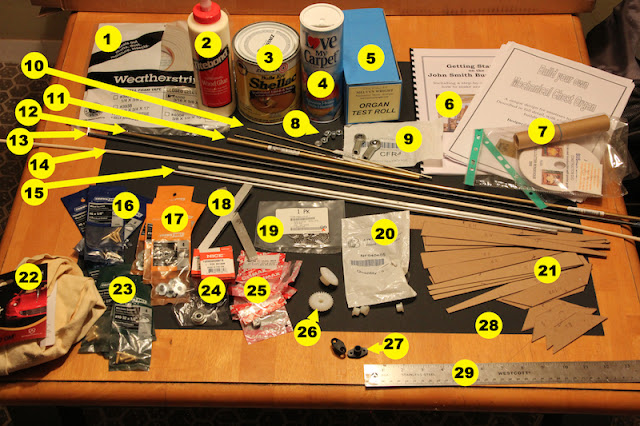
The Universal was designed in the mid-1990s (John Smith built the first organ after his grandson Daniel asked for one; see Vol 01) around a deliberate constraint: no part should require a specialist supplier if a hardware-store or household equivalent will serve. The plans are peppered with substitutions that are half thrift, half engineering wit. They matter here because several are not merely cheap — they are genuinely good choices that a first-time builder would otherwise over-buy.
Table 1 — The "readily-available materials" ethos
| Called-for function | John Smith’s ready substitute | Why it works |
|---|---|---|
| Tracker-bar body | A wooden school ruler | Straight, seasoned, dimensionally stable hardwood already milled flat |
| Idler / drive tire | A vacuum-cleaner drive belt | Correct diameter, high-friction rubber, cheap and replaceable |
| Crankshaft case bearing | An English penny (pre-1992, bronze) drilled to size | Bronze on steel is a serviceable plain bearing at these loads/speeds |
| Take-up spool | Rainwater downspout or a stout mailing tube | Rigid, light, exactly the right bore for the roll core |
| Reservoir / relief spring | A binder clip (or music wire) | Provides the tens-of-grams spring force the relief flap needs |
| Stopper handles | Bamboo skewers | Stiff, glueable, trimmable, free |
| Stoppers / gaskets | Adhesive weather-stripping (foam/felt) | Compressible, self-adhesive, seals wood-to-wood joints |
| Lid paper tensioner | Coat-hanger wire | Springy mild steel, bent to a light constant tension |
| Air hose | Flexible electrical conduit or vinyl tube | Flexible, kink-resistant, standard bore |
| Bellows / reservoir cover | Blackout curtain cloth | Airtight rubberised backing; a low-cost bellows-hinge substitute |
(Senger, COAA #25; the substitution list is the “good colour” of John Smith’s plans.) None of these compromises airtightness or musical result; the pressure box window and the leather are the two places where the plans stop economising, and so should the builder.
8.2 Woods: where each species goes and why
The Universal is overwhelmingly a wooden instrument. The wood choices are not decorative — each species is picked for a specific mechanical property, and substituting freely across roles is the most common first-build mistake.
8.2.1 The pipe woods
Pipe walls must be light, dimensionally stable, glueable, and workable to close tolerance in thin section. John Smith’s own plans specify balsa for the pipe bodies (with a hardwood strip laminated in at the languid) — the lightest option and the cheapest, but soft, easily dented, and demanding careful sealing. Many builders, Senger included, substitute basswood (American lime, Tilia): denser than balsa, far more dent-resistant, holds a crisp mouth and languid edge, and still light. Basswood is the recommended default for a first Universal — the modest weight penalty buys a much more forgiving pipe (Senger, COAA #24).
- Pipe bodies: 1/8 in (3.2 mm) basswood sheet for the melody ranks; 3/16 in (4.8 mm) basswood for the five bass pipes and helpers, where the larger cross section and mitre want more wall (National Balsa stock sizes; Senger #24).
- Pipe fronts / caps: walnut — chosen for looks (the fronts are the visible face of the organ) and for a hard, stable surface that takes the rubber-band-then-glue voicing method without creeping (Beckman #31; see Vol 10).
- Languid strip: a hardwood insert — solid maple or a maple/hardwood strip laminated to the balsa — because the languid edge and the block define the windway and must not compress or fuzz (Senger #24). Solid maple pipes are a valid all-in-one alternative for the languid-critical parts.
Note: Pipe cut-up (the mouth height above the block) and windway width are voicing dimensions, not stock dimensions — they are set in Vol 05 (scale) and Vol 10 (voicing). Here the concern is only cutting the blanks to length with the +5–10 % tuning margin (and +1 in / 25 mm on the largest three bass pipes for mitring) that Vol 05 specifies, so nothing is cut fatally short.
8.2.2 The case, chest, and structural woods
Table 2 — The case, chest, and structural woods
| Part | Material & thickness | Role / why |
|---|---|---|
| Case / cabinet sides | 1/4 in (6.4 mm) Baltic-birch ply | Void-free multi-ply; rigid, stable, screws and glues well; the structural shell |
| Pipe walls (ply builds) | 1/8 in (3.2 mm) Baltic-birch ply | Where builders prefer ply pipes over solid — thin, stable, airtight |
| Valve chest core | 1/4 in (6.4 mm) particle board | Cheap, flat, dimensionally stable core; wind channels are router-cut before lamination |
| Valve chest skins | Two 1/8 in (3.2 mm) Masonite/hardboard faces | Smooth, hard sealing faces laminated over the routed core to close the channels |
| Tracker bar (if not a ruler) | Maple | Maple beats walnut for the drilled tracker holes — walnut splinters at the hole edges; maple drills cleanly (Senger #25) |
| Wear parts / bushings blocks | Maple (and UHMW polyethylene for bearing blocks) | Hard, low-fuzz wear surfaces; UHMW self-lubricates for the drive-shaft blocks |
| Pipe valves | 1/4 in (6.4 mm) poplar dowel + leather punching | Light, stable dowel stem-carriers glued to a leather face (Beckman #31) |
| Covers / base trim | Walnut (or pine where hidden) | Visible woodwork; pine for concealed structure to save cost |
Baltic birch is the one wood worth buying to grade. Its void-free core is what keeps the case square and the ply pipes airtight; construction-grade ply with internal voids will leak and warp. It is sold in the metric-derived nominal thicknesses (1/8, 3/16, 1/4 in / 3, 4, 6 mm) by model-wood suppliers such as National Balsa Wood Co., which stocks premium model-grade Baltic birch alongside basswood, walnut, maple, and cherry in the exact sheet sizes this build uses (nationalbalsa.com).
The following map shows which wood lands where in the finished organ.
8.3 Leather: the one thing to buy right
Leather is where the Universal earns its airtightness, and it is the one material class the plans do not tell the builder to improvise. All of the working leather can be sourced from Columbia Organ Leathers (Columbia, Pennsylvania; columbiaorgan.com), the standard supplier to the reed- and pipe-organ trade.
Table 3 — Leather: the one thing to buy right
| Function | Columbia leather | Approx. thickness | Why this weight |
|---|---|---|---|
| Feeder-bellows & reservoir gussets | CPL Gusset, Medium | ~0.012–0.017 in (0.3–0.43 mm) | Hairsheep “gusset” leather flexes millions of cycles without cracking; medium is the sweet spot of airtight vs. supple. Heavy CPL runs ~0.017–0.021 in (columbiaorgan.com) |
| Reservoir / feeder flap valves | CGL Valve-Heavy | ~0.020–0.030 in (0.5–0.76 mm) | A flap valve wants stiffness and mass to seat and stay flat; the heavier, de-glossed valve leather seals against the port and does not curl |
| Pouches (pillow-pouch board) | Zephyr skin (fine pouch leather) | very thin, ~0.005–0.010 in | The pouch must lift on a few in H₂O of signal pressure — it has to be as light and airtight as possible; zephyr skin is the pipe-organ pouch standard |
| Pipe-valve face | Leather punching (valve-weight scrap) | punched disc | Glued to the poplar dowel; seals the valve seat over the pouch board (Beckman #31) |
| Stoppers, gaskets, hinges | Split leather | as available | Compressible sealing for stopped-pipe caps and board joints |
The distinction that trips builders up is gusset versus valve leather: gusset leather is chosen to flex forever (bellows), valve leather is chosen to seal flat and stay put (flaps). Using stiff valve leather on a bellows gusset cracks it within a season; using supple gusset leather on a flap lets it curl and leak. Columbia’s valve leathers are double-buffed — a suede side for glue grip and a de-glossed grain side — precisely so they bond well and seat flat (columbiaorgan.com). Buy the grades to their role; do not economise here.
8.4 Metals and the small hardware
The metal in the Universal is minimal and all readily available:
- Crankshaft: a 5/16 in (7.9 mm) steel rod carrying three lobes of 1/4 in (6.4 mm) aluminium bar, set 120° apart, retained with Loctite 680 retaining compound and spring pins (Beckman #31). The valveless siblings use a 1/2 in (12.7 mm) steel rod with welded flat-steel arms instead.
- Hand crank: 1/2 in (12.7 mm) aluminium bar, bent and drilled.
- Valve stems: 1/8 in (3.2 mm) brass rod, running in the valve guides.
- Tracker nipples & tubing spigots: brass tube (nipples) with neoprene tubing, or vinyl tube glued directly into the drilled holes per the original plan.
- Springs / wire: music wire for the reservoir spring (or the binder-clip substitute); .024 in (0.6 mm) MIG wire for the glockenspiel beater springs; 3/32 in (2.4 mm) stainless welding rod for the beaters themselves; coat-hanger wire for the lid tensioner.
- Bearings: bronze bushings at the drive shafts, UHMW blocks as bearing carriers, and the celebrated drilled English penny at the crankshaft case (Senger #25).
8.5 Glues: the right adhesive for each joint
Glue selection is a load-bearing decision on this organ because most joints are either flexing (leather) or air-sealing (box seams). The plans and the build articles converge on a small kit, each glue matched to a joint type.
Table 4 — Glues: the right adhesive for each joint
| Glue | Where it is used | Note / lesson learned |
|---|---|---|
| Fish glue (liquid hide-type) | Leather-to-wood: bellows gussets, pouches, valve faces, stoppers | Long open time, strong, slightly flexible, water-reversible for repairs; the organ-trade standard for leather. John Smith’s plans specify it (Senger #25). Hot hide glue is the traditional alternative |
| Contact cement | The pressure-box Lexan/polycarbonate window to its frame | Contact cement is ~2× stronger than silicone in this joint (Senger #25). The window must hold pressure and be gasket-tight; silicone was the earlier call and proved the weaker bond |
| Epoxy (slow-set) | Brass nipples into wood; metal-to-wood generally | Fills the annular gap around a brass nipple and grips the non-porous metal where PVA cannot. Two-part, slow-cure for gap-filling strength |
| PVA / aliphatic wood glue | All wood-to-wood joinery: case, chest laminations, pipe bodies | The workhorse for porous wood-to-wood; strong, sandable, no gap-fill. Use it for the particle-board/Masonite chest sandwich and the pipe seams |
| Cyanoacrylate (CA) | Small tacking, skewer handles, quick fixtures | Fast tack for tiny parts and jig-holding; not a structural or sealing adhesive here |
| Loctite 680 retaining compound | Crankshaft lobes to the steel rod | Anaerobic retainer for the slip-fit metal press; backed up by spring pins (Beckman #31) |
Note: The two glue lessons worth internalising before the first joint: use fish glue on every leather joint (never PVA, which dries too stiff and cracks a flexing gusset), and use contact cement, not silicone, on the window (roughly double the bond strength for a joint that must hold box pressure). The deeper classic-vs-modern glue and restoration comparison — hot hide glue chemistry, reversibility, modern PVA/epoxy trade-offs — is the subject of program Dive 15; this table is the build-practical shortlist.
8.6 Tools and jigs
8.6.1 The tool inventory
The Universal is buildable with a modest shop, but the sheer part count rewards a few power tools. The table saw is the workhorse — most of the ~800 parts are straight rips and crosscuts in sheet stock — and for the thousands of small cuts a mini / hobby table saw (e.g. a Byrnes-type saw) is genuinely worth it: it holds tolerance on parts too small to feed safely across a full-size saw (Senger #24).
Table 5 — The tool inventory
| Tool | What it does on this build | Essential / optional |
|---|---|---|
| Table saw (full size) | Ripping case ply, chest boards, long pipe stock | Essential |
| Mini / hobby table saw | The thousands of small pipe and chest parts to tolerance | Strongly recommended |
| Band saw | Curved and thick cuts, mitring bass pipes, resawing | Essential (or scroll saw) |
| Scroll saw | Internal cuts, small profiles, glockenspiel bars | Optional |
| Drill press | Tracker-bar holes, valve guides, nipple holes — squareness is critical | Essential |
| Disc / belt sander | Squaring ends, the pipe-taper jig, fitting | Essential |
| Router (table preferred) | Wind channels in the chest core before lamination | Essential |
| Combination / try square + steel rule | Every layout; the tracker-bar cumulative dimensioning | Essential |
| Digital calliper | Verifying stock thickness and small part fits | Recommended |
| Sharp low-angle block plane + chisels | Trimming languids, fitting caps, cleaning joints | Essential |
| Manometer (water column) | Setting/checking ~5 in H₂O (127 mm H₂O ≈ 1.24 kPa) wind | Essential (Vol 04/10) |
| Bench clamps, spring clamps, rubber bands | Gluing pipes square; holding pipe fronts during voicing | Essential |
| Soldering iron / small welder | Beater assembly; crankshaft (welded siblings) | As design requires |
8.6.2 The jigs that make it repeatable
With hundreds of near-identical parts, jigs are not optional refinements — they are what keeps 26 pipes in a rank consistent and a tracker bar’s holes on pitch.
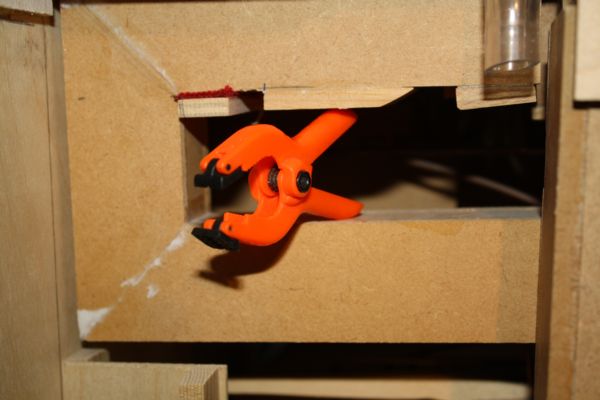
- Pipe-gluing right-angle jig — a simple square fixture (two fences at 90°) that holds each pipe body square while the PVA sets; without it, pipe bodies rack and the mouths twist, throwing off voicing.
- Pipe-taper belt-sander jig — a sled that presents each pipe cap or foot at the correct taper angle to the disc/belt sander, so every pipe’s taper matches.
- Tracker-bar drilling setup — the single most precision-critical jig: a drill-press fence + steel rule with a cumulative-dimension spreadsheet (measure every hole from a single datum, never tip-to-tip), a brad-point bit for clean entry, and a sacrificial backer board to prevent breakout on exit. The Universal’s holes are 4 mm (the last three bass notes originally 6 mm, later revised so bass can also be 4 mm by lengthening the tracker slots), on 31-note Raffin roll spacing but with 20 (or 26) holes (Senger #25; see Vol 06). Maple beats walnut here because walnut splinters at the hole edge.
- Crankshaft weld/assembly jig — holds the rod and the three lobes at the correct 120° spacing and axial positions while Loctite 680 cures (or, on the welded siblings, while the arms are welded opposite each other — getting the arms 180° wrong is a classic ruinous error) (Senger #24; Beckman #31).
8.7 Cut planning: from sheet stock to ~800 parts
The Universal comprises roughly 800–900 parts (Senger cites ~800–901), distributed unevenly: about 300 parts are in the pipes and about 200 in the pressure box (Senger #25). The remaining ~300 are the wind system, chest, drivetrain, case, and hardware. That distribution is the planning insight: the pipes and the pressure box dominate the parts list and the sheet-stock budget, so they drive the nesting.
The workable method is to plan the cuts before buying wood, using a spreadsheet or CAD to nest parts onto standard sheet sizes and estimate total board area:
- Enumerate parts by subsystem from the plans — for each pipe: body walls, cap, foot/block, languid, front; for the chest: core, two skins, valve carriers, guides. Multiply by rank/note counts (four melody ranks over 20–26 notes, plus five bass pipes and five helpers).
- Group by stock — every 1/8 in basswood part on one list, every 1/4 in Baltic-birch part on another, and so on, since wood is bought by thickness and sheet.
- Nest each group onto the supplier’s stock sizes (e.g. National Balsa’s 4 in × 36 in basswood strips and 12 in × 24 in / 12 in × 48 in Baltic-birch sheets), leaving kerf allowance (~1/8 in / 3 mm per cut) and the pipe length margin (+5–10 % for tuning, +1 in on the big three for mitring).
- Add a waste factor — plan ~15–20 % extra area for miscuts, grain defects, and voicing spares; a spare pipe blank per rank is cheap insurance.
- Batch identical cuts — set a table-saw fence once and cut all of a given dimension, then reset. This is where the mini table saw and a stop block pay off across hundreds of parts.
A spreadsheet nest also produces the bill of materials directly: summing the grouped areas gives sheet counts, and the small-hardware and leather lines are fixed quantities. That BOM is what turns the £75 target into an honest number.
8.8 Bill of materials & cost (single Universal)
The figures below are order-of-magnitude planning estimates for one Universal at 2020s hobby-supplier prices; they are marked (est.) and will vary by supplier, region, and which substitutions are accepted. The two anchor totals are John Smith’s design target of ~£75 / ~$150 (Beckman #31) and Senger’s actual ~$439 (Senger #24/#25), the difference being bought leather, basswood, and Baltic-birch upgrades over the cheapest readily-available options.
Table 6 — Bill of materials & cost (single Universal)
| Line | Qty (est.) | Material / source | Cost (est.) |
|---|---|---|---|
| Basswood sheet 1/8”–3/16” | ~6–10 sheets | National Balsa | $60–110 |
| Baltic-birch ply 1/4” & 1/8” | ~2–3 sheets | National Balsa / hardwood dealer | $40–70 |
| Walnut (fronts, covers) | ~2–3 small boards | Hardwood dealer | $25–45 |
| Maple (tracker, languids, wear parts) | ~1–2 small boards | Hardwood dealer | $15–30 |
| Particle board + Masonite (chest) | offcuts / 1 sheet ea. | Home centre | $15–25 |
| CPL Gusset leather, medium | 1 skin/panel | Columbia Organ Leathers | $40–70 |
| CGL Valve-Heavy leather | small piece | Columbia Organ Leathers | $20–35 |
| Zephyr skin (pouches) | small piece | Columbia Organ Leathers | $20–35 |
| Fish glue + PVA + contact cement + epoxy | 1 kit | Trade / hardware | $30–45 |
| Brass tube/rod, steel & aluminium bar | assorted | Hardware / metal supplier | $30–55 |
| Music wire, MIG/SS welding rod, springs | assorted | Hardware / welding supplier | $10–20 |
| Loctite 680, spring pins, screws, fasteners | assorted | Hardware | $20–35 |
| Polycarbonate (Lexan) window | 1 small panel | Plastics / home centre | $10–20 |
| Neoprene/vinyl tubing | 1 length | Hardware | $8–15 |
| Ready-made parts (optional): tracker bar, crankshaft, turned wheels, leather, springs | as bought | Roll Cutter / johnsmithbusker.co.uk | varies (kit route) |
| Plans | 1 set | Roll Cutter / johnsmithbusker.co.uk | ~$30–60 |
| Scratch-build total (est.) | ~$375–620 |
The Roll Cutter kit route (buying the tracker bar, crankshaft, turned wheels, leather, tubing, and springs ready-made) trades cost for time and reduces the precision-tooling burden — attractive for a first build that lacks a mini table saw or a drill press capable of holding tracker-hole tolerance (Beckman #31). The readily-available substitutions in the first table pull the scratch-build number back down toward John Smith’s original target; buying every part to organ-trade grade pushes it toward and past Senger’s $439.
Sources: Beckman, “John Smith Universal (20/26) Organ,” Carousel Organ Association of America (COAA) journal #31 (Universal construction specifics — pipe woods, valves, three-lobed crankshaft, Loctite 680, glockenspiel beater specs, kit-parts route, cost target); Senger, “Building the John Smith Organ,” COAA #24/#25 (basswood/Baltic-birch substitution, ~$439 actual cost, ~800–901 parts with ~300 in pipes and ~200 in the pressure box, readily-available materials list, tracker-bar drilling method, fish glue, contact-cement-vs-silicone window lesson, mini-table-saw recommendation); columbiaorgan.com (CPL gusset and valve leather grades and thicknesses, double-buffed valve leather); National Balsa Wood Co., nationalbalsa.com (basswood and Baltic-birch stock sizes and grades); Melvyn Wright, melright.com/busker (build tips). Cost lines and part counts marked (est.) are planning estimates and will vary. Cross-references: Vol 04 (wind system, ~5 in H₂O), Vol 05 (pipe scale, +5–10 % length margin, the four ranks and bass pipes), Vol 06 (tracker bar 4 mm/6 mm holes, pouch/valve action), Vol 09 (assembly sequence — the build order these parts feed), Vol 10 (voicing and tuning). The deeper classic-vs-modern materials-science, glue chemistry, and restoration comparison is program Dive 15.
Comments (0)