John Smith Universal Organ · Volume 10
John Smith Universal — Vol 10: Setup, Voicing & Tuning
Everything the earlier volumes built converges here. Vol 04 delivered a regulated column of wind at roughly 5 in H₂O; Vol 05 explained what a flue pipe is and why each of its dimensions matters; Vol 09 put the whole instrument together and made it airtight. This volume is the bench session that turns a mechanically finished organ into a musical one: first wind and leak-chasing, then voicing each flue pipe for tone, then tuning the ranks to a temperament, and finally setting the deliberately sharp front rank so it beats against a unison rank to give the Universal its singing tremolo. It closes with the un-glamorous truth that a crank organ is never tuned once — it drifts with the weather, and a cold morning at a rally will move its pitch before the first roll is loaded.
The order is not arbitrary. Wind must be proved before voicing, because a pipe is voiced against a specific pressure; voicing must precede tuning, because cut-up and cover position shift a pipe’s pitch as a side effect; and the tremolo rank is set last, because it is defined relative to an already-tuned unison rank. Skip the sequence and the work undoes itself.
Note on units and method. Pitches and pitch errors are given in Hz and cents (1200 cents = one octave; 100 cents = one equal-tempered semitone). Cut-up and cover positions are in millimetres with inch equivalents where the plans are inch-native. Wind pressure is in inches of water column (in H₂O); the Universal is voiced and tuned at its working pressure of ~5 in H₂O ≈ 127 mm H₂O ≈ 1.24 kPa (Senger, COAA #24–25). Facts from the two COAA build articles are cited inline; estimates the sources do not pin down are marked (est.) and never invented.
10.1 First wind and bring-up
The first time the completed organ is cranked is a diagnostic exercise, not a performance. The goal is to confirm three things in order: that the wind system holds pressure, that every note speaks when its tracker hole is opened, and that every note stops cleanly when the hole closes. Nothing is voiced or tuned until all three pass, because a leak or a hanging valve will masquerade as a voicing fault and send the builder chasing the wrong problem.
10.1.1 Prove the wind before anything speaks
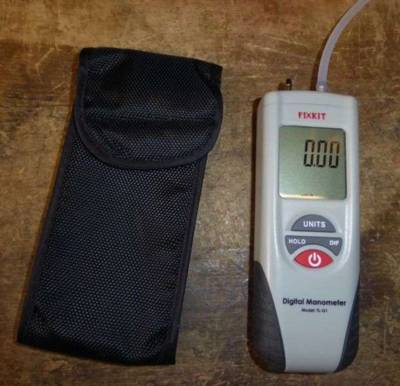
Before a single pipe is allowed to sound, block the wind off to the pipework (or simply pull the ranks) and crank the bare wind system with the manometer teed into the reservoir output, exactly as Vol 04 §6 describes. Two readings matter:
- Static pressure. Crank to a steady, comfortable speed and read the column. It should settle at 5 in (127 mm) and hold there. If it climbs past the set point the spill valve is set too stiff; if it never reaches 5 in the reservoir spring is too weak, a feeder flapper is leaking, or the reservoir gusset itself leaks (Vol 04 §4–5).
- Steadiness. Watch the meniscus. A column that bounces with each crank revolution points back to feeder phasing, a weak reservoir spring, or a slow leak the reservoir cannot bridge. A good Universal wind system shows a nearly still column that a listener could not hear the crank in (Vol 04 §8).
10.1.2 Chase the leaks
Air lost to leaks is pressure the pipes never see, and on a valved organ every joint in the pressure box, every tubing nipple, and every valve seat is a candidate. Standard leak-chasing on a John Smith build:
- Soap-and-water on the joints. With the system under wind, brush dilute washing-up liquid over the pressure-box seams, the Lexan-window gasket, and the tubing nipples; growing bubbles mark the leak (Melvyn Wright, John Smith pages). The pressure-box window is a repeat offender — recall that contact cement seals it roughly twice as well as silicone (Senger, COAA #25).
- Listen with the pipes out. With no pipes speaking, a steady hiss is a leak; a quiet organ is a tight one.
- Watch the manometer under a full chord. Open several tracker holes at once (a test roll or a strip of tape lifted off the bar) and confirm the column does not collapse. A pressure that reads 5 in H₂O idling but sags to 3 in under a full chord means the feeders or reservoir are undersized or a valve is bleeding wind (Vol 04 §6, “read it under load”).
10.1.3 Confirm every valve speaks and stops
With wind proved, admit air to the pipework and test the note action one hole at a time. Each of the Universal’s valves is a poppet on a brass stem sitting over a pillow-pouch; paper over the tracker hole pressurizes the pouch, the pouch lifts the valve, and the pipe speaks (Vol 06). Two failure modes are being hunted:
- A note that will not speak. The pouch is not lifting (bleed too large, pouch leaking, or tubing blocked) or the valve is stuck down. Adjust the bleed — the small calibrated leak that lets the pouch deflate — smaller so the pouch inflates fully (Vol 06).
- A note that will not stop (a “cipher”). The valve is not re-seating: dirt on the seat, a warped valve face, a bent stem binding in its guide, or a bleed set so small the pouch cannot deflate between notes. The bleed is the balance — large enough to release the note promptly, small enough that the pouch still lifts fully against the working pressure (Vol 06). A ciphering note found now is a mechanical fix; found later it will be mistaken for a voicing problem.
Only when every valve speaks promptly and silences cleanly, and the manometer holds 5 in H₂O under load, is the organ ready to voice.

10.2 Voicing the flue pipes
Voicing is the process of adjusting a pipe’s mouth geometry until it speaks promptly, cleanly, and in the intended tone at the working pressure. On the Universal the single dominant control is the cut-up — the height of the upper lip above the languid — and John Smith’s genius was to make that control adjustable after the pipe is otherwise finished, by leaving the front cover unglued and sliding it to sweep the cut-up before committing.
10.2.1 Why voicing must happen on the organ’s own wind
A flue pipe’s speech and pitch both move with pressure (Vol 04 §8; Vol 05). A pipe that speaks beautifully off a shop compressor at some arbitrary pressure will over-blow or go dull on the organ if the organ’s pressure differs. The rule is absolute: voice at the pressure the organ actually holds. In practice that means either voicing each pipe in its place on the chest, or building the small voicing jig — a single valved wind outlet fed from the organ’s own reservoir (or a duplicate reservoir set to 5 in H₂O against the manometer) into which one pipe at a time is seated (Melvyn Wright, “voicing machine”). The jig is faster because pipes can be swept on the bench at seated height without reaching into the case, but it is only valid if its pressure is the manometer-verified 5 in H₂O.
10.2.2 The sliding-cover method
John Smith’s melody pipes are square wooden boxes whose front cover carries the upper lip; the cover is held on temporarily with rubber bands so it can be slid up and down before it is glued (Senger, COAA #25; Melvyn Wright). Sliding the cover changes the cut-up, and the tone sweeps through three distinct regimes:
- Cover high (large cut-up): the mouth is tall, the air-sheet has far to travel to reach the upper lip, and the pipe speaks thin, breathy, and airy — weak fundamental, slow to start, sometimes barely speaking at all. Too much cut-up starves the tone.
- Cover slid down (cut-up narrowing toward the sweet spot): as the upper lip descends the air-sheet couples more strongly to the column, the fundamental fills in, and the tone grows full, round, and prompt — the “best tone” window.
- Cover too low (cut-up too small): the mouth is now so short that the air-sheet is over-driven; the pipe chokes — it goes reedy or strangled, hisses, may jump (over-blow) to the octave, or the pitch flies sharp and unstable. Past the window the tone collapses again.
The procedure is to slide the cover slowly from high toward low while the pipe speaks on 5 in H₂O, listen for the point where the tone is fullest and the speech promptest, mark that position in pencil across the cover and body, then glue the cover at the mark (Senger, COAA #25). The rubber bands hold everything until the glue grabs; the pencil line is the record of a decision made by ear against a verified pressure.
10.2.3 The languid-line starting reference
The sweep is faster if it starts near the answer. John Smith’s plans follow the Wurlitzer melody-pipe convention of setting the cover so its lower edge stands roughly 1/64 in (~0.4 mm) proud of the languid (block) as a starting cut-up, then refining from there (Senger, COAA #25; Stanoszek, Wurlitzer 104/105 voicing guide). This “languid line” is a first guess, not the final position — it puts the cover in the neighbourhood of the window so the ear only has to sweep a few millimetres either way rather than the whole range.
10.2.4 Windway spacing and its effect
The windway — the flue gap between languid and lower lip that aims the air-sheet — is set on the John Smith pipe not by planing but by a shim of cereal-box cardboard (~0.4–0.5 mm) laid on the languid while the cover is glued, then pulled out (Senger, COAA #25; Vol 05). Windway width is a secondary voicing control:
- A narrower windway makes a thinner, faster air-sheet — brighter, more harmonic development, but more prone to hiss and needing more cut-up to tame.
- A wider windway makes a thicker, slower sheet — rounder and quieter, but sluggish to speak and wind-hungry.
Because a whole rank is shimmed with the same cardboard, the windway is uniform across the rank by construction; the builder tunes tone primarily with cut-up (the cover) and reserves the shim thickness as a rank-wide character decision made once.
10.2.5 Ears on the bass
The five mitred bass pipes carry small wooden flaps — ears — glued to the two vertical edges of the mouth. Ears load the mouth aerodynamically: they stabilize the air-sheet, help the long stopped pipe speak promptly, and lower the pitch by roughly half a note for a given length, buying back length in a case that has none to spare (Senger, COAA #25; Vol 05). During voicing the ears are set for prompt, solid bass speech; their pitch-lowering effect is accounted for when the bass pipes are tuned by their stoppers (§3).
10.2.6 Voicing symptom → cause → fix
Table 1 — 2.6 Voicing symptom → cause → fix
| Symptom | Likely cause | Fix |
|---|---|---|
| Pipe won’t speak / very slow to start | Cut-up too high (cover too high); windway blocked or wind starved | Slide cover down; clear/re-shim windway; confirm 5 in H₂O at the pipe |
| Thin, breathy, no body | Cut-up too high; windway too narrow | Slide cover down into the window; consider a slightly wider windway shim rank-wide |
| Hiss / wind noise over the tone | Windway too narrow, or air-sheet not meeting the lip cleanly | Widen windway shim; deburr/lightly round the upper-lip edge |
| Choked, strangled, reedy | Cut-up too low (cover too low) | Slide cover up toward the window |
| Over-blows to the octave; pitch flies sharp | Cut-up far too low, or foot-hole/pressure too high | Slide cover up; verify pressure is 5 in H₂O, not higher |
| Speaks but pitch unstable / warbles | Pressure bouncing (wind fault), not a pipe fault | Return to Vol 04 §6 — steady the wind first, then re-judge |
| Whole rank uniformly wrong in one direction | Windway shim thickness wrong for the rank | Re-shim the rank; the cover sweep only trims per-pipe variation |
10.3 Tuning
Voicing sets tone; tuning sets pitch. On the Universal the two are entangled — moving the cover to voice a pipe also moves its pitch — which is exactly why voicing is finished first and tuning done after, against the same working pressure.
10.3.1 Tune on the organ’s own air, monitored by the manometer
Because pipe pitch tracks pressure, the organ must be tuned at the same 5 in H₂O it will play at, with the manometer live throughout so the operator can confirm the pressure has not drifted between pipes (Vol 04 §6). Tuning a pipe at one pressure and playing it at another simply moves the whole rank sharp or flat. The tuning manifold is therefore the organ’s own reservoir (or a duplicate reservoir trimmed to 5 in H₂O), feeding one pipe at a time with the manometer teed in.
10.3.2 The tuning rig: reservoir → manometer + pipe → mic → TUNE!IT
Pitch is read electronically rather than by ear-beating against a fork, because a wooden flue pipe’s tone is rich enough that a software tuner resolves cents faster and more repeatably than a beginner’s ear. The John Smith community’s tool of record is TUNE!IT, the organ-tuning software written by Detlef Volkmer, driven by a small microphone placed near the pipe mouth (Senger, COAA #24–25; Volkmer, TUNE!IT). Any chromatic strobe-class tuner or an organ-tuning app (e.g. the TuneLab-family Organ Tuner) serves the same function — the essentials are a mic, a display reading in cents against a chosen temperament and A-reference, and a quiet enough space that the mic hears the pipe and not the crank.
10.3.3 What to adjust: stoppers vs length/mitre
The tuning control differs by pipe type (Vol 05):
- Stopped pipes (the closed flute rank, the sharp front rank, and the bass) are tuned by sliding the stopper: push it in to shorten the effective column and sharpen; pull it out to lengthen and flatten. This is the reason pipes are cut 5–10 % long — every stopped pipe is tuned down to pitch by pulling its stopper (Senger, COAA #25). The stopper’s soft weather-strip or leather facing must stay airtight while sliding.
- Open pipes (the unison open-flute rank and the 4′ octave rank) have no stopper. They are tuned at the top, by length: shortening a pipe raises its pitch, so the open ranks are cut a little long (and therefore flat), then trimmed shorter to bring each up to pitch. Fine or reversible adjustment is made with a small tuning flap or slide at the top — closing it down flattens the pipe. The mitred bass pipes’ fold is set at build; their fine pitch is still taken at the stopper.
Work note by note against the software, one pipe at a time, confirming the manometer still reads 5 in H₂O for each. A pipe that reads wildly off after voicing usually needs a stopper move, not a re-voice — but if the tone has gone with the pitch, the cut-up was disturbed and the pipe returns to §2.
10.3.4 Choosing a temperament
A temperament is the scheme by which the twelve semitones are spaced. For a busker organ the choice is straightforward:
- Equal temperament is the default and the sane choice. Every semitone is 100 cents; the organ plays acceptably in every key, which matters for a busking repertoire that wanders across keys and for rolls arranged without regard to a home key. TUNE!IT (and every organ tuner) defaults to equal temperament at A4 = 440 Hz.
- Meantone / other historical temperaments are possible and occasionally chosen by builders after a period sound. Quarter-comma meantone makes the common major thirds beat-free and sweet at the cost of unusable remote keys (the “wolf” fifth). On a solo instrument that never plays with others and whose rolls stay in a few keys, a mild well-temperament can be pleasant — but it constrains the repertoire and is not recommended for a first organ (general temperament practice; est. as to any specific John Smith builder’s choice).
Because the Universal plays alone, absolute concert pitch matters far less than internal consistency: the organ need not be exactly A440, only in tune with itself. This becomes important in §5 when the weather moves the whole instrument off A440 at once.
10.3.5 Tuning-workflow checklist
Table 2 — 3.5 Tuning-workflow checklist
| Step | Action | Confirm |
|---|---|---|
| 1 | Voicing complete on every pipe; covers glued at their marks | No pipe still on rubber bands |
| 2 | Reservoir cranked/set to working pressure; manometer teed in | Column steady at 5 in H₂O |
| 3 | Software set to temperament + A-reference (equal, A4 = 440 Hz) | Displayed reference correct |
| 4 | Mic placed near the pipe mouth, crank held steady | Software locks onto the pipe, not the crank |
| 5 | Tune each stopped pipe by its stopper (in = sharp, out = flat) | Reads 0 cents (±1–2 cents, est. tolerance) |
| 6 | Tune each open pipe at the top (trim/flap) | Reads 0 cents |
| 7 | Re-check pressure every few pipes | Manometer still 5 in H₂O |
| 8 | Set the sharp front rank last, relative to a unison rank (§4) | Target beat rate reached by ear |
| 9 | Trim all stopper pulls to a uniform length | Tuning unchanged; cosmetically even |
| 10 | Play a full roll and listen for ciphers, warbles, sour notes | Whole organ musical at working pressure |
10.4 The slightly-sharp tremolo rank
The Universal’s signature effect is a whole rank — the front row of closed pipes — tuned a few cents sharp of a unison rank so the two, sounding together, beat into a gentle tremolo (Vol 05; Beckman, COAA #31). There is no mechanical tremulant; the wobble is pure acoustic interference between two nearly-equal pitches.
10.4.1 How many cents, and the beat it makes
Two tones a small interval apart beat at a rate equal to their frequency difference. For a celeste-style undulation the target is a slow, singing beat of roughly 1.5–3 Hz across the middle of the compass. At A4 = 440 Hz a detuning of +7 cents (est.) puts the sharp pipe at ≈ 441.8 Hz, beating at ≈ 1.8 Hz — a gentle wobble (Vol 05; general celeste practice). Because a fixed cents offset means a larger Hz difference at higher pitches, the beat naturally quickens toward the treble and slows in the bass, which sounds musically right rather than wrong. Wider detuning (say +12 to +15 cents) beats faster and sounds more agitated; +3 to +5 cents is barely-there shimmer. The builder chooses the character; +7 cents is a sensible middle (est.).
10.4.2 Setting it by ear against a unison rank
The front rank is set last, after its neighbour unison rank is dead in tune, because it is defined relative to that rank, not to A440:
- Draw the unison rank and the front rank together so both sound.
- For each note, slide the front pipe’s stopper to introduce a slow beat, and adjust until the beat rate is the chosen target (say ~2 Hz at A4), judged by ear or by watching the software’s needle swing at the beat frequency.
- Keep the offset consistent in cents up the rank (a fixed stopper-position bias won’t do it — tune to a target cents offset per note, letting the Hz beat scale naturally).
Because the effect lives in the difference between the two ranks, it survives the whole organ drifting with temperature (§5): if both ranks move together, their beat rate barely changes.
10.4.3 Trim the stopper pulls afterward
Tuning leaves every stopped pipe with its stopper pulled out to a different depth — a ragged row of protruding handles. Once tuning is final, the stopper pulls are trimmed to a uniform visible length so the rank looks tidy, without moving the stopper’s sealing position and thus without disturbing the tuning (Senger, COAA #25). Cosmetic, but it is the difference between a finished instrument and a workbench mock-up, and on a busker organ the pipes are the face of the machine.
10.5 Staying in tune: seasonal drift and the cold-morning rally
A flue pipe’s pitch is governed by the speed of sound in the air column, and the speed of sound rises with temperature (≈ 0.6 m/s per °C near room temperature). Pitch scales with it: a pipe runs sharp when warm and flat when cold, by roughly +3 cents per °C (est.) — so a pipe tuned in a 20 °C workshop and played on a 10 °C morning drops on the order of 30 cents flat, most of a third of a semitone (general pipe-organ temperature behaviour; est. for this instrument). This is why an organ can sound in tune at home and sour at an outdoor rally at dawn, and why it “comes into tune” as the sun warms the case.
The saving grace is that the effect is uniform: every pipe shares the same air, so the whole organ moves together and stays in tune with itself. The temperament is preserved; only the overall pitch (concert A) shifts. For a solo busker organ that plays with no other instrument, this is nearly harmless — the tremolo rank still beats correctly against its neighbour (§4.2), and a listener hears a slightly low organ, not a badly tuned one. Practical consequences:
- Do not re-tune for weather in the field. Chasing pitch pipe-by-pipe on a cold morning would *un-*tune the organ once it warmed. Let it stabilize to the ambient temperature and play it as it sits.
- Let the organ acclimatize before judging tuning. A cold organ carried into a warm hall (or the reverse) needs 20–30 minutes to reach equilibrium before its pitch is meaningful (est.).
- Seasonal re-tuning is normal maintenance. Wooden pipes also move slightly with humidity — stopper facings compress, joints breathe — so a small annual touch-up against the software is expected. This is a re-tune (stopper nudges), not a re-voice; the cut-up set in §2 is permanent once glued.
The organ that holds its tune season to season is the one that was voiced and tuned at its working pressure against a manometer in the first place, so that the only variable left in the field is the weather — which moves everything together and therefore changes almost nothing a solo listener can fault.
10.5.1 Cross-references
- Vol 04 — The Wind System — proving and steadying the 5 in H₂O working pressure, the water manometer, and why pipe pitch and loudness track pressure (§1, §3 tune on the organ’s own verified air).
- Vol 05 — Pipework & the Four Stops — what cut-up, windway, ears, and stoppers are and the stopped-vs-open physics behind tuning by stopper vs by length; the four ranks including the slightly-sharp front rank set here in §4.
- Vol 06 — The Pressure Box, Tracker Bar & Valves — the pouch/valve action and bleeds behind the “won’t speak / won’t stop” bring-up checks in §1.3.
- Vol 09 — Assembly Sequence — airtightness and the leak-chasing this volume begins from in §1.2.
Sources
- Senger, Paul. “Building the John Smith Organ,” Carousel Organ #24 & #25 (COAA). Working pressure 5 in H₂O and the water manometer in the plans; front covers held with rubber bands during voicing and glued at the best-tone mark; cut-up per the Wurlitzer guide (cover ~1/64 in over the block on melody pipes); cereal-box cardboard windway spacer; ears lowering bass pitch ~½ note; stoppers as the tuning control (bamboo-skewer handles); cutting pipes 5–10 % long to tune down; TUNE!IT software + microphone + manometer; trimming stopper pulls to a uniform look; contact-cement window seal.
- Beckman. “John Smith Universal (20/26) Organ,” Carousel Organ #31 (COAA). The four ranks including the front rank tuned slightly sharp to beat for tremolo/vibrato; five bass pipes (mitred, eared) + octave helpers.
- Volkmer, Detlef — TUNE!IT organ-tuning software (used with a microphone against a chosen temperament and A-reference); corroborated as a category by mainstream organ-tuning apps (TuneLab-family Organ Tuner, tunelab-world.com).
- Melvyn Wright, John Smith Busker Organ pages (melright.com/busker) — voicing on the organ vs a dedicated voicing machine/jig; leak-chasing; pipe voicing tips.
- Stanoszek, Building Plans and Voicing Tips, Wurlitzer 104/105 — melody-pipe cut-up conventions (cover proud of the block; upper-lip edge treatment) the John Smith pipes follow.
- General acoustics / organ practice — flue-pipe pitch ∝ speed of sound ∝ √(air temperature) → ≈ 3 cents/°C drift (est.); beat rate = frequency difference for the celeste/tremolo detune; equal vs meantone temperament trade-offs for a solo instrument.
Comments (0)