John Smith Universal Organ · Volume 5
John Smith Universal — Vol 05: Pipework & the Four Stops
Everything upstream of the pipe exists to deliver steady wind; the pipe is where that wind is finally spent as sound. This volume is about the objects that do the spending: the Universal’s wooden flue pipes, the physics that makes a stopped pipe speak an octave below an open one of the same length, the small geometry at the mouth that decides whether a pipe sounds like a flute or a string, and the way John Smith’s design strips the traditional pipe-maker’s craft down to something an amateur can cut with a hobby knife. It then assembles those pipes into the Universal’s defining feature — four melody stops from four ranks, backed by five bass pipes with octave helpers and an optional glockenspiel.
The air that reaches these pipes, and the pouch-and-valve stage that gates it, are Vol 02 and Vol 06; the wind that pressurizes them is Vol 04. The detailed tuning and voicing procedure — sweeping cut-up on the bench, setting the tremolo beat against a strobe, tempering the scale — belongs to Vol 10. The subject here is what the pipe is and why each dimension matters, up to but not including the bench session that dials it in.
Note: Pipe dimensions are given in millimetres (the John Smith plans and the Wurlitzer voicing guides both work in a mix of mm and inches; this volume uses mm with inch equivalents where a fastener or stock size is inch-native). Pressures are in inches of water column (in H₂O) to match the plans; the pipes are voiced at the organ’s working pressure of roughly 5 in H₂O ≈ 127 mm H₂O ≈ 1.24 kPa (Senger, COAA #24).
5.1 The flue pipe: how a column of air is made to sing
A flue pipe is a whistle. Wind enters the foot, is squeezed into a thin sheet by the windway (the flue), and is thrown across the mouth — the rectangular opening cut in the front of the pipe. The sheet strikes the upper lip, and the interaction between the oscillating air-sheet and the resonant air column inside the body locks into a stable oscillation: the column’s natural frequency controls the sheet, the sheet drives the column, and the pipe speaks a musical tone. Nothing moves but air; there is no reed, no string, no moving part in the pipe at all. The organ builder’s whole art is in the proportions of that mouth and the tuning of that column (Wikipedia, “Flue pipe”; Stanoszek, Building Plans and Voicing Tips, Wurlitzer 104/105).
Two named surfaces at the mouth do the work. The languid (the “block” in the Wurlitzer guides) is the horizontal shelf just inside the foot; the gap between the top of the languid and the lower lip is the windway, and it aims the air-sheet. The upper lip is the top edge of the mouth, and the vertical distance from the lower lip to the upper lip is the cut-up. Cut-up is the single most important voicing dimension: raise the upper lip and the tone rounds and softens toward a pure flute; lower it and the tone brightens and grows edgy toward a string. The mouth width, on a wooden pipe, is simply the full internal width of the pipe, so the cut-up is usually specified as a fraction of that width (Stanoszek; Wyman, “Building a Wurlitzer 105 Band Organ,” COAA #5–7).
5.1.1 Why a stopped pipe sounds an octave lower
The air column resonates like any pipe. An open pipe is open at both ends, so it supports a standing wave with a pressure node (a displacement antinode) at each end; its fundamental wavelength is λ = 2L, and its frequency is f ≈ v / 2L, where v is the speed of sound (~343 m/s at room temperature). A stopped pipe is closed at the top by a stopper or cap, so it has a displacement antinode at the open mouth end and a node at the closed end; the fundamental now fits a quarter wavelength in the tube, λ = 4L, giving f ≈ v / 4L. For the same physical length L, the stopped pipe’s frequency is exactly half that of the open pipe — one octave lower (Wikipedia, “Flue pipe”; “Organ pipe”). Equivalently, a stopped pipe need only be half as long as an open pipe to sound the same note, which is why stopped ranks are the space-saver of the organ world and why John Smith leans on them heavily in a case the size of a small suitcase.
The closed end also changes the timbre, not just the pitch. A stopped pipe resonates only its odd-numbered harmonics (1st, 3rd, 5th, …); the even harmonics are suppressed by the boundary condition at the closed end. An open pipe resonates the full harmonic series, even and odd. The audible result is that the stopped pipe is rounder, hollower, quieter, and sweeter — a “closed flute” or Gedackt character — while the open pipe of the same pitch is fuller, louder, and brighter because it carries the even harmonics too (Organ Historical Society, “Pipes and Timbres”). That single difference — same note, two different colours — is the raw material of the Universal’s stop list.
Note: Real speaking length is always a little shorter than the simple quarter/half-wave figure because of an end correction at the open end and at the mouth (the air just outside the opening participates in the oscillation). For a stopped pipe the correction is roughly one mouth-width’s worth of length; the practical consequence is that pipes are cut long on purpose and tuned down, not cut to the theoretical figure and hoped for (see the scale table below).
5.2 John Smith’s simplified pipe
Traditional organ pipes demand fine joinery: a bevelled languid, a chamfered lower lip, a precisely planed windway, sometimes a “nick” filed into the languid edge. John Smith’s contribution — the reason a first-time builder can make sixty working pipes at a kitchen table — is a pipe that reaches acceptable voicing without a single tapered cut.
- Square wooden box. Each pipe is a four-sided box of thin wood: two sides, a back, and a removable front (the board that carries the upper lip). Because the mouth width equals the internal width, the front simply butts across the full face; there is no rounded mouth to carve.
- The cardboard windway spacer. Instead of planing a tapered flue, Smith sets the windway gap with a shim of cereal-box cardboard (~0.4–0.5 mm) laid on the languid while the front is glued (Senger, COAA #25). The cardboard sets a uniform, repeatable air-sheet thickness across the whole rank; pull it out after the glue sets and the flue is exactly one cardboard thick. It is a jig, not a part.
- Cut-up by rule, not by ear-at-first. The front is cut so the upper lip sits a specified height above the languid — the plans follow the Wurlitzer melody-pipe convention of the cover standing roughly 1/64 in (~0.4 mm) proud of the block as a starting reference, then the cut-up proper is set as a fraction of mouth width during voicing (Senger, COAA #25; Wyman, COAA #5–7). Vol 10 covers the bench sweep; the point here is that the geometry is specified, so the builder is trimming toward a target, not guessing.
- Ears for the bass. Small wooden flaps — ears — are glued to the two vertical edges of the mouth on the bass pipes. Ears load the mouth aerodynamically: they stabilize the air-sheet and lower the pitch by roughly half a note for a given length, letting a bass pipe hit its note without being made physically longer (Senger, COAA #25). On a suitcase-sized organ that half-note of “free” length is worth having.
- The stopper. Stopped pipes are closed by a sliding stopper — a wooden plug faced with soft weather-stripping or leather, often with a bamboo-skewer handle in Smith’s readily-available-materials spirit (Senger, COAA #25). The stopper is the tuning control for a stopped pipe: push it in to sharpen, pull it out to flatten. Open pipes have no stopper and are tuned at the top (by length, a tuning slide, or a small adjustable flap).
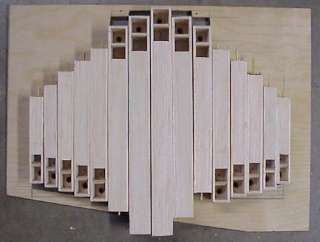
5.2.1 Materials
The pipe is thin wood, and the choice trades workability against tone and durability:
- Balsa — John Smith’s original specification. It is feather-light and cuts cleanly with a hobby knife, which is exactly why an amateur can build a full set; the downside is fragility and a slightly softer tone. Balsa remains the fastest path to a working organ (Senger, COAA #25).
- Basswood — the common upgrade. Stiffer and more durable than balsa, still easy to cut, and dimensionally stable; many builders substitute it throughout (Senger, COAA #25).
- 1/8 in Baltic birch plywood — Beckman’s Universal uses birch ply for the pipe bodies (the case is 1/4 in Baltic ply). Ply is the most robust and holds glue joints and screw-on fronts well, at some cost in weight and cutting effort (Beckman, COAA #31).
- Walnut fronts — the visible mouth boards are often made of walnut, both for looks (the mouths are the face of the organ) and because a hardwood upper lip keeps its edge, which matters acoustically (Beckman, COAA #31).
5.3 The pipe scale
The scale is the rule that assigns each note its pipe length and cross-section. John Smith supplies it two ways in the plans: a slope-line chart — a graph on which the builder reads a pipe’s length off a straight line ruled between the smallest and largest pipe — and an equivalent millimetre table. The chart is the friendlier tool on the bench; the table is the check.
The governing physics is the quarter/half-wave relationship above. The table below gives the nominal speaking length (from L = v / 4f stopped, L = v / 2f open, v ≈ 343 m/s) for representative notes, so the octave halving is visible at a glance. Internal cross-sections follow the plans’ scale chart and taper smoothly from bass to treble; the values here are representative (est.) rather than the plans’ exact figures.
Table 1 — The pipe scale
| Note | f (Hz) | Open speaking length (mm) | Stopped speaking length (mm) | Internal W × D (mm, est.) |
|---|---|---|---|---|
| C3 (bass) | 130.8 | 1311 (mitred) | 655 | 42 × 46 |
| C4 | 261.6 | 655 | 328 | 28 × 32 |
| G4 | 392.0 | 437 | 219 | 24 × 27 |
| C5 | 523.3 | 328 | 164 | 20 × 22 |
| G5 | 784.0 | 219 | 109 | 16 × 18 |
| C6 (top) | 1046.5 | 164 | 82 | 13 × 15 |
Nominal lengths from L = v/4f (stopped) and v/2f (open); cross-sections est. from the plans’ slope-line chart. Two adjustments are then applied before cutting:
- Add 5–10 % to the length for tuning margin. A pipe cut to the theoretical figure will almost always come out sharp once the end correction, the real cut-up, and the working pressure are accounted for. Cutting 5–10 % long guarantees the pipe can be tuned down to pitch — a stopped pipe by pulling its stopper, an open pipe by trimming the top or opening a flap. It is always easier to remove length or lower pitch than to add it back (Senger, COAA #25).
- Add ~1 in (25 mm) on the largest pipes for mitring. The lowest bass pipes are physically too long to stand upright in the case, so they are mitred — folded with a 90° elbow to run horizontally under the skirt. The mitre joint itself eats a little effective length, so the plans add about an inch to the longest pipes to compensate (Senger, COAA #25; Beckman, COAA #31). Mitring, not lengthening, is how a 1.3 m bass pipe fits in a case a third that tall.
Tip: Cut-up interacts with scale. A pipe that speaks flat and dull can often be brought to life by lowering the cut-up (brighter, more harmonics) rather than re-cutting the body; a pipe that overblows to the octave or hisses usually wants a higher cut-up. The scale sets the pitch; the cut-up sets the tone at that pitch. The full bench routine is Vol 10 §“Voicing the flue pipes.”
5.4 The four stops (four ranks)
The Universal’s signature is that it offers four registration choices from four distinct ranks of melody pipes. Each rank is a full set of pipes across the melody compass; a stop gates the wind to a whole rank at the chest (Vol 06), so the player selects which colour, or combination, sounds. Because the ranks differ in construction (open vs stopped) and tuning (unison, octave, or slightly sharp), the four give a genuinely different palette from the same roll (Beckman, COAA #31).
5.4.1 Rank 1 — open flute (unison, 8′)
A full rank of open wooden pipes at unison pitch — the organ’s fundamental voice. It is the loudest and fullest of the four because the open ends let the whole harmonic series ring; it is also the longest and most wind-hungry rank. This is the default “on” voice that most melodies ride on.
5.4.2 Rank 2 — closed (stopped) flute (unison, 8′)
The same pitches as Rank 1, but built as stopped pipes: capped, half the length, and voiced round and soft. Selecting Rank 2 instead of Rank 1 gives the same notes in a quieter, hollower colour — the busker organ’s “soft” registration, and the rank that makes the whole instrument fit in a small case, since these pipes are half the size of their open counterparts.
5.4.3 Rank 3 — open flute one octave up (4′)
A rank of open pipes tuned an octave above unison. Drawn together with Rank 1 or Rank 2 it adds brilliance and cut — the classic “add a 4′ stop for sparkle” move — letting the little organ project and sound larger than it is. Because these pipes are an octave up they are already short, so the rank is cheap in both wind and space.
5.4.4 Rank 4 — the slightly-sharp front rank (tremolo / vibrato)
The Universal’s most charming trick. The front row of pipes is a rank tuned a few cents sharp of the corresponding unison rank. When it sounds together with a unison rank, the two pitches are close but not identical, so they beat: the small frequency difference produces a slow amplitude undulation the ear reads as tremolo / vibrato (a celeste or Vox Humana effect). For a detuning of about +7 cents at A4 (440 Hz), the sharp pipe runs near 441.8 Hz and the pair beats at roughly 1.8 Hz — a gentle, singing wobble (est.; general celeste-tuning practice, corroborated against Beckman, COAA #31). Wider detuning beats faster and sounds more agitated; the target beat rate is set on the bench in Vol 10. This is pure acoustics — no mechanical tremulant, no rotating anything — achieved only by building one rank slightly out of tune with another.
Table 2 — Rank 4 — the slightly-sharp front rank (tremolo / vibrato)
| Stop / rank | Pipe type | Pitch | Character | Role in registration |
|---|---|---|---|---|
| Rank 1 — open flute | open | 8′ (unison) | full, bright, loud; all harmonics | primary melody voice |
| Rank 2 — closed flute | stopped | 8′ (unison, ½ length) | round, hollow, soft; odd harmonics | quiet colour; space-saver |
| Rank 3 — open flute +oct | open | 4′ (octave up) | brilliant, cutting | adds sparkle/projection |
| Rank 4 — front rank | stopped (front row) | 8′, a few cents sharp | beats against a unison rank | tremolo / vibrato (celeste) |
| Bass pipes | stopped, mitred, eared | 8′/16′ region | deep foundation | under the skirt, always-on bass |
| Bass helpers | stopped/open, octave up | +1 octave of bass | definition/clarity | reinforce the bass line |
Source: Beckman, COAA #31 (the four ranks + bass + helpers); pitch/character from stopped-vs-open acoustics (Wikipedia, “Flue pipe”; OHS, “Pipes and Timbres”).
5.5 The bass: five pipes plus five helpers
The melody ranks stop at the bottom of the melody compass; below them sit the five bass pipes, the organ’s foundation. They are stopped (to keep them short), mitred to fold under the case, and fitted with ears at the mouth to win back the last half-note of pitch — three space-saving tricks stacked on one rank, because bass pipes are the longest and most awkward objects in the whole instrument (Beckman, COAA #31; Senger, COAA #25). They live under the skirt — the decorative panel around the base of the case — running horizontally where their length is hidden.
Deep stopped bass pipes are strong on fundamental but weak on upper harmonics, so the bass line can sound woolly and hard to follow. The Universal answers with five bass “helpers”: a second small rank tuned an octave above the bass pipes, mounted on top of the bellows (Beckman, COAA #31). Sounding an octave with each bass note, the helpers add the upper-harmonic definition the stopped basses lack, so the bass reads clearly to the ear without the case having to house five more long pipes. It is the same “add a 4′ for clarity” logic applied at the bottom of the keyboard.
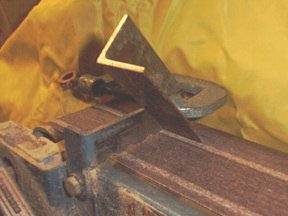
5.6 The optional glockenspiel / xylophone
Not every voice on the Universal is a pipe. The plans offer an optional percussion rank — a glockenspiel (metal bars) or xylophone (wooden bars) — mounted in the base of the case, and by common report it “generates the most comments at rallies” because a struck bar is visibly and audibly different from a blown pipe (Beckman, COAA #31).
It is driven pneumatically, exactly like a pipe rank: a tracker hole opens a valve, but instead of admitting wind to a pipe the valve fires a striker at a tuned bar. John Smith’s mechanism is characteristically frugal:
- Beaters of 3/32 in stainless-steel welding (MIG/TIG) rod — stiff, springy, and rust-proof — carry a small head that strikes the bar.
- Return springs of 0.024 in MIG welding wire snap the beater back off the bar after each strike, so the bar rings freely instead of being damped by a resting beater.
- The beater is anchored with a cable tie, the whole assembly leaning on hardware-store parts rather than machined pivots (Beckman, COAA #31).
Because a metal or wooden bar sustains far longer than a flue pipe, the glockenspiel reads as a bright, bell-like counter-voice over the flutes; on melody notes it adds attack and shimmer that pipes alone cannot. It is wired as just another gated rank at the chest (Vol 06), so it can be brought in or left out like any stop.
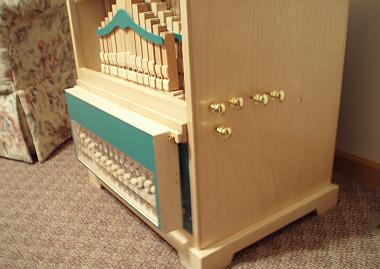
5.7 What this means for the rest of the build
The pipes set the terms for everything they touch. Their wind appetite sizes the reservoir and feeders (Vol 04): four ranks plus bass, helpers, and a glockenspiel is why the Universal needs three feeders where the one-rank Basic 20 gets by on two. Their rank grouping defines the stops and the chest layout (Vol 06): each rank is a wind group with its own gate. Their scale — the length and cut-up of each pipe — is fixed here but realized on the bench in Vol 10, where cut-up is swept for tone, stoppers are set for pitch, ears are trimmed on the basses, and Rank 4 is detuned against a unison rank to the chosen tremolo beat. This volume built the objects; Vol 10 makes them sing in tune.
Sources
- Beckman, “John Smith Universal (20/26) Organ,” Carousel Organ #31 (COAA) — the four melody ranks (open flute; closed/stopped flute; open flute one octave up; a front rank tuned slightly sharp for tremolo); five bass pipes (mitred, under the skirt) + five bass helpers (octave up, on the bellows); pipe bodies of 1/8 in Baltic birch ply with walnut fronts; the optional glockenspiel/xylophone with 3/32 in stainless-rod beaters, 0.024 in MIG-wire springs, and cable-tie anchoring.
- Senger, “Building the John Smith Organ,” Carousel Organ #24–25 (COAA) — balsa original pipe material cut with a hobby knife (basswood substitution); the cereal-box-cardboard windway spacer; the slope-line chart and mm scale table; adding 5–10 % to length for tuning margin and ~1 in on the largest pipes for mitring; “ears” lowering bass pitch ~½ note; cut-up per the Wurlitzer guide (cover ~1/64 in over the block on melody pipes); stopper handles from bamboo skewers; working pressure 5 in H₂O.
- Wright, melright.com/busker (Melvyn Wright’s John Smith pages) — pipe-making tips and rank photographs; the readily-available-materials ethos.
- Stanoszek, Building Plans and Voicing Tips, Model 104/105 Wurlitzer Band Organ, and Wyman, “Building a Wurlitzer 105 Band Organ,” Carousel Organ #5–7 (COAA) — wooden flue-pipe construction and voicing conventions (removable front carrying the upper lip/ears, cut-up as a fraction of mouth width) that the John Smith melody pipes follow.
- General flue-pipe acoustics — open pipe f ≈ v/2L (λ = 2L, full harmonic series); stopped pipe f ≈ v/4L (λ = 4L, odd harmonics only, one octave lower, quieter and rounder); end correction near the mouth (Wikipedia, “Flue pipe” and “Organ pipe”; Organ Historical Society, “Pipes and Timbres”).
Cross-references: the air path that feeds these pipes and the pouch-and-valve stage that gates each note in Vol 02; the wind supply (feeders, reservoir, ~5 in H₂O working pressure) sized to the pipes’ appetite in Vol 04; the chest, the per-rank stop gates, and the glockenspiel wiring in Vol 06; pipe materials, cutting, and jigs in Vol 08; the bench voicing and tuning procedure — cut-up sweep, stopper setting, ear trimming, and the Rank 4 tremolo detune — in Vol 10.
Comments (0)