Hammond B-3 · Volume 13
Hammond B-3 — Vol 13: Chopping a B-3: Planning & Philosophy
This volume opens Part III of the bench manual — the chop and portable build path. It covers the planning and philosophy of converting a tonewheel console organ into a multi-piece portable gigging rig: what a chop is and is not; the community ethic that governs when a chop is and is not appropriate; the sub-assembly inventory that gets extracted vs. left behind; a weight and piece budget; the key build decisions the builder must commit to before cutting; and a project checklist that sets the scope for the fabrication and electronics volumes that follow. Cabinet fabrication and portable enclosure construction are in Vol 14; preamp wiring, power routing, Leslie switching, and output in Vol 15. Build-record photography is in Vol 16.
This volume carries a specific constraint that governs every recommendation in it: a chop is electrically identical to a standard console. No tonal capability is added or subtracted by moving the sub-assemblies into a new enclosure. The reason to chop is entirely portability — and portability must be weighed honestly against the irreversibility of the modification. Console weight and the full lifting procedure are established in Vol 06 §“Moving & lifting a console.” The standard-cabinet alternative — and the “keep it original” ethic that is the counterpart to this volume — is in Vol 12 §“Keeping it original.”
Warn: A chop is a one-way modification. Once the console cabinet has been cut, the tonewheel generator and manual assemblies extracted, and the console shell discarded, the instrument cannot be returned to its original form. Before committing to the chop path, exhaust the standard-restoration alternative documented in Vol 12 and confirm that the donor console is genuinely unsuitable for standard restoration or that portability is a genuine and primary requirement, not a preference.
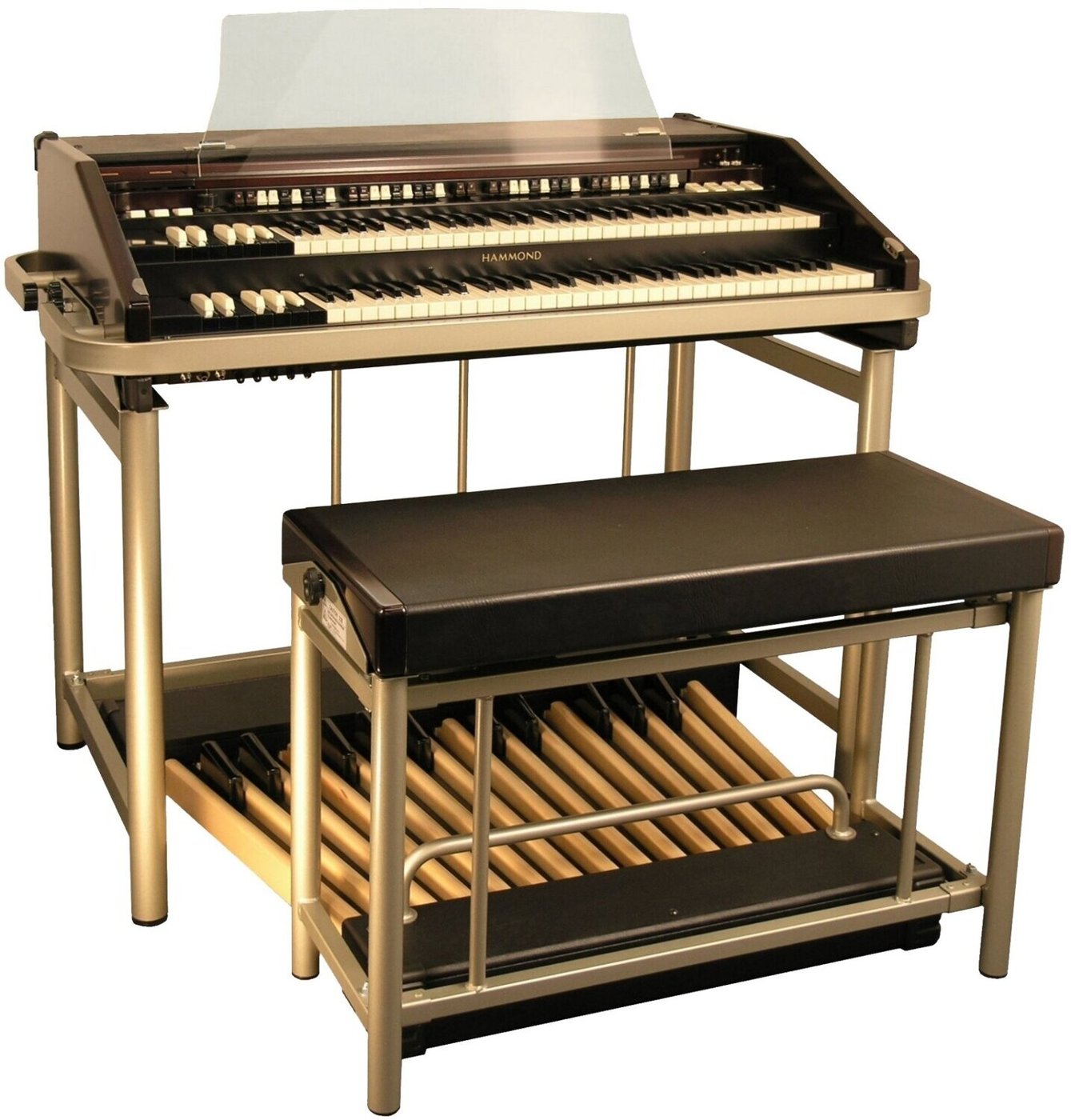
13.1 What “chopping” means
A Hammond chop is a tonewheel console organ — most commonly a B-3, C-3, or A-100 — whose original console cabinet has been disassembled and its working sub-assemblies extracted and rehoused in a compact, portable enclosure designed to travel in pieces. The term appears in the Hammond restoration and gigging community across organforum.com, dairiki.org/HammondWiki, r/Hammond, and custom-build shops including BB Organ and Boss Organ, where it consistently refers to the same core modification regardless of the specific approach.
The sub-assemblies that move into the new enclosure are those that produce and process tone: the tonewheel generator, the keyboard manual assembly (or assemblies), the drawbar hardware, the AO-28 preamp (or its replacement), the vibrato scanner and line box, the expression pedal mechanism, and the start/run motor wiring. These are the parts that make the instrument sound; they are electrically unchanged by the move. The sub-assemblies that stay behind — or are discarded — are those that provide only cabinet structure: the console shell, the four turned legs, the leg stretcher, the organist’s bench, and the internal swell box (replaced in the new enclosure by a compact expression pedal).
The portability the chop provides is not primarily about total weight reduction. Because a large portion of the console mass is in the working sub-assemblies that move into the new enclosure (generator, manuals, preamp) rather than in the discarded cabinet shell, the total weight of the rebuilt rig after rehousing is only moderately less than the original console weight. The portability gain is about piece weight: where an intact B-3 console requires a dolly and two or more people to move as a single 310 lb (141 kg) (est.) unit, a chopped rig divides the same working components into pieces each light enough for one- or two-person lift-in. Two people can move it bare-handed into venues that would be inaccessible to the original console (dairiki.org/HammondWiki; organforum.com, Hammond chop community discussions).
The diagram below shows the console sub-assembly inventory in relation to a chop: the extracted components (darker fill) that move into the portable enclosure, and those (lighter) that remain with or are discarded from the console shell.
The chop does not alter the signal chain: the tonewheel generator, the drawbar system, and the preamp are electrically connected in exactly the same way in the portable enclosure as in the original console. A well-executed chop is tonally indistinguishable from the original instrument (organforum.com, chop community discussions; dairiki.org/HammondWiki, “HammondChops”).
Warn: The B-3 console contains live 120 V AC mains wiring and an AO-28 B+ rail at approximately +200 VDC (Vol 08) at the moment of power-off. Before photographing, labelling, or disconnecting any sub-assembly for a chop, the console must be fully powered off, unplugged, and the B+ rail discharged and confirmed at 0 VDC per Vol 06 §“Capacitor-discharge procedure.” The portable context of a chop does not change the electrical hazards present during teardown — it adds to them by requiring that those hazards be managed in a workshop setting rather than a purpose-built service environment.
13.2 The ethic: what to chop, what to spare
The Hammond restoration community has a clear and widely held position on when a chop is appropriate: do not chop a clean original instrument. This ethic parallels the “keep it original” framework for cabinet restoration documented in Vol 12 §“Keeping it original” and applies the same logic: an intact console in serviceable cabinet condition carries historical value, playability, and authenticity that cannot be recovered once the cabinet is destroyed. Chopping it reduces its value permanently in exchange for portability that other solutions — a well-maintained B-3 with a good transport setup, or a modern clone-wheel instrument — can provide without the irreversible modification.
The community position, as expressed across organforum.com and the HammondWiki, is that chop candidates are instruments where the console cabinet is no longer viable — or where the instrument’s origin and condition already place it outside the category of “historically significant console to be preserved.” Legitimate chop candidates include:
- A console with structurally failed cabinet — rotted frame, irreparably damaged veneer substrate across multiple panels, cracked or separated corner posts that cannot be safely repaired, or broken leg-to-frame joints that cannot be re-glued without complete disassembly of the console.
- An incomplete console that lacks a cabinet, legs, or other structural components — an instrument that arrives as an internal-only assembly or that has been partially disassembled by a previous owner and is missing its console shell.
- An A-100 (or other home-market console) with built-in speakers and/or reverb chambers that would be removed regardless, particularly in a finish — such as the French Provincial or Mediterranean styles — that commands no premium and that most buyers find unsuitable for stage or studio use. The A-100 carries the same tonewheel generator, the same AO-28 preamp, and the same keyboard action as the B-3 and C-3 — it is tonally equivalent — but its built-in speaker system and domestic cabinetry make it a natural chop candidate when portability is the goal (organforum.com; dairiki.org/HammondWiki).
- A console in Grade D cabinet condition (per Vol 12 §“Assess: revive vs refinish”) where the cost of a standard restoration would exceed the value of the result.
Warn: Do not chop a B-3, C-3, or A-100 in Grade A or B original cabinet condition (Vol 12). A console that plays well, stands safely, and has a finish in recoverable condition is worth preserving as a console. The portability problem is real, but it has other solutions — the chop is the right answer only when the cabinet is already beyond saving, the instrument is a natural chop candidate by type, or portability is an overriding requirement that the player has consciously chosen over originality. A chop performed on a clean, original B-3 is an irreversible act that the community consistently regards as a loss (organforum.com, multiple threads; dairiki.org/HammondWiki, “HammondChops”).
13.2.1 The reversibility question
A chop is described as “reversible in theory” — the working sub-assemblies could, in principle, be reinstalled into a donor console shell. In practice, the original console shell is almost never retained: it is heavy, awkward to store, and the whole point of the chop is to eliminate it. Once the shell is discarded or sold, reversal is a major fabrication project requiring a new or donor console box, appropriate hardware, and complete re-wiring — a project comparable in scope to the original chop itself. The builder should treat the decision as permanent (organforum.com; general chop community discussions).
13.3 What you keep vs. lose
The following table classifies every major B-3 console sub-assembly by its disposition in a standard dual-manual chop. “Extracted” means it moves into the portable enclosure unchanged. “Decision” means the builder must choose from the options listed in §“Key build decisions.” “Left behind” means the sub-assembly stays with the console shell or is discarded.
Table 1 — What you keep vs. lose
| Sub-assembly | Disposition | Tonal impact if omitted |
|---|---|---|
| Tonewheel generator | Extracted — always | N/A — the generator is the instrument; omitting it means no tonewheel sound |
| Upper manual (Swell, 61 keys) | Extracted — always | N/A — no manuals means no playable instrument |
| Lower manual (Great, 61 keys) | Decision — extracted for dual-manual; omitted for single-manual chop | Loss of Swell/Great split voicing; the upper manual is playable solo (Great-register drawbars reassigned or sacrificed) |
| Drawbar assemblies (9 × upper, 9 × lower, 2 × pedal (16′ and 8′ only)) | Extracted with manuals | Lower drawbars lost if single-manual chop; pedal drawbars lost if no pedal board |
| AO-28 preamp chassis | Decision — keep original or replace (→ Vol 15) | The original AO-28 preserves the full tube character; a combo preamp is a close substitute (see §“Key build decisions”) |
| Vibrato scanner + run motor + line box | Extracted — keep original or substitute solid-state | Loss of authentic B-3 vibrato and chorus if omitted entirely; a solid-state scanner preserves the effect electronically |
| Preset keys + wiring | Extracted with manuals | Preset-key function is lost if wiring is not fully re-routed in the new enclosure |
| Expression pedal mechanism | Extracted or replaced with compact new unit | Expression control is essential for volume and Leslie balance; a compact potentiometer unit can substitute for the original swell box |
| Start/run motor and wiring | Extracted — always | The synchronous motor is required for tonewheel rotation at 1,200 rpm (at 60 Hz); no motor means no tone |
| 25-note pedalboard + pedal contacts | Decision — keep, remove, or convert (→ §“Key build decisions”) | Removal eliminates tonewheel bass pedal tone and pedal solo capability |
| Console cabinet shell | Left behind / discarded | Not part of the tonal instrument; purely structural and cosmetic |
| Four turned legs + leg stretcher | Left behind / discarded | No tonal function |
| Organist’s bench | Left behind | No tonal function |
| Expression shutter / swell box (speaker chamber on A-100 donors) | Left behind — replaced by compact expression pedal in new enclosure | The swell box provides no tonal processing; it houses the expression potentiometer, which is replaced |
A chop that faithfully extracts all of the items in the “Extracted” category and resolves all items in the “Decision” category produces an instrument that is electrically and tonally identical to the original console. No tonewheel is removed; no drawbar is eliminated (in a dual-manual chop with full pedals); no signal path is altered (organforum.com; dairiki.org/ HammondWiki; general chop community practice).
Warn: The vibrato scanner and line box are easy to overlook in chop planning. Without the scanner in the new enclosure — connected to its run motor and routed to the AO-28 input per the original wiring — the instrument will have no vibrato or chorus effect (Vol 10 §“The Vibrato/Chorus Scanner & Run Box”). The scanner is not an optional accessory; it is part of the standard signal path. Plan its mounting location in the portable enclosure before fabrication begins.
13.4 Weight and piece budget
The portability of a chopped rig depends on two related budgets: total weight (how much the complete rig weighs) and piece weight (how much each individually transported piece weighs). Total weight matters for long carries and stair climbs; piece weight determines whether any single piece can be moved by one person without assistance. The chop builder must plan both.
The weight figures in the table below are (est.) from the Hammond community (dairiki.org/ HammondWiki weight reference page, which itself draws from community measurement and the shipping weight documentation: B-3 with bench and pedalboard packed at approximately 425 lb / 193 kg; console alone at approximately 310 lb / 141 kg). Individual sub-assembly weights are community estimates and should be confirmed by weighing the specific units on the actual donor console, as weight can vary by production year and revision. No factory sub-assembly breakdown by weight has been located in the service literature reviewed for this volume; all per-item figures below are (est.).
Table 2 — Weight and piece budget
| Sub-assembly | Approx. weight (est.) | Disposition | Piece in transit? |
|---|---|---|---|
| Console cabinet shell | approx. 125 lb / 57 kg (est.) | Left behind | No |
| Four legs + leg stretcher | approx. 15–20 lb / 7–9 kg (est.) | Left behind | No |
| Organist’s bench | approx. 20–25 lb / 9–11 kg (est.) | Left behind | No |
| 25-note pedalboard | approx. 75 lb / 34 kg (est.) | Decision (keep / remove / MIDI) | If kept: separate piece |
| Tonewheel generator | approx. 45 lb / 20 kg (est.) | Extracted | Separate piece — the generator case is the natural single-unit transport |
| Upper manual (Swell) | approx. 48 lb / 22 kg (est.) | Extracted | Part of main enclosure, or separate piece depending on enclosure design |
| Lower manual (Great) | approx. 48 lb / 22 kg (est.) | Decision — dual or single | Part of main enclosure if kept |
| AO-28 preamp chassis | approx. 15 lb / 7 kg (est.) | Extracted or replaced | Mounts inside main enclosure |
| Vibrato scanner + run motor | approx. 5–10 lb / 2–5 kg (est.) | Extracted | Mounts inside main enclosure |
| Drawbar assemblies, hardware, wiring | approx. 10–20 lb / 5–9 kg (est.) | Extracted | Part of manual assemblies or enclosure |
| New portable enclosure | approx. 30–70 lb / 14–32 kg (est. — varies by material: plywood vs. steel vs. aluminium road case) | New | Main enclosure piece |
| Leslie 122 (separate instrument) | approx. 145 lb / 66 kg (est.) | Not part of console — separate | Separate transport |
Warn: The generator (approximately 45 lb / 20 kg, est.) and each manual (approximately 48 lb / 22 kg each, est.) are the sub-assemblies the builder must plan to lift individually during extraction and installation. Neither is unmanageably heavy for two people, but the generator case has sharp edges and awkward geometry — extraction requires a helper and clear staging space per the procedure in Vol 14. Do not attempt to extract the generator alone.
13.4.1 Piece-count and load-in targets
A common goal in the chop community is a three- to five-piece rig that two people can move from a vehicle into a venue in one round trip without lifting equipment (organforum.com; dairiki.org/HammondWiki). Typical piece assignments:
Table 3 — (organforum.com; dairiki.org/HammondWiki). Typical piece assignments
| Piece | Contents | Target weight (est.) |
|---|---|---|
| Piece 1 — main enclosure | Manuals, drawbar rail, AO-28 or combo preamp, scanner, expression hardware, enclosure shell | approx. 130–180 lb / 59–82 kg (est.) — two-person lift |
| Piece 2 — generator | Tonewheel generator in its own sub-case or on a padded cart | approx. 45 lb / 20 kg (est.) — one-person carry with a cart or two-person lift |
| Piece 3 — pedalboard (if kept) | 25-note pedalboard, pedal contact wiring | approx. 75 lb / 34 kg (est.) — two-person carry or dolly |
| Piece 4 — Leslie 122 | Rotary speaker cabinet | approx. 145 lb / 66 kg (est.) — two-person carry |
| Piece 5 — stand, cables, bench | Folding keyboard stand, Leslie cable, expression pedal cable, power strip, stool | approx. 20–40 lb / 9–18 kg (est.) combined |
A single-manual chop with no pedalboard can reduce the main enclosure weight by approximately 48 lb (22 kg) (est., one manual) and eliminate the pedalboard piece entirely, at the cost of the Great/Swell split voicing.
13.5 Key build decisions
Five decisions must be committed to before cabinet fabrication begins in Vol 14. Each decision has implications for the enclosure dimensions, the wiring plan, and the piece budget. Changing any of them after fabrication is underway is costly.
The decision tree below maps the dependencies.
13.5.1 Decision 1 — Donor instrument and model
All three principal tonewheel console models — the B-3, the C-3, and the A-100 — carry the identical tonewheel generator, AO-28 preamp, drawbar system, vibrato scanner, and keyboard action. The generator, preamp, and scanner are interchangeable across models. Electrically, the choice of donor model is irrelevant to tone.
From a practical and ethical standpoint, the A-100 is the most commonly recommended chop donor in the community, for several reasons: its built-in speaker system and reverb chambers would be removed regardless, making the modification additive rather than subtractive in the sense of removing something otherwise useful; its domestic cabinetry is not in demand on the used-instrument market; and its lower market value relative to a stage B-3 reduces the opportunity cost of the modification (organforum.com; dairiki.org/HammondWiki). A B-3 or C-3 in structurally failed or derelict condition is equally appropriate. A B-3 or C-3 in serviceable condition is not.
Warn: The vibrato scanner, line box, and preset wiring mechanism are the sub-assemblies most commonly missing from incomplete donor consoles offered for sale as “chop donors.” A console missing the scanner is a substantially harder chop — the scanner is an unusual component and expensive to source separately. Before committing to a donor instrument, confirm that the scanner, the line box, and the full preset wiring are present (organforum.com, Hammond chop planning threads).
13.5.2 Decision 2 — Manual count: dual-manual vs. single-manual chop
A dual-manual chop extracts both the Swell (upper) and Great (lower) 61-note manual assemblies and mounts them in the new enclosure in their original relative positions. The full B-3 drawbar complement — nine drawbars per manual — is preserved, and the complete Swell/Great voicing split is available to the player. This is the standard approach for a player who uses both manuals in performance.
A single-manual chop takes only the upper (Swell) manual. The lower drawbars, Great preset keys, and the Great-manual pedal-coupling circuit are left behind with the console or discarded. The resulting instrument is simpler, lighter by approximately 48 lb (22 kg) (est.), and easier to enclose. The trade-off is the loss of the Swell/Great split: registration techniques that depend on separate Great and Swell voicing — playing bass parts on the lower manual with a different drawbar setting than the melody on the upper manual — are no longer available (organforum.com; general chop community practice).
13.5.3 Decision 3 — Preamp: keep the original AO-28 or fit a combo preamp
The AO-28 is the original eight-tube preamp of the B-3/C-3/A-100 (Vol 08). It is the period-correct device and is widely regarded as contributing to the authentic tonal character of the instrument, both through its tube stages and through its specific harmonic-percussion circuit. In a chop, the AO-28 chassis is extracted from the console and mounted inside the portable enclosure. No circuit changes are required. The AO-28 is approximately 15 lb (7 kg) (est.) and requires its own B+ power supply (120 V AC input; approximately +200 VDC B+ rail — Vol 08).
A combo preamp is a smaller, typically solid-state or hybrid tube/solid-state device designed for portable Hammond applications. Boss Organ’s combo preamp (a two-tube unit using 12AX7 and 12AU7 tubes with a quality output transformer) and similar products from other suppliers are available for this application. A combo preamp is smaller and lighter than the AO-28 and simplifies the power and wiring layout of the portable enclosure. The trade-off involves tonal and circuit differences — specifically, the combo preamp’s percussion circuit, if any, differs from the AO-28’s single-trigger implementation. The electronics of both paths are covered in Vol 15.
Warn: If the original AO-28 is retained in the chop, its B+ supply develops approximately +200 VDC (Vol 08 §“Power supply & safe discharge”). This voltage is present inside the portable enclosure during operation and requires the same discharge and safety procedures as in the original console. The portability of the enclosure does not reduce the electrical hazard. Design the enclosure so the AO-28 chassis is never accessible from the outside during operation, and ensure all internal wiring meets the clearance requirements for an HV environment (Vol 06 §“Safety first”).
13.5.4 Decision 4 — Vibrato scanner: keep original or substitute
The Hammond vibrato scanner is a mechanical device: a motor-driven drum carrying signal-pickup fingers that sweep across a delay line to produce the characteristic vibrato and chorus effects. Vol 10 covers its service in detail. In a chop, the scanner and its run motor are extracted from the console and must be given a mounting location in the new enclosure, with the run-motor wiring and the vibrato line-box connections re-routed appropriately.
Some builders substitute a solid-state vibrato scanner — an electronic circuit that approximates the scanner’s sweep — to avoid the mechanical complexity and run-motor power requirement. The electronics of both approaches are covered in Vol 15. From a planning standpoint, the decision affects enclosure dimensions (the original scanner requires a specific form-factor mounting space) and the enclosure’s power wiring.
Warn: Skipping the scanner and leaving the vibrato circuit unpopulated in the new enclosure does not produce a silent vibrato — it produces a potential circuit fault if the AO-28’s vibrato routing is left connected but unterminated. Plan a definitive scanner decision (keep original, substitute solid-state, or deliberately disable and terminate the circuit path) before the enclosure wiring begins. Do not leave the vibrato circuit in an indeterminate state (bentonelectronics.com; Vol 10).
13.5.5 Decision 5 — Pedals: full 25-note, none, or MIDI
The B-3’s 25-note pedalboard generates pedal tone through the same tonewheel generator as the manual keys — the pedal contacts key the lowest two octaves of the tonewheel frequency buses, and the pedal drawbars shape the pedal tone through the same additive-synthesis principle as the manual drawbars (Vol 05). In a chop, the builder must decide what to do with the pedal contacts and the pedalboard:
- Full 25-note tonewheel pedalboard: the original pedalboard is extracted, wired into the portable rig, and brought to the venue as a separate piece. This preserves authentic tonewheel bass (not synthesized) and the pedal solo capability. It adds approximately 75 lb (34 kg) (est.) to the rig as a separate piece and requires a pedal-board stand or mounting frame at the venue. This is the heaviest option and the one most demanding of setup time.
- No pedals: the pedalboard is left behind and the pedal-contact wiring is disconnected and capped. The portable rig is played with a portable organ stand and a keyboard bench. This is the simplest option. Pedal-bass voicing using the lower manual’s bass register is still possible, but tonewheel pedal tone (which has a different harmonic content from the manual bass registers) is not.
- MIDI pedalboard: a lightweight MIDI foot controller is used to trigger a separate bass synthesizer or to send MIDI pedal data to a host device. This is the lightest portable option, but it adds a dependency on external electronics and does not reproduce the tonewheel character of the original pedal bus (Vol 05 §“Tonewheel pedal tone”).
13.6 A chop project checklist
The following checklist consolidates the planning items documented in this volume into a single go/no-go gate before beginning the physical work of teardown (Vol 14) and electronics (Vol 15). All items must be resolved before the console is disassembled.
Warn: Beginning the teardown (Vol 14) before all five build decisions in §“Key build decisions” are committed is the most common source of chop-project derailment. Decisions that are deferred past the start of fabrication — particularly the preamp choice and the manual count — drive enclosure dimensions and will require reconstruction if changed after cutting. Commit to all five decisions before picking up a screwdriver.
13.6.1 Gate 1 — Ethics and donor qualification
Table 4 — Gate 1 — Ethics and donor qualification
| Check | Status |
|---|---|
| Donor console is a legitimate chop candidate (derelict cabinet, A-100, incomplete, or Grade D — not a clean Grade A/B original B-3/C-3) | [ ] |
| Standard restoration alternative has been assessed per Vol 12 and found unsuitable or inappropriate for this instrument and use case | [ ] |
| Builder accepts that the chop is irreversible — the console shell, once discarded, cannot be practically restored | [ ] |
| Donor instrument has been powered on and tested — tonewheel tone confirmed on both manuals (or a known-dead instrument with confirmed-intact internal components) | [ ] |
13.6.2 Gate 2 — Sub-assembly inventory
Table 5 — Gate 2 — Sub-assembly inventory
| Check | Status |
|---|---|
| Tonewheel generator present and confirmed rotating at 1,200 rpm (60 Hz); oil reservoir not bone-dry | [ ] |
| Upper manual assembly intact — all key contacts, drawbar wiring, preset wiring confirmed | [ ] |
| Lower manual assembly (if dual-manual chop) intact | [ ] |
| AO-28 chassis present with all eight tubes; B+ confirmed (or condition assessed per Vol 08) | [ ] |
| Vibrato scanner present; run motor confirmed rotating; line box present | [ ] |
| Expression-pedal potentiometer confirmed functional (or replacement sourced) | [ ] |
| 25-note pedalboard confirmed intact (if keeping tonewheel pedals) | [ ] |
| Start/run motor switch, wiring harness, and 6-pin Leslie connector confirmed | [ ] |
13.6.3 Gate 3 — Build decisions committed
Table 6 — Gate 3 — Build decisions committed
| Decision | Choice made | [ ] |
|---|---|---|
| Manual count | Dual-manual / Single-manual | [ ] |
| Preamp | Keep original AO-28 / Combo preamp (Vol 15) | [ ] |
| Vibrato scanner | Keep + relocate original / Solid-state substitute (Vol 15) | [ ] |
| Pedals | Full 25-note tonewheel / None / MIDI pedalboard | [ ] |
| Enclosure material and style | Road case / Plywood custom / Aluminium frame / Other | [ ] |
13.6.4 Gate 4 — Service work planned (or completed before installation)
The sub-assemblies extracted from the donor console should be serviced before they are installed in the new enclosure. Installing a failing component into a completed portable enclosure is far harder to diagnose and correct than servicing it on the open bench.
Table 7 — Gate 4 — Service work planned (or completed before installation)
| Service item | Vol reference | Status |
|---|---|---|
| Tonewheel generator oiling, cap replacement, dead-note triage | Vol 07 | [ ] |
| AO-28 B+ discharge; ESR test on filter caps; tube test all eight | Vol 08 | [ ] |
| Upper (and lower) manual key contacts, busbar cleaning | Vol 09 | [ ] |
| Vibrato scanner inspection, run-motor bearing check | Vol 10 | [ ] |
| Leslie 122 service (if using the same Leslie as the console build) | Vol 11 | [ ] |
13.6.5 Gate 5 — Fabrication and electronics planning
Table 8 — Gate 5 — Fabrication and electronics planning
| Check | Status |
|---|---|
| Enclosure internal dimensions sketched to fit the generator, manuals, AO-28 or combo preamp, and scanner (with clearances) | [ ] |
| Piece-weight budget confirmed against one- or two-person lift-in targets (§“Weight and piece budget”) | [ ] |
| Generator isolation plan confirmed (rubber mounts to decouple mechanical vibration from the enclosure) | [ ] |
| Wiring run plan drafted — preamp to scanner, scanner to manual buses, expression pedal, Leslie connector | [ ] |
| Leslie connection strategy confirmed — original 6-pin Amphenol or converted output (Vol 15) | [ ] |
Sources consulted: dairiki.org/HammondWiki — “HammondChops” (definition of a Hammond chop as a repackaged console; two primary cut methods; weight note that “not much weight is saved” in total, with portability gained through piece distribution; A-100 as chop donor; community builder references); dairiki.org/HammondWiki — “WhatDoesAHammondWeigh” (B-3 shipping weight approximately 425 lb / 193 kg; console alone approximately 310 lb / 141 kg; sub-assembly weight estimates: preamp approx. 15 lb / 7 kg, tonewheel generator approx. 45 lb / 20 kg, each keyboard manual approx. 48 lb / 22 kg, case/cabinet approx. 125 lb / 57 kg, pedalboard approx. 75 lb / 34 kg — all flagged (est.) as community data without factory confirmation); organforum.com — Hammond chop threads including “Hammond Chop Questions” and related discussions (A-100 French Provincial as preferred chop donor; “don’t chop a clean B-3/C-3” community ethic; missing-scanner problem on incomplete donors; piece-count and load-in targets; importance of pre-chop service); organforum.com — “Connecting an expression pedal to a B3 chop” (expression pedal routing and wiring in a portable enclosure context); Hammond-Leslie FAQ Edition 1.4.2 (theatreorgans.com) — general portable-organ context; bossorgan.com — combo preamp product description (12AX7 + 12AU7 tube combo preamp with Hammond-type output transformer, as an AO-28 substitute in chop builds); groupdiy.com — “Hammond B3 Chop” thread (scanner and line-box identification as commonly missing sub-assemblies in incomplete donors; general chop assembly experience). Cross-references: Vol 01 §“Lineage & the tonewheel console family” (B-3 / C-3 / A-100 equivalence); Vol 05 §“Tonewheel pedal tone” (pedal-bus tonewheel character vs. synthesized bass); Vol 06 §“Moving & lifting a console” (console weight ≈ 310 lb / 141 kg est. fully assembled without pedalboard; two-person lift requirement); Vol 06 §“Safety first: the death cap & B+” (HV hazard in the portable enclosure); Vol 07 (generator service before installation); Vol 08 (AO-28 preamp service; B+ discharge; approximately +200 VDC rail); Vol 09 (key contacts and busbar service); Vol 10 (vibrato scanner service and run motor); Vol 12 §“Keeping it original” (standard-cabinet alternative; ethic counterpart to this volume; Grade A/B/C/D condition framework); Vol 14 (teardown, generator extraction, portable enclosure fabrication); Vol 15 (preamp, power, scanner, and Leslie switching in the chop); Vol 16 (build record gallery for chopped and standard builds); Vol 18 (reference cheatsheet and bibliography). All sub-assembly weight figures are (est.) from community sources; no factory-specification breakdown of Hammond B-3 console sub-assembly weights has been located in the service literature reviewed for this volume.
Comments (0)